In a recent incident at Indian Cottage Industry in Mehrauli, Delhi, idols of Radha-Krishna were found placed just outside a toilet area, prompting immediate community concern and intervention. The civic group Youths Stand For Society (YSS) responded on site, removed the idols with care, and engaged the facility’s representatives to prevent recurrence. The episode drew attention not only because it involved revered Hindu deities in India, but also because it touched a deeper question of cultural literacy, institutional responsibility, and interfaith sensitivity in shared public and commercial spaces.
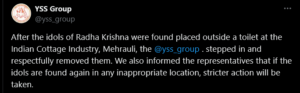
As YSS communicated: “After the idols of Radha Krishna were found placed outside a toilet at the Indian Cottage Industry, Mehrauli, the @yss_group stepped in and respectfully removed them. We also informed the representatives that if the idols are found again in any inappropriate location, stricter action will be taken”. The measured tone of this responseprompt removal without escalationoffers a useful template for community-led remedies that remain lawful, respectful, and solutions-focused.
Across Dharmic traditionsHinduism, Buddhism, Jainism, and Sikhismsacred images and scriptures are honored through practices that emphasize śuddhi (cleanliness), maryādā (propriety), and careful spatial separation from areas considered impure. Placing deities adjacent to sanitation facilities is therefore widely experienced as hurtful. For many devotees, such images are not simply decorative; they embody living reverence in ways that carry both spiritual and cultural meaning. Even when no malice is intended, adjacency to toilets can be perceived as diminishing the sacred and, by extension, the dignity of the communities that venerate these icons.
This is not an isolated concern. Similar controversies have periodically surfaced in India’s hospitality, retail, and public-infrastructure settings, including a well-publicized 2018 décor case at a hotel that drew swift appeals and corrective action. These patterns suggest that casual commercialization, supply-chain disconnects, and gaps in staff trainingrather than overt hostilityoften precipitate preventable mistakes. A constructive approach therefore seeks to elevate cultural literacy among managers, vendors, and designers while avoiding rhetoric that fragments India’s social fabric.
A measured, law-anchored response is essential. Indian law provides relevant guardrails: Section 295 of the Indian Penal Code (IPC) addresses injuring or defiling places of worship with intent to insult a religion; Section 295A addresses deliberate and malicious acts intended to outrage religious feelings; and Section 298 concerns utterances that intentionally wound religious sentiments. Whether an incident attracts penal consequences hinges on evidence of intent and context. In practice, most such situations are best handled by immediate correction, documentation, and education, reserving legal escalation for instances where malice or repeated non-compliance is demonstrable.
For facility owners, market associations, and hospitality operators, a simple compliance protocol reduces risk and builds trust. First, avoid placing sacred imageryincluding mūrtis, framed prints, thangkas, Tirthankara depictions, and scriptural quotationsnear toilets, urinals, footwear areas, trash bins, or floor-level signage. Second, designate “respect zones” for sacred motifseye-level locations away from sanitation, pathways, or storage. Third, train staff and external contractors (interior designers, visual merchandisers, and signage vendors) to apply a basic review: if an image or text is venerated by a community, then display only in dignified, clean, and stable environments.
If a Hindu deity image or mūrti must be moved or retired, follow recognized conventions. When a mūrti has undergone prāṇa-pratiṣṭhā (consecration), appropriate decommissioning (uddvāsa/visarjana) is recommended under priestly guidance before relocation or storage. Even for non-consecrated décor items, handle respectfully: cover with a clean cloth, avoid placing directly on the floor, store above waist height, and consult a local temple or community trust for guidance on permanent placement or ritual disposal. These steps, while simple, communicate a consistent ethic of care that protects both devotion and dignity.
When incidents occur, de-escalation preserves safety and trust. Document the scene, notify management, and, where needed, alert local authorities. Seek help from credible community organizations experienced in cultural mediation. Remove the item promptly and respectfully; do not crowd spaces, amplify confrontations, or create conditions for rumor-driven mobilization. This approach aligns with best practices in risk management and with the shared Dharmic emphasis on ahimsā (non-violence), satya (truthfulness), and mutual respect.
Responsible digital conduct is equally important. While public awareness can deter recurrence, indiscriminate sharing of images and personal details can trigger harassment, misidentification, or vigilantism. When posting, blur sensitive details, avoid doxxing, and emphasize corrective outcomes over outrage. Direct complaints through official channels, such as local police cyber cells or civic helplines, and, when possible, coordinate with recognized interfaith or community bodies that specialize in reconciliation and training.
Education offers the most durable fix. Short modules for retail and hospitality teamscovering the meaning of sacred imagery in Hinduism, Buddhism, Jainism, and Sikhism; common placement sensitivities; and simple do’s and don’tscan be integrated into onboarding. Suppliers and visual merchandisers can include a “religious sensitivity checklist” in proposals and invoices. Municipal market associations can codify voluntary guidelines and designate cultural liaisons to whom concerns may be reported early, before situations become public controversies.
From a broader societal perspective, incidents like the Mehrauli case magnify how small placement decisions can shape perceptions of Hinduphobia and, more generally, of disregard toward sacred traditions. Even absent malice, repetitive misplacements erode confidence, especially among communities for whom deities and scriptures hold daily, lived meaning. Countering that erosion requires more than criticism; it requires systemstraining, protocols, and relationshipsthat make respect the default and recurrence unlikely.
The Mehrauli removal also highlights how Dharmic unity can be advanced through shared solutions. The core principlesmaintaining sacred dignity, avoiding impurity-adjacent placement, and handling icons with careare consistent across Hinduism, Buddhism, Jainism, and Sikhism. Joint workshops, interfaith codes of display, and collaborative rapid-response networks can convert moments of tension into durable frameworks that protect everyone’s heritage while strengthening social cohesion.
Many community members recall everyday scenes that raise similar concerns: revered prints near shoe racks, sacred mantras inscribed on floor-level mats, or devotional images used as generic décor in washroom corridors. These are often oversights, not provocations. Still, the effect is real. A practice of empathetic correctionimmediate adjustment, an explanation of why it matters, and preventive trainingworks better than shaming or polarization, and it builds the civic muscle memory needed in diverse public spaces.
Ultimately, the YSS intervention in Mehrauli underscores a practical lesson: respectful, law-aware, and non-confrontational action solves problems and sets replicable standards. If commercial and public institutions adopt straightforward guidelinesbacked by light-touch audits, community partnerships, and staff educationincidents like “idols near toilets” can quickly become rare exceptions rather than recurring flashpoints. That outcome advances cultural preservation, interfaith harmony, and the unity of India’s Dharmic traditions.
Inspired by this post on Hindu Human Rights Blog.