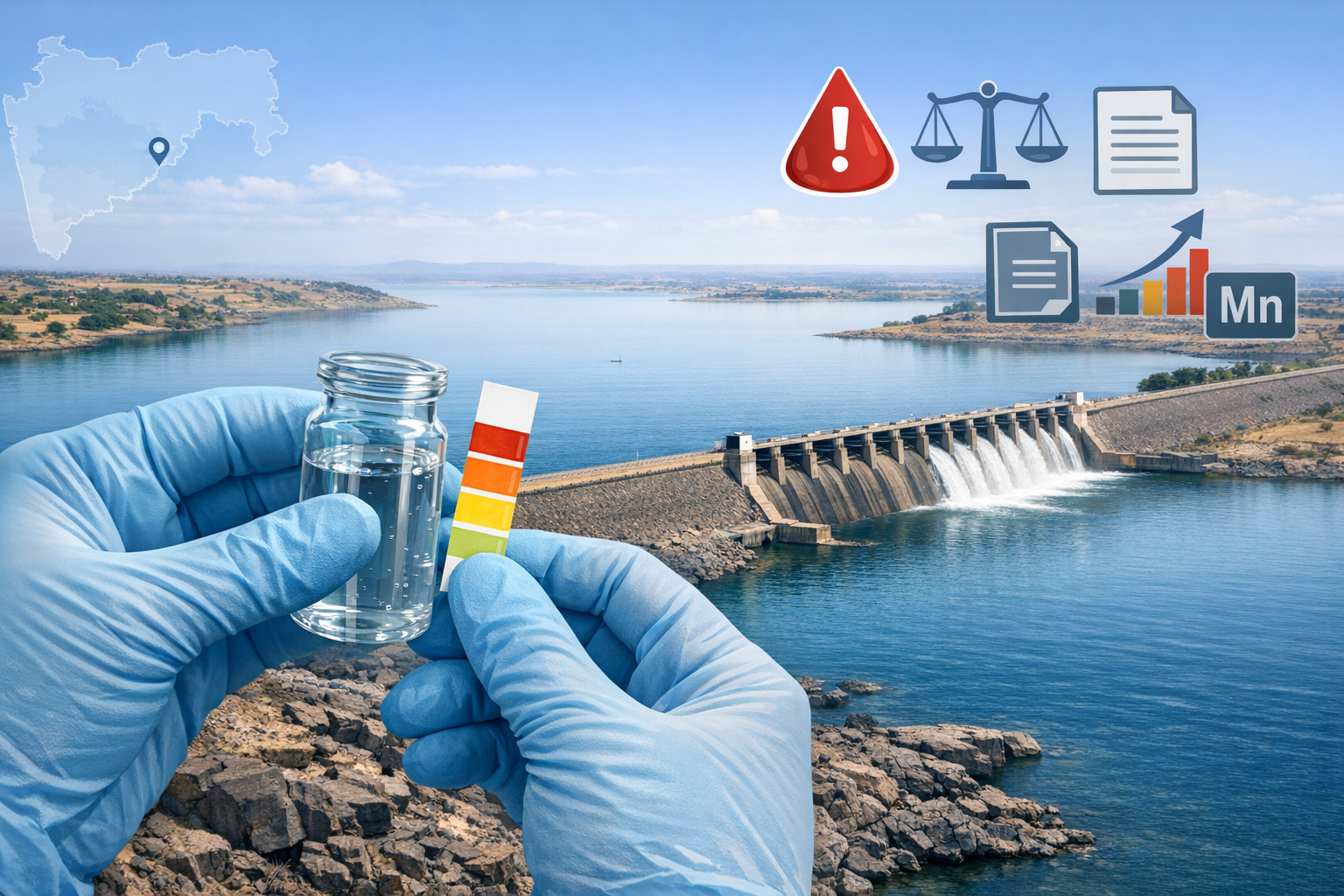
The National Human Rights Commission (NHRC) has issued notices to authorities in Maharashtra following a complaint by Surajya Abhiyan about severe pollution in the Ujani (Ujjani) Dam in Solapur district, highlighting reported manganese concentrations at 51 times the permissible limit. The intervention positions access to safe water as a core human rights concern, given the dam’s central role in regional drinking water supply, irrigation, and public health.
Ujani Dam, a major reservoir on the Bhima River in Maharashtra, underpins livelihoods across Solapur and adjoining districts. Beyond irrigation and fisheries, the reservoir buffers seasonal variability and supports downstream ecosystems. Any sustained deterioration in water quality therefore has cascading implications for health, agriculture, and economic stabilitymaking effective risk management both a technical and governance imperative.
The specific pollutant of concernmanganese (Mn)is a trace element with essential physiological roles at very low levels but demonstrable toxicity when significantly elevated. Chronic overexposure is associated in scientific literature with neurotoxic effects, especially in infants, children, and pregnant women, as well as aesthetic issues such as staining and off-tastes at comparatively lower concentrations. The reported exceedance magnitude51 times the permissible thresholdsignals an urgent need for verification, rapid risk assessment, and time-bound remediation.
Indian regulatory benchmarks provide a clear compliance framework. The Bureau of Indian Standards’ IS 10500 (Drinking Water Specifications) sets reference limits for metals in potable water, while the Central Pollution Control Board (CPCB) prescribes discharge norms and water quality criteria for different water uses. Parallel statutory obligations arise under the Water (Prevention and Control of Pollution) Act, 1974 and the Environment (Protection) Act, 1986. Against this backdrop, the NHRC’s notices underscore that persistent non-compliance implicates the right to life and health under Article 21 of the Constitution.
Multiple pathways can drive elevated manganese in large reservoirs. Geogenic contributions are plausible in basaltic terrains due to natural mineral weathering; at the same time, anthropogenic inputsuntreated or partially treated municipal sewage, industrial effluents, and high organic loadscan alter redox conditions and enhance metal mobility. When organic matter increases oxygen demand, bottom waters can turn anoxic, promoting the reduction of particulate Mn(IV) oxides to dissolved Mn(II), thereby increasing concentrations in the water column.
Reservoir dynamics can intensify these effects. Thermal stratification commonly develops in deep reservoirs during dry and pre-monsoon months, isolating bottom waters from atmospheric oxygen. Under such conditions, manganic oxides in sediments are reduced and released into pore water, which can then diffuse into the hypolimnion. Turnover events or operational drawdowns may subsequently transport dissolved Mn into abstraction points feeding water treatment plants.
The public health risk chain is shaped by source water quality, treatment efficacy, and distribution integrity. If treatment trains are not optimized for manganese removal, or if sudden spikes exceed design assumptions, finished water may carry residual Mn downstream. Aging distribution systems can also contribute to variability through corrosion and biofilm interactions. In such scenarios, risk communication and targeted protections for sensitive populations (infants, children, pregnant women, and the elderly) become essential components of response.
NHRC’s action typically entails seeking detailed, time-bound action taken reports from the concerned authorities, including descriptions of immediate mitigation, ongoing monitoring, and structural fixes. A rights-based approach requires authorities to ensure safe, reliable, and equitable access to drinking water, transparently disclose data, and demonstrate continuous improvement. This is consistent with national jurisprudence recognizing safe water as integral to dignity, health, and livelihood.
Immediate, precautionary risk management measures are well established in water safety practice. These include securing alternative sources or blending strategies to dilute elevated manganese, enhancing pre-oxidation and filtration at treatment plants, and deploying point-of-use solutions (such as catalytic media filters based on MnO₂ or equivalent oxidative-filtration technologies) for high-risk households until centralized treatment stabilizes. Prioritized provision for schools, anganwadis, health facilities, and households with infants or pregnant women can substantially reduce exposure.
Process optimization at treatment plants is a critical medium-term lever. Proven approaches include controlled pre-oxidation (e.g., free chlorine, ozone, or, with careful dosing, potassium permanganate), followed by catalytic filtration (greensand or MnO₂-coated media) and rigorous sludge handling to prevent secondary contamination. Biological filtration, where feasible, can enhance metal removal while moderating chemical demand. Integrating online sensors for surrogate parameters, periodic metal analyses using AAS/ICP-MS, and SCADA-based process control can maintain finished water within IS 10500 specifications.
Catchment and reservoir interventions complement treatment upgrades. Consistent operation and compliance of sewage treatment plants, stringent industrial effluent controls, and riparian buffer restoration reduce organic and contaminant loads at source. Within the reservoir, selective withdrawal (hypolimnetic outlets), destratification via diffused aeration, and managed drawdowns can help maintain oxic conditions that immobilize manganese in sediments. Floating wetlands and targeted desiltation, where appropriate and environmentally vetted, can incrementally improve water quality.
Robust governance aligns technical fixes with institutional accountability. Coordinated action among the Water Resources Department, the Maharashtra Pollution Control Board (MPCB), public health authorities, and local bodies is necessary to ensure coherent monitoring, enforcement, and communication. Adoption of Water Safety Plans (WSPs), as recommended by the World Health Organization, offers a preventive, system-wide frameworkfrom catchment to consumergrounded in hazard identification, critical control points, and continuous verification.
Data transparency strengthens public trust and accelerates problem-solving. Regular disclosure of validated reservoir and treated water quality results, including metals, should be published on public dashboards in user-friendly formats. Peer review by accredited laboratories, third-party audits, and opportunities for citizen engagement can reduce uncertainty, counter misinformation, and create a constructive feedback loop between communities and institutions.
Environmental stewardship is also a civilizational value shared across dharmic traditions. Principles such as Ahimsa and Aparigraha, the Sikh spirit of seva, and the Buddhist commitment to non-harm all converge on protecting jal and its life-supporting ecosystems. Reframing water safety as a collective dharma encourages cooperation across social, religious, and institutional boundaries, promoting unity of purpose in safeguarding rivers and reservoirs for present and future generations.
In the near term, stakeholders will be watching for prompt compliance with NHRC notices, credible and repeated measurements confirming the extent of manganese exceedance, and immediate protective measures for affected communities. Over the medium term, attention will likely focus on catchment controls, plant upgrades, and operational changes that consistently keep finished water within standards, including during seasonal turnover events. If structural violations are identified, parallel avenuessuch as proceedings before the National Green Tribunal (NGT) or other statutory forumsmay complement administrative remedies.
NHRC’s cognisance of the Surajya Abhiyan complaint marks a pivotal moment to align technical rigor, regulatory enforcement, and community engagement. By combining rapid risk reduction with durable engineering and catchment solutions, Maharashtra can protect health, uphold human rights obligations, and enhance resilience in one of the state’s most important reservoirs. The pathway forward is clear: verify, communicate, remediate, and institutionalize best practices so that safe water remains a guaranteed public good.
Inspired by this post on Hindu Jagruti Samiti.