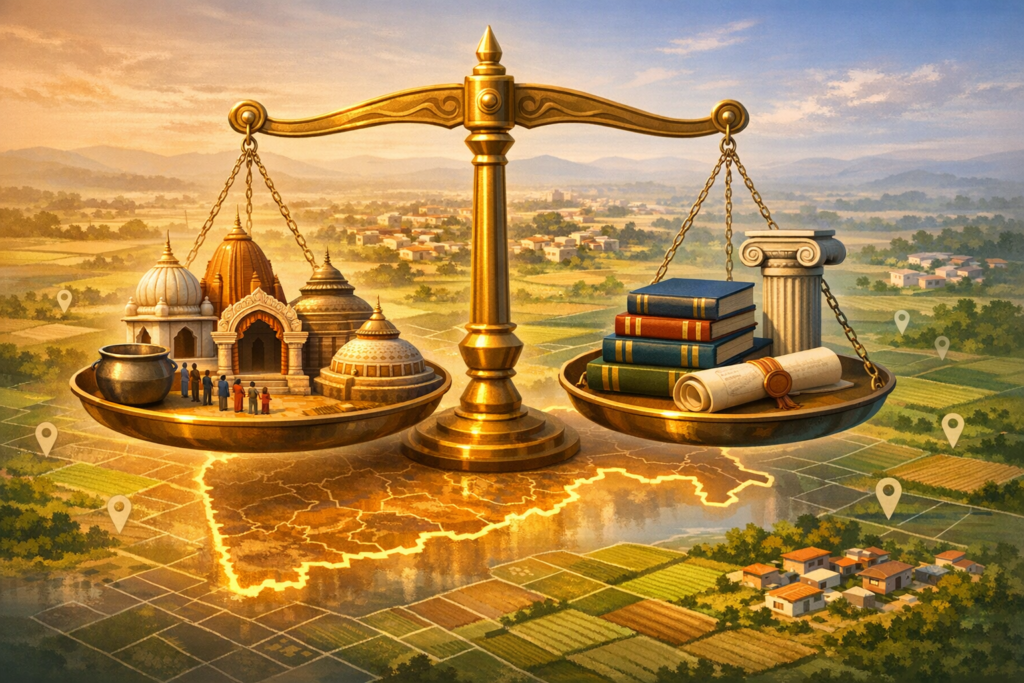
India’s decision to reopen its embassy in Kabul and formally receive a Taliban delegation in New Delhi marks a consequential diplomatic shift. The move promises trade access, humanitarian reach, and counterterrorism coordination, yet it also revives an ethical dilemma that India’s democracy cannot ignore: how to engage a repressive regime without erasing moral memory or compromising constitutional values.
A turning point in New Delhi
In the second week of October 2025, External Affairs Minister S. Jaishankar announced that India would upgrade its technical mission in Kabul to a full embassy, restoring a presence curtailed since 2021 (Reuters). Soon after, the Taliban’s Foreign Minister, Amir Khan Muttaqi, visited New Delhi for high-level meetings and signaled that Afghanistan would post diplomats in India (AP News). While the engagement has been framed as “technical and humanitarian,” the optics point to a phased normalization between the world’s largest democracy and an authoritarian movement still accused of systemic rights violations.
A disturbing echo: the badges of 2001
Historical memory weighs heavily on the present. In May 2001, the Taliban’s Ministry for the Promotion of Virtue and Prevention of Vice decreed that Afghan Hindus must wear yellow identifying badges and mark their homes, drawing immediate global outrage for its resemblance to Nazi-era persecution (BBC Archives). Although the order was never fully enforced, the symbolism endured. Two decades later, the shrinking Hindu and Sikh communities in Afghanistan live in fear, their population reduced from tens of thousands to mere dozens, with desecrations and displacement etched into recent memory.
Women excluded in Delhi
On October 11, 2025, during a Taliban media briefing in New Delhi, women journalists were reportedly denied entry; multiple outlets confirmed the exclusion (Times of India). India’s Ministry of External Affairs noted the event was “organized independently,” yet the incident occurred on Indian soil during a government-facilitated visit. The episode briefly imported Kabul’s gender apartheid into the heart of India’s capital, underscoring the stakes of engagement without explicit safeguards.
Why engagement makes sense
Several strategic and humanitarian considerations explain India’s outreach. Geopolitically, sustained engagement helps counter Pakistan’s influence, preserve India’s equities in Afghanistan, and stabilize a critical neighborhood. Economically, access via Iran’s Chabahar Port and potential cooperation around Afghanistan’s lithium and rare-earth reserves align with India’s supply-chain resilience goals (Reuters). Humanitarian corridors allow life-saving medical aid, scholarships, and food supplies to reach millions. On security, direct channels can help deter extremist spillovers into Kashmir and Central Asia. Pragmatism is not betrayal; yet realpolitik must not replace ethical clarity.
A principle-first framework for Parliament
To ensure that engagement advances India’s interests without sacrificing values, Parliament and the Ministry of External Affairs can embed verifiable red lines into policy design:
1) Human rights clauses in all trade, transit, and aid agreements, with measurable benchmarks.
2) Legal and physical protection guarantees for Afghan Hindus, Sikhs, Christians, and Hazaras, including monitored safe-passage protocols.
3) Unhindered access to girls’ education and women’s employment, linked to phased incentives.
4) Assured media access, with explicit protection for female journalists and civil society monitors.
5) Public accountability through quarterly MEA reports on the status of minorities, women, and basic freedoms in Afghanistan.
Conditionality is not punitive; it is the ethical scaffolding that prevents normalization from becoming complicity.
Signals of possible reform?
There are tentative signals that calibrated engagement may secure limited moderation. Some Taliban representatives have privately conveyed readiness to welcome Hindu and Sikh community leaders back to Kabul under security guarantees (Times of India). Economic fragility may also incentivize small, verifiable steps: reopening girls’ schools in select provinces, nominal minority representation in local councils, or easing rules on women-led NGOs. However, absent codification, independent verification, and public reporting, such overtures remain projection rather than progress.
Dharmic unity and India’s moral test
Across India’s dharmic traditions—Hinduism, Buddhism, Jainism, and Sikhism—there is a shared civilizational ethic that upholds dignity, pluralism, and non-violence. That ethos provides a unifying compass for policy: protect vulnerable minorities, defend women’s rights, and align statecraft with humanitarian duty. The central question is not whether to talk to the Taliban, but how to do so without forgetting documented abuses: forced markers for Hindus, the destruction of Buddhist heritage, the expulsion of Sikhs, the silencing of Christians, and the erasure of women from public life. Engagement without conditions risks legitimizing ideological apartheid—by gender and by faith. A principle-first approach allows India to advance trade, security, and humanitarian aims while holding firm on rights and accountability.
India can be both pragmatic and principled—building corridors of commerce and dialogue while insisting on verifiable respect for fundamental freedoms. That balance aligns with the civilizational wisdom encapsulated in the teaching: “Ahimsa paramo dharmaḥ — Non-violence and truth are the highest duties.”
References
1. Reuters – India to reopen its embassy in Kabul (https://www.reuters.com/world/india/india-reopen-its-embassy-kabul-indian-foreign-minister-says-2025-10-10/?utm_source=chatgpt.com)
2. AP News – India to upgrade Kabul mission (https://apnews.com/article/899bac27dee2422e88a54372bdd9efaa?utm_source=chatgpt.com)
3. Times of India – Women journalists barred from Taliban presser (https://timesofindia.indiatimes.com/india/women-journalists-barred-taliban-presser-in-new-delhi-restricts-entry-of-females-draws-ire/articleshow/124468538.cms?utm_source=chatgpt.com)
4. BBC Archives – Taliban orders Hindus to wear badges (https://news.bbc.co.uk/2/hi/south_asia/1340571.stm?utm_source=chatgpt.com)
5. Human Rights Watch – Afghanistan country report 2025 (https://www.hrw.org/world-report/2025/country-chapters/afghanistan?utm_source=chatgpt.com)
Inspired by this post on Hindu Human Rights Blog.