Reports from Pune indicate that civil society organisations, including Hindu Janajagruti Samiti (HJS), have urged city authorities to implement calibrated restrictions in and around Sarasbaug ahead of Bakri Eid (Eid al-Adha) 2026. The appeal focuses on crowd management, movement of livestock, noise compliance, and the orderly use of shared public space adjoining the historic Sarasbaug Ganpati Mandir. In a city where diverse traditions converge daily, the central policy question is how to safeguard religious freedom under Article 25 of the Constitution while applying reasonable, proportionate, and time-bound measures that protect public order, animal welfare, and the everyday rhythms of residents.
Sarasbaug functions simultaneously as a heritage devotional precinct and a high-footfall urban commons. Families walk its pathways at dawn, elders gather for quiet conversation, children learn to ride bicycles, and devotees visit the Ganpati shrine across the day. This layered space—temple, garden, transit corridor, and civic breathing room—requires precision planning during peak festivals, not blanket prohibitions. The tone of public administration therefore matters: rules should be evidence-based, time-specific, location-bound, and communicated in advance to avoid uncertainty for both worshippers at the temple and Muslims observing Eid al-Adha.
Eid al-Adha entails prayers, community gatherings, charitable distribution, and—where legally permitted—the ritual sacrifice of approved animals in designated, licensed facilities. In large cities, the days preceding the festival typically see increased movement of livestock, higher traffic density near markets, and demand spikes on sanitation and cold-chain systems. These are operational—not ideological—stressors; they are best addressed through standard operating procedures (SOPs) grounded in existing law and municipal capacity. Framing the issue in administrative rather than communal terms helps preserve the spirit of coexistence cherished across Pune’s Hindu, Buddhist, Jain, Sikh, and Muslim communities.
India’s constitutional and statutory architecture already provides clear guardrails for such planning. Article 25 protects freedom of conscience and religion subject to public order, morality, health, and other fundamental rights. The Maharashtra Police Act, 1951 (notably Section 37) empowers local authorities to regulate assemblies, processions, and vehicular movement when necessary. Where narrower, temporary controls suffice, Section 37 orders are generally more proportionate than blanket Section 144 orders under the Code of Criminal Procedure.
On sound management, the Noise Pollution (Regulation and Control) Rules, 2000 set measured limits and a 10 p.m. to 6 a.m. night-time window. States may notify limited exemptions (up to 15 days annually), but compliance remains the norm, particularly near hospitals, schools, and heritage religious sites. Municipal licensing frameworks govern designated slaughterhouses and hygiene standards, while the Prevention of Cruelty to Animals Act, 1960 and the Transport of Animals Rules, 1978 require humane transport with adequate space, shade, and water. The Maharashtra Animal Preservation Act, 1976 (as amended) regulates species-specific slaughter and certification, placing explicit responsibilities on transporters, traders, and facilities; unauthorized, street-side slaughter is prohibited.
National Disaster Management Authority (NDMA) Guidelines on Crowd Management (2014) offer a useful backbone for city-level SOPs: pre-event risk assessment, route planning, entry–exit segregation, real-time monitoring, assured emergency egress lanes, and trained volunteer marshals. Applied to Sarasbaug and its approach roads, these principles translate into low-friction controls that protect worship, mobility, and livelihoods while minimizing friction points.
A calibrated, rights-respecting blueprint for Pune ahead of Bakri Eid 2026 can therefore rest on five pillars: proportionate mobility controls, lawful animal-welfare compliance, humane crowd and queue systems, transparent communication, and interfaith liaison. Each pillar can be implemented in a time-bound, data-driven manner that preserves access for devotees at Sarasbaug Ganpati Mandir, facilitates Eid observances in licensed venues, and assures residents of predictability and safety.
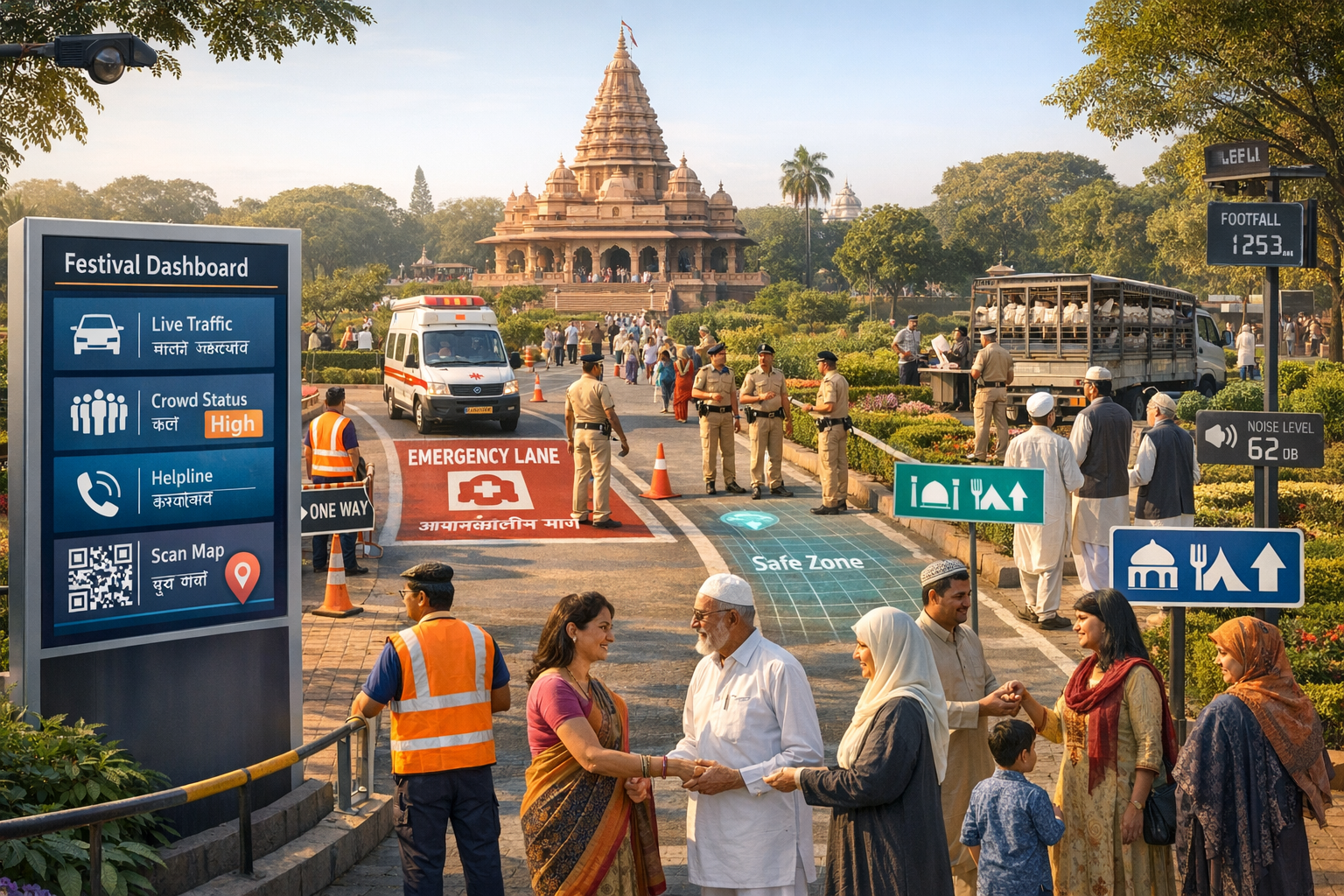
First, mobility and access. Temporary, geofenced traffic diversions during peak hours can be announced a week in advance, with dynamic signboards and QR-code maps showing live routes. Heavy vehicles can be rerouted away from the immediate temple perimeter while maintaining pedestrian and emergency access. Clear egress corridors—kept unobstructed at all times—should be marked for ambulances and fire services, reflecting NDMA norms. Micro-delivery windows for local businesses and vendors help sustain livelihoods during restricted hours.
Second, lawful animal movement and welfare. Joint Pune Police–PMC–Animal Husbandry check-posts on key ingress roads can verify health certificates, transport compliance, and species eligibility under state law. Humane handling standards—adequate space, shade, hydration—should be enforced without exception. Municipal communication must reiterate that ritual slaughter, where practiced, is restricted to licensed facilities with proper sanitation, drainage, and waste management; unauthorized slaughter in public spaces remains unlawful and will attract penalties.
Third, crowd management at shared spaces. Around Sarasbaug, one-way pedestrian loops with soft barricades reduce cross-flows, while volunteers guide elderly devotees and families. Queue systems at the Ganpati shrine can use simple tokenization to flatten peak loads. Shade tents, potable water kiosks, and first-aid stations lower health risks. Short, predictable “quiet windows” near the temple help maintain the devotional ambiance without impeding general civic movement.
Fourth, transparent, multilingual communication. An official festival dashboard—maintained by Pune Municipal Corporation (PMC) and Pune City Police—can publish real-time updates on traffic, crowd density, helpline numbers, and grievance redress. A rumor-control cell should coordinate with community leaders to counter misinformation swiftly. Public notices must foreground rights and responsibilities: freedom to celebrate, duty to follow licenses and decibel limits, and zero tolerance for provocation or hate speech.
Fifth, interfaith and inter-dharmic liaison. A joint peace committee comprising representatives from Hindu, Muslim, Buddhist, Jain, and Sikh groups—along with locality RWAs and market associations—can meet daily during the run-up to the festival. Trained community liaisons accompanying foot patrols often defuse minor frictions before they escalate. Women’s volunteer groups enhance approachability and increase the reporting of early-warning signals such as overcrowding or stalled vehicles in sensitive corridors.
Environmental and public health safeguards should run in parallel. Licensed facilities must ensure scientific disposal of animal by-products, effective effluent treatment, and disinfection protocols. Daily sanitation sweeps, vector-control measures, and safe drinking-water logistics protect both residents and visitors. Air and noise monitoring near sensitive receptors—temple precincts, hospitals, schools—should be reported publicly to build trust through transparency.
Digital tools can multiply capacity. Low-cost camera counters at entry nodes help estimate footfall and trigger pre-defined responses (for example, temporary pause on inward flows beyond thresholds). GIS layers showing crowd density, traffic bottlenecks, and emergency access routes can sit on a command dashboard shared by PMC, police, fire services, and medical responders. Importantly, any use of technology must respect privacy, follow minimal-collection principles, and be decommissioned post-event.
The benefits of this approach are widely shared. Devotees at Sarasbaug retain unimpeded darshan in a calm environment; Eid participants receive clear guidance on lawful venues and routes; traders and transporters gain predictability; and residents experience orderly mobility with minimal noise overshoot. Most of all, Pune strengthens a reputation it values deeply: a city that celebrates many traditions with mutual respect and civic poise.
Many Puneites recall greeting neighbors of different faiths on morning walks in Sarasbaug, sharing stories of festivals and family milestones. That everyday warmth is the true asset to protect. When public appeals by any group—HJS included—are channeled into evidence-based, rights-affirming SOPs, the outcome is not contention but cooperation. Proportionate, law-anchored measures, communicated transparently and reviewed openly after the event, offer the surest path to a peaceful Bakri Eid 2026 in and around Sarasbaug.
In sum, the city’s task is not to choose between rights and order, but to knit them together. By grounding planning in existing law, NDMA crowd guidelines, humane transport rules, municipal licensing, and interfaith liaison, Pune can turn calls for curbs into a practical peace playbook—one that honors the sanctity of the Sarasbaug Ganpati Mandir, upholds the lawful observance of Eid al-Adha, and strengthens the unity of Hindu, Buddhist, Jain, Sikh, and Muslim communities alike.
Inspired by this post on Struggle for Hindu Existence.