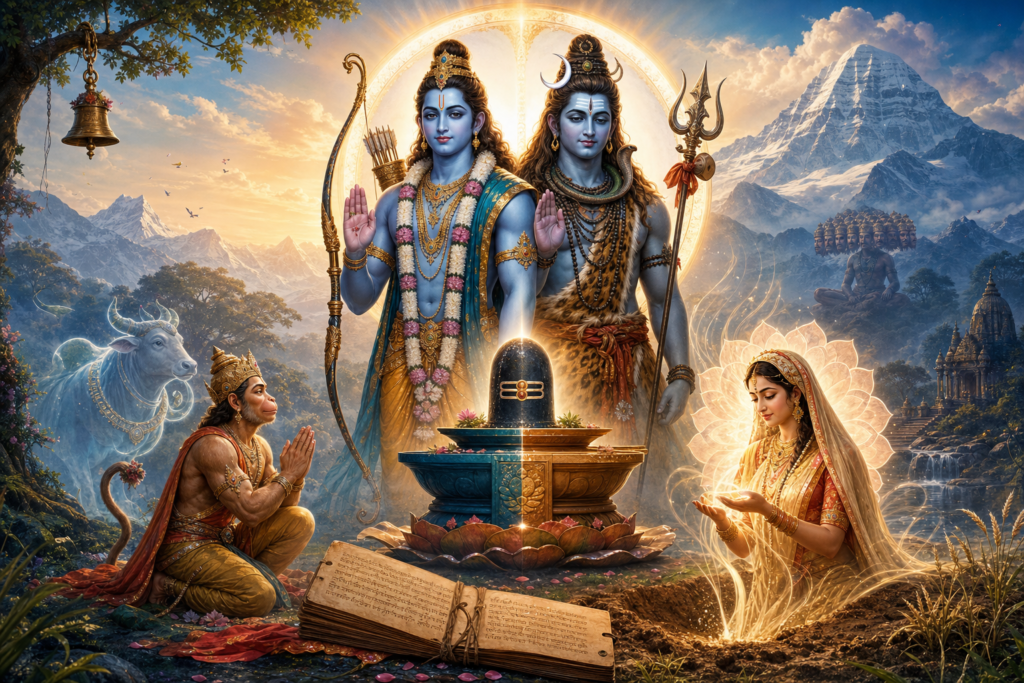
Mahakapala emerges in the Ramayana’s wider narrative landscape as a loyal demon commander whose fate underscores a profound theme: divine grace can illuminate the path to moksha even for those aligned, by duty or delusion, with adharma. This motif resonates across dharmic storytelling, where moral clarity and compassion coexist with the demands of justice in the great drama of dharma and adharma.
Traditional retellings and regional recensions of the Ramayana preserve brief references to Mahakapala’s encounter with Sri Rama. While details vary and canonical emphasis remains limited, the episode is consistently framed as an instructive moment: a warrior committed to a misguided cause faces the radiance of righteousness and discovers release at the threshold of death. In this sense, Mahakapala’s end functions less as a biographical account and more as a moral exemplar within the epic’s layered pedagogy.
Mahakapala’s loyaltyperhaps his defining traitbecomes a double-edged quality. As commander among the asuras, his steadfast devotion to a flawed sovereign demonstrates how virtues can harden into vices when severed from truth. Yet, at the decisive instant, the presence of Lord Rama reveals an alternative horizon: sincere recognition of truth, even at the end, can transform the trajectory of a life. The encounter evokes the Ramayana’s compassionate logic, where grace does not erase justice but fulfills it by revealing a higher ethical order.
This episode also illuminates the epic’s treatment of Dharma-Yuddha: warfare governed by moral bounds, restraint, and purpose. The defeat of Mahakapala is not celebrated as annihilation but contemplated as a passagea sacred end in which adharma is halted and the dignity of the soul is upheld. Such framing aligns with the Ramayana’s broader ethic, where Sri Rama embodies maryada (right conduct) and channels power through compassion and responsibility.
Viewed through a comparative dharmic lens, Mahakapala’s “sacred end” harmonizes with the shared aspiration for ultimate liberation across Hinduism, Buddhism, Jainism, and Sikhism. Whether termed moksha, nirvana, kevala jnana, or mukti, the common quest is release from bondage and awakening to truth. The narrative gently affirms a unifying principle: sincere turning toward truththrough wisdom, devotion, or ethical clarityopens the door to liberation, regardless of one’s prior alignment.
For many readers and practitioners today, this brief episode becomes personally resonant. The image of a fierce commander lowering the weight of hostility before truth mirrors inner battlesmoments when stubborn loyalties, unexamined habits, or inherited narratives yield to discernment. In such moments of surrender, the inner enemy is quelled without humiliation, and moral clarity replaces compulsion.
Mahakapala’s story thus offers a practical meditation on devotion and discernment. Loyalty is ennobling when tethered to dharma; without that tether, it risks entanglement. Yet, the Ramayana affirms that genuine recognitionhowever lateinvites grace. The lesson is not triumphalism but transformation: a reminder to cultivate courage, humility, and compassion together.
In contemporary life, the narrative encourages daily disciplines consonant with the Ramayana’s spirit: introspection before action, devotion balanced by reason, and strength tempered by empathy. By aligning intention with dharma, one participates in a persistent, living tradition that honors unity in spiritual diversity across dharmic paths while keeping the quest for liberation at its heart.
Inspired by this post on Hindu Blog.