The thirteenth chapter of the Panchadasi, known as Advaitananda Prakarana, offers a precise and illuminating inquiry into the nature of bliss arising from non-dual realization. Composed by Vidyaranya in the 14th century, this chapter anchors its analysis in Vedanta and the Upanishads, clarifying how the realization of Brahman reveals an intrinsic, ever-present ananda that is not produced by the mind but recognized as the very essence of self.
Situated within the Ananda-panchaka (chapters 11–15), Advaitananda Prakarana builds upon earlier sections of Panchadasi that cultivate discrimination (viveka) and illumination (deepa). The structure is methodical: after establishing the identity of Atman and Brahman, the text turns to the phenomenology of blisswhat it is, how it appears in ordinary experience, and how it is fully unveiled through knowledge (jnana). This systematic progression enables a clear understanding of both doctrine and lived realization.
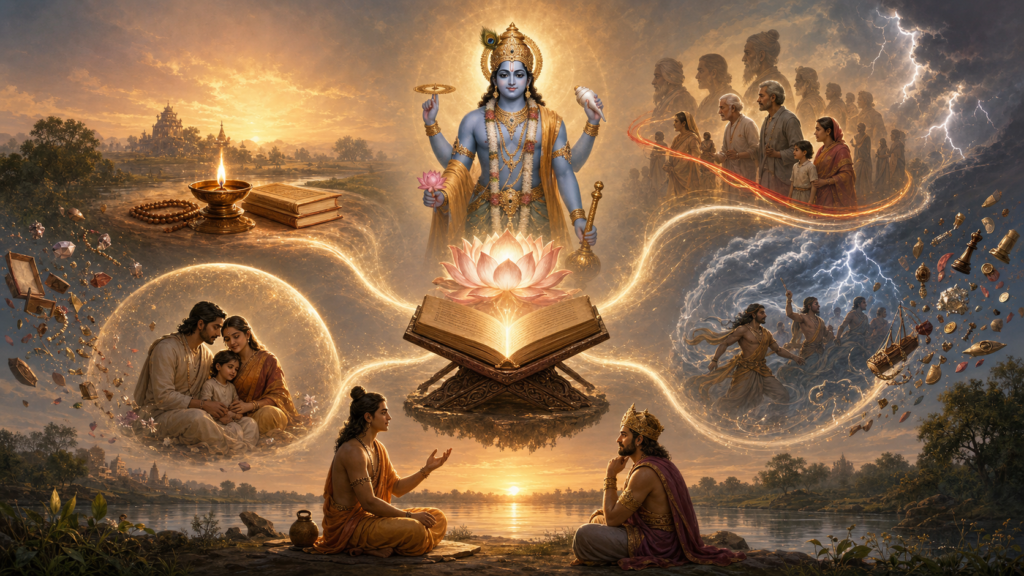
A key contribution of this chapter is its nuanced typology of bliss. Drawing on the Taittiriya Upanishad’s anandamimamsa, it distinguishes between vishaya-ananda (the fleeting pleasure that follows desire-fulfillment), the quietude glimpsed when mental agitation subsides, and brahmananda, the unconditioned bliss that shines when non-dual knowledge dawns. The text is unambiguous: brahmananda is not a psychological state, not a result of action, and not conditioned by time; it is the self-luminous nature of Brahmansat-chit-anandarecognized when ignorance is removed.
The practical pathway is equally clear. Through sravana (systematic study of Vedantic teachings), manana (reasoned reflection), and nididhyasana (deep contemplative assimilation), understanding matures into direct recognition. Advaitananda Prakarana explains that when the mind becomes steady and transparent, the akhandakara-vrittithe non-fragmented cognition of Brahmanarises, sublating the notion of separation. Bliss is not attained; it is abidance in what always is, free from grasping and aversion.
Psychologically, the chapter clarifies why ordinary pleasure is mistaken for true fulfillment. When a desire ceases, the temporary quietude allows a reflected semblance of inner fullness to be tasted; yet this is intermittent and dependent. By contrasting this with the continuity of brahmananda, the text dissolves confusion between the cessation-driven ease of deep sleep and the awake, self-evident clarity of knowledge. Concepts such as chidabhasa (reflected consciousness) are used to map how experience becomes colored by ignorance and how it is subsequently clarified.
Advaitananda Prakarana also underscores ethical and contemplative fruition. Non-dual recognition naturally flowers as compassion, equanimity, and non-violence (ahimsa), since the many are seen in the One. This insight resonates across dharmic traditions: Buddhism’s emphasis on the end of craving, Jainism’s kevala-jnana as unobstructed awareness, and Sikhism’s anandcelebrated in Anand Sahibeach point to freedom from dualistic fixation and a deep sense of unity. While doctrinal frameworks differ, the shared aspiration toward inner clarity, responsibility, and harmony supports inter-traditional understanding.
For contemporary seekers navigating distraction and strain, the chapter’s guidance is practical and humane. Discriminative inquiry, coupled with steady contemplative practice and ethical steadiness (shama-dama and allied disciplines), transforms the mind from a field of restlessness into a medium of insight. As many practitioners observe, even brief intervals of settled awareness reveal a quality of peace that naturally reduces reactivity and strengthens resilience.
In terms of scriptural engagement, Advaitananda Prakarana acts as a bridge between conceptual knowledge and experiential certainty. It equips students of Hindu scriptures, Vedanta, and the Upanishads with a rigorous framework to discern the difference between conditioned pleasures and unconditioned bliss, and to appreciate why knowledge, not effortful acquisition, is decisive in non-dual realization.
Ultimately, the chapter’s importance lies in its clarity: it articulates the provenance of bliss, outlines the means to its recognition, and situates that recognition within a life of ethical poise and contemplative depth. By highlighting convergences with broader dharmic insights while respecting distinct formulations, it encourages unity in spirit and purposean approach that strengthens mutual respect across Hinduism, Buddhism, Jainism, and Sikhism.
Inspired by this post on Hindu Blog.