
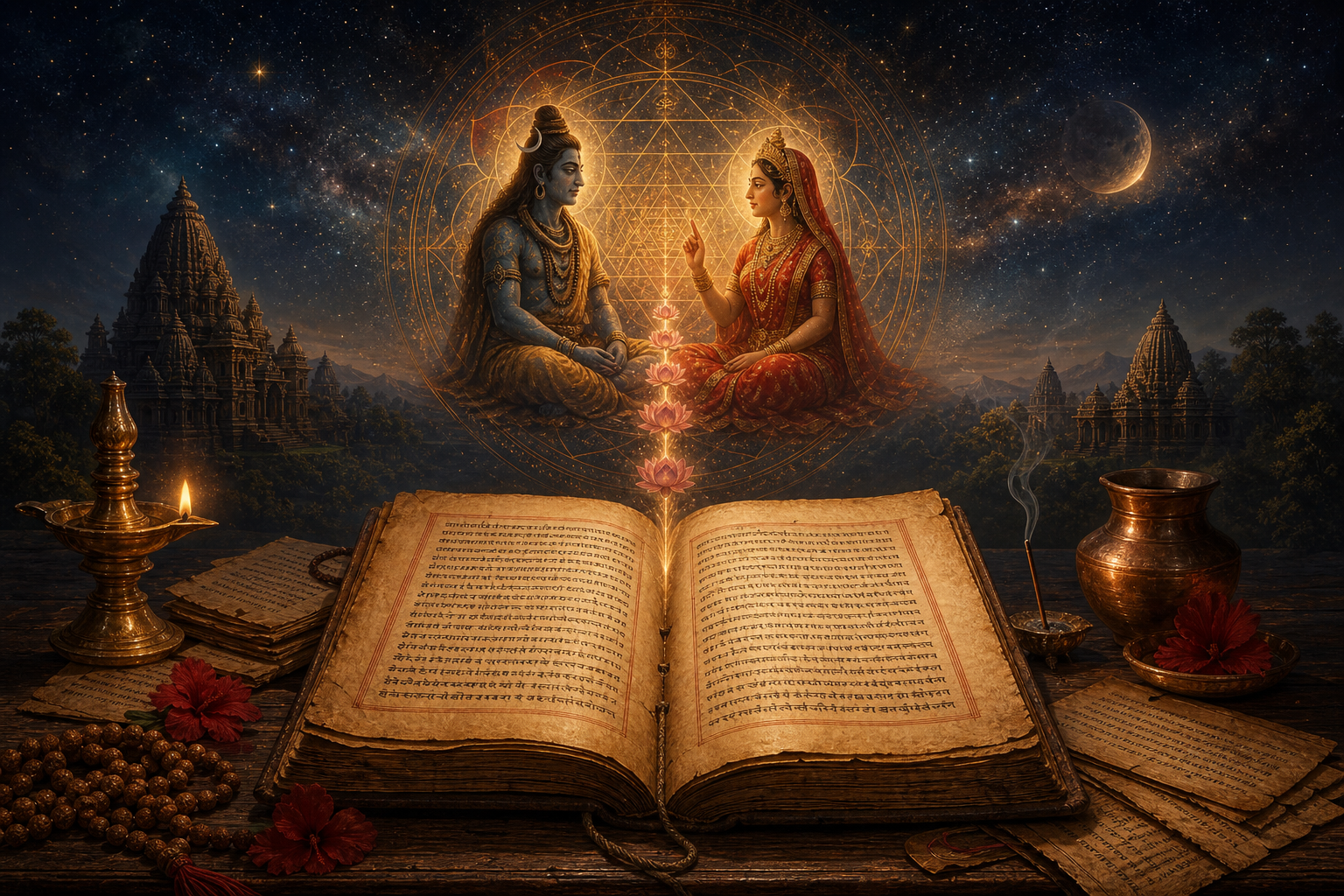
The Rudrayamala Tantra (रुद्रयामल तन्त्र) occupies an unusually important yet difficult place in the study of Hindu Tantra. It is repeatedly invoked as an authority within Shaiva, Shakta, Bhairava, Kaula, mantra, and yoga traditions, but the name does not lead to one pristine book preserved in a single uncontested form. What survives is a layered textual archive: printed editions, incomplete manuscripts, extracts, ritual chapters, hymns, later citations, and works that identify themselves with the Rudrayamala stream. Its importance therefore rests not only in particular teachings but also in the remarkable history through which those teachings were transmitted.
A careful account must hold devotion and textual criticism together. Traditional communities receive the scripture as revelation communicated by Rudra or Bhairava and Shakti; historical scholarship asks when particular passages were compiled, copied, expanded, or attributed to that revelation. These approaches answer different questions. The first concerns sacred authority and lived practice. The second concerns manuscripts, language, chronology, and reception. Neither inquiry is strengthened by pretending that the surviving evidence is simpler than it is.
What the Title Identifies
The Sanskrit word yāmala commonly carries the sense of a pair, twin formation, or conjunction. In Tantric literary usage, it can identify a class of scriptures organized around a divine pair and a revelatory dialogue. Rudra is a powerful form or name of Shiva, while the dialogue partner is Shakti in one of her many manifestations. “Rudrayamala” may consequently be understood as the paired revelation of Rudra and Shakti, although short English renderings such as “union of Rudra” remain interpretive glosses rather than exhaustive translations.
Lists of Yamalas vary across sources. Names such as Brahmayamala, Vishnuyamala, Shaktiyamala, and Rudrayamala recur, but no single list should be treated as a universally fixed canon for every region and period. The genre belongs to the broader history of esoteric Shaiva revelation and helped nourish goddess-centered currents. It is often placed near the Bhairava stream because of its deities, dialogical form, initiatory disciplines, and concern with the transformation of embodied consciousness.
The title must not be confused with a modern table of contents. In premodern manuscript culture, a prestigious scriptural name could designate a large corpus, a recension, a section, or an authority cited by later compilers. A hymn said to occur “in the Rudrayamala” may preserve an old extract, a regional transmission, or a later attribution. The statement is valuable evidence, but it does not automatically prove that the hymn belonged to every version once circulating under the name.
A Scripture Preserved Through a Fragmented Archive
Modern catalogues commonly describe a Pūrva Khaṇḍa and an Uttara Khaṇḍa, an earlier and a later division. The PANDiT prosopographical and textual database records both divisions while noting that much of the first is lost and that available editions largely contain the second. A CiNii bibliographic record for the two-volume Sanskrit university edition likewise identifies the publication as the Uttaratantra and notes the reported loss of the first part. “The Rudrayamala Tantra” should therefore not be discussed as though every ancient division remains continuously available.
Even basic numerical descriptions differ. Some cataloguing traditions describe a work of sixty-four paṭalas, or chapters. A widely circulated printed Uttara recension contains sixty-six chapters and roughly six thousand verses, predominantly in the anuṣṭubh metre, while later references sometimes imagine a vastly larger revelation. Such figures need not be forced into agreement. They probably reflect different recensions, idealized scriptural totals, lost materials, and the tendency of a famous title to gather related teachings over time.
Material evidence makes that complexity tangible. The Nepal-German Manuscript Preservation Project record for NAK 5/1447 describes an incomplete Sanskrit paper manuscript in Devanagari, extending to 151 folios, copied by Amṛtānanda and dated ŚS 1716. It lacks folios 30v–31r. Its closing material identifies a sixty-chapter Devīrahasya within the Rudrayamala framework. A missing leaf, an uneven colophon, or a change of title can materially alter what later readers think a work contains.
A different witness illustrates the breadth of the name. The Institut Français de Pondichéry record T0992b preserves an incomplete thirty-one-folio transcript copied from a Tulu manuscript. Its contents concern a chariot festival, faults in preliminary sprouting rites, and expiation; the ritual portion identifies itself as the 366th instruction in a Rudrayamala described as comprising thirty-nine thousand verses. This witness is not simply another copy of the familiar sixty-six-chapter yoga-oriented edition. It points to a wider ritual archive associated with the title.
The best-known modern Sanskrit edition of the Uttaratantra was published in two volumes by Sampurnanand Sanskrit University in Varanasi, with Rāmaprasāda Tripāṭhī as editor and a foreword associated with Maṇḍana Miśra. Library records date the second edition to 1991–1996. Earlier printed forms also circulated from Kolkata. These publications made important materials accessible, but a printed page does not erase the differences among manuscripts or establish that every passage belongs to an early, unitary archetype.
The archive also includes free-standing stotras, kavacas, ritual procedures, and deity liturgies attributed to the Rudrayamala. PANDiT catalogues materials associated with Bhairava, Kali, Chinnamasta, Bhavani, Shiva, Ganesha, Gayatri, and Rama, among others. That diversity helps explain the scripture’s broad reputation, yet it also demands restraint: an attribution should be reported as an attribution until manuscripts, citations, and recensional relationships have been compared.
Composition, Sacred Attribution, and Date
No identifiable historical individual can be securely credited with the Rudrayamala corpus. In the sacred frame, the teaching is revealed through Bhairava, Shiva, Devi, or a paired form of divine discourse. In historical terms, the surviving materials are anonymous and probably composite. They bear the marks of recitation, lineage transmission, redaction, regional copying, and expansion. A scribe named in a manuscript is responsible for that copy, not necessarily for the teachings copied into it.
A single date is equally misleading. The wider Rudrayamala authority appears to be older than many surviving paper manuscripts, while the extant Uttaratantra has often been placed in the later medieval textual world. Portions may be earlier or later than their present compilation. The Vijñanabhairava’s explicit association with Rudrayamala teachings also shows that the name belonged to an influential doctrinal horizon before the production of current printed recensions. Responsible chronology therefore distinguishes the age of an idea, the compilation of a recension, the date of a physical copy, and the date of a modern edition.
This layered model is not a defect peculiar to Tantra. Many long-lived Sanskrit traditions survive through recensions rather than through an autograph manuscript. The difference is that esoteric transmission often valued controlled circulation, initiation, and oral explanation. Restricted access could preserve a lineage’s integrity while also limiting the number of copies. When manuscripts disappeared, later quotations and extracts sometimes became the only witnesses to an earlier textual form.
The Dialogue of Bhairava and Shakti
One prominent Uttara recension reverses the pattern familiar from many Shaiva Agamas: Bhairava asks questions and Bhairavi answers. Traditional classifiers may call this a nigama orientation, in contrast with an āgama in which Shiva teaches and the Goddess asks. The distinction should not be universalized across every Rudrayamala-related work, but it is theologically significant. Shakti is not merely the silent recipient of doctrine; she becomes the articulate source who orders ritual, yoga, mantra, and knowledge.
The dialogical form does more than decorate the text. Question and response stage revelation as relationship. Consciousness and power, stillness and articulation, teacher and disciple, inquiry and realization arise through mutual presence. A modern reader may find this structure emotionally compelling because uncertainty is not treated as failure. A divine question opens the space in which precise instruction becomes possible.
Different passages address different levels of competence, and the divine dialogue does not make every instruction universally available. Tantric scriptures routinely distinguish public praise, initiatory doctrine, encoded mantra, and practices limited by lineage rules. Their rhetoric of secrecy can protect ritual knowledge, establish authority, and signal that meaning depends on oral interpretation. It can also be misused by human institutions, which is why traditional reverence and ethical scrutiny must remain partners rather than opponents.
Core Teachings: Consciousness, Power, Sound, and the Sacred Body
The most influential philosophical theme is the inseparability of Shiva and Shakti. Shiva can signify luminous consciousness, while Shakti signifies its capacity to know, manifest, differentiate, act, and return phenomena to unity. The pair is not best imagined as two independent substances that later meet. Many Shaiva-Shakta interpretations treat them as distinguishable aspects of one reality, comparable to fire and its power to burn. The ritual union of the pair thus expresses a metaphysical claim about awareness and manifestation.
The human body is treated as a condensed cosmos rather than an obstacle to spirituality. Cakras, nāḍīs, vital breaths, seed syllables, deities, sacred places, lunar rhythms, and elements are mapped onto embodied practice. Outer pilgrimage sites can be contemplated within the subtle body, and an external altar can be mirrored in the heart or crown. This correspondence does not reduce geography to psychology. It creates a ritual homology in which body, temple, landscape, language, and cosmos become mutually interpreting fields.
Sound provides the connective tissue. A mantra is not merely an inspirational sentence; within Tantric theory it is a disciplined sonic form of divine presence. Sanskrit phonemes may be distributed across diagrams, body regions, deities, lunar mansions, or levels of manifestation. The alphabet can function as a matrix of creation, and a seed syllable can condense an entire theology. Correct transmission therefore concerns pronunciation, rhythm, visualization, intention, ritual authorization, and the practitioner’s relationship to the mantra—not vocabulary alone.
The movement from outer worship to inner realization is another central pattern. Flowers, lamps, water, incense, food, fire offerings, diagrams, and gestures organize attention in visible form. Mental worship then reconstitutes those acts within consciousness. An internal fire offering may treat breath, thought, identity, or sensory experience as the oblation. External and internal rites are not necessarily competitors; the inner rite often presupposes mastery of the symbolic grammar learned through the outer one.
Tantric goals are frequently described through the paired language of bhoga and moksha or apavarga: meaningful participation in embodied life and liberation from limiting bondage. Texts may also promise siddhis, including extraordinary attainments. Academic reading must distinguish a traditional promise from an experimentally verified claim. Within the religious system, siddhi language can describe ritual efficacy, mastery, transformed perception, social power, poetic capacity, or supernatural accomplishment; its meaning varies with context.
The Technical Architecture of Practice
Dīkṣā, or initiation, is foundational. It is more than permission to repeat a formula. In Tantric theory, initiation establishes a living connection to lineage, purifies impediments, configures the ritual body, and authorizes a specific discipline. Extant Rudrayamala materials discuss the suitability of mantras and employ letter-based or astrological diagrams in initiatory decision-making. These systems reflect premodern cosmology and lineage practice; they should be studied historically rather than converted into automated tests of spiritual worth.
The guru is correspondingly central, but the category is technical rather than merely charismatic. A qualified teacher is expected to understand scripture, ritual sequence, mantra, eligibility, correction, and the disciple’s capacities. Traditional praise of the guru expresses gratitude for transmission, not a scholarly or ethical exemption from accountability. Modern communities preserve the spirit of the tradition most faithfully when learning, consent, financial transparency, personal boundaries, and freedom from coercion are treated as indispensable.
Mantra practice may involve selection, awakening, purification, installation, repetition, counting, fire offerings, and observances extending beyond ordinary daily recitation. Some chapters classify flaws in a mantra or describe ways of resolving ritual defects. Such language presumes a world in which sacred sound is an operative body with conditions of activation. It also explains why isolated syllables copied from an image or social-media post cannot be assumed to reproduce a complete practice.
Yantras and cakras serve several functions. Some are geometric seats for a deity; others arrange phonemes, zodiacal signs, lunar mansions, or relationships between a name and a mantra. The familiar subtle-body cakras form only one subset of this broader diagrammatic technology. Translating every occurrence of cakra as a colored spinal “energy center” erases important distinctions among ritual diagrams, initiatory charts, deity circles, and embodied lotuses.
Nyāsa places mantras, phonemes, deities, or powers upon the body through touch and visualization. Bhūtaśuddhi ritually dissolves and reconstitutes the elements, while prāṇapratiṣṭhā establishes living presence in an icon, diagram, or ritual support. Mudras coordinate gesture and meaning. Together, these methods transform the practitioner from an observer standing outside worship into a consecrated participant whose body is treated as part of the altar.
Puja, japa, homa, dhyāna, and stotra form an interlocking discipline. Puja establishes relationship and hospitality toward divine presence. Japa stabilizes sacred sound through repetition. Homa translates offering into the medium of fire. Dhyāna supplies an exact contemplative form, and stotra cultivates praise, memory, and theological understanding. A kavaca, literally “armour,” ritually imagines protection around the body. Each genre has its own logic; none is adequately understood as generic positive thinking.
Kuṇḍalinī is especially prominent in the sixty-six-chapter Uttara recension. She is not presented as an impersonal wellness current waiting for casual stimulation but as Mahākuṇḍalinī, a form of the Goddess, breath, mantra, time, knowledge, and transformative power. The ascent through lotuses culminates in a thousand-petalled center and the experiential union of Shiva and Shakti. The symbolism joins physiology as understood within yoga, ritual imagination, devotion, cosmology, and nondual insight.
Breath links the subtle body with mantra. The natural movement of inhalation and exhalation can be interpreted through the haṃsa formula or unrecited repetition, making life itself a continuous liturgy. Practices may include attention to central and lateral channels, retention, visualization, and concentration at bodily locations. Premodern texts often speak in compressed instructions designed for supervised training. Forceful breath retention or attempts to provoke altered states without competent guidance can produce physical or psychological harm.
The categories paśu, vīra, and divya classify dispositions or levels of ritual competence in many Tantric sources. They are often rendered as bound, heroic, and divine. They should not be turned into insults, caste labels, or fashionable personality types. Their definitions vary, and an extant Rudrayamala recension relates them to knowledge, action, deity perception, and differing ritual capacities. The categories are pedagogical and initiatory, not a warrant for contempt.
Goddess worship ranges across Kumari forms, Yoginis, Kali-related manifestations, Bhairavis, and the feminine powers presiding over cakras. Some rites honor young girls as embodiments of the Goddess through food, gifts, and reverence. Historical analysis must acknowledge both the theological dignity such rites intend and the absolute modern requirement of safeguarding children, consent, and non-exploitation. Sacred symbolism never cancels ordinary ethical responsibility.
Some recensions discuss transgressive or cremation-ground practices, psychoactive substances, the five makāras, and ritualized sexuality. These passages are easily sensationalized. Within Tantric systems, they may be literal, substituted, internalized, restricted to particular initiates, or interpreted differently by different lineages. Mere consumption, sexual activity, or rule-breaking is not Tantric attainment. A technical discussion of these materials should describe their place in ritual history without supplying unsupervised instructions or romanticizing risk.
Why the Rudrayamala Matters for Shakti Worship
The Rudrayamala is significant for Shakti worship because divine power is not treated as a secondary ornament added to a self-sufficient Shiva. Shakti speaks, initiates, inhabits mantra, animates breath, presides over the body’s subtle centers, and manifests as the power through which liberation becomes possible. Even when the vocabulary remains Shaiva, the operative center is thoroughly Shakta: consciousness is never encountered apart from its capacity to reveal itself.
Its goddess theology is embodied and plural. The one power is worshipped through many names, forms, mantras, diagrams, moods, and ritual locations. Unity does not require the erasure of distinction. Kali, Kundalini, Kumari, Bhairavi, and cakra goddesses can be related without becoming interchangeable. This disciplined plurality offers a valuable model for religious coexistence: shared sacred ground can support real differences in practice and interpretation.
The sacred feminine should not be reduced either to biological sex or to a modern slogan. Shakti is a metaphysical, ritual, linguistic, and devotional category. At the same time, a recension in which Bhairavi teaches Bhairava unsettles any claim that spiritual authority must always be voiced as male. The text can therefore support thoughtful reflection on gender and authority, provided historical complexity is not replaced by anachronistic certainty.
The same recension includes Shaiva, Shakta, and Vaishnava materials, including diagrams or contemplations associated with Shiva, Vishnu, Krishna, and Narasimha. Their coexistence demonstrates the porous boundaries of many premodern ritual environments. It does not mean that every sect held identical theology. It shows that a practitioner or compiler could arrange multiple divine forms within a larger Tantric cosmology without experiencing them as mutually destructive.
The Vijñanabhairava Connection
The Vijñanabhairava is frequently called a chapter or essence of the Rudrayamala. Its own opening states that the Goddess has heard the teaching arising from the Rudrayamala, and its conclusion identifies the instruction as that tradition’s essence. The digitized Sanskrit text hosted by GRETIL preserves these framing verses. This self-identification establishes a meaningful relationship, but it does not prove that the surviving Vijñanabhairava can be placed at a numbered location in the modern sixty-six-chapter Uttaratantra.
The Vijñanabhairava is famous for a series of contemplative dhāraṇās traditionally counted as 112. They work with breath, pauses, sound, sensory intensity, space, emotion, attention, and the dissolution of conceptual supports. Its compact focus contrasts with the broad ritual and initiatory scope of extant Rudrayamala materials. The relationship is best understood as evidence that the Rudrayamala name encompassed or authorized more than one style of practice.
Later Shaiva thinkers valued the Vijñanabhairava highly, and the larger Rudrayamala reputation echoes through citations in subsequent Tantric literature. Influence, however, must be demonstrated passage by passage. A later work may quote a lost recension, summarize an oral teaching, or cite the title to locate itself within an authoritative lineage. Similarity of theme alone does not establish direct borrowing.
A Plural Dharmic Horizon
The Uttaratantra’s praise of the Atharvaveda is noteworthy. It situates Tantric practice in relation to Vedic authority while also preserving methods and values that cannot be reduced to Vedic sacrifice. Rather than proving a single linear origin, the juxtaposition shows an ongoing negotiation among revelation, ritual innovation, and lineage legitimacy. Hindu traditions have repeatedly developed through such acts of reinterpretation.
A celebrated narrative sends the sage Vasistha toward Mahacina, where a Buddha figure teaches a form of esoteric discipline after conventional austerity has failed. This episode has often been cited in discussions of Hindu and Buddhist Tantric interaction. It should not be read as straightforward biography or as proof that one tradition simply owns the other. It is a literary construction that records awareness, adaptation, rivalry, and respect across porous religious frontiers.
That complexity serves the wider aim of unity among dharmic traditions. Hindu, Buddhist, Jain, and Sikh paths possess distinct scriptures, histories, vows, institutions, and philosophical vocabularies; unity becomes durable when those differences are understood rather than dissolved. The Rudrayamala can contribute to this conversation by showing how a tradition may absorb dialogue and plurality into its sacred imagination. It should not be recruited to claim that every dharmic path teaches the same doctrine.
Jain and Sikh traditions are not direct subjects of the surviving Rudrayamala materials, so specific claims about them would be projection. Comparative study can nevertheless ask careful questions about disciplined practice, the teacher-disciple relationship, sacred sound, embodied ethics, compassion, liberation, and community. Such comparison is most fruitful when each tradition is allowed to define its own terms and when shared concerns are not mistaken for textual dependence.
Beyond Meditation: Temple Ritual, Protective Texts, and Alchemy
The Pondicherry transcript’s material on a chariot festival and expiation demonstrates that Rudrayamala transmission was not confined to private meditation. Pratiṣṭhā, festival procedure, preliminary rites, icon or vehicle construction, and correction of ritual faults connect scripture with temple institutions and public sacred life. This broader evidence prevents Kundalini from becoming the sole lens through which the corpus is viewed.
Protective hymns, deity name-lists, ritual armours, and specialized liturgies circulated under the Rudrayamala name. They show how scripture functioned in practice: not only as philosophical discourse but also as recited protection, consecrated identity, liturgical memory, and a resource for local ritual specialists. Their authority was performative as well as textual, renewed whenever a community recited, copied, taught, or installed them.
The Rasārṇavakalpa, a work on mercury and alchemical procedures associated with the Rudrayamala, has attracted attention in the history of Indian science. The Indian National Science Academy repository records M. Roy’s 1967 study of this material. Its attribution should be handled with the same recensional caution applied elsewhere. Even so, it reveals a premodern intellectual world in which mineral transformation, ritual power, longevity, medicine, and liberation could inhabit a shared conceptual field.
Modern labels such as religion, science, medicine, magic, and technology divide knowledge differently from many Sanskrit sources. Historical study should neither dismiss alchemical passages as irrational nor advertise their claims as proven chemistry or medicine. The more accurate task is to reconstruct ingredients, apparatus, observations, aims, metaphors, and ritual settings while recognizing that hazardous substances require contemporary laboratory and medical safeguards.
How the Text Can Be Read Responsibly
Four layers should be separated during study. The descriptive layer asks what a passage says. The prescriptive layer asks whom it instructs and under what conditions. The experiential layer asks how a lineage interprets the practice in lived discipline. The reception layer asks how later editors, teachers, devotees, and scholars reused the passage. Confusion arises when a statement at one layer is silently treated as proof at all four.
Reliable reading begins with edition details. A citation should identify the recension, volume, chapter, verse, editor, and publication whenever possible. Manuscript records should note script, material, completeness, date, folio range, and colophon. Digital scans are invaluable, but an image of a manuscript is not yet a critical edition. Textual criticism requires comparing witnesses, identifying scribal errors, and explaining editorial choices.
Translation requires equal care. Terms such as śakti, cakra, siddhi, bhāva, kula, nyāsa, and yoga change meaning by context. A single English equivalent can conceal doctrinal distinctions. Good translation therefore combines semantic accuracy with annotations on ritual function, grammar, parallel passages, and lineage usage. It also admits uncertainty where a manuscript is corrupt or a technical term remains obscure.
Online quotations require verification. A mantra may be genuine but detached from its preliminary rites; a verse may come from a late compilation; a popular translation may silently combine several sources. Reverse-searching the Sanskrit, consulting catalogues, and checking printed editions can often clarify the claim. Where verification fails, “attributed to the Rudrayamala” is more accurate than a confident chapter number invented through repetition.
Study and performance are not identical. Historical, literary, and philosophical reading can be open to all. Advanced breath retention, psychoactive materials, fire rites, sexual rites, corpse-related practices, and attempts to induce extreme states require a different level of competence and may carry serious legal, medical, and psychological risks. No article, scan, or automated translation can supply initiation, clinical screening, emergency support, or the judgment of a trustworthy living guide.
Ethics remains the decisive test of interpretation. A practice that depends on coercion, secrecy used to conceal abuse, financial exploitation, disregard for health, or the violation of consent cannot be defended merely by invoking Tantra. Traditional disciplines emphasize qualification and responsibility precisely because power without discernment becomes destructive. Reverence for Shakti is hollow if living beings are treated as expendable instruments.
Contemporary Relevance Without Simplification
The Rudrayamala remains relevant because it refuses a sharp division between body and spirit. Breath, sound, imagination, emotion, gesture, space, and disciplined attention participate in religious knowledge. Contemporary readers can appreciate this integrated anthropology without pretending that medieval subtle physiology is identical to modern neuroscience. Analogy may inspire research; it is not evidence of scientific equivalence.
Its ritual system also challenges the idea that freedom means the absence of form. Repetition, sequence, consecration, and carefully learned symbolism can train perception. At the same time, internal worship shows that form is meant to become transparent to insight rather than remain empty performance. The productive tension between structure and direct experience explains much of Tantra’s enduring appeal.
The prominence of the guru raises a modern question that cannot be avoided: how can deep transmission survive without authoritarianism? The strongest answer combines lineage competence with accountable institutions, informed consent, and the learner’s capacity to question. The divine dialogue itself offers a precedent. Bhairava asks; Bhairavi answers. Inquiry is not disloyalty but part of revelation’s form.
Its manuscript history also carries an emotional lesson. A revered scripture can survive in a damaged paper copy, a regional transcript, a quotation, or the memory of a chapter no longer found. Encountering that fragility replaces triumphal certainty with gratitude toward scribes, librarians, editors, practitioners, and digitization teams. Preservation becomes a form of cultural service shared by devotional and academic communities.
Essential Questions Answered
What is the Rudrayamala Tantra? It is the name of an influential Sanskrit Tantric scriptural tradition associated with Rudra or Bhairava and Shakti. Surviving evidence includes a substantial Uttaratantra, incomplete manuscripts, ritual sections, hymns, extracts, and citations. It is more accurate to speak of a Rudrayamala textual corpus or transmission than of one perfectly preserved ancient book.
Who composed it? Historical composition remains anonymous and layered. Tradition frames the teaching as divine revelation, while manuscripts point to generations of compilers, transmitters, commentators, and scribes. Named modern editors prepared printed editions; they did not originate the sacred corpus.
Why is it important in Shakti worship? It presents Shakti as teacher, mantra, Kundalini, embodied power, and the dynamic capacity of consciousness. Its rituals coordinate goddess forms, subtle-body practice, initiation, diagrams, recitation, meditation, and internal worship. It helped preserve a vision in which liberation occurs through divine power rather than through rejection of manifestation.
What are its principal teachings? Major themes include Shiva-Shakti inseparability, the body as sacred geography, mantra as divine sound-form, correspondence between microcosm and macrocosm, the necessity of initiation, movement from external to internal worship, Kundalini yoga, and the pursuit of both spiritual freedom and ritually meaningful life. No single summary applies equally to every recension.
Is the complete original available? No complete, universally accepted original is presently available. The Pūrva division is largely lost, extant witnesses are incomplete or divergent, and later attributions complicate reconstruction. Modern editions remain valuable, but they represent particular textual forms rather than the totality once associated with the title.
Can it be practised from a translation? General philosophy, history, and devotional passages can be studied responsibly in translation. Initiatory mantras and high-risk rites cannot be reconstructed safely from decontextualized instructions. Traditional guidance, textual competence, informed consent, and contemporary health and legal standards remain essential.
Final Assessment
The Rudrayamala Tantra is foundational not because every later Tantric idea can be traced to one surviving volume, but because the name became a powerful meeting place for Bhairava theology, Shakti worship, mantra science, subtle-body yoga, temple ritual, protective liturgy, and contemplative insight. Its authority crosses sectarian and regional boundaries while retaining the technical specificity of initiation and lineage.
Its deepest contemporary contribution may be methodological. It asks readers to see consciousness and power together, body and cosmos together, devotion and knowledge together, while its fragmented archive demands humility about every sweeping claim. Read with reverence, philological care, ethical clarity, and respect for different dharmic traditions, the Rudrayamala becomes more than an exotic book of secrets. It becomes a case study in how sacred knowledge lives, changes, disappears, and is patiently recovered.
Research Note: This overview draws on the institutional manuscript and bibliographic records linked above, including PANDiT, the Nepal-German Manuscript Preservation Project, the Institut Français de Pondichéry, CiNii Books, GRETIL, and the Indian National Science Academy repository. These records should be consulted alongside the Sanskrit editions and qualified lineage commentary for any chapter-level or practice-specific study.
Inspired by this post on Hindu Pad.


Leave a Reply
You must be logged in to post a comment.