
Pratyangira Devi Sadhana occupies a distinctive place within Śākta and Tantric traditions. Pratyangira is revered as an ugra, or intensely powerful, manifestation of the Divine Mother whose fierceness serves a protective purpose. Devotional accounts associate her with the reversal of hostile influences, the removal of severe obstacles, and the restoration of courage when fear has overwhelmed ordinary confidence. Yet an academically responsible account must distinguish theology, inherited ritual belief, regional oral tradition, and historically verifiable evidence. It must also distinguish public worship from an initiated Tantric discipline: attending a temple ceremony is not the same undertaking as adopting a mantra-based Pratyangira Sadhana.
An essential clarification
This discussion is educational rather than initiatory. It does not confer adhikāra, the ritual eligibility or authorization to perform a lineage-restricted practice. Nor can a webpage reproduce the contextual instruction traditionally communicated through diksha. References to black magic, curses, psychic attack, or subtle energies describe the interpretations found in particular religious communities; they are not presented as scientifically established explanations for illness, conflict, financial loss, intrusive thoughts, or unusual perceptions. Spiritual care may provide meaning and emotional support, but persistent distress still requires appropriate medical, psychological, legal, or practical assistance.
Who is Goddess Pratyangira?
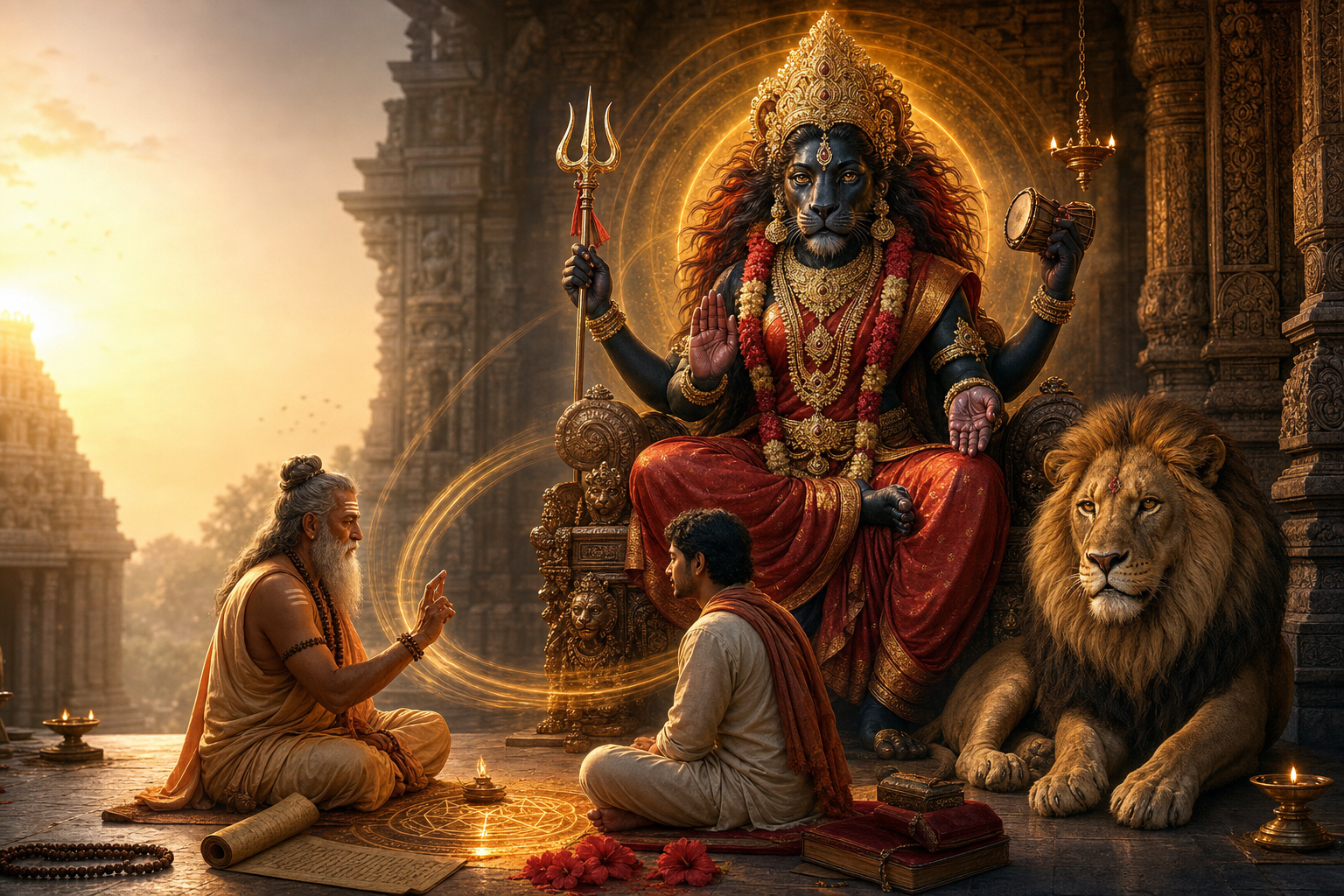
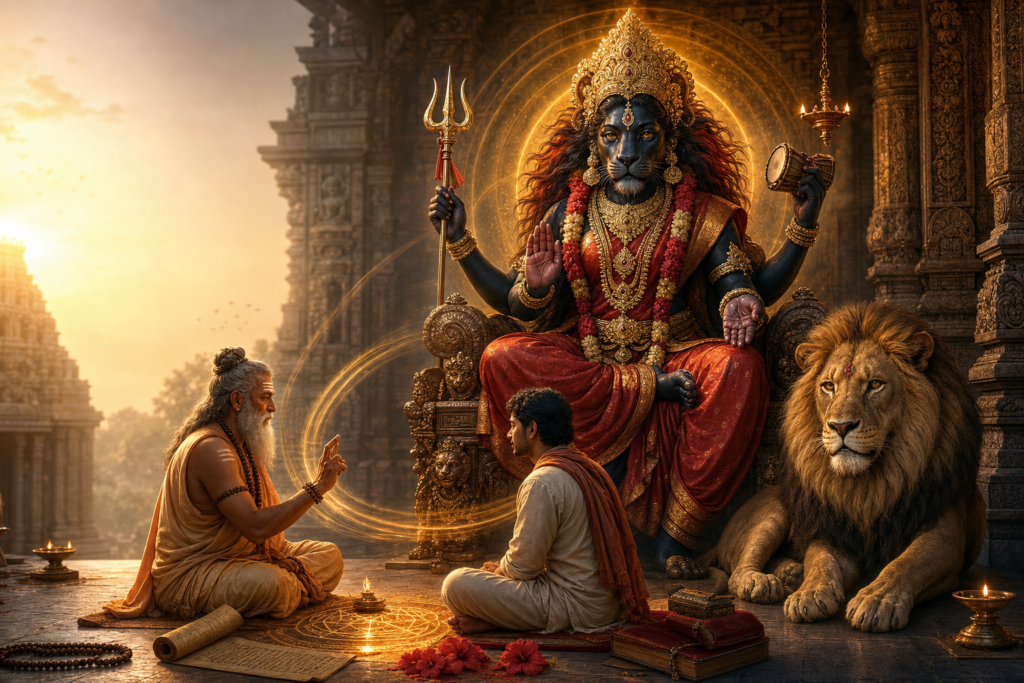
Pratyangira is principally understood as a protective Tantric goddess associated with the wider theology of Śakti. Her modern iconography is commonly lion-faced, dark-complexioned, flame-haired, many-armed, and accompanied by a lion. Textual and sculptural forms vary considerably: some representations give her four arms, while others envision an almost cosmic multiplicity of faces, arms, and lion vehicles. The implements may include the trident, drum, noose, skull-cup, sword, shield, bow, or goad. Protective gestures such as abhaya mudrā and boon-giving gestures such as varada mudrā may appear alongside fearsome weapons. This combination communicates an important theological principle: the terrifying form is directed against disorder, not against sincere devotion.
Names such as Atharvana Bhadrakali, Simhamukhi, Pratyaṅgirā, and Narasimhi occur in contemporary devotional discourse, but they should not automatically be treated as historically interchangeable. Narasimhi is also the name of a lion-faced Mātṛkā, and iconographic scholarship distinguishes her from Pratyangira even where later worshippers identify or closely associate the two. Likewise, the title Atharvana Bhadrakali reflects Pratyangira’s association with Atharvavedic and later mantra traditions; it does not prove that every modern Pratyangira narrative or mantra appears verbatim in the early Atharvaveda Saṃhitā.
The textual history is layered, not uniform
A detailed 2024 study published in the Heritage: Journal of Multidisciplinary Studies in Archaeology traces a gradual development rather than a single, uncomplicated origin. It identifies an early Purāṇic use of the name in the Agni Purāṇa, where Pratyaṅgirā denotes a ritual diagram connected with the worship of Tvaritā rather than a fully narrated independent goddess. The Brahmāṇḍa Purāṇa later includes Pratyaṅgirā among the powers of the Supreme Goddess, while the Devī Purāṇa preserves ritual material associated with her worship. These references show that the name, ritual technology, and divine identity developed through several textual environments. The evidence is reviewed in Sanjay S., A Cross-Cultural Study on the Mythology and Iconography of Goddess Pratyangira.
Ancillary Atharvavedic manuscripts add another layer. The Āṅgirasa or Abhicārakalpa materials studied in manuscript collections describe a lion-faced Mahākṛtyā or Pratyangira invoked to counter hostile ritual actions. These works are associated with Atharvavedic learning, but their Tantric and Purāṇic features suggest that they should not simply be equated with the oldest Vedic strata. This distinction matters because the popular phrase “Goddess of the Atharva Veda” compresses a complex history of Saṃhitā passages, ancillary texts, ritual reinterpretation, manuscript traditions, and later temple theology into one convenient label.
Śaiva Āgamic and Tantric sources further develop Pratyangira’s mantras and iconography. The Kāmika Āgama describes a lion-faced, flame-haired form, while works such as the Mantramahodadhi present multiple fierce visualizations. Other Tantric classifications associate her with Kālīkula traditions and with Siddhilakṣmī. The result is not one universally fixed portrait but a family of related ritual forms. A mantra, visualization, yantra, offering sequence, and theological identification that are authoritative in one lineage may differ from those used in another.
Material evidence and the growth of temple worship
Pratyangira is not merely a recent internet phenomenon. A standing stone image associated with the Sri Vriddhachalam temple in Tamil Nadu has been dated to the thirteenth-century Chola period. After being illicitly removed and sold abroad, it was repatriated from Australia to India in 2016. The documented sculpture provides firm material evidence for a medieval South Indian iconographic tradition, even though the goddess’s much broader public popularity is relatively recent. The object and its provenance are documented by India’s Ministry of Culture in Re(ad)dress: Return of Treasures.
Contemporary Pratyangira temples are especially prominent in Tamil Nadu and elsewhere in southern India. Modern temple images commonly combine her fierce face, fiery hair, weapons, lion vehicle, and protective hand gestures. Temples may also decorate her as Durgā, Lakṣmī, Sarasvatī, or Mahiṣāsuramardinī during festivals. Such practices show how living traditions relate an esoteric goddess to more familiar expressions of the Divine Mother. They also demonstrate the permeability of Śākta, Śaiva, and Vaiṣṇava devotional worlds: Pratyangira may be interpreted through different sectarian frameworks without being confined to only one of them.
Pratyangira, Narasimha, and Sharabha
A widely repeated narrative places Pratyangira within the conflict between Narasimha and Sharabha. In versions of this account, Narasimha’s cosmic fury remains unpacified after the death of Hiraṇyakaśipu; Śiva assumes the form of Sharabha, and Pratyangira manifests through the power of one of Sharabha’s wings to bring the confrontation to rest. Some tellings instead emphasize a convergence of Śiva’s and Narasimha’s energies. These are meaningful sectarian and oral narratives, but current scholarship does not treat every detail as a single early canonical biography. The careful formulation is therefore that Pratyangira became associated with Narasimha and Sharabha in influential later traditions, not that only one universally accepted origin story exists.
This narrative is theologically valuable because it portrays divine fierceness as self-regulating. Power does not culminate in endless domination; it is brought back into cosmic order. Pratyangira’s intervention can consequently be read as the moment when unbounded rage is transformed into disciplined protection. For a contemporary devotee, that symbolism can be more constructive than imagining the goddess as a supernatural weapon against disliked people.
What the fierce iconography communicates
The lion face conveys sovereignty, alertness, and an ability to meet danger without retreat. Flame-like hair suggests a power that consumes disorder and exposes concealment. Weapons signify differentiated capacities: a noose restrains, a sword separates truth from confusion, a trident penetrates the threefold limitations interpreted in different philosophical systems, and a drum recalls rhythm, speech, and manifestation. The skull and cremation-ground imagery found in some forms confront mortality and the instability of ego. These interpretations are symbolic readings rather than fixed dictionary definitions; iconographic meanings change across texts, temples, and lineages.
The presence of abhaya mudrā is particularly significant. It turns a frightening image into an assurance of refuge. A devotee standing before such an image may experience awe, but the deeper ritual movement is from panic toward steadiness. Fierceness is thus not the opposite of compassion. Within Śākta theology, it can be compassion acting without sentimentality when entrenched fear, injustice, or self-deception must be confronted.
A shared history across Dharmic traditions
Pratyangira also illuminates the historical exchange of ritual concepts among Hindu, Buddhist, and Jain communities. Buddhist works associated with Nepal describe Mahāpratyaṅgirā in protective contexts, including a sādhanā in the Sādhanamālā. Jain evidence includes the thirteenth-century Pratyaṅgirā Kalpa attributed to Bālachandrasūri and later yantras that place Pratyangira among Jain symbols and Tīrthaṅkaras. The forms are not identical, and their differences should be respected. Their coexistence nevertheless demonstrates that premodern Dharmic traditions exchanged images, mantras, ritual grammars, and protective motifs without losing their distinct philosophical identities.
This cross-traditional history encourages intellectual humility. It resists claims that one community possesses every form in an isolated, historically untouched state. Hinduism, Buddhism, Jainism, and Sikhism remain distinct traditions, but unity does not require erasing difference. It can instead arise through mutual respect, nonviolence, honest scholarship, and recognition of centuries of cultural conversation. Pratyangira’s documented presence in Hindu, Buddhist, and Jain materials offers a particularly vivid example of that conversation.
What Pratyangira Sadhana actually means
Sādhanā means a disciplined means of spiritual accomplishment. In casual usage, the term may refer to almost any regular prayer, but Tantric Pratyangira Sadhana can involve a tightly coordinated system of mantra, visualization, breath regulation, nyāsa, yantra worship, offerings, vows, repetition counts, and ritual completion. The important distinction is between general devotion to Pratyangira and a lineage-specific technical discipline. A person may respectfully visit a temple, receive prasāda, witness ārati, or pray to the Divine Mother without claiming initiation into advanced mantra practice.
The word ugra should likewise be understood carefully. It describes intensity and a fierce mode of divine activity; it does not mean that every devotee will experience paranormal events. The practical risks of unsupervised austerity can be quite ordinary and serious: sleep disruption, excessive fasting, smoke exposure, fear-driven suggestion, obsessive repetition, social isolation, or the aggravation of an existing mental-health condition. Traditional supervision and modern health safeguards can therefore support one another.
Why diksha is central to Tantric mantra practice
Dīkṣā is commonly translated as initiation, but it involves more than receiving a line of syllables. In Tantric systems, initiation admits a disciple into a teaching and practice lineage, establishes ritual eligibility, and assigns a disciplined relationship to mantra. The Oxford Handbook of Tantric Studies identifies initiation by a qualified master as one of Tantra’s most important social institutions. The process links personal practice with a living chain of interpretation, correction, and responsibility.
Academic study of Hindu mantra traditions similarly notes that a preceptor traditionally selects and transmits a mantra during initiation, thereby authorizing its ritual cultivation. Gudrun Bühnemann’s study, Selecting and Perfecting Mantras in Hindu Tantrism, shows that mantra selection, transmission, repetition, and application form a technical sequence in classical sources. Diksha is therefore not adequately represented by purchasing a generic recording, downloading a certificate, or copying a mantra from social media.
From within the tradition, the guru communicates sound, rhythm, visualization, ritual associations, restrictions, and the intended spiritual orientation. From a historical perspective, the guru also preserves a community’s embodied knowledge—details that a manuscript may abbreviate because its original readers already knew the ritual grammar. In both interpretations, the continuing relationship matters as much as the initial ceremony.
Pratyangira Mantra Diksha Vidhi: a responsible high-level outline
No single Pratyangira Diksha Vidhi governs every lineage. A responsible comparative outline can identify recurring stages without pretending to replace initiation. First comes mutual assessment. The teacher considers the aspirant’s motivation, prior practice, emotional stability, ability to maintain a routine, and suitability for the particular mantra. The aspirant, in turn, examines the teacher’s lineage, ethical conduct, authority to initiate, accessibility, and treatment of disciples. This period of discernment may be more important than ceremonial spectacle.
Second comes preparation. Depending on the sampradāya, the teacher may prescribe bathing, dietary restraint, abstention from intoxicants, truthfulness, sexual restraint, preliminary japa, temple attendance, or a specified period of ordinary devotional practice. These are not interchangeable universal rules. A temporary vow should have a clear duration and purpose, and it should not endanger health. A person with diabetes, an eating disorder, pregnancy, a medication schedule, or another medical consideration should not undertake fasting without qualified clinical advice.
Third comes the initiatory act. It may include a saṅkalpa, worship of Gaṇeśa and the lineage, purification, the establishment of a ritual space, and the communication of the mantra by the guru. Some traditions add nyāsa, in which mantra elements are ritually placed on parts of the body, or teach a corresponding dhyāna, yantra, mudrā, and sequence of offerings. The teacher may explain the mantra’s ṛṣi, chandas, devatā, bīja, śakti, kīlaka, and viniyoga when those categories belong to the transmitted practice.
Fourth comes the assignment. The guru specifies how often, when, and under what conditions the disciple should practise. The assigned regimen may include a daily minimum, a fixed-duration vrata, a mala, a direction of sitting, a visualization, rules for missed sessions, and a method of concluding the practice. Figures such as 108 or 1,008 are common in modern instructions, but their popularity does not make them mandatory for every practitioner. The transmitted count takes precedence over an online chart.
Fifth comes integration and review. A serious teacher remains available for questions, helps distinguish ordinary fluctuations from genuine problems, and adjusts the regimen when necessary. A disciple reports persistent insomnia, panic, agitation, dissociation, or compulsive behaviour rather than interpreting every difficulty as proof that the mantra is becoming powerful. Initiation begins a relationship of accountable practice; it does not end with the ceremonial whispering of syllables.
How a trustworthy guru is evaluated
A credible Pratyangira guru should be able to identify a recognizable lineage or teacher, explain the basis of the practice, and clarify whether that lineage authorizes the guru to initiate others. Personal devotion alone does not automatically confer such authority. It is reasonable to consult established disciples, a known temple, or senior members of the same tradition. Lineage secrecy may limit the public disclosure of a mantra, but it should not be used to prevent all verification or to silence legitimate questions about conduct.
Ethical integrity is indispensable. A sound teacher does not promise guaranteed miracles, threaten supernatural retaliation for leaving, encourage attacks on alleged enemies, demand unquestioning obedience, or use private initiation to obtain sexual access. Financial arrangements should be transparent and proportionate. Dakṣiṇā may have a legitimate ritual place, but escalating payments, manufactured emergencies, and claims that another expensive rite is the only way to avert disaster are warning signs of exploitation.
A trustworthy teacher also respects ordinary responsibilities. Such a teacher does not command a disciple to discontinue medication, ignore a court proceeding, conceal abuse, sever supportive relationships, or interpret every disagreement as sorcery. Spiritual instruction should deepen discernment, compassion, courage, and self-command. When it systematically produces fear, dependence, secrecy, or financial coercion, the relationship requires reassessment.
Remote initiation cannot be judged by format alone. Some established communities may recognize a carefully prepared remote transmission, while others require physical presence. The decisive questions concern lineage authorization, prior relationship, accurate instruction, informed consent, and continuing supervision. A mass livestream that distributes the same secret mantra to strangers without assessment is not equivalent to a sustained guru–śiṣya relationship merely because it is called diksha.
Core rules after initiation
1. Follow the transmitted method. Mantras, visualizations, nyāsas, and ritual sequences should not be casually combined across unrelated books, videos, and lineages. More complexity does not necessarily produce deeper practice. When two instructions conflict, clarification should come from the initiating tradition rather than from an anonymous online discussion.
2. Maintain a protective rather than aggressive intention. Pratyangira worship is frequently described as counteracting hostile influence, but counteraction must not become a pretext for hatred or revenge. A dharmic saṅkalpa seeks safety, truth, justice, clarity, and the cessation of harm. It does not designate a caste, religion, neighbour, colleague, relative, or political opponent as an occult enemy without evidence.
3. Protect regularity and bodily stability. A manageable daily discipline is preferable to bursts of extreme repetition followed by exhaustion. Adequate sleep, hydration, nutrition, work, and family responsibilities remain part of ethical practice. Intoxication and reckless sleep deprivation undermine the attention that mantra discipline is intended to cultivate.
4. Respect lineage-specific vows. Vegetarian food, celibacy, silence, particular clothing, and restrictions on social interaction appear in some modern Pratyangira instructions. They should not be falsely presented as identical across every Tantric school. The disciple follows the vows actually received, understands their duration, and seeks clarification when health or unavoidable responsibilities create a conflict.
5. Preserve appropriate confidentiality. Secrecy in mantra traditions can protect concentration and prevent decontextualized imitation. It should never conceal abuse. A disciple may refrain from publishing a private mantra while still discussing coercion, misconduct, threats, or health concerns with trusted people and relevant professionals.
6. Record the practice soberly. A simple journal can note time, duration, attention, sleep, mood, and questions for the teacher. Extraordinary interpretations should not be added automatically. Dreams, bodily sensations, emotional releases, and coincidences can have many causes. The most dependable signs of constructive practice are usually greater steadiness, ethical restraint, humility, compassion, and capacity to meet difficulty.
The technical character of Pratyangira mantra
Tantric mantras often contain bīja syllables whose ritual function cannot be captured through ordinary word-for-word translation. Vowel length, aspiration, retroflexion, nasalization, cadence, and the placement of pauses may be important within a transmitted recitation. A Roman spelling such as “Kreem” is only an approximation of krīṁ; it does not communicate every phonetic detail. For that reason, reading a transliteration is not equivalent to hearing a competent recitation and receiving correction.
A short formula widely circulated in modern devotional material is:
ॐ क्रीं क्रीं क्रीं हूं हूं फट् स्वाहा॥
Om Kreem Kreem Kreem Hum Hum Phat Swaha॥
Its public circulation does not establish it as the unique “main mantra” of every Pratyangira lineage. Longer root mantras and mahāmantras also circulate, sometimes with significant textual variation. The source page itself presents several formulas, which demonstrates why a practitioner should not splice their components together. A public mantra may be discussed for educational purposes, while the exact initiatory mantra, phonetics, nyāsa, visualization, count, and ritual application remain matters for the lineage that transmits them.
The syllable phaṭ is commonly associated in Tantric ritual language with forceful separation, cutting, or protection, while svāhā often marks an offering or ritual completion. Such glosses are only orientation; they do not exhaust the meanings assigned by different texts. Claims that each syllable mechanically produces a guaranteed material result should be treated cautiously. Mantra practice is embedded in intention, discipline, theology, ritual context, and ethical formation rather than operating as a verbal vending machine.
Timing, repetition counts, and materials
Amāvasyā, Aṣṭamī, Tuesdays, and Fridays are frequently associated with modern Pratyangira worship. Brahma Muhūrta, the period before sunrise, and nighttime observances also appear in published instructions. These timings describe recognizable traditions, not an international rule binding every temple and lineage. A temple calendar and the guru’s directions provide better guidance than a generalized astrological claim. Midnight practice should never be pursued at the cost of chronic sleep loss, personal security, or household safety.
Counts such as 9, 108, and 1,008 are often reported. The number 108 has broad ritual significance across Indian traditions, while 1,008 intensifies the scale of observance. Nevertheless, counting is only one technical component. Correctness also concerns attention, pronunciation, posture, intention, and completion. A disciple should not multiply repetitions competitively or assume that a larger number guarantees faster protection.
Modern practice may employ a Rudrākṣa or dark stone mala, sesame or ghee lamps, red or dark flowers, black sesame, fruit, sweets, an image, or a yantra. These materials vary by temple and teacher. No object should be treated as a substitute for training, and no practitioner should ingest unfamiliar ritual substances. Cleanliness in this context is best understood as orderly preparation, bodily care, and focused attention rather than as a basis for stigmatizing another person or community as impure.
Pratyangira Homa is not a casual home experiment
Contemporary Pratyangira Homa commonly includes a saṅkalpa, preliminary worship, invocation, mantra offerings into a consecrated fire, pūrṇāhuti, ārati, and distribution of prasāda. Red chillies are a conspicuous offering in several South Indian temple traditions, alongside ghee, black pepper, grains, sesame, and designated woods. The exact sequence belongs to trained priests or initiated ritual specialists. It should not be reconstructed from a condensed article.
Fire and smoke create physical hazards independent of theology. Burning chillies can severely irritate the eyes and respiratory tract, especially for children and people with asthma or other pulmonary conditions. A homa requires a suitable venue, ventilation, fire-control provisions, lawful supervision, and knowledge of the prescribed materials. Temple participation under qualified leadership is the appropriate route for most devotees seeking this form of worship.
Protection, black magic, and responsible interpretation
Traditional descriptions call Pratyangira apotropaic, meaning that her worship is intended to avert or reverse harmful influence. Devotees may interpret recurring misfortune through categories such as dṛṣṭi, abhicāra, curses, or hostile subtle forces. These categories carry genuine religious and emotional significance, but there is no reliable empirical test that can identify a neighbour or relative as the source of occult harm. Accusations can destroy families and expose vulnerable people to exploitation.
A mature protective interpretation begins with verifiable causes. Financial losses require records and professional advice; harassment requires documentation and appropriate authorities; persistent illness requires clinical assessment; anxiety, paranoia, voices, dissociation, or prolonged insomnia require mental-health evaluation. Prayer may accompany those responses, but it should not displace them. Anyone claiming that a costly ritual is the only permissible response to every problem is reducing a complex spiritual tradition to fear-based commerce.
The internal symbolism of Pratyangira can also be spiritually fruitful. The “enemy” may be uncontrolled anger, compulsive fear, vindictiveness, addiction, deception, or the ego’s demand for domination. This reading does not deny traditional cosmology; it ensures that the practice also produces ethical self-examination. Protection becomes more than escape from an external threat—it becomes freedom from reproducing the same hostility within oneself.
Beginner-safe forms of devotion
A person drawn to Pratyangira does not need to imitate advanced Tantra immediately. A responsible beginning may consist of temple darśana, participation in a publicly conducted ārati or homa, respectful study of the goddess’s history, ordinary prayer to the Divine Mother, and ethical service. Public stotras or nāma recitations may be learned from a recognized temple or teacher when that community explicitly permits them. The boundary between public devotion and restricted mantra practice should be stated clearly rather than guessed.
Foundational disciplines are equally relevant: truthful speech, non-harm, moderation, regular sleep, care for dependants, and the ability to sustain a simple daily practice. A seeker unable to maintain a brief, peaceful routine is unlikely to benefit from a demanding regimen involving thousands of repetitions. Preparation is not a lesser spiritual path; it is the cultivation of the stability that advanced practice presupposes.
Frequently asked questions
Is diksha mandatory for every form of Pratyangira worship? No universal institution regulates all worship, and temple darśana or public prayer does not ordinarily require private mantra initiation. However, classical Tantric practice commonly treats diksha as necessary for lineage-specific mantra, nyāsa, puraścaraṇa, and advanced ritual application. The distinction is therefore not between worship and no worship, but between accessible devotion and restricted technical sādhanā.
Can a beginner repeat a mantra found online? The existence of a mantra on a public page does not establish its suitability for every person. A beginner can request guidance from a reputable temple or teacher and ask specifically which prayers are public. Seed-heavy or elaborate formulas should not be assumed to be universal simply because they appear in search results.
Must every practitioner be vegetarian and celibate? Some lineages prescribe these disciplines permanently or during a defined vrata; others formulate eligibility differently. They should be represented as lineage rules rather than universal historical facts. The practitioner follows the actual instruction received and avoids vows that conflict with medical safety or existing ethical obligations.
Are Amāvasyā and midnight compulsory? They are important in several modern temple and Tantric contexts, but not every devotional act must occur then. The relevant temple calendar and transmitted practice determine timing. Spiritual seriousness is not measured by choosing the most dramatic hour.
What counts as progress? Visions, heat, dreams, bodily vibrations, and coincidences are not reliable universal measures. Greater honesty, courage, emotional regulation, compassion, concentration, and freedom from revenge provide more ethically meaningful evidence. Persistent fear, grandiosity, obsession, or deterioration in daily functioning calls for reassessment rather than celebration.
Can Pratyangira Sadhana cure disease or replace professional treatment? No such promise can be made responsibly. Religious practice may support hope, community, and resilience, but medical symptoms require evidence-based assessment and care. The same principle applies to psychiatric distress, legal disputes, domestic abuse, and financial problems.
A practical decision framework for serious seekers
Before seeking initiation, an aspirant can ask five questions. Is the motivation protection and spiritual maturity, or retaliation and fascination with power? Is a stable foundational practice already present? Can the proposed teacher’s lineage and authority be reasonably verified? Are the financial, ethical, and interpersonal boundaries transparent? Will the practice coexist with health care, family responsibilities, lawful conduct, and respect for other traditions? Unclear answers indicate that more preparation and investigation are needed.
Many people encounter Pratyangira during a period of genuine fear. That emotional reality deserves compassion rather than ridicule, but fear also makes a person vulnerable to manipulation. The most protective first step may be slower than expected: establish the facts, stabilize sleep and health, seek practical assistance, visit a reputable temple, and observe the community before making commitments. Discernment is itself a form of spiritual protection.
Conclusion: fierceness disciplined by dharma
Pratyangira Devi Sadhana is best understood as an advanced and diverse Tantric field rather than a single internet ritual. Its history reaches through Purāṇic, ancillary Atharvavedic, Āgamic, manuscript, sculptural, temple, Buddhist, and Jain contexts. Its living practice places exceptional importance on mantra, initiation, ritual competence, and the guru–śiṣya relationship. Because these elements differ by lineage, no responsible article can provide one universally valid Diksha Vidhi or guarantee supernatural results.
The enduring value of Pratyangira’s image lies in the transformation of fearsome power into protection. Properly oriented, her worship does not inflame suspicion or turn spiritual language against other people. It calls for courage without cruelty, strength without domination, discipline without exploitation, and reverence without abandoning reason. Those principles offer a sound foundation for devotional participation and for any later decision to pursue initiation under a qualified, ethical guru.
Sources and further reading
This account critically expands the material presented in Pratyangira Devi Sadhana | Pratyangira Mantra Diksha Vidhi, Rules, Initiation by Guru. Historical and iconographic details are supported by A Cross-Cultural Study on the Mythology and Iconography of Goddess Pratyangira. The broader explanations of Tantric initiation and mantra transmission draw on the Oxford Handbook of Tantric Studies and Cambridge scholarship on selecting and perfecting mantras. These sources document history and ritual theory; they do not substitute for lineage instruction.
Inspired by this post on Hindu Pad.




Leave a Reply
You must be logged in to post a comment.