
Śrīmad-Bhāgavatam 4.20.1–2 presents a compact but profound study of conflict, spiritual leadership, forgiveness, and divine purpose. The passage begins after rivalry has disrupted King Pṛthu’s sacrificial undertaking. Lord Viṣṇu then enters the sacrificial arena with Indra, the very person responsible for the disruption, and asks Pṛthu to forgive him. In only two verses, the narrative moves from wounded prestige and escalating anger toward accountability, reconciliation, and renewed devotion.
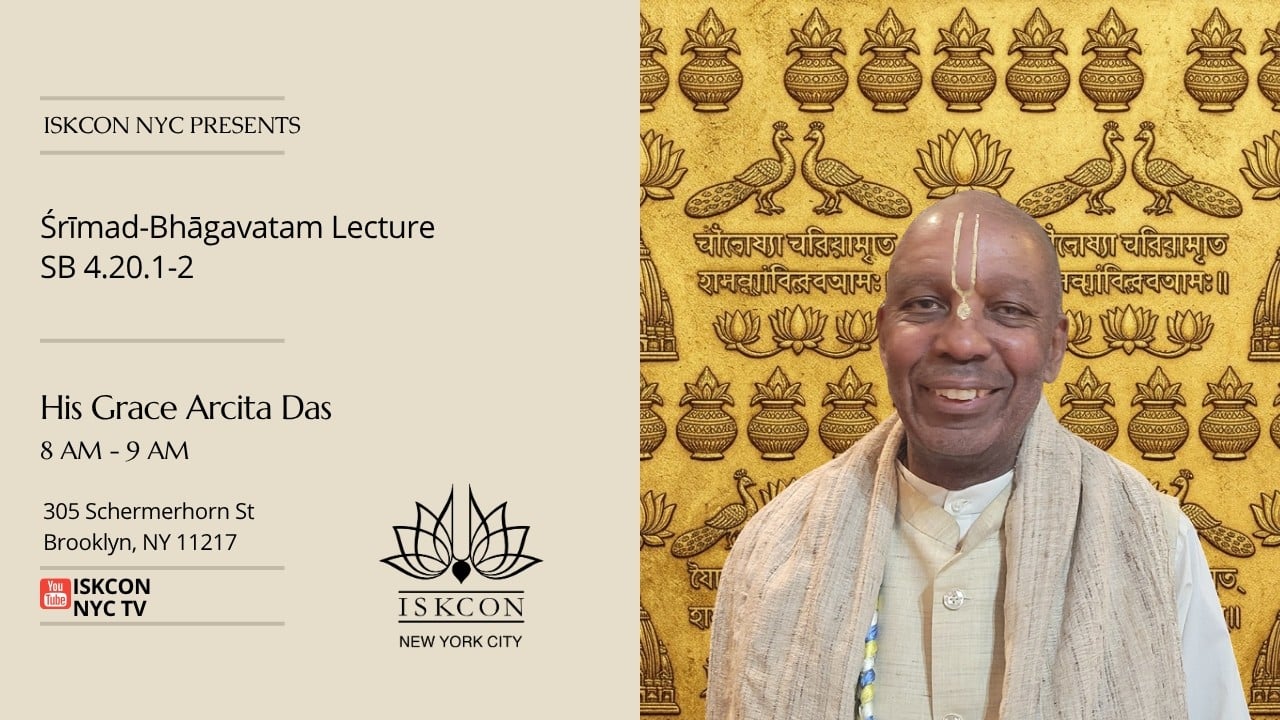
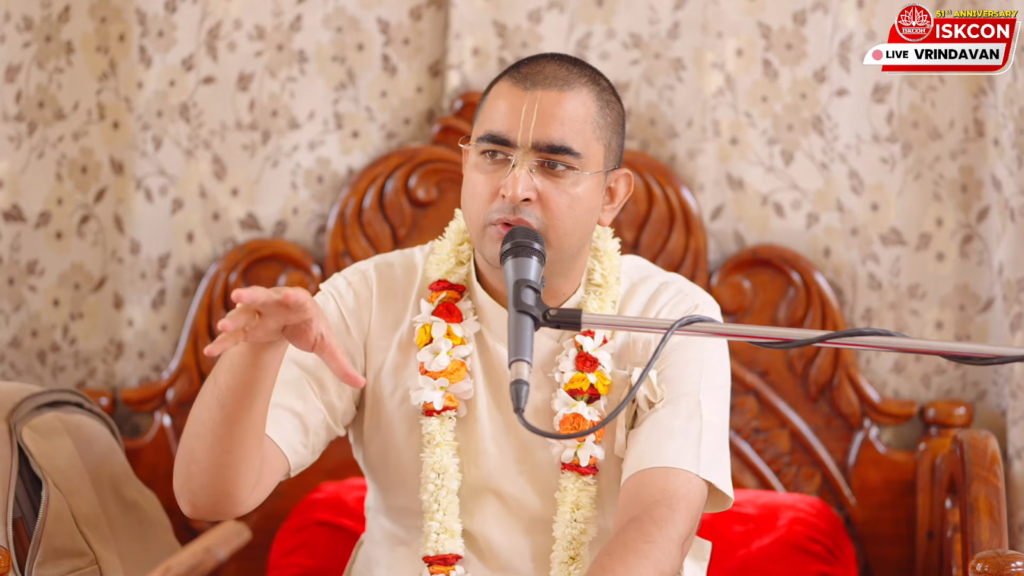
Source lecture: SB 4.20.1-2 | HG Arcita Das, published by ISKCON NYC TV. The recording provides the oral setting for this expanded textual study of King Pṛthu, Indra, yajña, dharma, and the spiritual discipline of forgiveness.
This examination follows the theological vocabulary and narrative setting of the verses while distinguishing textual claims from modern applications. The aim is not to reduce a Purāṇic account to a management parable. Rather, the episode is first understood within its Vaiṣṇava framework and then considered as a source of practical insight into leadership, conflict resolution, and the dignity of every living being.
Why these two verses matter
The dramatic force of Śrīmad-Bhāgavatam 4.20.1–2 depends on what has just occurred. According to the preceding chapter, King Pṛthu intended to perform one hundred horse sacrifices. Indra, fearing that Pṛthu’s accomplishment would rival his own distinction, repeatedly obstructed the final sacrifice and stole the sacrificial horse. The conflict became increasingly dangerous because legitimate religious symbols were used as disguises in the course of deception. The account in Śrīmad-Bhāgavatam, Chapter Nineteen consequently treats the dispute as more than a personal quarrel: rivalry among leaders was beginning to distort public understandings of religion.
King Pṛthu’s anger was not presented as incomprehensible. An important undertaking had been sabotaged, sacred procedure had been disturbed, and deceptive conduct had threatened the integrity of dharma. Yet the legitimacy of a grievance did not make every possible response legitimate. When Pṛthu prepared to retaliate, Lord Brahmā intervened and advised him to abandon the hundredth sacrifice. Completing one more ritual could no longer justify the social and religious damage generated by the contest.
This intervention introduced a decisive distinction between purpose and prestige. Yajña was meant to sustain sacred order and satisfy the Divine; it was not meant to become an instrument for defeating a rival. Once competition displaced the higher purpose, numerical completion ceased to be spiritually decisive. Pṛthu therefore accepted guidance, stopped the escalation, and made room for reconciliation.
Śrīmad-Bhāgavatam 4.20.1
maitreya uvāca
bhagavān api vaikuṇṭhaḥ
sākaṁ maghavatā vibhuḥ
yajñair yajña-patis tuṣṭo
yajña-bhuk tam abhāṣata
The first verse reports that Maitreya continued speaking to Vidura. Lord Viṣṇu, satisfied by King Pṛthu’s ninety-nine sacrifices, appeared with Indra and addressed the king. The verse is narratively brief, but its carefully repeated sacrificial vocabulary identifies the true center of the event.
The expression maitreya uvāca preserves the immediate dialogical frame: the sage Maitreya is instructing Vidura. Bhagavān identifies the personal Supreme Lord, while vaikuṇṭhaḥ invokes the Lord associated with Vaikuṇṭha, the realm beyond material anxiety and limitation. Sākaṁ maghavatā means that He appeared together with Maghavān, a name for Indra. Indra is therefore not discussed as an absent offender; he is brought into the encounter and made present to the person he harmed.
The terms yajñaiḥ, yajña-patiḥ, and yajña-bhuk form a deliberate semantic cluster. The Lord is satisfied by the sacrifices, is their master, and is their ultimate recipient or enjoyer. This repetition clarifies the theology of yajña. A sacrifice is not spiritually complete merely because its external sequence has been executed. Its meaning depends upon orientation toward the Supreme, who cannot be reduced to a mechanism controlled by ritual technique.
The fact that Lord Viṣṇu is satisfied after ninety-nine sacrifices carries considerable interpretive weight. Pṛthu’s hundredth performance has been interrupted, yet divine satisfaction is not withheld on account of the unfinished total. The text thereby separates spiritual success from obsessive numerical completion. The intended hundredth sacrifice had become the focus of rivalry, but the Lord recognizes the devotion and duty already expressed.
This distinction challenges a familiar human tendency. A person may complete nearly every part of a worthy undertaking and still feel that everything has failed because the final milestone remains unmet. In institutional life, the same attachment can cause a metric, title, publication, promotion, or public distinction to eclipse the purpose that originally gave the work value. Pṛthu’s experience suggests that relinquishing a contested achievement may sometimes protect the deeper objective more effectively than forcing its completion.
The Lord’s arrival with Indra also establishes a model of mediation. The mediator does not deny the offense, excuse deception, or ask the injured party to pretend that nothing occurred. Instead, the parties are brought together under a moral authority capable of naming the harm and directing the relationship toward repair. Reconciliation begins with reality rather than sentimentality.
Śrīmad-Bhāgavatam 4.20.2
śrī-bhagavān uvāca
eṣa te ’kārṣīd bhaṅgaṁ
haya-medha-śatasya ha
kṣamāpayata ātmānam
amuṣya kṣantum arhasi
In the second verse, Lord Viṣṇu identifies Indra as the person who disrupted Pṛthu’s attempt to complete one hundred horse sacrifices. Indra has now come seeking pardon, and Pṛthu is told that he ought to forgive him. The sequence is ethically significant: wrongdoing is identified, the offender appears before the injured party, pardon is sought, and forgiveness is requested.
The deictic pronoun eṣa, meaning “this person,” emphasizes Indra’s presence. Akārṣīt bhaṅgam states that he caused a break or disturbance. The compound haya-medha-śatasya connects that disruption specifically to the projected hundredfold horse sacrifice. The verse does not conceal responsibility behind vague language. Indra performed the disruptive act, and the reconciliation process begins only after that fact has been made explicit.
The final expression, kṣantum arhasi, gives the passage its normative force. Kṣantum is an infinitive associated with forgiving or enduring, while arhasi communicates what is fitting or what one ought to do. Forgiveness is therefore presented not merely as a passing emotion but as conduct appropriate to Pṛthu’s spiritual maturity and public responsibility.
The verse is equally notable for the word ātmānam. The traditional purport draws attention to a spiritual vision in which a living being is not equated with the temporary body. Within Gaudiya Vaishnava theology, each jīva is an eternal conscious self and a dependent part of the Supreme. The self and the Superself share spiritual quality, although the individual being is not treated as identical to the unlimited Lord in magnitude, agency, or personhood.
This ontological point gives forgiveness a foundation deeper than social convenience. Indra is responsible for deception, envy, and disruption, but he is not reducible to those actions. Pṛthu is genuinely injured, but he is not reducible to the role of an injured rival. Both possess identities more enduring than the conflict. Recognition of spiritual dignity does not erase moral difference; it prevents a wrongful act from becoming the total definition of a person.
The next verse develops the same logic by describing the most intelligent and welfare-oriented persons as free from malice because they understand that the self is different from the body. The progression into Śrīmad-Bhāgavatam 4.20.3 shows that forgiveness is not an isolated command. It follows from disciplined perception: the body, status, role, injury, and reactive emotion are real features of embodied experience, but none constitutes the complete spiritual identity of a living being.
Forgiveness without denial
Śrīmad-Bhāgavatam 4.20.1–2 does not define forgiveness as denial, forced trust, or the absence of consequences. Indra’s misconduct has already produced serious consequences, including the termination of the hundredth sacrifice and the exposure of deceptive religious forms. Lord Viṣṇu explicitly names the disruption before asking Pṛthu to forgive. Accurate moral description and compassionate reconciliation are therefore presented as compatible.
Forgiveness also does not require the harmed person to declare the harmful action acceptable. It releases the demand that retaliation, humiliation, or permanent enmity must settle the account. Trust may still need to be rebuilt through truthful conduct. Institutional safeguards may still be necessary. A leader can forgive an individual while correcting the conditions that allowed the wrongdoing to occur.
Nor does the passage place the entire burden on Pṛthu. Indra accompanies Lord Viṣṇu and comes to seek pardon. Later in the chapter, Indra is described as ashamed of his actions and approaching Pṛthu, while Pṛthu responds by embracing him and relinquishing envy. The full chapter thus depicts reconciliation as an encounter in which remorse and generosity meet. An offender’s willingness to appear, acknowledge the breach, and accept vulnerability is part of the repair.
Pṛthu’s role is demanding in a different way. He must distinguish justice from wounded prestige. His anger arose in response to an actual wrong, but continued retaliation would have multiplied the damage. By accepting divine and institutional counsel, he demonstrates that strength includes the capacity to stop. The ruler who can conquer others but cannot interrupt his own escalation remains internally ungoverned.
A technical model of conflict transformation
The episode can be analyzed as a sequence with seven stages: status threat, covert obstruction, exposure, reactive escalation, authoritative intervention, acknowledged responsibility, and relational repair. Indra perceives Pṛthu’s achievement as a threat to status. That perception leads to sabotage and deceptive presentation. Exposure produces anger and the possibility of retaliatory violence. Brahmā and then Lord Viṣṇu interrupt the cycle, re-establish the higher purpose, bring the parties together, and make forgiveness possible.
This sequence shows why conflicts cannot always be solved at the level at which they began. Pṛthu and Indra were competing over the symbolic meaning of the hundredth sacrifice. Resolution became possible only when the frame shifted from comparative prestige to dharma and divine satisfaction. Effective mediation often performs this reframing function: it identifies a shared or higher value that neither party can protect through continued escalation.
The intervention also preserves proportion. The loss of one ritual completion is weighed against the proliferation of religious confusion and hostility. Brahmā’s counsel recognizes that a formally legitimate objective can become practically destructive when pursued without regard for changing conditions. Dharma therefore requires discernment, not mechanical persistence.
Spiritual leadership beyond achievement
King Pṛthu represents a ruler whose authority is judged by self-governance, receptivity to counsel, protection of social order, and orientation toward the Supreme. His greatness is not diminished when he abandons the final sacrifice. It becomes more visible. The capacity to relinquish a prestigious goal for the sake of dharma demonstrates a freedom that mere achievement cannot provide.
Indra’s conduct reveals the opposite dynamic. Even elevated office does not eliminate insecurity. Authority can intensify comparison when identity depends upon distinction from others. Indra’s fear of being surpassed turns another person’s success into a personal danger. The narrative therefore treats envy as an epistemic failure as well as a moral one: it causes a leader to misread shared prosperity as private loss.
Lord Viṣṇu’s satisfaction corrects both forms of attachment. Pṛthu does not need the hundredth sacrifice to secure divine recognition, and Indra does not need to sabotage Pṛthu to preserve his own worth. When identity is grounded in service rather than comparison, another person’s excellence no longer has to be experienced as dispossession.
This insight remains relevant in workplaces, temples, families, academic communities, and public institutions. A colleague may obstruct a project, a peer may claim credit, or a community member may fear losing influence. The immediate impulse is often to protect status through exposure, counterattack, or exclusion. The Pṛthu–Indra episode asks a more disciplined set of questions: What value is actually being protected? Has the original purpose been displaced by rivalry? What response will restore integrity without reproducing the offense?
The emotional realism of the account should not be overlooked. An unfinished achievement can carry grief, especially when its interruption was deliberate. Forgiveness does not require Pṛthu to deny that loss. It requires him to prevent the loss from governing his future action. This is why the embrace described later in the chapter is powerful: it follows moral clarity rather than emotional avoidance.
Yajña as an architecture of relationship
In this passage, yajña is simultaneously ritual, offering, duty, and relationship. The sacrificer does not possess the sacrifice as a private achievement. Priests, rulers, divine recipients, natural resources, inherited teachings, and the larger community all participate in its meaning. The repeated titles yajña-pati and yajña-bhuk relocate ownership in Lord Viṣṇu and prevent the sacred act from becoming a trophy of the performer.
This relational structure helps explain why rivalry corrupts sacrifice. Once yajña becomes a means of self-magnification, its outward form can remain impressive while its inward orientation shifts. The narrative’s concern with deceptive religious appearances in the preceding chapter reinforces that distinction. Clothing, titles, procedures, and public claims cannot independently establish spiritual authenticity; motive, conduct, and fidelity to dharma remain essential.
The lesson is not that ritual is unnecessary or merely symbolic. Within the text, Pṛthu’s sacrifices are significant and Lord Viṣṇu is pleased by them. The lesson is that ritual derives its integrity from its proper end. Form and intention belong together. Abandoning the hundredth sacrifice protects yajña from being subordinated to the very envy and competition it should help transcend.
Unity across dharmic traditions without erasing difference
The episode can contribute to constructive dialogue among Hindu, Buddhist, Jain, and Sikh traditions when similarities are treated as ethical resonances rather than declarations that every doctrine is identical. The Bhāgavata grounds forgiveness in the reality of the eternal self and its relationship with the Supreme. Buddhist accounts of anātman do not share that same metaphysical formulation, yet Buddhist disciplines of non-hatred, compassion, and equanimity offer a meaningful ethical point of contact.
Jain traditions affirm the reality of individual jīvas and give exceptional prominence to ahiṃsā, restraint, repentance, and forgiveness. Sikh teachings address the destructive force of haumai, or ego-centeredness, while honoring humility, truthful conduct, compassion, remembrance of the Divine, and responsible action. These traditions retain their own scriptures, disciplines, and metaphysical commitments, but each provides resources for interrupting retaliation and refusing to make ego the final judge of a conflict.
Such comparison supports dharmic unity precisely because it does not demand doctrinal flattening. Unity is strongest when traditions can recognize shared ethical concerns while accurately naming their differences. Śrīmad-Bhāgavatam 4.20.1–2 contributes a distinctly Vaiṣṇava account: divine grace does not bypass responsibility, spiritual identity does not erase individuality, and forgiveness becomes an expression of devotion and clear intelligence.
A practical discipline derived from the passage
First, the event should be described accurately. Indra’s disturbance is named before reconciliation is requested. A mature response begins with verifiable actions rather than exaggeration, rumor, or character assassination.
Second, the action should be distinguished from the whole person. Spiritual vision neither excuses misconduct nor turns misconduct into an offender’s permanent essence. This distinction makes correction possible without dehumanization.
Third, the higher purpose should be recovered. Pṛthu must decide whether the hundredth sacrifice still serves dharma or whether it has become fuel for competition. Modern conflicts similarly become clearer when the original mission is separated from the desire to win.
Fourth, qualified mediation should be accepted. Pṛthu does not interpret receptivity to Brahmā and Lord Viṣṇu as weakness. Wise counsel can reveal consequences that anger hides and create a setting in which acknowledgment becomes possible.
Fifth, forgiveness should be joined to responsible repair. Indra approaches in shame, and Pṛthu relinquishes envy. The offended party releases retaliation, while the offender abandons concealment and seeks pardon. The relationship changes because both truth and mercy are present.
Questions for close study
A careful listener to HG Arcita Das’s class may attend to several textual signals: Why does the first verse repeat the language of yajña? Why is Lord Viṣṇu already satisfied with ninety-nine sacrifices? Why does He arrive with Indra rather than merely send an instruction? What does kṣantum arhasi imply about forgiveness as duty? How does ātmānam prepare for the body–self distinction developed in the following verses?
Further reflection may consider where a contested milestone has begun to overshadow a worthy mission, whether an opponent has been reduced to a single offense, and what form of mediation could prevent a legitimate grievance from producing disproportionate harm. These questions translate the passage into disciplined self-examination without stripping it of its theological setting.
The enduring insight of SB 4.20.1–2
Śrīmad-Bhāgavatam 4.20.1–2 portrays forgiveness as the strength to uphold truth without becoming governed by retaliation. Lord Viṣṇu does not conceal Indra’s offense, and Pṛthu’s loss is not dismissed. Yet divine satisfaction reveals that Pṛthu’s spiritual achievement never depended upon defeating Indra or completing a prestigious total.
The passage ultimately relocates greatness from external completion to internal freedom. Indra must step out from behind deception, Pṛthu must release the demand for retaliatory victory, and both must return to a purpose larger than status. In that movement, yajña regains its sacred orientation, leadership becomes service, and forgiveness becomes an intellectually rigorous expression of dharma, compassion, and Krishna consciousness.
Inspired by this post on Dandavats.





Leave a Reply
You must be logged in to post a comment.