
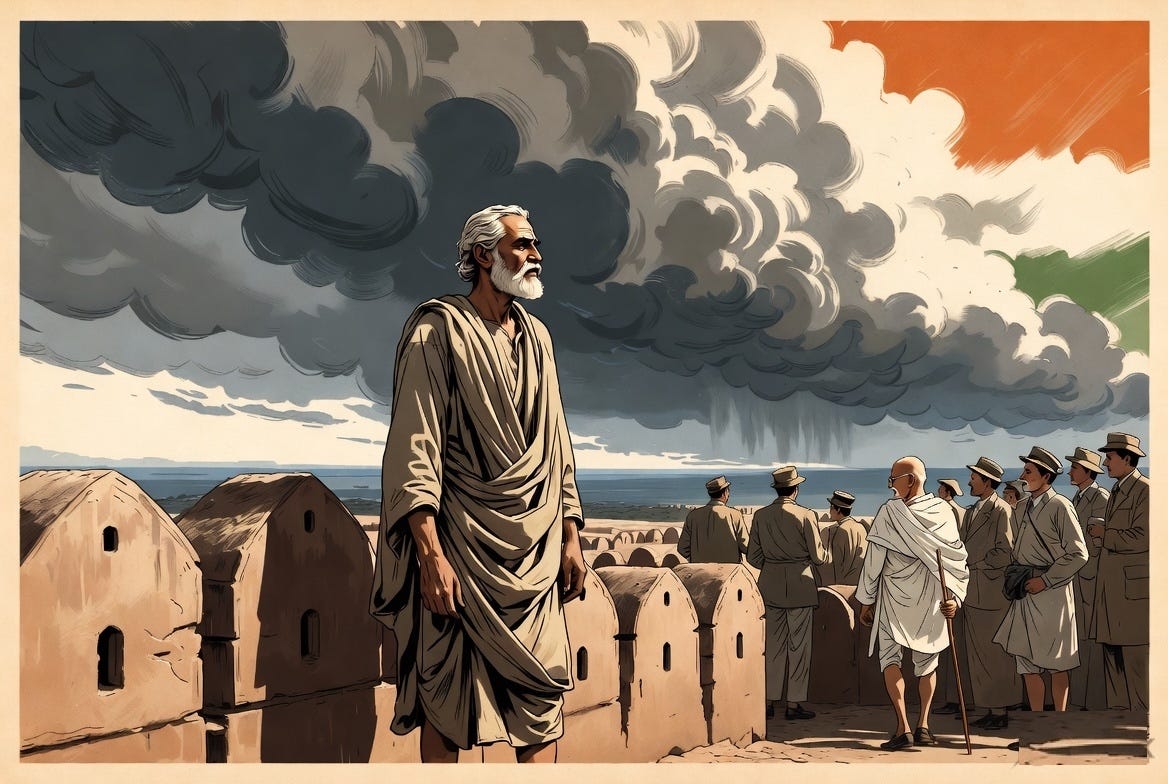
National Defence, Colonial Rule, and the Meaning of Loyalty
Few political questions are more difficult than the one India confronted during the final decades of British rule: what did national defence mean when the nation itself was governed without democratic consent? Indian leaders opposed an imperial administration that denied them sovereignty, yet they also had to consider the danger that Britain’s enemies might attack Indian territory. Cooperation with the colonial government could be represented as complicity in imperialism, while refusing cooperation could be condemned as indifference to India’s security. The resulting dispute cannot be understood through slogans alone. It requires a careful distinction among India as a civilisation and homeland, the British Indian state as a colonial structure, and the government in London as the authority directing that structure.
The controversy also unfolded within an increasingly divided political environment. The Indian National Congress, the All India Muslim League, the Khilafat leadership, constitutional liberals, revolutionaries, socialists, Hindu political organisations, and regional movements did not share a single understanding of freedom, citizenship, non-violence, or national interest. Even within Congress, Mahatma Gandhi, Maulana Abul Kalam Azad, Jawaharlal Nehru, Subhas Chandra Bose, Vallabhbhai Patel, Abdul Ghaffar Khan, and other leaders differed over strategy. Treating any religious community or political organisation as a unified bloc obscures these differences and substitutes collective accusation for historical analysis.
The supplied historical passage presents a forceful critique of Congress policy. It connects debates from 1921 with controversies surrounding the Second World War, cites statements attributed to Maulana Abul Kalam Azad and Lala Lajpat Rai, and argues that Congress subordinated national defence to political bargaining. Its central concern is legitimate and enduring: leaders seeking national authority must be prepared to protect the country from external aggression. Its rhetoric, however, frequently moves from criticism of identifiable leaders to generalisations about entire communities. A factual assessment must preserve the political question while rejecting communal essentialism.
Two Historical Moments Are Compressed into One Argument
The passage moves between two distinct periods. The first is 1921, when the Non-cooperation and Khilafat movements were challenging British authority. The second is the opening phase of the Second World War, especially the crisis created after Britain declared India to be at war in September 1939 without consulting elected Indian representatives. These moments were connected by the unresolved question of sovereignty, but they were not identical. Political positions developed during the agitation over the Ottoman Caliphate cannot automatically be transferred to the strategic conditions of the 1940s.
This chronology matters because the passage describes Azad as the serving president of Congress while quoting a statement dated 1 June 1921. Azad briefly held the Congress presidency in 1923 and then served again from 1940 to 1946. The accompanying references to a world war, Congress ministries, the Poona resolution, and Muhammad Ali Jinnah’s followers strongly suggest that the commentary belongs to the early 1940s and uses material from 1921 to interpret later events. The argument is therefore retrospective: it treats an earlier statement as evidence of a continuing political disposition.
Retrospective arguments can be illuminating, but they carry methodological risks. A statement made during the Khilafat agitation addressed a particular combination of colonial repression, pan-Islamic mobilisation, and anti-imperial politics. Two decades later, Germany, Italy, and Japan posed different military threats, Congress had acquired experience in provincial government, and the Muslim League had become a far stronger constitutional claimant. Historical continuity must be demonstrated through evidence; it cannot simply be assumed from similar language.
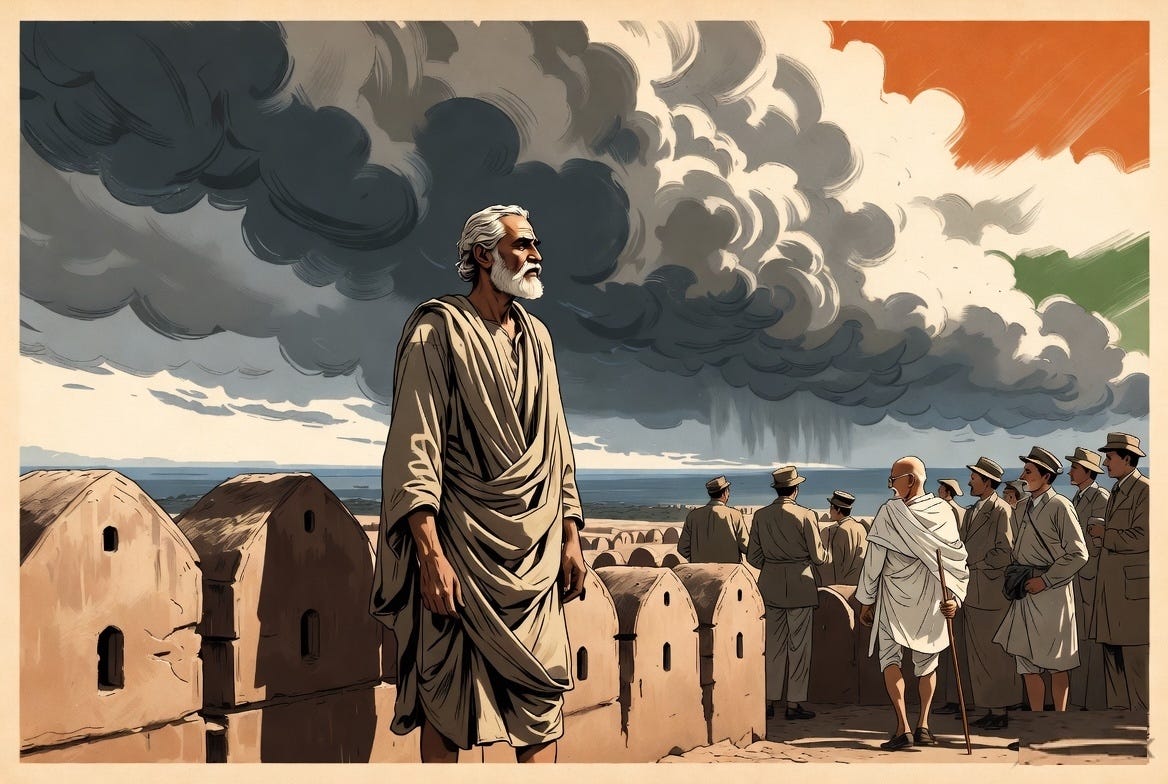
The Khilafat and Non-cooperation Convergence
The Khilafat Movement arose after the First World War amid uncertainty over the future of the Ottoman Empire and the office of the Caliph. Many Indian Muslim activists regarded the threatened dismemberment of Ottoman territories as an assault on a significant Islamic institution. The movement was not merely theological. It combined religious solidarity, anti-imperial resentment, mass mobilisation, and opposition to British policy. Its leadership included the Ali brothers, Maulana Abul Kalam Azad, and several prominent ulema, but Muslim opinion remained diverse. Modernists, regional leaders, landlords, constitutionalists, and ordinary believers did not respond in identical ways.
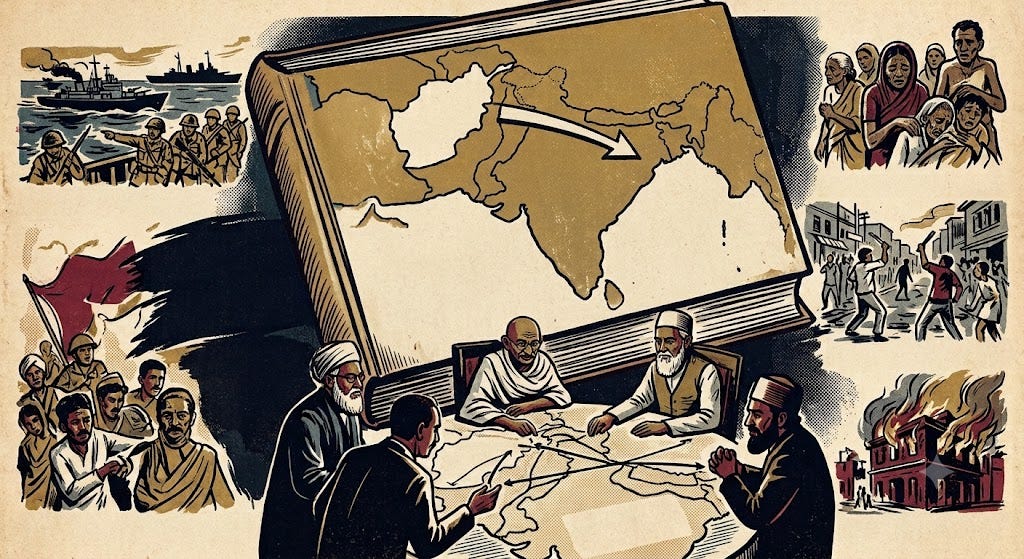
Gandhi supported cooperation between the Khilafat campaign and the broader Non-cooperation Movement. He believed a shared struggle could unite Hindus and Muslims against colonial rule while disciplining political action through non-violence. Congress endorsed non-cooperation in 1920, and the programme included the surrender of honours, boycotts of certain institutions, withdrawal from government-linked activity, and promotion of swadeshi. The alliance greatly expanded mass participation, but it also tied Congress strategy to a religiously framed international issue whose trajectory it could not control.
The alliance produced genuine moments of cooperation, yet it also exposed major contradictions. Gandhi treated Hindu-Muslim solidarity as both a moral aspiration and a practical requirement for national freedom. Khilafat leaders often approached the partnership through their own religious and geopolitical priorities. Congress contained members who welcomed mass unity, members who feared the communalisation of politics, and members who objected to non-cooperation itself. These differences were present from the beginning and became harder to manage as political expectations diverged.
The movement’s international objective eventually disappeared. The Ottoman sultanate was abolished in 1922, and the Turkish Republic abolished the Caliphate in 1924. Gandhi had already suspended the Non-cooperation Movement after the violence at Chauri Chaura in February 1922. The collapse of the shared campaign left disappointment and mutual recrimination. It also demonstrated the danger of constructing a durable national coalition around an external institution whose survival depended on forces beyond India.
That strategic criticism should not be converted into a claim that cooperation across religious communities was inherently illegitimate. A national movement in a diverse society necessarily required coalitions. The more precise question is whether the coalition rested on a common civic programme, whether its commitments were reciprocal, and whether its leaders communicated honestly about their different objectives. Coalition-building becomes unstable when symbolic unity conceals incompatible ideas of sovereignty and political obligation.
Azad’s 1921 Statement and Its Necessary Context
The supplied passage reproduces the following statement attributed to Maulana Abul Kalam Azad and dated 1 June 1921:
There are only four circumstances under which India can be attacked from outside. Firstly, the present circumstance, under which the British Government is ruling over us against our will and holding us as slaves. In this case, any attack directed against India will not be against the country and ourselves, but against the British Government and as that Government has established its rule over the Islamic countries, and is fighting against the Khilafat, no Muslim under any Islamic law has any obligation to side with it. (1-6-1921.)
This is a consequential passage, but its evidentiary limits must be recognised. It announces four circumstances and supplies only the first. Without the complete article, original publication details, and surrounding argument, it is impossible to determine how Azad distinguished among attacks on the colonial government, attacks on Indian society, and attacks intended to conquer Indian territory. Before the quotation is used as definitive proof of a settled doctrine, its wording and completeness should be checked against the original text or a reliable critical edition.
Read narrowly, the quotation denies that Indians owed military loyalty to an unrepresentative colonial government. That was a common anti-imperial position, although Azad expressed it through Islamic jurisprudence and the Khilafat dispute. Read more broadly, it could imply that an invasion aimed at British power would not constitute an attack on India. That broader proposition is strategically dangerous because foreign armies rarely confine their actions to a change of government. Invasion brings coercion, requisition, violence, displacement, and the possible replacement of one imperial authority by another.
The distinction between a regime and a country is philosophically valid but operationally unstable during war. A colonised population may reject the legitimacy of its rulers while still having vital interests in territorial security, civilian safety, food supplies, communications, and the prevention of foreign occupation. The colonial government may be unjust without every enemy of that government becoming a friend of the colonised. Anti-imperial reasoning therefore requires a second principle: opposition to British rule did not justify indifference to another power’s attempt to dominate India.
Azad’s later career also complicates attempts to reduce him to a single quotation. He became a leading advocate of a united India, opposed the partition demanded by the Muslim League, and remained within Congress through the decisive constitutional struggles of the 1940s. These later positions do not erase the 1921 statement, but they demonstrate why political thought must be studied across time. A historical figure’s views can develop in response to changing institutions, alliances, and dangers.
From the 1937 Elections to the Wartime Crisis
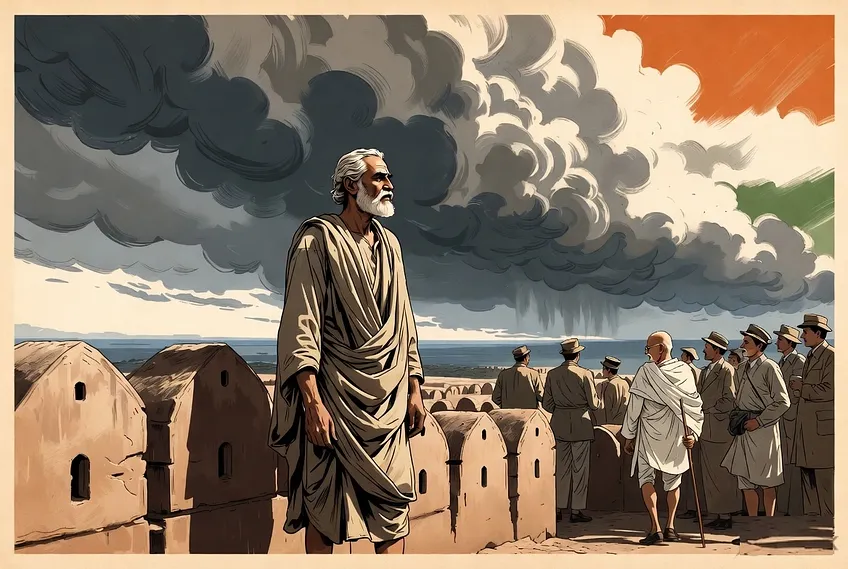
The Government of India Act of 1935 created a system of provincial autonomy while leaving decisive imperial powers in British hands. Elections in 1937 brought Congress ministries to office in several provinces. This gave the party administrative experience and a measure of democratic legitimacy, but defence and external affairs remained beyond Indian control. The constitutional arrangement thus placed Indian politicians in an awkward position: they could govern portions of domestic life while the imperial government retained authority over the questions most closely associated with sovereignty.
When Britain entered the Second World War on 3 September 1939, Viceroy Lord Linlithgow declared India to be at war without obtaining the consent of India’s elected representatives. Congress objected not only to the conflict but also to the method by which India had been committed to it. The party asked Britain to clarify its war aims and recognise India’s right to freedom. When no satisfactory transfer of responsibility followed, Congress ministries resigned during the autumn of 1939.
The resignations remain open to competing interpretations. One view holds that Congress abandoned valuable provincial power at a moment of international danger. Another sees the resignations as a principled refusal to provide democratic legitimacy to a war directed by an imperial government. Both interpretations identify a real cost. Remaining in office risked normalising colonial control over defence; leaving office reduced Congress influence within the administration and created new political opportunities for its rivals.
The Muslim League, led by Muhammad Ali Jinnah, responded differently. It presented itself as the indispensable representative of Muslim political interests and used the wartime constitutional deadlock to strengthen its bargaining position. Jinnah called for a Day of Deliverance after the resignation of Congress ministries, reflecting the League’s allegations concerning Congress provincial rule. In March 1940, the Lahore Resolution gave institutional form to demands for autonomous or sovereign Muslim-majority regions. These developments widened the distance between Congress’s claim to represent the Indian nation and the League’s assertion that Muslims constituted a separate political nation.
It would nevertheless be inaccurate to say that all Muslims refused to assist the war effort or shared Jinnah’s objectives. Muslim soldiers continued to serve in the British Indian Army, Muslim politicians outside the League pursued different constitutional strategies, and regional interests often shaped political behaviour more strongly than all-India declarations. The same caution applies to Hindus, Sikhs, Buddhists, Jains, Christians, and others. Communities do not act as single historical persons; organisations and leaders make decisions within communities that remain internally diverse.
The Poona Resolution and the Dispute over Conditional Cooperation
In 1940 Congress debated whether it could offer wartime cooperation if Britain accepted Indian demands for freedom and responsible national government. The Congress Working Committee’s Poona resolution represented an attempt to connect assistance in defence with a transfer of political authority. The logic was constitutional: a nation asked to sacrifice lives and resources should possess a government responsible to its people. Critics interpreted the conditions as political bargaining during an emergency; supporters regarded them as the minimum requirement of democratic legitimacy.
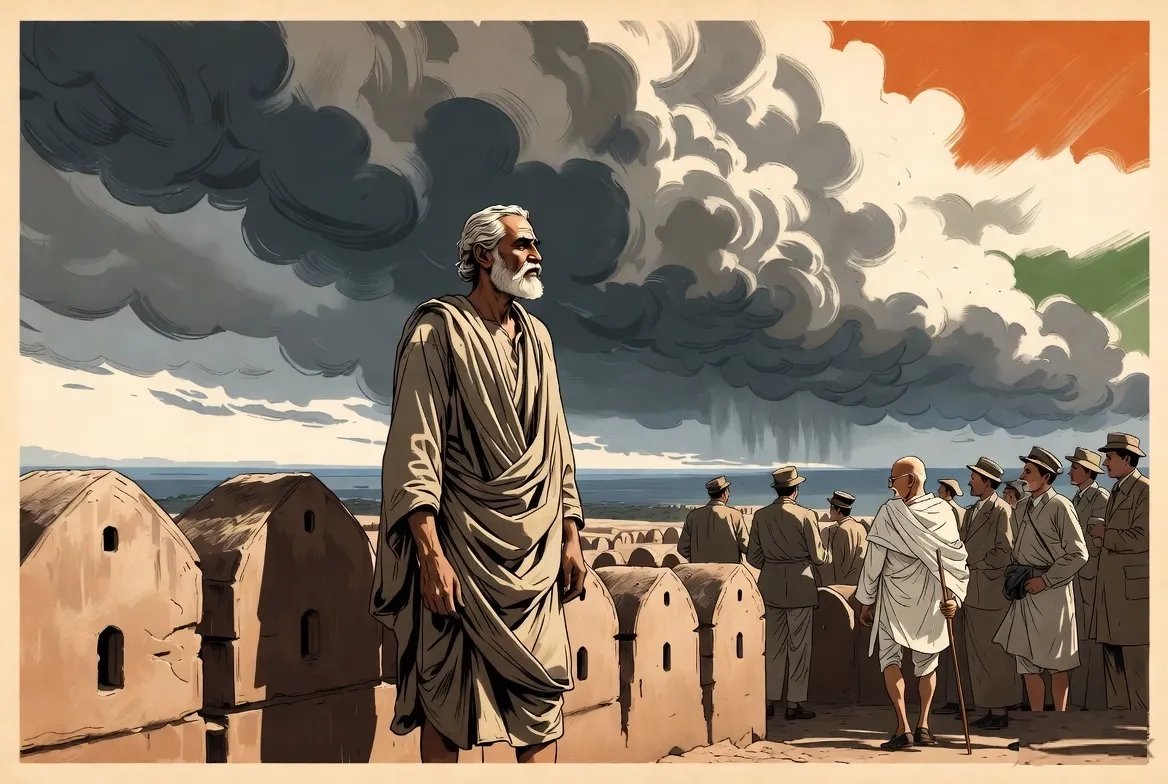
Gandhi’s position did not fit neatly into the categories of cooperation and obstruction. His commitment to non-violence made support for war morally difficult even if Britain conceded political demands. Congress, however, was a broad political organisation rather than a community bound to Gandhi’s personal creed. Some members accepted non-violence as a strategy for India’s freedom struggle but not as an absolute rule governing the defence policy of a future state. This distinction created a fundamental debate over whether Gandhian ethics could serve as the security doctrine of a sovereign country.
Abdul Ghaffar Khan, widely known as Frontier Gandhi, represented another principled current. His Khudai Khidmatgar movement had cultivated disciplined non-violent resistance among Pashtuns of the North-West Frontier Province. His objection to a Congress policy that appeared to permit participation in war arose from a deep commitment to non-violence, not from a desire to invite foreign conquest. Describing his position merely as obstinacy misses the ethical consistency behind it, even if critics reasonably question whether strict non-violence could protect civilians against an invading army.
The disagreement reveals three distinct positions. Absolute non-violence rejected participation in war regardless of political concessions. Conditional cooperation permitted assistance if India received effective national authority. Revolutionary or strategic anti-imperialism sought to exploit Britain’s wartime weakness to secure independence, sometimes without adequate concern for the intentions of Britain’s enemies. Historical commentary becomes misleading when these positions are collapsed into a single charge of disloyalty.
Lala Lajpat Rai and the Rejection of Replacement Imperialism
The passage also cites a statement attributed to Lala Lajpat Rai in Vande Mataram, dated 1 June 1921:
If ever the British Government were so weakened that some other foreign power were to overpower it, Hindus would have to think what to do, because they would not like to see India under any foreign power or nation.
The strategic principle expressed here extends beyond any one community: the weakening of an existing colonial ruler does not make conquest by a rival power desirable. Lajpat Rai’s formulation addressed Hindus, but the underlying obligation belongs to every Indian citizen. No religious tradition gains security when the country’s institutions collapse, its territory is occupied, or its population becomes subject to a new imperial power. National defence is therefore not a sectarian interest. It is a shared civic responsibility.
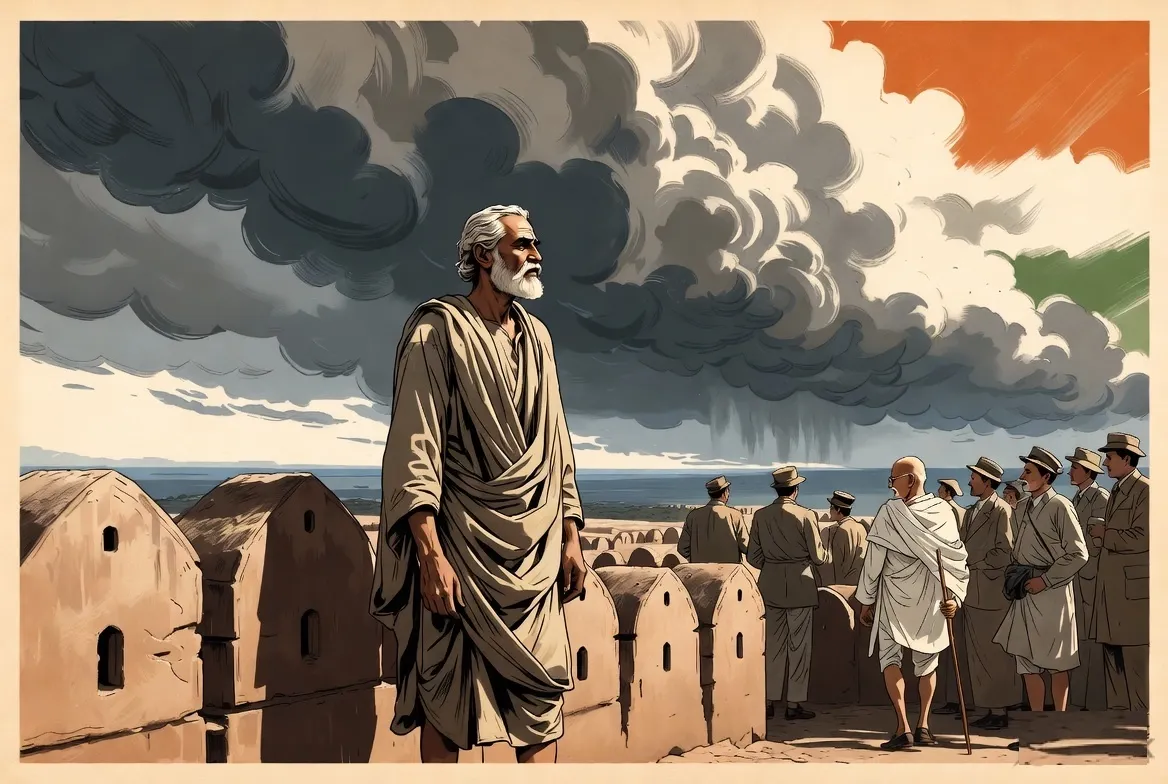
This position also avoids the false choice between loyalty to Britain and passivity before invasion. An Indian could oppose British rule, demand independence, and still resist any foreign army attempting to occupy Indian territory. The key distinction is between defending an imperial government’s global interests and defending the inhabitants, territory, and future sovereignty of India. In practice the two could overlap, which made political judgment difficult, but conceptual difficulty did not remove the obligation to think strategically.
What National Defence Requires
National defence is more than military loyalty to a government. It includes territorial integrity, protection of civilians, continuity of essential institutions, economic resilience, intelligence, diplomacy, internal cohesion, and the legitimacy needed to mobilise public sacrifice. A colonial regime might possess armed forces without possessing national legitimacy. Conversely, a freedom movement might command moral allegiance without having the institutions required to repel an invasion. The crisis of British India arose from this separation between coercive capacity and representative authority.
A coherent defence doctrine for a colonised country would have needed to answer at least five questions. Who had the constitutional authority to commit India to war? Under what conditions should Indians serve in armed forces controlled by Britain? How would civilians be protected if the colonial administration weakened? Could cooperation be limited to the defence of Indian territory rather than Britain’s wider imperial campaigns? What political guarantees would prevent wartime mobilisation from merely restoring imperial power after the emergency?
Congress’s demand for responsible government addressed the first and fifth questions but did not always provide a detailed answer to the others. Gandhian non-violence offered a moral discipline for mass resistance but faced severe practical tests when applied to mechanised invasion and organised totalitarian violence. The Muslim League concentrated on constitutional safeguards and political parity, yet its separate-nation strategy further weakened the prospect of a unified defence consensus. British policy aggravated every division by retaining decisive authority while offering concessions too limited to create full Indian ownership of the war effort.
Defence planning also depends on trust. Citizens accept extraordinary burdens when they believe institutions represent them and sacrifices are distributed fairly. British rule suffered from a structural trust deficit because Indians did not control the state that demanded their loyalty. Communal politics deepened the deficit by encouraging groups to fear domination by one another after independence. The unresolved argument over who constituted the nation therefore became inseparable from the question of who would command its armed power.
Citizenship Cannot Be Reduced to Religious Identity
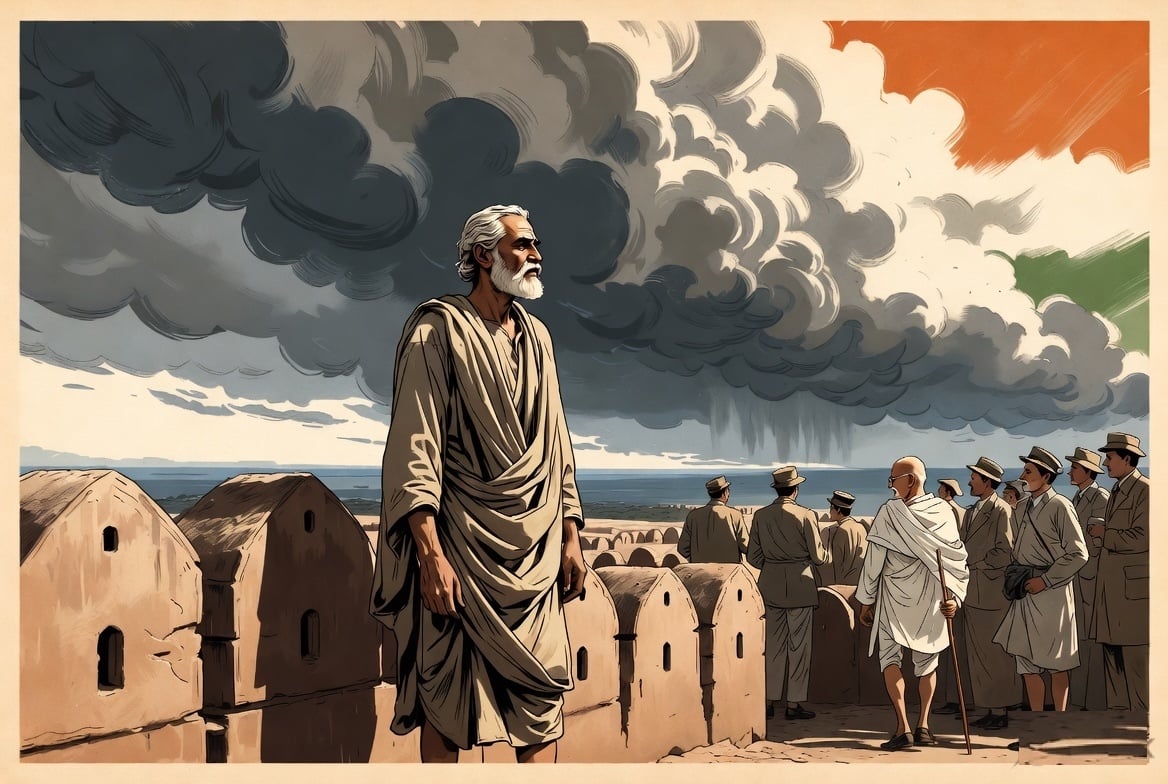
The original polemic suggests that the right to citizenship and leadership belongs to those prepared to sacrifice for the country’s frontiers. Read as a civic principle, this proposition has considerable force: political authority entails duties as well as rights, and deliberately assisting an invading force is a grave betrayal. Yet the test must be applied to conduct, not ancestry, religious affiliation, or communal stereotype. Citizenship in a democratic nation cannot depend on collective suspicion.
A rigorous standard distinguishes dissent from treason. Opposition to a government’s policy, refusal to endorse a particular war, criticism of military decisions, or advocacy of constitutional change does not by itself amount to assistance for an enemy. Treason ordinarily requires a much more concrete relationship to hostile action, such as intentionally aiding an invading power. When political disagreement is casually labelled treachery, democratic debate is weakened and genuine security threats become harder to identify.
The same rule protects national unity. Hindu, Buddhist, Jain, and Sikh traditions have distinct histories, institutions, philosophies, and internal schools, yet they have also interacted across the civilisational landscape of India. Their security cannot be built through hostility toward Indian Muslims, Christians, or any other community. A durable national framework requires equal citizenship, mutual obligations, lawful accountability, and confidence that no group will be judged guilty because of the statements of selected leaders.
Dharmic unity is strengthened when historical memory encourages courage without cultivating inherited animosity. The principle of dharma places responsibility on conduct: leaders should be judged by whether they protect society, honour commitments, restrain violence, and uphold justice. This approach permits sharp criticism of Congress, the Muslim League, the British government, the Khilafat leadership, or any other political organisation without transforming criticism into contempt for a religious population.
The Problem with the Language of Appeasement
Appeasement is a powerful political label, but it often combines several different activities. A party may negotiate with another group, recognise a legitimate grievance, grant a constitutional safeguard, tolerate coercive pressure, or sacrifice a general principle for temporary support. Only the last two meanings necessarily imply political failure. Historical analysis should therefore identify the exact concession, the institutional process through which it was made, the reciprocal obligation expected, and the measurable consequences that followed.
Gandhi’s alliance with Khilafat leaders can be criticised for attaching Indian nationalism to a religious cause outside India and for overestimating the unity that a shared agitation could create. Congress can also be criticised when symbolic demonstrations of harmony substituted for enforceable civic principles. Yet it does not follow that every effort to include Muslim leaders was appeasement. Inclusion was indispensable in a country of profound religious and linguistic diversity. The relevant question is whether inclusion occurred under equal rules or through asymmetrical political bargaining.
The description of Congress politics as a parasitic growth dependent on Muslim leaders belongs to polemical rhetoric rather than neutral scholarship. It conveys anger but does not specify the institutional mechanism being alleged. Congress possessed its own organisation, provincial ministries, mass constituencies, ideological factions, and strategic objectives. Its decisions could be misguided, inconsistent, or opportunistic without being reducible to external control. Precise criticism is stronger than metaphor because it identifies who decided what, under which constraints, and with what consequences.
Claims of a deep and consistent plot require especially strong evidence. Similar outcomes across several events do not establish central coordination. Political movements may converge because they face the same incentives, imitate one another, or temporarily share opponents. To demonstrate a conspiracy, evidence would be needed of planning, communication, common intent, and coordinated action. In the absence of such material, the more defensible language is that Congress, the League, Khilafat leaders, and British authorities pursued overlapping strategies that sometimes produced mutually advantageous results.
Gandhi’s Moral Politics and Its Strategic Limits
Gandhi’s contribution to Indian politics cannot be evaluated solely through admiration or denunciation. He transformed ethical concepts into techniques of mass mobilisation, expanded political participation, and insisted that means shaped ends. At the same time, his reliance on personal moral authority could create uncertainty within a large political organisation. His confidence that disciplined suffering could transform adversaries was difficult to translate into policy against actors who did not share his moral premises.
Non-violence functions differently in domestic protest and national defence. In a protest movement, participants may accept suffering to expose the injustice of a government that remains sensitive to legitimacy, administration, or public opinion. During an invasion, civilians who have not volunteered for sacrifice may face an enemy seeking territory rather than moral recognition. The ethical burden therefore changes. A leader must consider not only personal purity but also responsibility for people who cannot escape violence.
This does not make non-violence irrelevant to security. Diplomacy, civil defence, non-cooperation with occupiers, protection of minorities, resistance to propaganda, and restraint in the use of force can all reduce suffering. The error lies in treating one method as sufficient for every threat. A mature doctrine combines moral limits with realistic assessments of hostile capacity, civilian vulnerability, and institutional preparedness.
Gandhi’s Hindu-Muslim outreach should be evaluated by the same balanced standard. The aspiration to prevent communal conflict was morally serious and politically necessary. The weakness arose when unity was treated as an achievement of sentiment rather than an institutional order requiring reciprocal obligations, enforcement against violence, and candour about incompatible political demands. Brotherhood cannot be sustained by suppressing disagreement; it must be supported by rules that protect all parties when trust fails.
Jinnah, the Muslim League, and Political Leverage
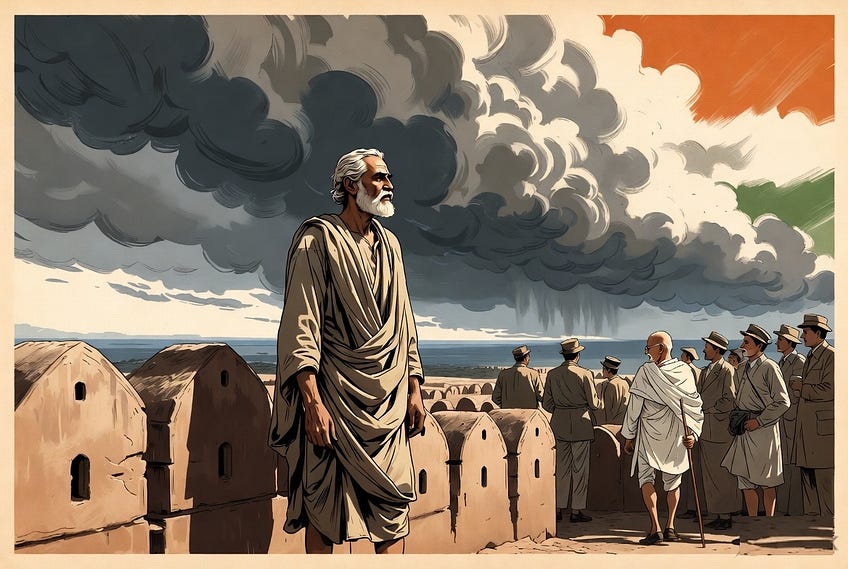
Jinnah’s wartime strategy was shaped by the League’s determination to prevent Congress from negotiating a constitutional settlement as the sole representative of India. British dependence on Indian manpower and resources increased the value of political cooperation. The League used this leverage to demand recognition as an essential party to any transfer of power. From its perspective, the strategy protected Muslims from permanent majoritarian rule. From the perspective of its critics, it transformed wartime vulnerability into an opportunity to advance separatism.
The League’s claim to speak for all Indian Muslims should not be accepted retrospectively without qualification. Its electoral position changed significantly between 1937 and the 1940s, and Muslim politics varied across Punjab, Bengal, Sindh, the North-West Frontier Province, the United Provinces, and other regions. Religious identity mattered, but so did class, language, province, landholding, patronage, and local leadership. Jinnah’s success lay partly in converting this diversity into a powerful all-India constitutional claim.
Congress also contributed to the polarisation by insisting on a national mandate that its rivals disputed. Its ideal of composite nationalism was broader than the League’s two-nation theory, but its organisational dominance could appear threatening to minorities seeking durable safeguards. A democratic answer required more than declarations of unity. It required credible federal arrangements, minority protections, power-sharing practices, and a shared commitment that political disputes would not be resolved by communal intimidation.
Colonial Policy Was an Active Cause, Not a Passive Background
Any assessment that concentrates only on Congress and Muslim leaders risks understating British agency. Colonial constitutional policy created separate electorates, distributed representation through communal categories, and repeatedly positioned the imperial government as arbiter among competing Indian claims. British officials did not invent every social division, but their institutions hardened political identities and rewarded organisations capable of presenting themselves as exclusive communal representatives.
During wartime, Britain wanted Indian resources without immediately conceding full Indian responsibility. This arrangement encouraged every major organisation to calculate how the emergency could improve its bargaining position. Congress used non-cooperation and conditional offers to press for independence. The League sought recognition and safeguards against Congress dominance. Princes protected their status, regional parties defended provincial interests, and British officials retained ultimate authority by emphasising the absence of Indian agreement.
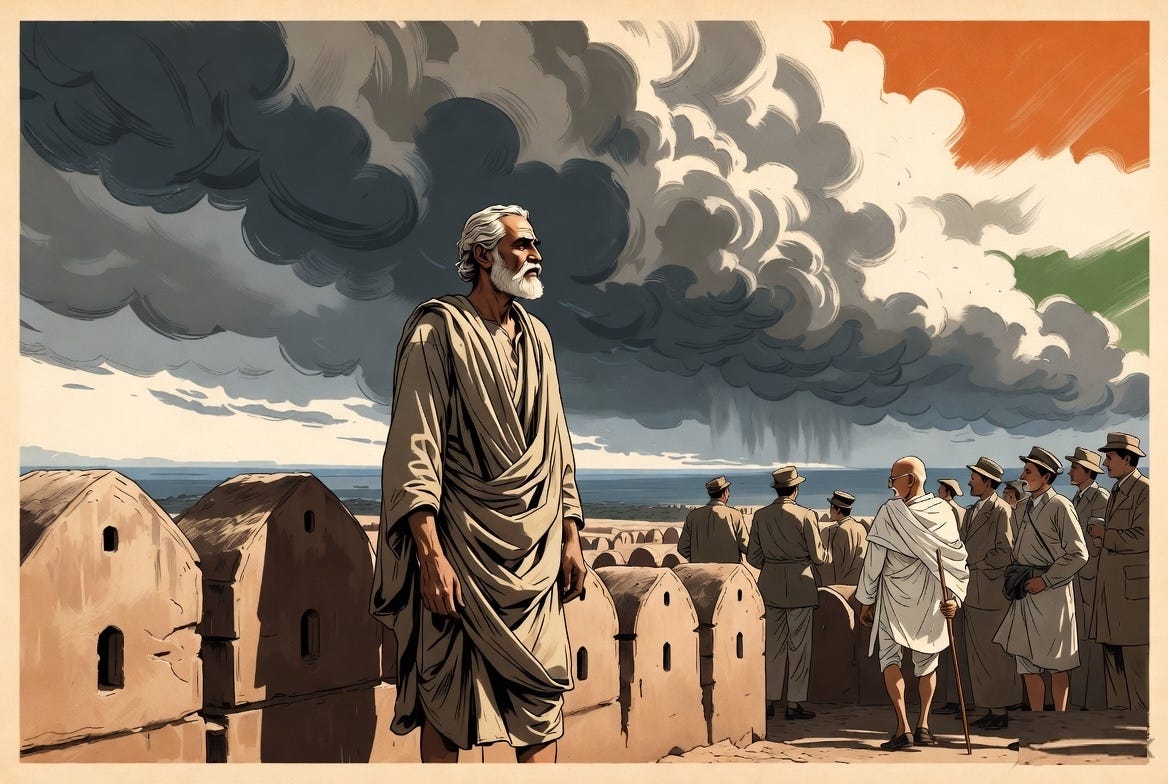
The resulting stalemate was not proof that Indians were incapable of national politics. It was evidence of a constitutional system in which responsibility and power were deliberately separated. Indian parties were expected to demonstrate unity before Britain would transfer authority, yet the colonial framework gave each party incentives to seek British recognition against its rivals. This cycle deepened mistrust precisely when national defence required a common command structure and a shared political purpose.
A Technical Test for Historical Claims
The quotations from the Free Press Journal, Muslim Outlook, Azad, and Lajpat Rai should be examined through a transparent evidentiary method. The first step is provenance: the original issue, page, language, and edition should be identified. The second is textual integrity: the full passage should be compared with the excerpt, especially where an argument announces four circumstances but reproduces only one. The third is chronology: the date of the later commentary should be established so that retrospective interpretation is not confused with contemporary testimony.
The fourth step is representativeness. A newspaper editorial or leader’s statement proves that a view was expressed; it does not prove that every member of a community accepted it. Electoral evidence, organisational resolutions, private correspondence, government records, memoirs, and regional studies are needed to determine influence. The fifth step is corroboration. Claims about refusal to assist a war effort, encouragement of invasion, or secret coordination require evidence of actual decisions and conduct, not merely provocative rhetoric.
The sixth step is comparison. Congress resolutions should be read beside British responses, League resolutions, speeches by competing leaders, provincial records, and military participation data. This prevents a single archive from dictating the narrative. The seventh is conceptual precision: opposition to British war aims, refusal of unconditional cooperation, absolute pacifism, separatist bargaining, and support for an invader are distinct positions. Conflating them produces a dramatic story but a weak explanation.
What a Responsible Nationalism Looks Like
A defensible nationalism begins with loyalty to the freedom, safety, and dignity of all citizens. It rejects foreign domination regardless of whether the invader is an enemy of the current government. It also rejects the idea that criticism of the state automatically constitutes betrayal. National strength depends on the ability to distinguish lawful dissent from material assistance to aggression.

Such nationalism is territorial and civic without being culturally empty. India’s civilisational traditions, including Hinduism, Buddhism, Jainism, and Sikhism, contribute profound resources for thinking about duty, restraint, courage, pluralism, and just authority. These traditions can enrich public life while equal citizenship remains independent of religious identity. Civilisational confidence is most durable when it does not require the civic exclusion of others.
Responsible nationalism also demands strategic foresight. Leaders should consider how an adversary might exploit internal conflict, how propaganda might deepen communal suspicion, and how a constitutional crisis might weaken defence. A country divided into mutually fearful populations becomes vulnerable even when its armed forces are large. Social cohesion is therefore not sentimental decoration; it is a component of national security.
This principle gives special importance to historical language. Metaphors that portray a community as a disease, parasite, or alien body may create emotional solidarity among partisans, but they weaken the common citizenship required for collective defence. Political organisations can and should be criticised severely. Responsibility, however, must remain attached to identifiable decisions, institutions, and individuals.
The Enduring Lessons of the Debate
The first lesson is that a nation cannot outsource strategic thought to moral optimism. Goodwill among communities is valuable, but agreements must define reciprocal duties, limits, and remedies for breach. Congress’s experience with the Khilafat alliance demonstrates how quickly symbolic unity can unravel when partners attach different meanings to a common campaign.
The second lesson is that national defence requires legitimate authority. Britain’s unilateral decision to take India into war exposed the contradiction of demanding sacrifice without granting sovereignty. Conditional cooperation was not inherently disloyal; it was an attempt to connect military responsibility with political consent. Whether Congress calibrated that strategy wisely remains a legitimate subject of debate.
The third lesson is that anti-colonialism must reject every form of imperial substitution. The enemy of a colonial ruler is not automatically the friend of the colonised. Lala Lajpat Rai’s warning captures this strategic reality: the weakening of Britain could create an opening for Indian freedom, but it could also invite domination by another power. Political maturity consists in pursuing independence without gambling away territorial security.
The fourth lesson is that non-violence must be examined at the level of public responsibility. Personal refusal to use force may express exceptional courage. A government responsible for millions must additionally consider the protection of civilians, borders, institutions, and vulnerable communities. Ethical statecraft must limit violence while remaining capable of confronting aggression.
The fifth lesson is that communal generalisation corrupts both history and strategy. Azad, Jinnah, Abdul Ghaffar Khan, and other Muslim leaders represented different programmes. Gandhi, Lajpat Rai, Nehru, Bose, Patel, and Hindu political leaders also disagreed profoundly. These differences are not minor details; they are the substance of political history. Accurate analysis follows institutions, ideas, decisions, and consequences rather than assigning a single will to millions of people.
The sixth lesson is that national unity cannot be preserved by avoiding difficult questions. Congress’s coalition choices, Gandhi’s strategic assumptions, the League’s constitutional leverage, British divide-and-rule practices, and the practical limits of pacifism all deserve scrutiny. Honest criticism does not weaken unity when it is grounded in evidence and applied consistently. It strengthens unity by replacing inherited accusation with shared standards of public responsibility.
Conclusion
The historic dispute over invasion, wartime cooperation, and Congress policy was ultimately a dispute over the location of legitimate sovereignty. British India possessed a government capable of declaring war but not accountable to the Indian people. Congress claimed national authority but lacked control of defence. The Muslim League challenged Congress’s representative claim and used the constitutional crisis to pursue its own programme. Gandhian non-violence supplied moral power but did not settle the institutional problem of protecting a sovereign state.
The harshest claims in the supplied passage should therefore be treated as polemical interpretations, not self-validating facts. Its demand for vigilance, territorial loyalty, and strategic clarity remains important. Its movement from criticism of leaders to suspicion of communities does not. India’s security is best understood as a common obligation shared by citizens of every faith, with accountability based on conduct rather than identity.
The most useful conclusion is neither an uncritical defence of Congress nor a communal indictment of its opponents. It is that freedom movements must unite moral legitimacy, constitutional responsibility, and strategic competence. Coalitions require reciprocity; non-violence requires an honest account of its limits; dissent must be distinguished from treason; and no foreign domination becomes acceptable merely because it weakens another empire. Those principles offer a stronger foundation for Indian nationalism and for unity among all of India’s civilisational and religious communities.
Inspired by this post on Dharma Dispatch.






Leave a Reply
You must be logged in to post a comment.