

Bhrgupati Prabhu’s class on Śrīmad-Bhāgavatam 4.8.66, dated July 9, 2026, opens a window onto one of the most emotionally concentrated moments in the account of Dhruva Mahārāja. The verse contains no battlefield, miracle, or philosophical debate. It presents a father imagining his five-year-old son alone, hungry, exhausted, and exposed to danger in a forest. Within that apparently simple scene, however, the text examines parental responsibility, moral failure, repentance, attachment, spiritual protection, and the transforming discipline of bhakti.
The recording provides the point of entry for this study, while the verse and its surrounding narrative supply the primary textual evidence. This distinction matters because an academic treatment should not attribute unverified statements to a speaker when a complete transcript is unavailable. What can be examined closely is the canonical sequence surrounding King Uttānapāda, Dhruva Mahārāja, Queen Sunīti, Queen Suruci, and the sage Nārada Muni.
The verse: a father’s imagination becomes an instrument of conscience
अप्यनाथं वने ब्रह्मन्मा स्मादन्त्यर्भकं वृका: ।
श्रान्तं शयानं क्षुधितं परिम्लानमुखाम्बुजम् ॥ ६६ ॥
apy anāthaṁ vane brahman mā smādanty arbhakaṁ vṛkāḥ
śrāntaṁ śayānaṁ kṣudhitaṁ parimlāna-mukhāmbujam
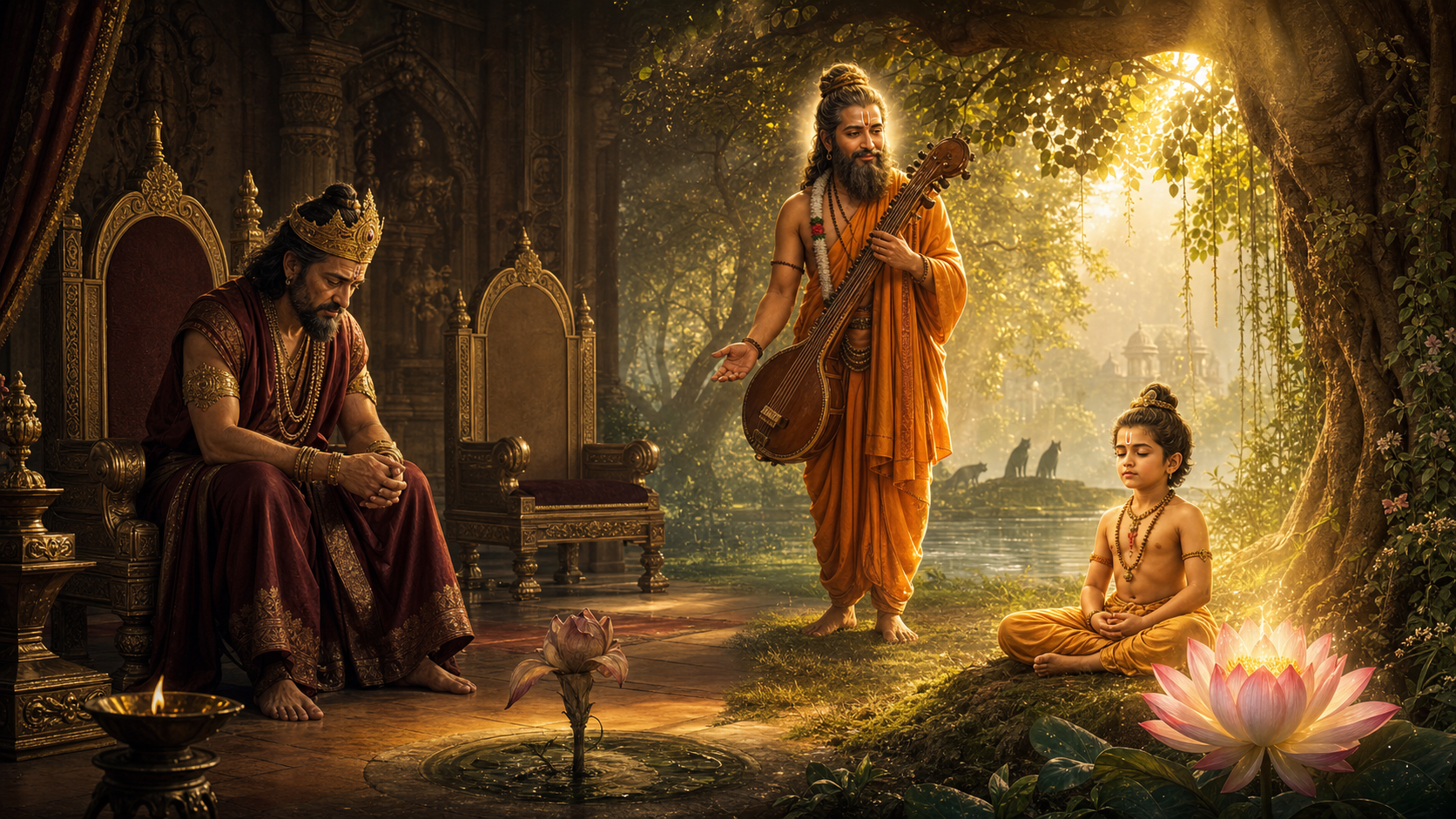
In a close paraphrase, King Uttānapāda asks whether his unprotected little son, fatigued and hungry, may be lying somewhere in the forest while wolves threaten him. He remembers the child’s face as a lotus now imagined to be withering. The Sanskrit text, word meanings, and published translation can be consulted at [Śrīmad-Bhāgavatam 4.8.66](https://vedabase.io/en/library/sb/4/8/66/).
The verse is emotionally powerful because the danger appears first in the father’s mind. Uttānapāda does not see Dhruva lying beneath a tree, and the narrative does not state that wolves actually attacked the child. His imagination constructs the worst possible outcome. That mental image is not merely fear; it is the return of a responsibility that had previously been suppressed. The child’s vulnerability forces the king to confront what his silence in the palace permitted.
How the crisis began
Chapter Eight introduces Uttānapāda as the father of two sons through two queens, Sunīti and Suruci. Suruci is the favored queen, while Sunīti and her son Dhruva occupy a less secure position within the royal household. When Uttānapāda places Suruci’s son Uttama on his lap, Dhruva also tries to approach his father. The king does not welcome him, and Suruci declares that Dhruva has no right to the royal lap or throne because he was not born from her womb. The complete narrative sequence is preserved in [Chapter Eight, “Dhruva Mahārāja Leaves Home for the Forest”](https://vedabase.io/en/library/sb/4/8/).
The lap carries more than sentimental meaning. It is simultaneously a place of parental affection, social recognition, and dynastic legitimacy. Dhruva’s exclusion is therefore personal and political. The child is not simply denied a comfortable seat; he is publicly informed that his relationship with his father is subordinate to palace favoritism. Suruci speaks the harsh words, but Uttānapāda’s failure to intervene gives those words institutional force.
This distinction is central to the ethics of the episode. Harm is not produced only by an aggressive act. It can also be produced by passive complicity, especially when the silent person possesses the authority to prevent injustice. Uttānapāda is king, husband, and father. His silence is consequently not neutral. The narrative demonstrates how private attachment can distort judgment and how distorted judgment can become a failure of dharma.
Dhruva returns to Sunīti trembling, angry, and grief-stricken. Sunīti shares his pain, yet she does not instruct him to retaliate. She explicitly discourages him from wishing misfortune upon others and directs his attention toward the Supreme. Her response does not deny that an injustice occurred. Instead, it attempts to prevent the injury from reproducing itself as hatred. This is an early and decisive redirection of emotional energy within the narrative.
A contemporary reader may recognize the painful realism of this scene. Children are acutely sensitive to comparison, favoritism, and the withdrawal of affection. Adults may dismiss an incident as brief, while a child experiences it as a judgment upon identity and belonging. The text neither treats Dhruva’s anger as trivial nor leaves it as the final measure of his character. His wounded desire becomes the raw material of a longer spiritual transformation.
Nārada Muni and the disciplined transformation of desire
After Dhruva leaves home, Nārada Muni meets him and initially advises patience, equanimity, and acceptance of life’s favorable and unfavorable conditions. Dhruva respectfully admits that this counsel does not yet reach his wounded heart. He wants a position greater than any attained by his ancestors and asks Nārada for an honest means of reaching that goal. His reply is psychologically candid: the child does not pretend to possess detachment that he has not attained.
Nārada’s response illustrates an important feature of spiritual guidance. He does not endorse resentment, but neither does he abandon Dhruva because the boy’s initial motivation is mixed. He recognizes determination that can be educated. Rather than offering a shortcut, he gives Dhruva a demanding program of sādhanā involving sacred place, bodily regulation, mantra, worship, meditation, attention, and disciplined use of available resources.
The central mantra is Oṁ namo bhagavate vāsudevāya, identified in the tradition as the twelve-syllable dvādaśākṣara-mantra. Nārada connects the mantra with worship, offerings, and meditation upon the divine form. The instructions also recognize deśa, kāla, and practical circumstance—place, time, and available means. This makes the practice disciplined without reducing it to inflexible formalism. The relevant instruction and its traditional explanation appear in [Śrīmad-Bhāgavatam 4.8.54](https://vedabase.io/en/library/sb/4/8/54/).
Dhruva’s practice integrates mind, speech, and body. Mantra disciplines speech and attention. Meditation gives the mind a stable sacred object. Regulated worship turns material things into offerings rather than possessions. Simplicity of diet and environment reduces distraction. Obedience to spiritual instruction protects intense aspiration from becoming self-invented extremism. Bhakti, in this account, is not a mood detached from conduct; it is a structured reorganization of the whole person.
The narrative returns from the forest to the palace
Once Dhruva enters Madhuvana, the narrative makes a deliberate transition. Nārada goes to Uttānapāda’s palace and asks why the king’s face appears withered. He frames the question in relation to dharma, artha, and kāma—religious duty, material order, and legitimate desire. The inquiry is diagnostic. A ruler whose inner life is disordered cannot assume that the external prosperity of his kingdom proves the health of his moral judgment.
Uttānapāda responds with confession rather than self-defense. In verse 4.8.65, he acknowledges that attachment and hardheartedness led him to neglect his five-year-old son and Sunīti. He even describes Dhruva as a great soul and devotee. This admission is significant because repentance begins when euphemism ends. He does not say that the household situation was complicated or that the child misunderstood him. He names his own failure.
Verse 4.8.66 then moves from moral recognition to emotional consequence. Uttānapāda imagines Dhruva as anātham, without a protector; arbhakam, a small and helpless child; śrāntam, exhausted; śayānam, lying down; and kṣudhitam, hungry. The grammatical accumulation of these descriptions slows the verse and intensifies the scene. Each term removes another layer of safety until the feared vṛkāḥ, the wolves, enter the picture.
The compound parimlāna-mukhāmbujam compares Dhruva’s face to a fading lotus. The lotus commonly suggests beauty, delicacy, purity, and spiritual promise. Here the image is painfully inverted. Uttānapāda remembers a child whose face should be flourishing in parental care but imagines that face withering through hunger and fatigue. The king’s grief therefore arises from a contrast between what the child is and what negligent authority has allowed him to suffer.
The verse also exposes an irony. Uttānapāda fears that Dhruva has no protector, but the king himself was supposed to provide protection. The word anātham returns his neglected duty to him in linguistic form. His anxiety is not abstract concern for a traveler; it is the recognition that his own inaction helped create the condition he now fears.
Repentance, responsibility, and repair
Repentance can be analyzed through four movements: recognition of harm, accurate naming of responsibility, emotional remorse, and practical repair. Uttānapāda clearly reaches the first three. He recognizes Dhruva’s vulnerability, identifies his own attachment and cruelty, and experiences intense grief. At this point in the narrative, however, he has not yet repaired the relationship. The text thereby distinguishes feeling guilty from completing the work of restoration.
This distinction is useful in family life, education, community leadership, and institutional governance. Remorse may reveal that conscience is active, but remorse centered only upon the offender’s pain can become another form of self-absorption. Responsible repentance asks what the harmed person needs, what authority failed to do, what patterns made the failure possible, and what conduct must change. The emotional force of verse 4.8.66 should therefore lead toward accountability, not merely sympathy for the grieving king.
Uttānapāda’s failure arises from attachment, but the problem should not be reduced to affection for a spouse or to a generalized suspicion of women. The narrative’s ethical issue is partiality that overrides duty. Any attachment—to a partner, child, faction, status, ideology, or personal comfort—can become destructive when it makes a responsible person indifferent to injustice. Such a reading preserves the text’s warning while applying it without misogynistic generalization.
As a king, Uttānapāda also embodies the link between household ethics and public ethics. A ruler who cannot protect a vulnerable child within his own home faces a crisis of credibility as the protector of citizens. The episode does not imply that private and public life are identical, but it refuses to isolate character from governance. Favoritism practiced in intimate relationships can readily reappear as partiality in institutions.
Divine protection does not cancel human duty
Nārada answers Uttānapāda by assuring him that Dhruva is deva-guptam, protected by the Supreme, and that the child will accomplish deeds difficult even for powerful rulers and sages. The reassurance is recorded in [Śrīmad-Bhāgavatam 4.8.68](https://vedabase.io/en/library/sb/4/8/68/) and [4.8.69](https://vedabase.io/en/library/sb/4/8/69/). The statement changes the father’s understanding of Dhruva’s condition: the apparently abandoned child is not spiritually abandoned.
Yet divine protection must not be interpreted as retroactive permission for parental neglect. Nārada comforts Uttānapāda, but he does not declare the king’s conduct harmless. The theological claim that Dhruva is protected and the ethical judgment that Uttānapāda failed can both remain true. Providence may bring spiritual good from an injury without converting the injury itself into moral good.
This point prevents a dangerous misuse of sacred narrative. A child’s suffering should never be romanticized on the assumption that hardship automatically produces greatness. Dhruva’s achievement reveals his extraordinary determination, the guidance of Nārada, the care of Sunīti, and divine grace. It does not establish abandonment, humiliation, or family favoritism as legitimate methods of spiritual education.
Two inner worlds: anxiety in the palace and attention in the forest
The structure of the chapter places two contrasting states of mind beside each other. Uttānapāda sits amid royal wealth but is consumed by images of danger. Dhruva stands in the forest with few external protections but follows a precise spiritual discipline. One possesses material security without inward steadiness; the other accepts material austerity while acquiring concentration. The contrast does not glorify deprivation. It demonstrates that power and comfort cannot substitute for moral clarity, while disciplined attention can transform adverse circumstances.
Verse 4.8.71 returns to Dhruva and reports that he bathes in the Yamunā, fasts through the night, and worships according to Nārada’s instruction. The emphasis falls upon careful execution rather than improvisation. Dhruva’s determination becomes spiritually productive because it is shaped by guidance. [Śrīmad-Bhāgavatam 4.8.71](https://vedabase.io/en/library/sb/4/8/71/) therefore completes the contrast begun in the palace: the father imagines helplessness, while the child is actively developing mastery of attention and conduct.
Bhakti psychology does not require Dhruva to deny that he was hurt. Instead, the practice changes the organization and object of his desire. His first aspiration is entangled with wounded honor and status. Through hearing, mantra, meditation, worship, and encounter with the divine, the center of value shifts. The later narrative shows that direct spiritual realization makes his earlier ambition appear small to him. Pain is not merely suppressed; it is interpreted, disciplined, and ultimately surpassed.
The guru’s role extends beyond the isolated seeker
Nārada’s conduct deserves particular attention. He first meets the injured child, tests his determination, supplies an appropriate discipline, and then visits the distressed father. His role is not confined to giving private mystical instruction. He attends to a damaged relational field. Dhruva needs direction, while Uttānapāda needs truth and reassurance. Spiritual guidance addresses each person differently because their responsibilities and states of consciousness are different.
This is an instructive model of the guru–śiṣya relationship. Nārada does not simply grant Dhruva’s desired result, and he does not exploit the boy’s emotional vulnerability. He gives a practice that requires agency, patience, and self-regulation. Authentic mentorship does not make the disciple permanently dependent upon the mentor’s personality; it equips the disciple to act responsibly within a tested tradition.
A trauma-aware reading without reducing the text to modern psychology
Modern psychological language can illuminate aspects of the episode, provided it is used with restraint. Dhruva experiences rejection, humiliation, anger, and threatened belonging. Uttānapāda experiences delayed guilt and catastrophic imagination. Sunīti models emotional validation without encouraging revenge. Nārada introduces regulation, attention, meaning, and disciplined action. These observations clarify human dynamics, but they do not exhaust a text whose own framework is theological, ethical, and devotional.
The account also challenges simplistic advice to “move on.” Dhruva cannot immediately accept Nārada’s initial counsel on equanimity, and he says so honestly. The sage then meets him at the level of his actual capacity. Sustainable spiritual growth often begins with truthful acknowledgment rather than imitation of an advanced state. A person may understand forgiveness intellectually while still needing disciplined practices that gradually loosen the grip of anger.
At the same time, the narrative rejects the idea that injury fixes identity forever. Dhruva is wounded, but he is not reducible to the wound. Uttānapāda fails, but his recognition of failure creates the possibility of changed relationship. Suruci speaks cruelly, yet the later reunion permits a different response. The tradition preserves moral consequences while leaving room for transformation.
A unifying Dharmic perspective
The episode belongs specifically to the Vaiṣṇava and broader Hindu scriptural tradition, and its distinctive theology should not be blurred. Nevertheless, several ethical themes can support respectful dialogue among Hinduism, Buddhism, Jainism, and Sikhism. These traditions differ on metaphysics, revelation, the self, liberation, and the nature of ultimate reality, yet all contain serious disciplines for confronting ego-centered attachment, harmful conduct, and unregulated desire.
Within Hindu bhakti, Dhruva’s pain is redirected through devotion, mantra, guru-guided sādhanā, and surrender. Buddhist traditions offer analyses of craving, aversion, mindful awareness, and compassion. Jain traditions emphasize ahiṃsā, restraint, responsibility for harmful action, and freedom from possessiveness through aparigraha. Sikh teachings emphasize remembrance of the Divine, seva, truthful living, and the overcoming of haumai, or ego-centeredness. These are not interchangeable systems, but they share a moral concern with transforming reactive consciousness into disciplined and compassionate action.
Sunīti’s refusal to encourage vengeance is especially important for Dharmic unity. Pain does not justify dehumanization. The injured person’s dignity can be affirmed without cultivating hatred toward another community, family member, or tradition. Likewise, Uttānapāda’s confession shows that unity is not maintained by concealing wrongdoing. Durable harmony requires truth, accountability, compassion, and the willingness to repair relationships.
Practical lessons for families and leaders
For parents and caregivers, the episode warns that visible favoritism can shape a child’s sense of worth long after a particular incident has ended. Protection includes more than food and shelter; it includes fair recognition, emotional safety, and intervention when humiliation occurs. Silence from a trusted adult may be experienced as agreement with the person causing harm.
For teachers and spiritual mentors, Nārada’s example suggests that guidance should be both principled and individualized. Advice that is true in the abstract may fail if it does not reach the actual condition of the person receiving it. Effective guidance preserves ethical standards while providing a realistic path from present emotion toward greater maturity.
For leaders, Uttānapāda’s confession demonstrates that status does not neutralize partiality. Authority increases responsibility for examining attachments, conflicts of interest, and patterns of avoidance. A leader should ask not only whether a harmful statement was personally spoken, but also whether silence, preference, or institutional power allowed it to prevail.
For anyone carrying regret, the verse offers neither cheap absolution nor hopeless condemnation. It shows that conscience may first appear as an uncomfortable image of the person who was failed. The appropriate response is to resist self-justification, name the failure accurately, seek wise guidance, and move toward repair. Regret becomes spiritually useful when it changes conduct.
Questions for reflection
The passage invites several demanding questions. Where has attachment weakened impartial judgment? When has silence protected comfort rather than a vulnerable person? Is remorse directed toward the injured person’s well-being or toward relief from personal guilt? Which daily discipline can transform anger without denying injustice? Who provides the kind of guidance that joins compassion with accountability? These questions carry the narrative beyond ancient royalty and into ordinary family, institutional, and spiritual life.
Conclusion: the lotus face remembered
Śrīmad-Bhāgavatam 4.8.66 endures because it compresses an entire moral crisis into a father’s memory of his child’s face. Uttānapāda imagines the lotus withering and finally understands the human cost of his partiality. Dhruva, meanwhile, is not lying spiritually defeated in the forest. Under Nārada’s guidance, he is converting wounded ambition into concentrated bhakti.
The deepest lesson is therefore neither that suffering should be sought nor that regret is sufficient. The lesson is that injury can be met with truthful recognition, disciplined transformation, compassionate guidance, and eventual restoration. Parental love must become protection, authority must become accountability, and spiritual aspiration must become practice. In that movement, a verse of fear becomes a profound study of responsibility and hope.
Inspired by this post on Dandavats.







Leave a Reply
You must be logged in to post a comment.