
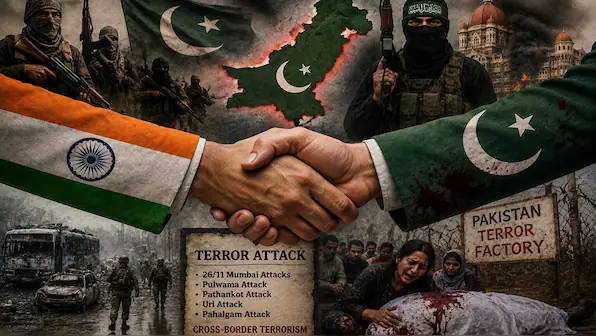
The question behind the controversy
Calls for renewed India–Pakistan dialogue often arrive wrapped in language that is morally attractive: peace, cooperation, connectivity and a better future for the young. Yet diplomacy cannot be judged by the warmth of its vocabulary. It must be judged by the political conditions in which it occurs, the objectives it serves and the conduct it is capable of changing. That is the central challenge raised by the Firstpost opinion published on July 5, 2026: does another appeal for talks represent prudent conflict management, or does it ask Bharat to restore normal relations without first securing meaningful changes in Pakistan’s behaviour?
The original polemic answers that question with anger and ridicule. An academic assessment requires a more disciplined approach. Labels such as “liberal elite,” “eminent citizens” or “peace lobby” may capture political frustration, but they do not by themselves explain why a proposal is strategically sound or unsound. The stronger method is to separate moral aspiration from policy design, distinguish Pakistani civilians from the institutions that exercise coercive power, and test every proposed confidence-building measure against evidence, reciprocity and national-security risk.
The resulting conclusion is firm but more precise than a blanket rejection of diplomacy. Communication between nuclear-armed neighbours may be necessary for crisis control, consular affairs and the protection of civilians. Comprehensive political normalisation, however, is a different undertaking. It should not be granted merely because influential people have declared dialogue inherently virtuous. Peace becomes durable only when engagement is conditional, verifiable, reciprocal and aligned with a coherent counterterrorism strategy.
What the 2026 open letter actually proposed
The immediate controversy concerned an open letter coordinated by the Centre for Peace and Progress and signed by 117 people—61 from India and 56 from Pakistan. According to a detailed account in The Indian Express, the signatories included politicians, former diplomats, public figures and civil-society participants. They asked Prime Minister Narendra Modi and Prime Minister Shehbaz Sharif to restore full diplomatic relations, reinstate high commissioners, normalise visa services and reopen airspace.
The letter went substantially further than requesting a telephone hotline or limited humanitarian contact. It proposed reopening the Attari–Wagah land route for trade and travel, reviving the Srinagar–Muzaffarabad bus service, expanding cross-border connectivity and restarting a comprehensive dialogue on outstanding disputes. It also urged consideration of the framework discussed between 2004 and 2007, along with demilitarisation and de-escalation measures. Religious access formed an important part of the appeal: the signatories supported reopening the Kartarpur Sahib Corridor, facilitating access to Sharada Peeth and enabling visits to cultural and religious heritage sites.
Several of these goals possess genuine humanitarian value. Divided families suffer when visas disappear. Pilgrims should not become collateral victims of geopolitical rivalry. Border communities bear costs that metropolitan policy circles rarely experience directly. Commercial aviation restrictions lengthen routes and increase expenses. Trade closures can damage small businesses more severely than political elites. These human consequences deserve recognition rather than dismissal.
Nevertheless, the package combines measures with very different levels of strategic risk. A medical visa is not equivalent to a comprehensive negotiation on Jammu and Kashmir. A hotline between military operations directorates is not equivalent to diplomatic normalisation. Access to a sacred site is not equivalent to demilitarisation. Treating all of these as one indivisible “peace” agenda obscures the sequencing, verification and security guarantees that each measure requires.
Dialogue is an instrument, not a moral destination
The most important analytical correction is simple: states do not hold talks because talking is intrinsically noble. They hold talks because communication may advance a defined objective at an acceptable cost. Negotiation is one tool among deterrence, intelligence, economic policy, legal action, military preparedness, public diplomacy and coalition-building. It can reduce uncertainty, transmit warnings, exchange prisoners, create verification procedures or settle disputes. It can also allow an adversary to gain time, dilute international pressure, divide domestic opinion or secure the appearance of normality without altering its underlying conduct.
A useful policy test therefore begins with five questions. What specific result is sought? Which institution across the border can deliver it? What evidence would demonstrate compliance? What concession is offered in return? What happens if the commitment is violated? A proposal that cannot answer these questions is an expression of hope rather than a diplomatic strategy.
This distinction also clarifies why the slogan that dialogue is the only alternative to war is misleading. International relations contains a broad spectrum between comprehensive talks and armed conflict: deterrence, quiet diplomacy, official hotlines, intelligence signalling, limited technical meetings, consular exchanges, humanitarian arrangements, multilateral pressure and calibrated economic restrictions. Refusing political normalisation does not require abandoning every communication channel. Equally, maintaining a hotline does not oblige Bharat to confer political legitimacy or restore all benefits of normal bilateral relations.
Four different tracks that should not be confused
Track One diplomacy consists of official negotiations conducted by authorised representatives of governments. Track 1.5 discussions bring serving officials together with non-governmental specialists, usually in an informal setting. Track Two diplomacy involves former officials, scholars, military veterans and policy experts who can explore ideas without formally committing their governments. Track Three activity is broader and more local, involving civil society, professional groups, religious communities, educators or grassroots peace initiatives.
These channels can perform useful functions. They can preserve personal contacts during a diplomatic freeze, clarify how the other side interprets a threat, generate options that officials cannot yet discuss publicly and reduce the chance that accidental escalation will be mistaken for deliberate war. Reports of a Track 1.5 meeting in Colombo in June 2026, for example, described discussions on crisis communication, terrorism and water. That is a narrower and more defensible purpose than treating informal meetings as a mandate for immediate political normalisation.
Track Two and Track Three processes also possess clear limitations. Participants may not represent public opinion, control security institutions or have access to decisive intelligence. Their recommendations may be influenced by professional networks, institutional funding or the incentives of conference diplomacy. External sponsorship does not automatically invalidate an event, but transparency matters: organisers, funding sources, participant selection and intended policy channels should be disclosed wherever security considerations permit. Aman ki Asha gatherings and similar initiatives should be evaluated by their methods and measurable contribution, not romanticised as inherently courageous or condemned merely because they occur abroad.
Most importantly, an unofficial dialogue cannot verify the dismantling of a terrorist infrastructure or compel a state institution to abandon proxy warfare. It can recommend, interpret and transmit. It cannot substitute for state authority. When civil-society advocacy presents itself as a moral veto over elected policy, it risks confusing access to elite platforms with democratic legitimacy.
Why historical memory produces scepticism
Bharatiya scepticism did not emerge from an instinctive dislike of negotiation. It arose from repeated sequences in which major outreach was followed by aggression or terrorism. The pattern does not prove that every future initiative must fail, but it creates a rational burden of proof for anyone proposing another comprehensive reset.
The Composite Dialogue established in the late 1990s covered humanitarian questions, bilateral cooperation, terrorism and contested political issues. Prime Minister Atal Bihari Vajpayee travelled to Lahore in February 1999, creating a powerful image of reconciliation. The Kargil intrusion followed. The episode demonstrated a structural problem that continues to shape India–Pakistan relations: a civilian diplomatic process may not constrain decisions taken by Pakistan’s military leadership.
Engagement resumed after General Pervez Musharraf stated in January 2004 that territory under Pakistan’s control would not be used for terrorism against India. Formal dialogue, a Jammu and Kashmir backchannel and a Joint Anti-Terror Mechanism followed. There was genuine progress in communication, travel and ceasefire management, and the period remains important to scholars of conflict resolution. Yet the November 2008 Mumbai attacks shattered the political basis of that process. The anti-terror mechanism itself could neither prevent the attack nor preserve trust after it.
Prime Minister Narendra Modi later invited Prime Minister Nawaz Sharif to his 2014 swearing-in and made an unexpected visit to Lahore in December 2015. The Pathankot airbase attack occurred shortly afterward, and the Uri attack of September 2016 closed the remaining space for comprehensive dialogue. A concise history by former diplomat Vivek Katju documents how successive phases of engagement, backchannel negotiation and counterterrorism discussion repeatedly collided with violence in his review of the bilateral process.
Historical analogy should be used carefully. Lahore and Kargil do not prove that every diplomatic opening causes aggression. Pathankot does not establish that every Pakistani institution opposed the 2015 outreach. The defensible conclusion is narrower: India has repeatedly found that diplomatic commitments made by civilian interlocutors do not necessarily bind the organisations capable of planning, enabling or tolerating cross-border violence. Any new process must solve that principal–agent problem instead of assuming it away.
The institutional centre of the problem
Pakistan is not a single strategic actor with one stable chain of political accountability. Elected governments, the army, intelligence institutions, provincial authorities, courts, religious organisations and armed groups operate with unequal power and sometimes divergent incentives. The army’s role in national security and foreign policy is especially consequential. A promise from a civilian government is valuable only to the extent that institutions capable of disrupting the promise are constrained by it.
This is why the identity of the negotiating counterpart matters as much as the text of an agreement. If the Pakistan Army retains a veto over India policy, an agreement that lacks its compliance may be politically impressive but operationally fragile. If the army is directly involved, India must still ask whether the commitment changes incentives or merely offers international legitimacy. Personal assurances, ceremonial photographs and carefully drafted joint statements cannot replace institutional enforcement.
The strategic challenge is reinforced by the continued existence of Pakistan-based extremist organisations with documented records of terrorism. The United Nations Security Council identifies Lashkar-e-Tayyiba as a Pakistan-based listed entity implicated in attacks on Indian civilian and governmental targets. The Security Council’s narrative for Jaish-i-Mohammed likewise records its Pakistan base and involvement in major attacks. These are not merely competing media narratives; they are matters reflected in an international sanctions regime.
The relevant policy question is not whether Pakistan occasionally arrests a militant leader, freezes an account or restricts an organisation under external pressure. The question is whether recruitment, fundraising, training, propaganda, weapons access, front organisations and operational planning have been dismantled in a sustained and irreversible manner. Tactical suppression is not the same as strategic abandonment. Rebranding an organisation is not disarmament. A period of reduced violence is not by itself proof that the underlying capability has disappeared.
Pahalgam, Operation Sindoor and the credibility problem
The 2026 appeal cannot be evaluated outside the trauma of the April 22, 2025 Pahalgam terrorist attack and the military escalation that followed. According to the Government of India, 26 people—25 Indian citizens and one Nepali citizen—were killed. New Delhi attributed the attack to Pakistan-backed terrorism and subsequently placed the Indus Waters Treaty in abeyance, closed the Attari Integrated Check Post, restricted visas, reduced diplomatic staffing and initiated Operation Sindoor. These measures are summarised in an official Press Information Bureau account.
During the May 2025 confrontation, both countries faced the danger that drones, missiles, artillery and rapidly circulating claims could produce uncontrolled escalation. India’s official Operation Sindoor briefing of May 9, 2025 described large-scale drone incursions, attacks on military infrastructure, cross-Line of Control firing and proportional Indian responses. Pakistan disputed important elements of India’s account and advanced allegations of its own. This contest over attribution makes reliable communication necessary, but it also demonstrates why a political reset based only on goodwill would be inadequate.
The pain is not abstract. Families who lost relatives in Pahalgam do not experience renewed dialogue as a seminar-room proposition. Soldiers stationed along the Line of Control, residents of Poonch and other border districts, and communities repeatedly exposed to terrorism or shelling bear risks that distant advocates do not. Their security cannot be treated as an obstacle to peace. It is the first test of whether a peace policy is real.
At the same time, grief must not be converted into hostility toward an entire population or faith. Responsibility should attach to perpetrators, planners, facilitators and institutions, not indiscriminately to ordinary Pakistanis or Indian Muslims. Such precision is both ethically necessary and strategically useful. Collective blame strengthens extremist narratives, obscures institutional accountability and weakens the plural civilisational character Bharat seeks to defend.
Why unconditional normalisation can reward the wrong behaviour
Diplomatic normalisation is not cost-free symbolism. Restored high-level engagement can signal that a period of isolation has ended. Reopened trade and travel generate economic and political benefits. Public ceremonies can help rehabilitate international standing. A renewed Kashmir process may allow Pakistan’s establishment to present itself as an indispensable party to South Asian stability. These benefits may be justified if they purchase verifiable restraint. They become strategically questionable if granted in advance.
This concern explains the claim that dialogue could provide Pakistan’s military leadership with a diplomatic exit after confrontation. The open letter alone cannot establish that such relief was its purpose, and advocacy for peace should not automatically be treated as collaboration with a foreign establishment. Nevertheless, policy must consider effects rather than declared intentions. A well-intentioned initiative can still weaken leverage if it demands restoration of benefits before the conditions that caused their withdrawal have changed.
Sequencing therefore matters. If concessions precede compliance, Pakistan’s decision-makers may infer that time and international pressure will eventually restore normality after each crisis. If measurable compliance precedes calibrated concessions, restraint becomes connected to reward. The difference is not semantic. It determines whether diplomacy changes incentives or merely resets the cycle.
The legitimate case for keeping narrow channels open
A hard-edged strategy should not become strategically deaf. Nuclear deterrence depends partly on each side understanding the other’s thresholds and intentions. Hotlines, military-to-military contacts and advance notifications can reduce the risk that an accident is misread as preparation for a larger attack. These channels are forms of risk management, not rewards for political virtue.
Humanitarian communication also deserves insulation where feasible. Fishermen who cross an unmarked maritime boundary, prisoners who have completed sentences, divided families, medical patients and vulnerable civilians require predictable procedures. Consular exchanges can be designed with strict verification and limited scope. Their existence does not compel negotiations on sovereignty or territorial questions.
Religious access is especially significant for a publication committed to unity among Hindu, Buddhist, Jain and Sikh traditions. Kartarpur Sahib carries profound importance for Sikhs. Sharada Peeth occupies a central place in Kashmiri Hindu memory. Buddhist, Jain, Hindu and Sikh heritage across the subcontinent should be documented and protected. Dharmic solidarity is strengthened when access, conservation and pilgrim safety are treated as shared questions of dignity rather than instruments for dividing communities.
Yet sacred access must not be used as a substitute for security policy. A corridor should have jointly agreed identity checks, emergency protocols, rules against political propaganda, transparent management and rapid consultation procedures. Heritage diplomacy is most durable when it is technically well designed and protected from abrupt political manipulation.
A disciplined ladder for conditional engagement
A credible India–Pakistan framework should proceed through levels rather than a dramatic all-or-nothing summit. The first level should preserve crisis-management mechanisms: military hotlines, clarification channels, ceasefire contacts and advance notification of activities that might be misread. These mechanisms protect civilians and reduce accidental escalation without implying political normalisation.
The second level should cover verified humanitarian matters. It could include prisoner lists, repatriation of fishermen, medical visas, cases involving minors, divided families and the recovery of remains. Progress should be recorded through deadlines, named officials and public compliance reports. Humanitarian arrangements fail when they depend on improvised goodwill after each crisis.
The third level could address tightly regulated religious and cultural access. Each route should have security screening, agreed capacity, incident-reporting rules and protection for pilgrims from harassment or political exploitation. Conservation arrangements should acknowledge the traditions connected to each site and include qualified heritage specialists.
The fourth level could permit limited economic or transport measures after sustained compliance. Reopening airspace is technically simpler than reopening land trade, but both should remain reversible. Land commerce requires customs controls, anti-smuggling measures, financial transparency and safeguards against the movement of prohibited goods or terror financing. Economic engagement should begin with clearly identified categories and expand only after review.
The fifth level—restoration of high commissioners and structured political dialogue—should follow demonstrable progress against terrorism. Comprehensive negotiations on Jammu and Kashmir, demilitarisation or revival of the 2004–2007 framework belong at the upper end of the ladder, not its beginning. Such questions affect sovereignty, force posture and the security of millions. They cannot responsibly be bundled with visas and pilgrimages as though every confidence-building measure carried the same risk.
What verification would need to measure
A condition such as “end terrorism” is morally clear but operationally incomplete. A serious framework would convert it into observable indicators. These could include the closure of known training and recruitment facilities; prosecution of designated leaders under credible procedures; prevention of fundraising and organisational rebranding; action against weapons, infiltration and drone-delivery networks; cooperation on specific investigations; and sustained reduction in attempted cross-border attacks.
Verification would require multiple forms of evidence. Official statements are insufficient. Compliance assessments should combine information from law-enforcement cases, financial records, international sanctions monitoring, border data, technical intelligence and observable organisational activity. No single quiet month should trigger a diplomatic reset. The relevant standard is sustained institutional change over a defined period.
Every concession should also possess a review date and a proportionate reversal mechanism. If a verified breach occurs, the response should be specified in advance where possible. This “snapback” structure reduces improvisation and communicates consequences before a crisis. It also protects diplomacy from the accusation that agreements are abandoned arbitrarily.
Attribution remains difficult because proxy organisations are designed to create deniability. The standard should therefore consider capability, command relationships, financing, sanctuary and patterns of facilitation, not only a public claim of responsibility. At the same time, evidence should be subjected to rigorous internal review. Strategic credibility is damaged when certainty is asserted beyond what available evidence can support.
Testing the open letter proposal by proposal
Restoring high commissioners could improve official communication, but it would also mark a major political normalisation. A prudent intermediate step would use chargé-level representation and issue-specific official contacts until agreed benchmarks are met. Full ambassadorial restoration should be a reward for sustained progress rather than an opening gift.
Visa services can be separated by category. Medical emergencies, elderly divided families, verified religious pilgrims and exceptional humanitarian cases may justify carefully screened access before general tourism or broad business travel resumes. Digital applications, advance passenger information, sponsor verification and post-visit compliance reviews could reduce administrative and security risks.
Commercial airspace can be treated as a technical and reversible confidence-building measure, provided aviation authorities agree on safety notifications, emergency diversion procedures and reciprocal treatment. Reopening a land border for trade is more complex because customs enforcement, informal financial channels, smuggling and political disruption create additional vulnerabilities.
The Srinagar–Muzaffarabad bus service carries humanitarian significance for divided families, but passenger verification and route security are indispensable. Previous mechanisms should be audited before revival. Every traveller should have a traceable approval process, and suspensions should follow published security criteria rather than ad hoc political signalling.
Kartarpur Sahib and Sharada Peeth merit focused negotiations of their own. Combining them with every territorial and military dispute risks making pilgrims hostage to the most difficult issues. Site-specific talks could address access, preservation, safety and reciprocity while explicitly excluding propaganda and alterations to legal positions.
The proposed return to the 2004–2007 framework requires the greatest caution. Earlier backchannel discussions occurred under a different military, technological and geopolitical environment. Drone warfare, digital radicalisation, changing force postures, the Pakistan–China security relationship and the post-Pahalgam doctrine have altered the strategic landscape. An old framework may offer historical lessons, but it cannot simply be revived as though the intervening record did not exist.
The role of Bharatiya public debate
India’s democracy benefits when diplomats, veterans, scholars, opposition parties, victims’ representatives and civil-society groups debate Pakistan policy. No ideological camp possesses a monopoly on patriotism, peace or strategic wisdom. Advocates of dialogue should not be branded disloyal merely for proposing engagement. They should, however, be expected to explain objectives, sequencing, leverage and verification with the same seriousness demanded of military or economic proposals.
Critics of dialogue carry responsibilities as well. Anger is not a doctrine, permanent silence is not necessarily deterrence, and rhetorical humiliation can make crisis management harder. A policy of pressure requires a theory of change: which conduct is being targeted, what would count as improvement and how compliance would be rewarded. Without such criteria, isolation can become as performative as summit diplomacy.
The language of self-laceration identifies a real psychological danger when sections of an elite repeatedly assign moral agency to Bharat while treating Pakistan’s institutional conduct as an unchangeable background condition. Such asymmetry can turn every failure into an Indian failure to communicate. Yet the phrase can also become an indiscriminate insult that prevents scrutiny of useful ideas. The better standard is neither elite prestige nor popular fury, but evidence-based national interest.
Public debate should also resist the temptation to reduce India–Pakistan relations to a Hindu–Muslim contest. The principal questions concern sovereignty, terrorism, military power, institutional accountability and regional order. Bharat’s plural traditions—including Hinduism, Buddhism, Jainism and Sikhism—are not protected by collective suspicion. They are protected by a confident state that distinguishes citizens from hostile actors, safeguards sacred heritage and applies responsibility precisely.
Strategic patience without permanent hostility
The defensible position lies between sentimental normalisation and permanent confrontation. India should preserve the channels needed to prevent accidental war, resolve humanitarian cases and protect pilgrims. It should refuse to treat those channels as proof that the political relationship has normalised. Higher levels of engagement should be earned through sustained, observable and institutionally credible action against cross-border terrorism.
This approach does not reject peace. It defines the conditions that make peace more than a pause between crises. It respects Pakistani civilians without confusing them with the security establishment. It honours the victims of terrorism without turning grief into prejudice. It supports religious access without allowing sacred sites to become instruments of strategic manipulation. Above all, it treats dialogue as a means governed by national interest, not as a ritual that absolves decision-makers from examining results.
The real question is therefore not “talks or no talks.” It is which talks, conducted by whom, about what, after which verified actions, with what safeguards and at what reversible cost. Once framed in those terms, the debate becomes less theatrical and more useful. Bharat can remain open to a genuinely peaceful future while refusing to finance that future with strategic amnesia.
Inspired by this post on Hindu Post.







Leave a Reply
You must be logged in to post a comment.