
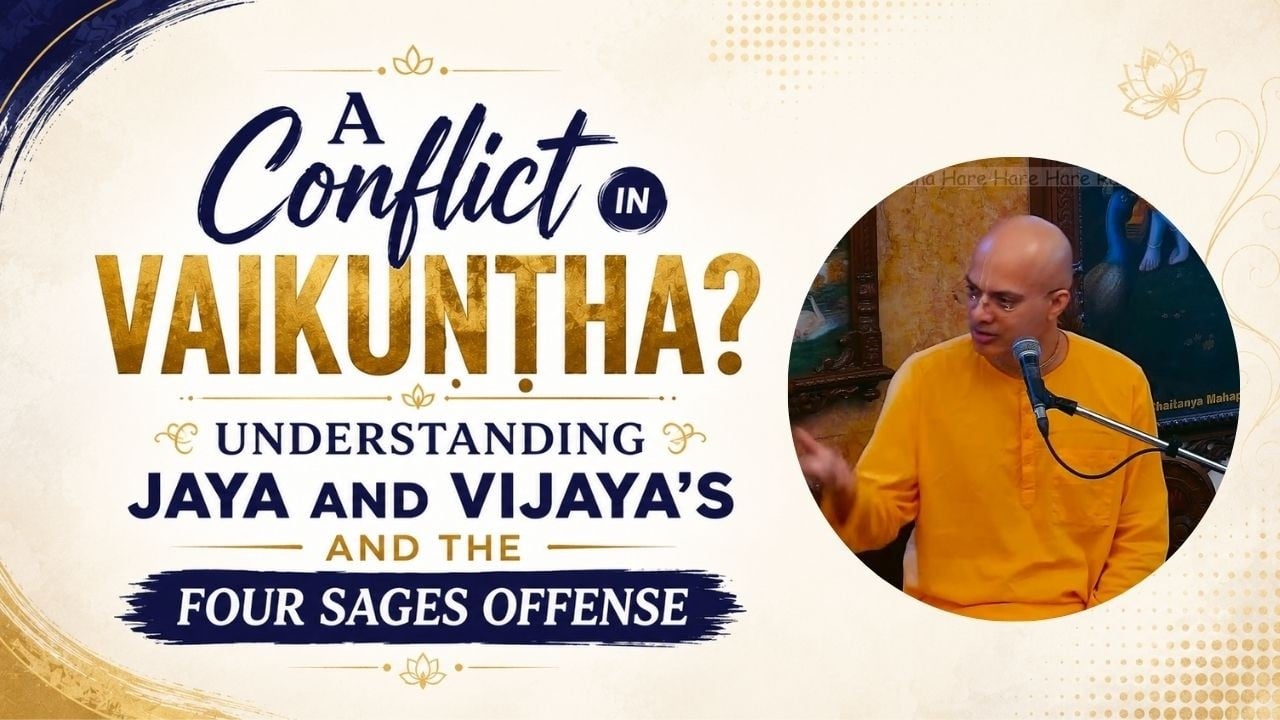
Context: On 23 June 2026, H.G. Akinchan Krishna Prabhu spoke at ISKCON Chowpatty, Mumbai, on Śrīmad-Bhāgavatam 3.15.28, a verse situated within one of the most philosophically rich episodes of the Bhāgavata Purāṇa: the meeting of the four Kumāras with Jaya and Vijaya at the seventh gate of Vaikuṇṭha. The episode appears simple at first glance, almost like a dramatic conflict in a divine realm, yet its theological depth lies in the way it examines devotion, etiquette, spiritual authority, anger, humility, and divine providence.
Śrīmad-Bhāgavatam 3.15 describes the kingdom of God, Vaikuṇṭha, not as an abstract paradise but as a conscious spiritual environment shaped by purity, beauty, freedom from envy, and direct relationship with the Supreme Lord. The verse under discussion, 3.15.28, portrays Jaya and Vijaya, the two doorkeepers of the Lord, as majestic beings adorned with fresh flower garlands, four blue arms, arched brows, reddish eyes, and a visibly agitated expression. This description is not merely ornamental. It prepares the reader for a subtle rupture in the atmosphere of Vaikuṇṭha, where even a slight misalignment of consciousness becomes spiritually significant.
The narrative begins with the four Kumāras: Sanaka, Sanandana, Sanātana, and Sanat-kumāra. They are among the mind-born sons of Brahmā and are described as eternally childlike sages who have realized the truth of the self. Their physical appearance is deceptively simple. They look like young boys, but their consciousness is ancient, disciplined, liberated, and deeply absorbed in spiritual inquiry. This contrast between appearance and realization is central to the episode, because Jaya and Vijaya fail not because they lack position, beauty, or proximity to the Lord, but because they misread the spiritual stature of those standing before them.
The Bhāgavatam emphasizes that the Kumāras passed through the first six entrances of Vaikuṇṭha without obstruction. They were not tourists attracted by splendor, architecture, jewels, or celestial ornamentation. Their focus was singular: they wished to see Śrī Hari. The text therefore presents them as ideal seekers whose movement is guided not by curiosity or entitlement but by spiritual longing. Their freedom of movement symbolizes the openness of a purified heart, one that does not see reality through possessiveness, social suspicion, or the categories of “ours” and “theirs.”
At the seventh gate, however, the atmosphere changes. Jaya and Vijaya stand armed with maces, decorated like residents of Vaikuṇṭha, and positioned near the inner presence of the Lord. In Śrīmad-Bhāgavatam 3.15.28, their garlands and bodily features indicate dignity, but their reddish eyes and agitation disclose an interior disturbance. The theological point is delicate: external proximity to sacred power does not automatically guarantee perfect inner alignment. Spiritual communities across dharmic traditions recognize this danger. A person may stand near a temple, text, lineage, or institution and still need to cultivate humility, discernment, and reverence for genuine seekers.
The central question is whether there can be conflict in Vaikuṇṭha. In a literal sense, Vaikuṇṭha is beyond the ordinary conflicts born of envy, fear, scarcity, and egoistic competition. Yet the Bhāgavatam uses this episode to reveal a higher type of divine drama, or līlā, in which apparent tension becomes a vehicle for instruction. The narrative does not portray Vaikuṇṭha as morally unstable. Rather, it shows that the Lord’s devotees, even when involved in an apparent mistake, remain under divine protection and participate in a larger spiritual purpose.
Jaya and Vijaya’s action is described as an offense because they obstruct saints who were qualified to approach the Lord. In Vaiṣṇava theology, offense to a devotee is not a minor lapse in social courtesy; it is spiritually grave because the devotee is dear to the Lord. The Lord later explains that disrespect shown by His attendants toward the sages is to be treated as disrespect toward Himself. This is a decisive teaching. Devotional life cannot be separated from how one treats those who seek truth, live sincerely, and carry spiritual realization.
The word “offense” in this context should not be reduced to a sectarian or punitive idea. It indicates a disruption of rightful spiritual perception. Jaya and Vijaya saw the Kumāras externally and responded defensively. Their error was not merely administrative; it was epistemological. They failed to know who was before them. The Bhāgavatam therefore invites a broader reflection: spiritual maturity requires the ability to perceive beyond costume, age, social role, institutional access, and first impressions.
The Kumāras’ response also requires careful study. They become angry, and the text does not hide this fact. Yet their anger is not presented as ordinary frustration arising from blocked personal desire. Their longing was to see the Supreme Lord, and the obstruction of that longing produced a spiritually charged reaction. Śrīmad-Bhāgavatam 3.15.31 makes an important distinction: anger in conditioned life generally arises when personal sense desire is frustrated, but anger in the life of liberated persons may arise when service to the Lord is obstructed. This distinction is technically important for understanding the psychology of devotion.
The episode therefore avoids sentimental spirituality. It does not claim that realized beings become emotionally inert. Rather, it teaches that emotions are transformed when they are connected to dharma and devotion. In the Bhagavad Gītā and the Bhāgavata tradition, the problem is not emotion itself but self-centered emotion. Anger, longing, grief, courage, and affection can all become spiritually meaningful when purified and directed toward service, truth, and protection of sacred values.
The curse given by the Kumāras sends Jaya and Vijaya into the material world. In later theological reflection, this descent is connected with their births as Hiranyakṣa and Hiraṇyakaśipu, then Rāvaṇa and Kumbhakarṇa, and finally Śiśupāla and Dantavakra. In each life, they oppose the Lord in different forms, and in each life the Lord appears to confront and liberate them. This sequence turns the incident at the gate into a vast theology of divine relationship across cosmic time.
A superficial reading may interpret Jaya and Vijaya as simply fallen gatekeepers punished for misconduct. A more careful reading sees a layered doctrine of providence. The Lord later states that the punishment was ordained by Him and that the doorkeepers would return to His presence after a short interval. Their descent is thus not comparable to ordinary spiritual collapse. It becomes part of the Lord’s līlā, a dramatic expansion of relationship in which even opposition is ultimately brought back into divine intimacy.
This is why the episode is so important for the study of Bhakti Yoga. It shows that the Supreme Lord is not distant from the moral consequences of His servants’ actions. He accepts responsibility, seeks forgiveness from the sages, and upholds the dignity of His devotees. The Lord’s humility is one of the most striking elements of the narrative. He does not defend institutional authority at the cost of justice. He does not excuse the doorkeepers because they hold office. Instead, He honors the offended sages and teaches that spiritual leadership is accountable before dharma.
For contemporary readers, this point is particularly relevant. Religious life often struggles when external position is mistaken for inner qualification. The Bhāgavatam challenges that error directly. Jaya and Vijaya possess authority at the gate, but authority without humility becomes spiritually hazardous. The Kumāras possess no conventional markers of power, yet their realization makes them worthy of the highest respect. The reversal is intentional and pedagogically powerful.
The episode also has relevance beyond Vaiṣṇava circles. Across Hinduism, Buddhism, Jainism, and Sikhism, one finds a shared concern for humility, reverence toward realized beings, restraint in judgment, and the purification of ego. The details of theology differ across traditions, but the ethical insight is widely intelligible: spiritual advancement is measured not by social display but by awakened consciousness, compassion, discipline, and freedom from arrogance. In this sense, the story supports unity among dharmic traditions by highlighting a common civilizational value: the sincere seeker must be honored.
The childlike form of the Kumāras also deserves philosophical attention. In many dharmic traditions, childlikeness does not mean ignorance; it can signify simplicity, purity, and freedom from manipulative social calculation. The Kumāras are ancient sages who appear as children, suggesting that spiritual maturity may restore a kind of innocence without abandoning wisdom. Their form becomes a critique of the habit of judging spiritual authority by age, clothing, wealth, institutional title, or physical presentation.
Jaya and Vijaya’s agitation in Śrīmad-Bhāgavatam 3.15.28 is therefore the first visible sign of a deeper issue. The verse does not yet narrate the full offense, but it paints the psychology of the moment. Their brows, nostrils, and eyes reveal that inner disturbance has already entered their conduct. In Sanskrit narrative art, physical details often function as moral signals. The body discloses the state of consciousness. Before the verbal confrontation fully unfolds, the reader is shown that the gatekeepers are not in the calm, welcoming, discrimination-free mood expected in Vaikuṇṭha.
This raises a practical lesson about spiritual etiquette. Sacred spaces require guardianship, but guardianship must not become gatekeeping rooted in pride. Temples, āśramas, gurudwaras, monasteries, community halls, and places of study all need order. Yet the purpose of order is to support access to the sacred, not to humiliate sincere seekers. The Bhāgavatam’s teaching is not that all boundaries are wrong. It is that boundaries must be governed by wisdom, humility, and sensitivity to spiritual qualification.
The Lord’s intervention further clarifies the matter. When He appears, He does not diminish the Kumāras’ pain. He acknowledges the offense and affirms that disrespect to His devotees is disrespect to Him. This principle has deep roots in bhakti thought: the devotee is not independent of the Lord’s affection. To dishonor the devotee is to misunderstand the Lord’s own heart. Devotion is therefore relational, not merely ritual. It is expressed in how one sees and serves living beings who carry spiritual aspiration.
The incident also explains why humility is not optional in Krishna consciousness. A devotee may chant, study, serve, and hold responsibility, but without humility the same devotional environment can become a field for subtle ego. Jaya and Vijaya’s mistake is not that they are outsiders to devotion. They are intimate attendants. Precisely for that reason, their lapse becomes more instructive. The closer one stands to sacred service, the greater the need for vigilance, softness, and accountability.
From a technical theological perspective, the episode also engages the question of free will and divine will. The doorkeepers act wrongly, the sages respond with a curse, and the Lord later reveals that the whole movement was included within His plan. The Bhāgavatam does not flatten these layers into a simplistic determinism. Human and divine agency are shown together. The doorkeepers are responsible, the sages are empowered, and the Lord’s providence encompasses the result. This layered causality is characteristic of Purāṇic theology.
The births of Jaya and Vijaya in the material world add another dimension: the Lord’s relationship with His devotees is so profound that even apparent opposition may become a mode of remembrance. Their later lives as powerful antagonists are not praised as models for ordinary conduct, but they demonstrate that the Lord can transform even conflict into a path of return. This does not justify hostility, arrogance, or violence. It shows instead that divine grace can operate through histories that seem morally and emotionally complex.
The story also deepens the understanding of avatāra. The Lord appears as Varāha, Narasiṁha, Rāma, and Kṛṣṇa in connection with the cosmic unfolding of dharma and the liberation of His associates. The descent of Jaya and Vijaya creates occasions for the revelation of divine forms and divine justice. Their opposition becomes the background against which the Lord’s protective nature, heroic compassion, and commitment to dharma are displayed.
In a lived devotional context, the episode encourages careful self-examination. One may ask whether spiritual life has made the heart more welcoming or more rigid, more perceptive or more judgmental, more humble or more attached to position. The Bhāgavatam does not allow the reader to stand outside the story as a spectator. The seventh gate becomes symbolic of the subtle threshold within the heart, where pride may still stand armed even when the surroundings are sacred.
The Kumāras represent the seeker’s innocence and intensity. Jaya and Vijaya represent the danger of role-based identity. The Lord represents the final harmonizing principle, where justice, compassion, accountability, and grace are integrated. This triangular structure gives the episode its enduring power. It is not merely a mythic quarrel but a study in spiritual psychology.
The class theme, “A Conflict in Vaikuntha? Understanding Jaya and Vijaya’s and the Four Sages Offense,” therefore points toward a paradox. The apparent conflict does not reveal defect in Vaikuṇṭha; it reveals how divine teaching can emerge through apparent contradiction. The Lord’s realm remains pure, yet the narrative allows devotees to learn about offense, humility, and the Lord’s affection for His servants. The incident is dramatic because it occurs at the threshold of perfection, where even a small deviation from reverence becomes visible.
For the modern devotee, the most practical lesson may be this: access to the sacred must be guarded by humility, not ego. Knowledge must be joined with respect. Institutional duty must be joined with compassion. Emotional intensity must be purified by service. Spiritual authority must be accountable to dharma. These principles are not limited to one community; they nourish the broader dharmic ethos of reverence, restraint, truth-seeking, and unity.
Śrīmad-Bhāgavatam 3.15.28 thus becomes more than a visual description of two divine doorkeepers. It is the opening frame of a profound meditation on how subtle pride can disturb service, how saintly persons must be honored, how anger can be spiritually distinguished from egoistic irritation, and how the Lord transforms even a grave mistake into a path of return. In the end, the episode does not leave the reader with despair over offense but with renewed confidence in divine grace, provided humility and sincere correction are embraced.
The enduring message is that Vaikuṇṭha is not a realm of impersonal stillness but of living relationship. Love, service, reverence, accountability, and divine play all operate there in perfected form. The story of Jaya and Vijaya and the four Kumāras reminds spiritual practitioners that the gate to the Lord is opened not by status, appearance, or control, but by humility, devotion, and the ability to recognize holiness wherever it appears.
Inspired by this post on Dandavats.






Leave a Reply
You must be logged in to post a comment.