
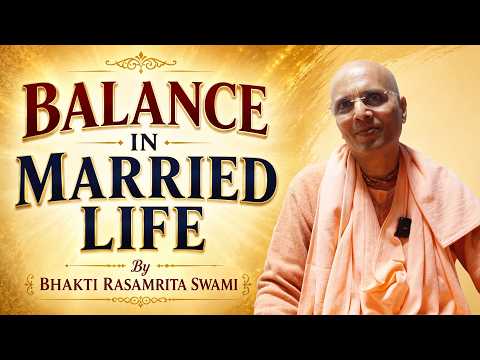

On 14 March 2026, at Vivah Samelana Pune, Bhakti Rasamrita Swami addressed a subject that remains deeply relevant for contemporary Hindu society: balance in married life. The topic appears simple, yet it touches some of the most demanding questions of dharma, emotional maturity, family responsibility, spiritual practice, and community stability. Marriage, in the dharmic imagination, is not merely a private arrangement between two individuals. It is a disciplined partnership in which two lives are gradually trained toward responsibility, service, restraint, affection, and higher purpose.
The phrase “balance in married life” is especially important because modern families often experience pressure from several directions at once. Work demands attention, economic responsibilities increase, social expectations become louder, and personal aspirations often compete with domestic duties. At the same time, spiritual life requires steadiness, humility, and regularity. A marriage that ignores material responsibilities can become impractical, while a marriage absorbed only in material pursuits can become spiritually empty. The dharmic view seeks neither escape from household life nor indulgence in household attachment. It seeks wise integration.
In Hindu tradition, the grihastha ashrama is treated as a vital stage of life because it supports not only the husband and wife but also children, elders, guests, teachers, temples, society, and the wider moral order. The household is expected to become a place of seva, discipline, charity, hospitality, learning, worship, and intergenerational transmission of values. This understanding prevents marriage from being reduced to romance alone. Affection is important, but affection matures when it is guided by dharma. Without dharma, love can become possessiveness; with dharma, love becomes service.
Bhakti Rasamrita Swami’s theme can be understood through this classical framework. Married life needs balance between affection and duty, freedom and commitment, economic effort and spiritual discipline, individual temperament and shared purpose. The dharmic household is not built by sentiment alone. It is built through daily conduct: speaking truthfully, listening respectfully, managing resources responsibly, honoring elders, guiding children, protecting spiritual practice, and creating an atmosphere in which both partners can grow.
One of the most important principles in this discussion is that marriage is not designed to erase individuality. Dharmic traditions recognize svabhava, the distinctive nature of a person, and svadharma, the responsibilities appropriate to that nature and situation. A husband and wife may differ in temperament, pace, emotional expression, habits, strengths, and weaknesses. Balance does not require mechanical sameness. It requires intelligent cooperation. A stable household learns how to convert difference into complementarity rather than conflict.
This insight is valuable for modern couples because many conflicts arise not from major moral failures but from unmanaged expectations. One person may expect constant verbal affirmation, while another expresses care through practical service. One may value order and predictability, while another may function with flexibility. One may become anxious about money, while another may be more relaxed. When these differences are interpreted as disrespect, conflict deepens. When they are understood as patterns requiring communication and adjustment, marriage becomes a field of learning.
From a dharmic perspective, communication is not merely a psychological technique. It is an ethical discipline. Speech has consequences. Words can nourish trust or corrode it. The classical emphasis on satya, truthfulness, and ahimsa, non-injury, is highly relevant in family life. Truth without kindness can become cruelty, and kindness without truth can become avoidance. Balanced speech requires honesty, restraint, timing, and compassion. In a household, this discipline is tested daily because the people closest to one another often see each other’s fatigue, frustration, and unguarded reactions.
Marriage also requires balance between personal emotion and long-term commitment. Modern culture often treats emotional intensity as proof of authenticity, but dharmic wisdom is more sober. Feelings are real, yet they are also changeable. A household cannot be governed by every passing mood. The Bhagavad Gita repeatedly emphasizes steadiness, self-control, and clarity of intelligence. Applied to family life, this means that anger, disappointment, attraction, pride, and insecurity must be observed and disciplined rather than allowed to dominate conduct.
This does not mean emotional suppression. A healthy marriage needs emotional honesty. However, dharmic emotional honesty is different from impulsive expression. It asks whether a feeling is being communicated for healing or weaponized for control. It asks whether one is seeking understanding or victory. It asks whether words are being used to serve the relationship or to defend ego. In this sense, married life becomes a practical training ground for inner work.
The technical language of dharma helps clarify why household life is spiritually significant. A marriage exposes attachment, pride, impatience, fear, and selfishness with unusual precision. A person may appear peaceful in public, yet become harsh at home. A person may speak about humility, yet refuse to admit fault before a spouse. A person may value devotion, yet neglect the emotional well-being of the family. The household therefore becomes a mirror. It reveals whether spiritual ideas have entered behavior.
In the bhakti tradition, this point is central. Devotion is not limited to ritual performance, temple attendance, kirtan, japa, or philosophical study. These practices are essential, but they are meant to transform character. If spiritual practice increases pride, indifference, or neglect, its purpose has been misunderstood. In married life, bhakti must appear as patience, gratitude, forgiveness, service, reliability, and respect. The partner at home is not an obstacle to devotion; the relationship itself can become a place where devotion is tested and refined.
A balanced marriage also requires an intelligent understanding of material responsibility. Hindu thought does not reject artha, the pursuit of resources and stability, when it is guided by dharma. A family needs food, shelter, education, healthcare, security, and planning. Financial carelessness can create anxiety and conflict, while greed can destroy contentment. The middle path is disciplined stewardship. Money should serve dharma, family welfare, hospitality, education, charity, and spiritual culture. It should not become the measure of human worth.
For many contemporary families, the challenge is not only earning money but managing the emotional energy that economic life consumes. Long working hours, digital overload, competitive comparison, and urban stress can leave little space for prayer, conversation, rest, or shared meals. A technically successful household can still become relationally starved. Balance therefore requires deliberate scheduling of sacred and relational time. Daily or weekly spiritual routines, however modest, give the family a center that is not controlled by the market or the phone screen.
The same applies to technology. Digital media can inform, connect, and educate, but it can also fragment attention. Many homes now suffer from a quiet form of distance in which family members sit together physically while living in separate digital worlds. A dharmic household must treat attention as a moral resource. To listen to a spouse, guide a child, care for an elder, or sit before the deity with focus requires the recovery of attention. Without attention, affection becomes shallow and worship becomes mechanical.
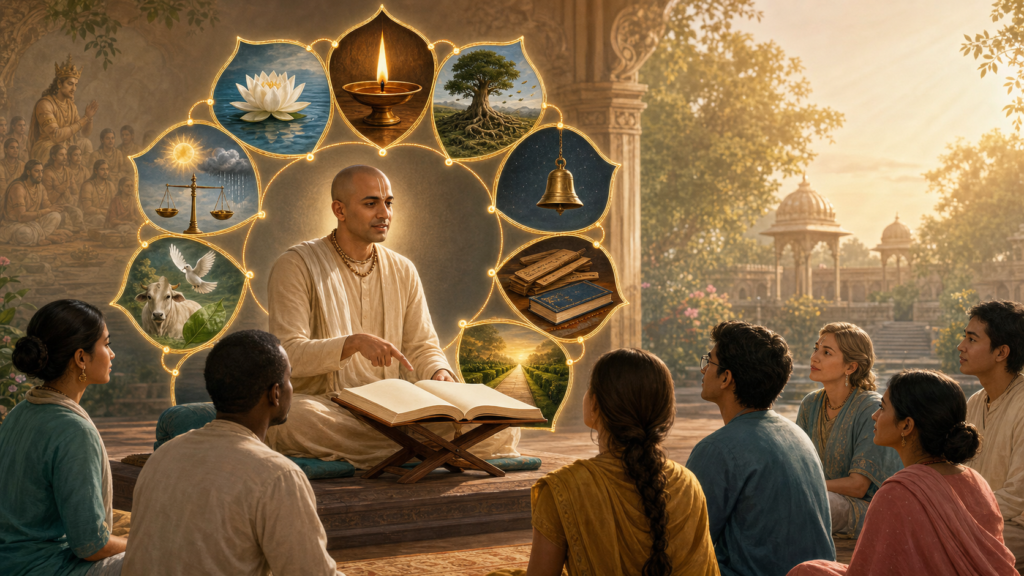
Balance in married life also depends on shared spiritual culture. In Hindu family life, rituals are not ornamental add-ons. They create rhythm, memory, identity, and sacred atmosphere. Lighting a lamp, offering food, chanting together, observing festivals, honoring Ekadashi, reading from scripture, visiting temples, serving guests, and teaching children stories from the Ramayana, Mahabharata, Bhagavad Gita, Bhagavata Purana, and the lives of saints all shape the household imagination. These practices teach that life is not merely consumption and survival; it is participation in a sacred order.
At the same time, spiritual practice in a family must be realistic. A newly married couple, a family with small children, a household caring for elderly parents, and a family under financial strain cannot all follow identical routines. Balance requires sincerity rather than imitation. A short, regular practice performed with attention may be more transformative than an elaborate routine performed with resentment. Dharma becomes sustainable when it is adapted without being diluted and preserved without becoming rigid.
This point is especially important for unity among dharmic traditions. Hinduism, Buddhism, Jainism, and Sikhism all place value on self-discipline, compassion, truthfulness, restraint, service, and inner purification, even though their metaphysical frameworks and ritual cultures differ. A household inspired by dharma can respect these shared ethical foundations. It can honor devotion, meditation, non-violence, seva, scriptural learning, and reverence for teachers without turning difference into hostility. Family life becomes healthier when spiritual identity deepens humility rather than sectarian pride.
Marriage also requires balance between the couple and the extended family. Traditional Indian family systems often preserve strong intergenerational bonds, and these bonds can offer emotional, cultural, and practical support. Elders can transmit memory, language, ritual knowledge, and resilience. However, extended family involvement must be guided by fairness and boundaries. Support should not become interference, and independence should not become neglect. A dharmic household honors parents and elders while also protecting the dignity and trust of the marital relationship.
Many marital tensions arise when loyalty is misunderstood. A spouse may feel abandoned when the other avoids difficult conversations with parents or relatives. Elders may feel discarded when a young couple seeks privacy. Balance requires maturity on all sides. The couple must not use modern independence as an excuse for ingratitude, and the family must not use tradition as an excuse for control. Dharma asks for right relationship, not domination by any one party.
The upbringing of children adds another dimension. In dharmic thought, children are not possessions; they are souls entrusted to the care of parents. Parenting requires affection, discipline, example, and spiritual nourishment. A child learns more from the emotional atmosphere of the home than from formal instruction alone. If parents preach respect but insult each other, the child learns conflict. If parents practice prayer, service, restraint, and mutual care, the child receives dharma through lived experience.
This makes marital balance a form of cultural preservation. Temples, schools, books, and public lectures are important, but the first classroom of dharma is the home. Language, food habits, festival observance, reverence for sacred texts, respect for elders, and the habit of offering gratitude are often absorbed in childhood. A balanced marriage therefore protects more than two individuals; it protects continuity. It allows Hindu culture and broader dharmic values to be transmitted naturally, without anxiety or aggression.
Another important aspect is conflict resolution. No serious discussion of marriage can pretend that harmony means the absence of disagreement. Differences over money, children, relatives, spiritual practice, career choices, household labor, and personal habits are common. The question is not whether conflict appears, but how it is handled. A dharmic approach discourages humiliation, contempt, manipulation, passive aggression, and revenge. It encourages accountability, apology, patience, and willingness to correct oneself.
Apology has a profound place in married life because it weakens false ego. Many relationships deteriorate because one or both partners treat apology as defeat. In reality, apology can be an act of strength. It acknowledges that the relationship is more important than pride. Similarly, forgiveness does not mean tolerating repeated harm without correction. It means refusing to turn the heart into a storehouse of bitterness while still addressing conduct responsibly.
Balance also requires a fair distribution of labor. In earlier social arrangements, household roles were often more fixed. Modern families frequently operate with both partners carrying economic, domestic, emotional, and caregiving responsibilities. Dharma must be applied with intelligence to these changed circumstances. The principle is not rigid role performance but responsible service. A household becomes strained when one partner carries invisible labor without acknowledgment. Gratitude, practical help, and mutual respect are essential to stability.
There is also a subtle spiritual danger in using dharma selectively. A person may invoke tradition to demand obedience but ignore the duties of kindness, protection, restraint, and sacrifice. Another may invoke freedom to avoid commitment. Both distortions harm the household. Dharma is not a weapon for winning domestic arguments. It is a discipline that binds each person first to self-correction. The question is not only what the other person owes, but what one must become in order to serve rightly.
In this sense, balance in married life is inseparable from self-awareness. A person brings into marriage impressions from childhood, family culture, social conditioning, previous pain, and personal insecurity. Without awareness, these impressions shape reactions automatically. One may become defensive when criticized, silent when hurt, controlling when afraid, or dismissive when overwhelmed. Spiritual practice helps because it creates a space between impulse and action. Through japa, prayer, study, meditation, satsanga, and honest reflection, the mind becomes more available for correction.
Married life also needs companionship. Duty without warmth can become dry. Spiritual discipline without tenderness can become severe. A balanced household allows laughter, shared meals, simple affection, meaningful conversation, and celebration. Festivals such as Diwali, Holi, Janmashtami, Rama Navami, Navratri, Guru Purnima, Kartik observances, and family samskaras bring sacred joy into domestic life. Joy is not opposed to seriousness; it often gives seriousness the strength to endure.
The place of the guru and spiritual community is also relevant. In many Hindu and Vaishnava settings, guidance from saints, acharyas, and experienced householders helps couples avoid avoidable mistakes. However, such guidance should cultivate responsibility, not dependency. Good counsel helps individuals see their duties more clearly. It does not encourage escapism, superiority, or neglect of family obligations. A mature spiritual community supports marriages by honoring both sadhana and household responsibility.
Bhakti Rasamrita Swami’s presence at a Vivah Samelana in Pune is meaningful in this respect. A marriage gathering is not only a social arrangement; it is a moment for education. Families and young people need a framework for understanding marriage before problems become severe. In many communities, weddings are lavishly organized, yet preparation for married life remains minimal. Ceremonies receive attention, but communication, conflict resolution, financial ethics, spiritual routines, and family expectations are not always discussed with sufficient clarity.
A serious dharmic culture must therefore recover marriage education. Young adults should understand that attraction alone cannot sustain a household. Compatibility matters, but character matters more. Shared values, emotional discipline, respect for spiritual practice, financial responsibility, willingness to serve, and capacity for honest conversation are central. Families should encourage realistic expectations rather than romantic fantasy or social pressure. Marriage is sacred, but sacred does not mean effortless.
The deeper purpose of balance is inner purification. Household life continually asks individuals to move from “What do I want?” to “What is right?” and eventually to “How may this life serve the Divine?” This movement is at the heart of dharmic living. In bhakti language, the household becomes successful when Krishna consciousness, devotion, humility, and service gradually inform daily life. In broader dharmic language, it becomes successful when truth, compassion, restraint, responsibility, and reverence guide conduct.
Such a vision does not deny the difficulties of marriage. It recognizes them and gives them meaning. Fatigue, misunderstanding, sacrifice, and adjustment are not signs that marriage has failed. They are often the ordinary conditions under which maturity develops. A balanced couple learns to distinguish between genuine harm, which must be addressed firmly, and ordinary friction, which must be handled patiently. This discernment protects both dignity and commitment.
For contemporary Hindu families, the message is both practical and profound. Balance in married life means making the home a place where dharma is livable. It means work is respected but not worshipped, spirituality is honored but not used to avoid duty, elders are valued but not allowed to destroy trust, children are guided but not controlled by ego, and the couple’s bond is protected without becoming selfish. It means the family becomes a small but serious center of culture, ethics, devotion, and service.
The featured video, “Balance in Married Life – Bhakti Rasamrita Swami,” therefore deserves attention not merely as a marriage talk but as a reminder of the civilizational importance of the household. A society that weakens the household weakens its capacity to transmit wisdom. A society that strengthens dharmic family life strengthens its temples, communities, children, elders, and future. In this sense, balanced married life is not a private luxury. It is a form of dharma seva.
The lasting lesson is that marriage becomes spiritually meaningful when it is consciously aligned with higher purpose. Balance is not achieved once and then possessed forever. It is renewed through daily choices: a restrained word, a sincere apology, a shared prayer, a responsible decision, a meal offered with gratitude, a festival celebrated with devotion, a child taught with patience, and a spouse treated as a companion in dharma. Through these ordinary acts, married life becomes a path of spiritual growth.
Inspired by this post on Dandavats.






Leave a Reply
You must be logged in to post a comment.