
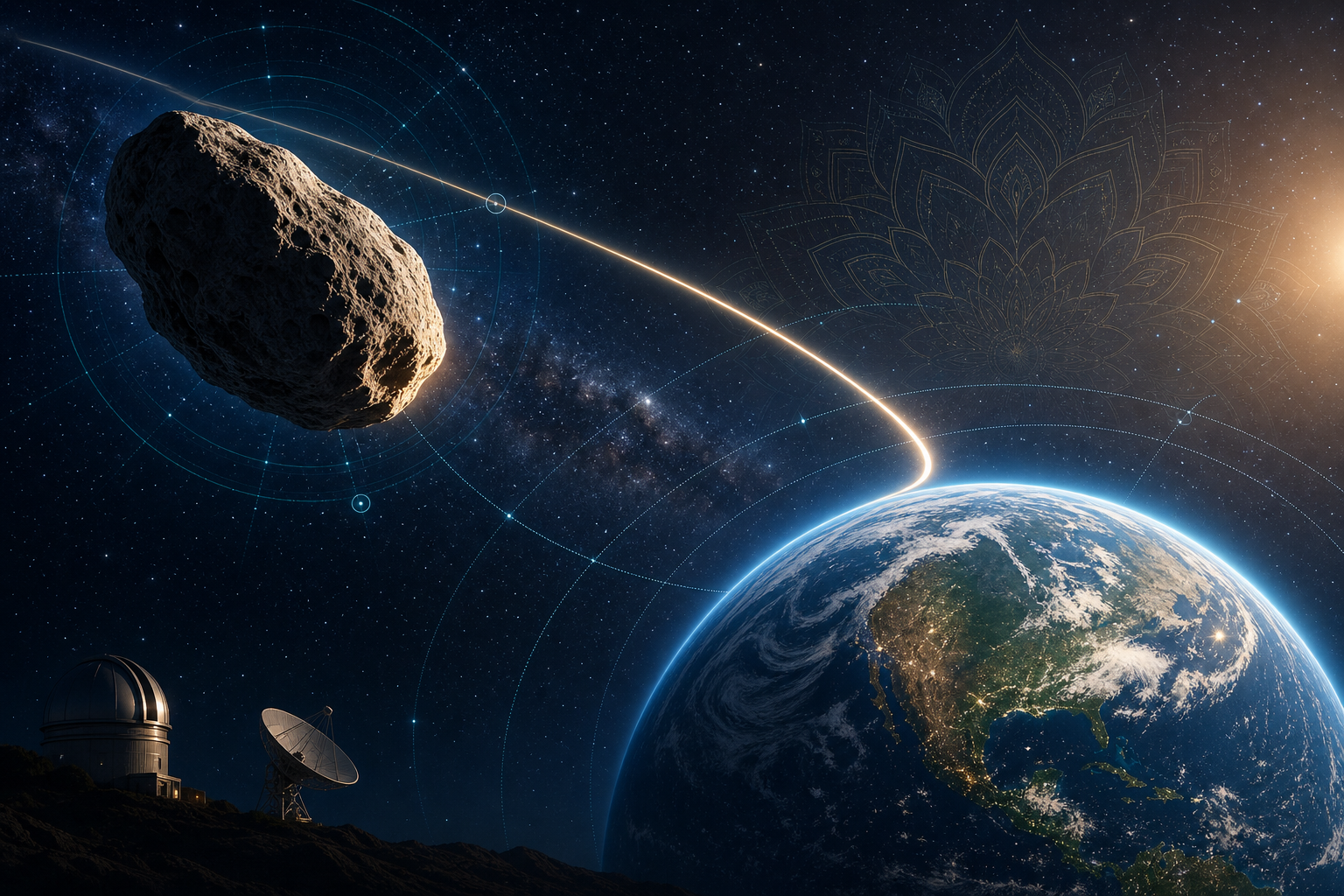
The claim that the world will end in 2029 has circulated largely because of asteroid 99942 Apophis, a near-Earth asteroid that will make an unusually close approach to Earth on April 13, 2029. The date is real, the asteroid is real, and the close passage is scientifically important. The conclusion that Earth will be destroyed, however, is not supported by the evidence.
Apophis was discovered in 2004, and early observations created understandable concern because the available data were limited. In orbital mechanics, uncertainty is normal when an asteroid has only been observed for a short time. A small uncertainty in position can grow into a wide range of possible future paths, especially when the object will pass close to a planet with strong gravity.
That is why the initial public anxiety around Apophis should be understood carefully. It was not a prophecy and it was not proof of disaster. It was a preliminary risk estimate based on incomplete observations. As more data arrived from optical telescopes and radar, astronomers were able to constrain the orbit with far greater precision, and the feared 2029 impact scenario disappeared.
NASA’s Jet Propulsion Laboratory has stated that radar observations and refined orbit analysis rule out any impact risk from Apophis for at least the next century. The same assessment explains that the earlier concerns for 2029 and 2036 had already been eliminated, and that the remaining 2068 concern was also removed after the 2021 radar campaign. In simple terms, Apophis will pass Earth in 2029; it will not strike Earth in 2029.
The 2029 flyby will still be extraordinary. Apophis is estimated to be about 1,100 feet, or roughly 340 meters, across. On April 13, 2029, it is expected to pass less than 20,000 miles, or about 32,000 kilometers, above Earth’s surface. That is closer than the orbit of many geosynchronous satellites and far closer than the Moon, which averages about 384,400 kilometers from Earth.
This close distance is the main reason the event attracts attention. A large asteroid passing so near Earth is rare, and the 2029 encounter will give scientists a remarkable natural laboratory. Earth’s gravity may slightly alter Apophis’ orbit, rotation, and perhaps even its surface structure. Such changes are valuable for astronomy, planetary defense, and the scientific study of near-Earth objects.
The term “potentially hazardous asteroid” often creates unnecessary fear. In technical astronomy, it does not mean that an object is predicted to hit Earth. It means the asteroid is large enough and has an orbit close enough to Earth’s orbit to deserve careful tracking. Many potentially hazardous objects are monitored precisely because science is cautious, systematic, and transparent about uncertainty.
Apophis was once listed as a serious object of concern because early calculations allowed a small range of risky possibilities. After additional observations, the uncertainty narrowed. NASA’s Center for Near-Earth Object Studies removed Apophis from its impact risk list after the 2021 analysis. That removal is significant because it shows how observation, calculation, and peer review replace fear with clarity.
There is also an important distinction between a close approach and an impact. A close approach can sound alarming in ordinary language, but in astronomy it simply means that two bodies pass near each other on cosmic scales. Apophis will pass close enough to be studied in detail, and in some regions it may be visible without a telescope, but its calculated path does not intersect Earth.
Even if a 340-meter asteroid were to hit Earth, it would be a grave regional catastrophe, not a literal destruction of the entire planet. This distinction matters because exaggerated language creates panic instead of understanding. Planetary defense is serious, but responsible science avoids turning every near-Earth object into an end-of-the-world story.
Some discussions of 2029 also invoke astrology, prophecy, or vague predictions of cosmic change. In Indian tradition, Jyotisha has long held cultural and calendrical importance, especially in relation to tithi, nakshatra, festivals, and ritual timing. But a physical claim about an asteroid impact requires physical evidence: telescopic observations, radar measurements, gravitational modeling, and repeatable calculations.
No credible astrological prediction has demonstrated that the world will end in 2029. More importantly, no credible scientific evidence supports such a conclusion. A mature dharmic approach should not require fear to sustain reverence for the cosmos. Hindu, Buddhist, Jain, and Sikh traditions all contain resources for self-discipline, compassion, truthful speech, and awareness in the face of uncertainty.
From a dharmic perspective, the 2029 Apophis event can be read not as a reason for panic, but as an invitation to viveka, discernment. Fear spreads quickly when people encounter dramatic headlines, especially about the sky, fate, and the future. Discernment asks whether a claim is supported by pramana, reliable means of knowledge, and whether repeating it helps or harms social harmony.
This is where scientific observation and spiritual maturity can support each other. Astronomy teaches patience because one night of data is rarely enough. Dharma teaches steadiness because one frightening rumor should not govern the mind. Together, they encourage a balanced response: investigate carefully, speak responsibly, and avoid turning uncertainty into collective anxiety.
The history of failed doomsday predictions is long. Many dates have been declared the final day of the world, and each has passed into memory as a lesson in human fear. Such predictions often thrive during periods of social stress, technological change, political conflict, or spiritual confusion. Their emotional appeal comes from certainty, but certainty without evidence is not wisdom.
The Apophis story is different when approached academically. It is a case study in how modern planetary defense works. Astronomers discover a near-Earth object, calculate a preliminary orbit, publish risk assessments, gather more observations, refine the model, and update the public record. The process is not a failure because early estimates change; it is a success because better evidence improves the conclusion.
One technical issue often mentioned in relation to Apophis is the Yarkovsky effect. This is a tiny force produced when an asteroid absorbs sunlight and later re-emits heat, creating a very small push over time. For long-term orbital predictions, such subtle effects can matter. Scientists studied this effect carefully in Apophis’ case, and later radar observations helped rule out the feared future impact scenarios.
The 2029 passage will therefore be a rare scientific opportunity rather than a cosmic threat. Researchers can observe how Earth’s gravity affects a small body at close range. Such data can improve models used for asteroid deflection, impact prediction, and mission planning. NASA’s OSIRIS-APEX mission is also expected to study Apophis after the flyby, turning a once-feared object into a major source of knowledge.
For readers interested in reliable sources, NASA JPL’s analysis is available at NASA Analysis: Earth Is Safe From Asteroid Apophis for 100-Plus Years. Technical research on orbital uncertainty and the Yarkovsky effect can also be explored through studies such as Yarkovsky-driven impact risk analysis for asteroid (99942) Apophis. These sources are more reliable than viral claims, anonymous predictions, or sensational social media posts.
The practical conclusion is clear: the world is not going to end in 2029 because of Apophis. The asteroid will come close, it will be watched intensely, and it will likely inspire public interest in astronomy. But the available scientific evidence does not support an impact, let alone a global apocalypse.
A more constructive response is to use the event for education. Families, students, temples, dharmic study circles, and science communities can discuss the sky with wonder rather than fear. The 2029 flyby can become an occasion to teach astronomy, critical thinking, humility before the cosmos, and the ethical responsibility to avoid spreading panic.
Humanity does face real challenges, including environmental degradation, conflict, misinformation, loneliness, and loss of trust. These are not solved by waiting for a predicted apocalypse. They are addressed through knowledge, discipline, compassion, cooperation, and responsible action. In that sense, the better question is not whether the world will end in 2029, but how human beings can live more wisely before, during, and after 2029.
The sky has always stirred awe in human beings. It has inspired Vedic hymns, Buddhist reflections on impermanence, Jain meditations on cosmic time, Sikh praise of the Creator, and modern scientific inquiry into the solar system. Apophis belongs to that larger story. It is not a message of doom; it is a reminder that truth becomes clearer when fear is met with disciplined observation and a calm mind.
Inspired by this post on Hindu Pad.











Leave a Reply
You must be logged in to post a comment.