
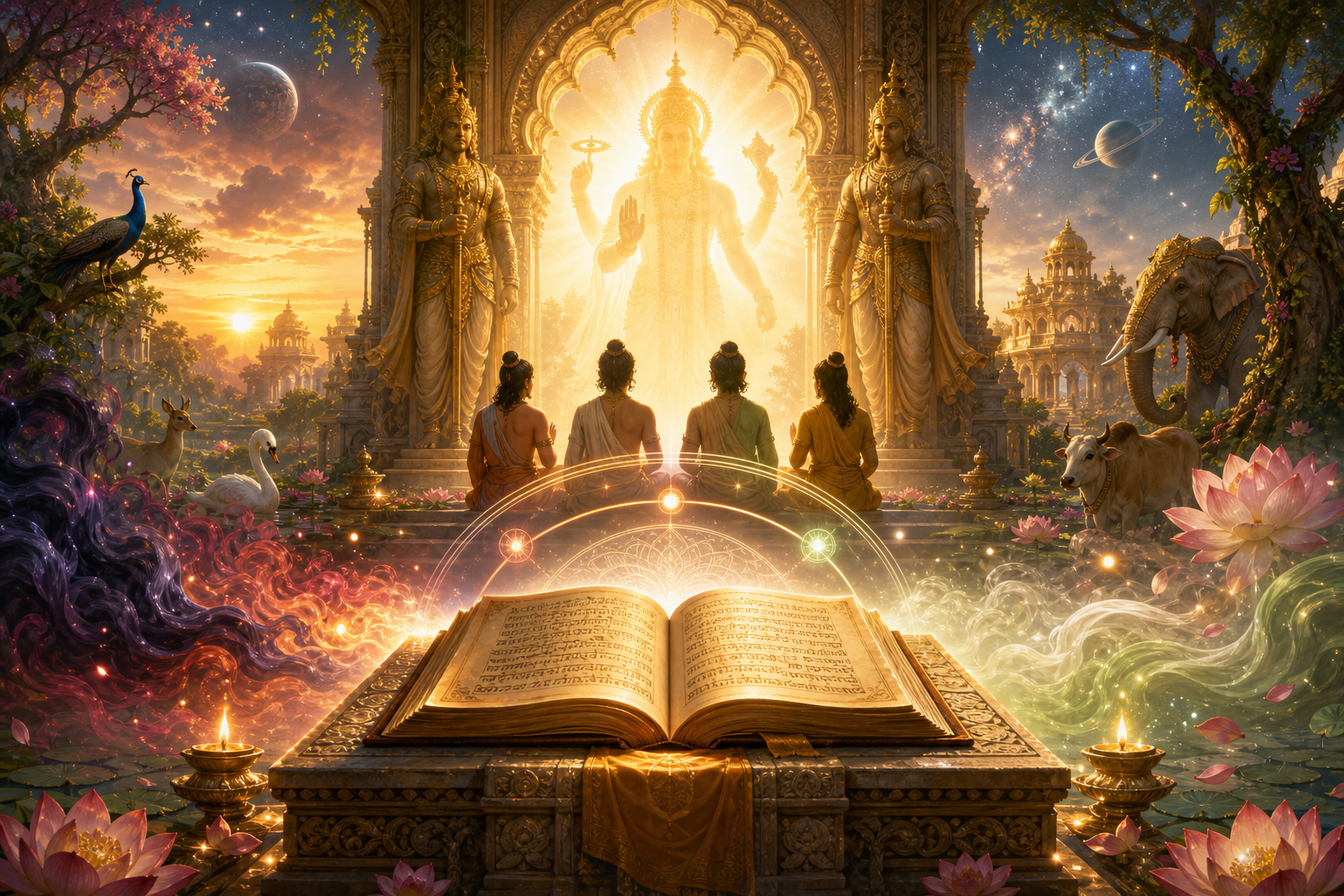
Śrīmad-Bhāgavatam 3.16.22 stands at a delicate theological moment in the account of the four Kumāras, the gatekeepers Jaya and Vijaya, and the Lord’s compassionate intervention in Vaikuṇṭha. The verse is brief, yet it carries a dense spiritual architecture: the Lord is addressed as the personification of dharma, the protector of the moving and unmoving universe, and the benefactor whose pure goodness removes the inner obstructions of rajas and tamas. In a single prayer, the Bhāgavatam connects cosmology, ethics, psychology, devotion, and the practical discipline of spiritual life.
धर्मस्य ते भगवतस्त्रियुग त्रिभि: स्वै: पद्भिश्चराचरमिदं द्विजदेवतार्थम् । नूनं भृतं तदभिघाति रजस्तमश्च सत्त्वेन नो वरदया तनुवा निरस्य ॥ २२ ॥
The Sanskrit phrase dharmasya te bhagavatas identifies the Supreme not merely as a teacher of religion but as the very embodiment of dharma. Dharma here is not reducible to social custom, sectarian identity, or ritual performance alone. It is the sustaining principle by which life, consciousness, order, compassion, and spiritual aspiration are held together. This is why the verse does not present religion as an argument to be won, but as a reality to be restored within the heart.
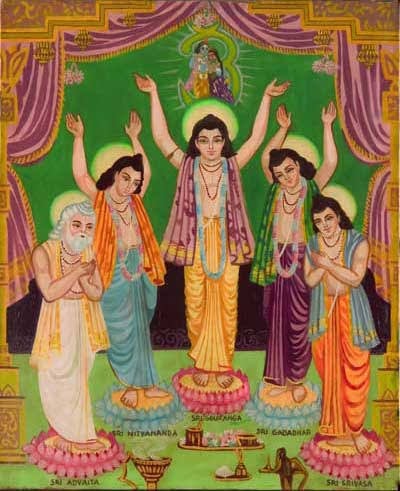
The address tri-yuga is especially significant. Traditional Vaiṣṇava commentators understand it to indicate the Lord who manifests openly in three yugas, while remaining hidden in Kali-yuga. In Gauḍīya Vaiṣṇava theology, this hidden descent is identified with Lord Caitanya, who appears not in the commanding posture of a sovereign deity but in the devotional mood of a bhakta. This theological idea is powerful because it shows that divine compassion adapts itself to the spiritual capacity of the age.
In Satya, Tretā, and Dvāpara yugas, dharma is preserved through visible manifestations and formal structures of spiritual culture. In Kali-yuga, where distraction, quarrel, pride, and instability become dominant, the Lord’s mercy becomes more inward, accessible, and intimate. The covered avatāra teaches through nāma-saṅkīrtana, humility, devotion, and the softening of the heart. The lesson is not that Kali-yuga is spiritually hopeless, but that its medicine must be direct, merciful, and suited to restless minds.
The verse also describes the universe as carācaram, composed of moving and unmoving beings. This term widens the moral imagination. Spiritual vision is not limited to human society, intellectual communities, or ritual specialists; it includes animals, plants, ecosystems, celestial beings, and all forms of embodied existence. Such a worldview naturally supports compassion, restraint, ecological reverence, and a sense of shared sacred belonging.
The prayer asks the Lord to protect the universe for the sake of the dvija and the devatā. In a narrow reading, these terms can sound merely social or hierarchical. In a deeper dharmic reading, they refer to the preservation of qualities necessary for sacred civilization: learning, discipline, gratitude, responsibility, worship, refinement, and alignment with cosmic order. The twice-born ideal points to spiritual rebirth through knowledge and discipline, while the devas symbolize luminous forces that sustain harmony.
The technical heart of the verse lies in the request to remove rajas and tamas through sattva. In Sāṅkhya and Vedāntic psychology, the three guṇas are not abstract categories; they are lived conditions of consciousness. Rajas agitates through craving, ambition, competition, and restless projection. Tamas obscures through inertia, confusion, resentment, negligence, and spiritual forgetfulness. Sattva clarifies through balance, purity, truthfulness, learning, compassion, and steadiness.
This makes Śrīmad-Bhāgavatam 3.16.22 a profound study in inner transformation. The four Kumāras had already reached an exalted spiritual position, yet the episode reveals that even advanced seekers may confront subtle traces of anger, judgment, and egoic reaction. Their prayer is therefore not superficial. It acknowledges that proximity to holiness does not automatically remove every impurity; conscious surrender, humility, and divine grace remain necessary.
There is an important ethical lesson in this. Spiritual maturity is not measured by the absence of mistakes alone, but by the willingness to recognize inner disturbance and seek purification. When anger arises in a sacred setting, the response should not be self-justification. The Bhāgavatam points toward introspection: what within the heart allowed rajas and tamas to speak before sattva could guide?
For contemporary practitioners, this insight is immediately relatable. Modern life often rewards rajasic speed and tamasic numbness. Work culture glorifies constant activity, digital life amplifies comparison, and social conflict often turns disagreement into identity. In such an atmosphere, sattva is not accidental. It must be cultivated through disciplined food, speech, association, study, worship, meditation, service, and remembrance of the Divine.
The Bhāgavatam’s emphasis on pure goodness is not moralism; it is spiritual technology. A sattvic mind can listen. A sattvic heart can forgive. A sattvic intellect can distinguish truth from impulse. A sattvic community can hold disagreement without collapsing into hostility. This is essential for the unity of dharmic traditions, including Hinduism, Buddhism, Jainism, and Sikhism, each of which values self-discipline, compassion, restraint, truth, and liberation from ego-centered bondage.
While Śrīmad-Bhāgavatam 3.16.22 emerges from a Vaiṣṇava theological setting, its psychological and ethical reach is broader. Buddhism analyzes craving and ignorance as roots of suffering. Jainism emphasizes purification of the soul through non-violence, austerity, and restraint. Sikhism teaches remembrance of the Divine Name, humility, service, and freedom from ego. Hindu traditions speak through the language of guṇas, karma, bhakti, jñāna, and yoga. The vocabularies differ, yet the shared civilizational concern is clear: consciousness must be refined.
The verse’s prayer for the removal of passion and ignorance therefore has social relevance. Communities are harmed when rajas becomes aggression and tamas becomes indifference. Public life becomes coarse when truth is secondary to victory. Religious identity becomes fragile when it is separated from humility and character. The Bhāgavatam insists that dharma is protected not only by institutions but also by purified hearts.
In the Gauḍīya Vaiṣṇava tradition, chanting the holy names is presented as the central practice for Kali-yuga because it addresses the heart directly. The holy name does not require social privilege, intellectual brilliance, or ritual complexity. It invites sincerity. In that sense, nāma-saṅkīrtana is both theological and democratic: it opens a path of purification for those who are burdened by the very conditions that define the age.
The reference to Lord Caitanya deepens this point. If the Lord appears in a covered form as a devotee, then the highest power is revealed through humility rather than domination. This reverses ordinary assumptions about authority. Divine authority is not merely command; it is compassion that enters human vulnerability and teaches by example. For a world shaped by ego, the image of the Divine as a servant-devotee is spiritually revolutionary.
Śrīmad-Bhāgavatam 3.16.22 also encourages a careful understanding of dharma beyond external markers. A person may know sacred vocabulary and still be moved by rajas. A person may occupy a respected position and still struggle with tamas. Conversely, a humble practitioner who sincerely cultivates purity, compassion, and remembrance may embody dharma more deeply than one who merely speaks about it. The verse therefore places attention on transformation rather than display.
The three virtues associated with spiritual culture in traditional commentary are austerity, cleanliness, and mercy. Austerity disciplines desire without hatred for the body. Cleanliness includes external order as well as purity of intention, food, speech, and thought. Mercy expands the heart beyond selfish appetite. Together, these qualities create the conditions in which sattva can become stable and devotion can mature.
Seen technically, austerity counters rajas by limiting compulsive expansion. Cleanliness counters tamas by removing dullness and contamination. Mercy transforms both by redirecting energy toward service. This is why dharmic practice is never merely private. The purified heart naturally becomes less exploitative, less reactive, and more capable of contributing to social harmony.
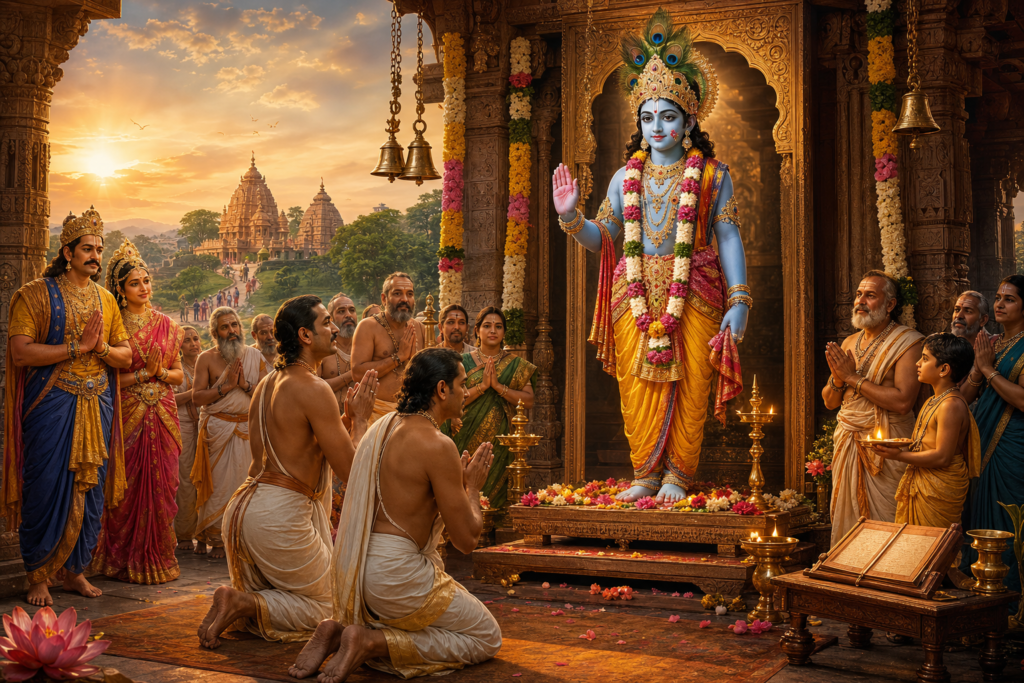
The verse’s appeal to the Lord’s varadayā tanuvā, the blessing-giving form, is also theologically rich. The Divine form is not treated as symbolic ornamentation; it is the locus of grace. Darśana, remembrance, worship, and meditation upon the Lord’s form are ways of reorienting consciousness. The restless mind needs a center, and the sacred form provides a center that is personal, beautiful, ethical, and transcendent.
There is a gentle emotional force in this prayer. It does not demand reward, power, or victory. It asks for purification. That is the mark of a refined spiritual aspiration. The deepest blessing is not control over others but freedom from the inner forces that distort perception. When rajas and tamas recede, the heart becomes capable of devotion, wisdom, and genuine peace.
For readers approaching the Bhāgavatam today, the practical question is straightforward: what would it mean to ask daily for rajas and tamas to be removed? It could mean pausing before reacting. It could mean choosing sāttvic food and speech. It could mean replacing cynicism with study, distraction with mantra, resentment with service, and pride with gratitude. These are not small changes; they are the daily mechanics of spiritual civilization.
Bhanu Swami’s teaching context invites a disciplined engagement with the verse, especially through the lens of Vaiṣṇava theology and traditional commentary. The value of such study lies in its precision. Words such as tri-yuga, sattva, rajas, and tamas are not decorative Sanskrit terms. They are conceptual instruments that help diagnose the condition of the age and the condition of the heart.
At the same time, the verse should not be confined to scholastic interest. Its relevance is existential. Every person knows the experience of being pulled by agitation or covered by inertia. Every serious practitioner knows the gap between aspiration and actual conduct. Śrīmad-Bhāgavatam 3.16.22 gives language to that struggle and directs it toward grace.
The broader message is that dharma is preserved when divine remembrance becomes practical character. The Lord protects the universe, but human beings participate in that protection by cultivating purity, compassion, and steadiness. The moving and unmoving world is not an object for exploitation; it is a sacred field in which consciousness is tested and refined.
In this way, Śrīmad-Bhāgavatam 3.16.22 becomes more than a verse from an ancient scripture. It becomes a map for living in a turbulent age. It teaches that the cure for disorder begins with the purification of consciousness, that divine compassion meets humanity according to time and capacity, and that the highest prayer is often the simplest: may the light of pure goodness remove passion and ignorance from the heart.
Inspired by this post on Dandavats.






Leave a Reply
You must be logged in to post a comment.