
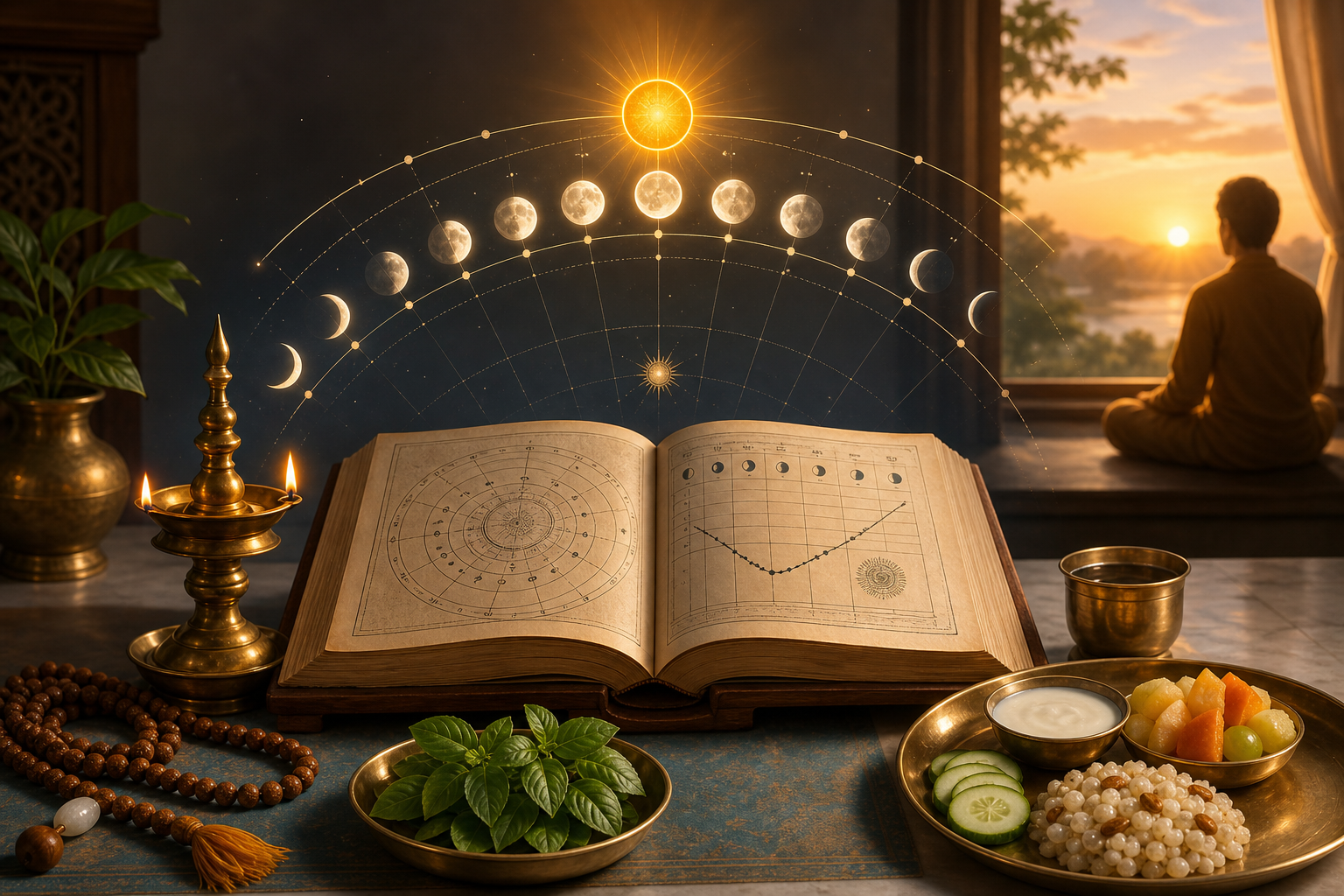
Bhooripaksha Ekadashi, also written as Bhooripaksham Ekadashi, is a technical calendrical expression connected with the way the eleventh lunar day, or Ekadashi tithi, overlaps with the civil day in the traditional Hindu calendar. It is not a separate deity, a separate sectarian observance, or an additional festival created apart from the normal Ekadashi cycle. Rather, it belongs to the careful science of Panchang calculation, where ritual time is determined by the relative movement of the Sun and Moon instead of by a fixed midnight-to-midnight civil date.
For practitioners, this distinction matters because Ekadashi is among the most widely observed fasting days in Hindu traditions, especially in Vaishnava sampradayas, while also being respected more broadly across dharmic religious culture as a day of restraint, worship, discipline, and inner refinement. A person looking at a wall calendar may see only one date printed for Ekadashi, but a traditional Panchang often reveals a more subtle reality: the tithi may begin after sunrise, end before the next sunrise, stretch across two sunrises, or appear in a way that requires rule-based interpretation. Bhooripaksha Ekadashi belongs to this subtle domain of time reckoning.
In Sanskrit-derived usage, the sense of “bhuri” is connected with abundance, fullness, or a larger measure. In the context of Ekadashi calculation, Bhooripaksha can therefore be understood as a condition in which the Ekadashi tithi has a broader or more substantial relationship with the civil day than a simple, ordinary occurrence. The term points toward the practical problem at the heart of Hindu calendar science: lunar time does not obey the clean boundaries of human clock time, and sacred observance depends on knowing which segment of time should be treated as ritually decisive.
The foundation of the subject is the tithi. A tithi is a lunar day measured by the angular distance between the Sun and the Moon. Each tithi corresponds to a 12-degree change in that relative angular separation. Since a full lunar cycle contains 360 degrees, it is divided into thirty tithis: fifteen in Shukla Paksha, the waxing fortnight, and fifteen in Krishna Paksha, the waning fortnight. Ekadashi is the eleventh tithi of either fortnight, making it a twice-monthly observance in the Hindu lunar calendar.
The technical elegance of this system is also the reason it becomes complex in practice. A civil day is normally experienced from one sunrise to the next, while a tithi can begin at any time: morning, afternoon, evening, midnight, or shortly before dawn. Its duration is not always exactly twenty-four hours because the apparent motions of the Sun and Moon are not uniform from day to day. As a result, a tithi may be present at sunrise on one day, absent at sunrise despite occurring between two sunrises, or present at sunrise on two consecutive days.
This is why Hindu timekeeping gives great importance to sunrise. In many ritual contexts, the tithi prevailing at sunrise determines the religious identity of the day. However, Ekadashi fasting has its own specialized rules, especially because the fast is observed on Ekadashi and broken on Dwadashi, the twelfth tithi. If the timing is misread, the vrata can be observed on a less suitable civil date or broken outside the proper parana window. Bhooripaksha Ekadashi is therefore best approached as a calendar-interpretation category rather than as a casual label.
The ordinary observer may ask a simple question: why can Ekadashi not be fixed like a modern holiday? The answer lies in the nature of Hindu sacred time. A modern civil calendar is designed for administrative convenience. The Panchang, by contrast, tries to align human action with celestial rhythm. It records tithi, vara, nakshatra, yoga, and karana because ritual time is not merely counted; it is qualified. Ekadashi becomes spiritually meaningful not because a printed date says so, but because a particular lunar condition is present and ritually usable.
Bhooripaksha Ekadashi arises from this relationship between lunar tithi and solar day. When Ekadashi has an expanded or abundant presence in relation to the relevant day-boundaries, traditional calculation may treat it differently from an Ekadashi that has only a brief or deficient presence. In practical language, it concerns the question of whether the eleventh tithi sufficiently occupies the day in a way that supports fasting, worship, and subsequent parana. This is why the same Ekadashi may sometimes be marked on one date for one group and another date for another group, depending on the sampradaya rule, location, sunrise time, and Panchang tradition used.
A useful comparison is the distinction between a tithi that is vriddhi, or extended, and a tithi that is kshaya, or lost at sunrise. In a vriddhi-type situation, a tithi may be present at sunrise on two consecutive civil days. In a kshaya-type situation, a tithi may begin after one sunrise and end before the next, meaning it does not hold the sunrise of any civil day. Bhooripaksha is related to this larger family of calendrical concerns, where the decisive issue is not only whether a tithi exists astronomically, but how it intersects with the ritual day.
The Ekadashi vrata is especially sensitive to these distinctions because of the sequence of Dashami, Ekadashi, and Dwadashi. The tenth tithi, Dashami, is relevant because certain traditions avoid beginning the fast when Ekadashi is contaminated by Dashami at a critical time. The eleventh tithi, Ekadashi, is the fasting period. The twelfth tithi, Dwadashi, governs the breaking of the fast. The vrata is therefore not an isolated twenty-four-hour act; it is a disciplined movement through three lunar conditions.
In traditional Vaishnava practice, this is why terms such as shuddha Ekadashi, viddha Ekadashi, Mahadvadashi, and parana are treated with seriousness. Shuddha means ritually clean or untainted in the relevant calendrical sense. Viddha means touched or affected by another tithi in a way that may alter observance. Mahadvadashi refers to special conditions in which fasting may be observed on Dwadashi because of the way Ekadashi and Dwadashi align. Bhooripaksha Ekadashi belongs to the same technical world, where correct observance depends on precision rather than guesswork.
There is also a deeply human dimension to this. Many devotees have experienced the confusion of seeing one calendar declare Ekadashi on one day while a temple, family elder, or regional Panchang observes it on another. This can feel unsettling, especially when fasting is undertaken with sincerity. Bhooripaksha Ekadashi helps explain why such differences are not necessarily contradictions. They often arise from different rule systems applied to the same astronomical facts, or from local sunrise differences that change the ritual identity of a day.
Location is not a minor detail. Panchang calculations are local because sunrise is local. A tithi that prevails at sunrise in Varanasi may not prevail in the same way in London, Toronto, Singapore, or Sydney. This is particularly important for Hindus living outside India, where inherited festival dates are sometimes followed from Indian almanacs without adjusting for local time. In most cases, community practice gives a stable framework, but technically accurate observance requires a Panchang calculated for the devotee’s own location.
The broader dharmic significance of Ekadashi is not limited to arithmetic. Fasting on Ekadashi is traditionally associated with control of the senses, purification of intention, remembrance of Lord Vishnu, study of sacred texts, japa, charity, and restraint in speech and behavior. In many households, the day becomes a monthly reset. Food discipline is visible, but the deeper purpose is mental discipline. The vrata asks the practitioner to pause habitual consumption and redirect attention toward dharma, devotion, and self-awareness.
This disciplined pause is why Ekadashi remains relevant even in modern life. Contemporary schedules are shaped by work calendars, school calendars, digital reminders, and social obligations. The Panchang introduces another way of relating to time: cyclical, sacred, and reflective. Bhooripaksha Ekadashi, with its technical attention to the exact placement of lunar time, reminds practitioners that dharmic traditions often combine spiritual aspiration with sophisticated observation. Devotion and astronomy are not opponents here; they cooperate.
The scientific structure behind the Panchang also deserves respect. The calculation of tithi requires determining the geocentric longitudes of the Sun and Moon and measuring their angular difference. Every increase of 12 degrees marks a new tithi. Ekadashi begins when the angular separation enters the eleventh tithi segment and ends when it moves into Dwadashi. Because the Moon’s speed varies, the length of the tithi varies. This variable motion is the source of the familiar calendar irregularities that Bhooripaksha-type classifications attempt to organize.
In practical observance, a devotee should not rely only on the English date attached to an Ekadashi name. The more reliable method is to consult a local Panchang or a temple calendar that clearly states the Ekadashi fast date and the Dwadashi parana time. The parana time is especially important because the fast is traditionally completed by breaking it within a prescribed period on Dwadashi, avoiding times considered unsuitable. This is one reason Ekadashi calendars often list both the fasting date and the parana window.
Bhooripaksha Ekadashi also illustrates why inherited terms should be handled carefully. Popular summaries sometimes reduce complex Panchang rules into brief phrases, which can be useful for quick reference but insufficient for serious understanding. A technical term may carry assumptions from a specific almanac tradition, temple tradition, or regional usage. Therefore, when the word Bhooripaksha or Bhooripaksham appears, it should be read as a signal to examine the actual tithi timings rather than as a substitute for those timings.
The same principle supports unity across dharmic traditions. Hinduism, Buddhism, Jainism, and Sikhism have distinct calendars, observances, and theological frameworks, yet they share a civilizational respect for disciplined time, ethical restraint, remembrance, and community rhythm. Ekadashi is specifically rooted in Hindu practice, but its emphasis on self-regulation, mindful consumption, and spiritual attention resonates with broader dharmic values. A technical calendar discussion can therefore become a reminder of shared seriousness about how human life is ordered.
For householders, the most useful approach is balanced and informed. Those following a family tradition may continue to honor the date given by their trusted Panchang, temple, or guru-parampara. Those seeking technical accuracy can compare the tithi start and end times, sunrise, Dwadashi availability, and parana period. Those who are elderly, ill, pregnant, traveling, or medically restricted should treat the vrata with prudence and adapt food discipline responsibly. The spirit of Ekadashi is not harmed by wisdom; it is protected by it.
The emotional strength of Ekadashi lies in its recurrence. It returns twice each lunar month, offering repeated opportunities for correction and renewal. A missed fast does not close the door. A confused calendar does not cancel devotion. A technical term like Bhooripaksha should not intimidate practitioners; it should invite them to appreciate the depth of the tradition. The Panchang is not merely a schedule of dates but a bridge between cosmic order and personal discipline.
In summary, Bhooripaksha Ekadashi refers to a specialized astronomical and calendrical condition connected with the way Ekadashi tithi overlaps the civil day in Hindu timekeeping. Its importance lies in clarifying when the Ekadashi vrata should be observed and when it should be broken. The concept demonstrates the precision of the Hindu calendar, the importance of local sunrise-based calculation, and the need to consult reliable Panchang guidance. Above all, it shows that sacred time in Sanatana Dharma is both devotional and technical, asking practitioners to bring sincerity, knowledge, and discipline into alignment.
Inspired by this post on Hindu Pad.







Leave a Reply
You must be logged in to post a comment.