
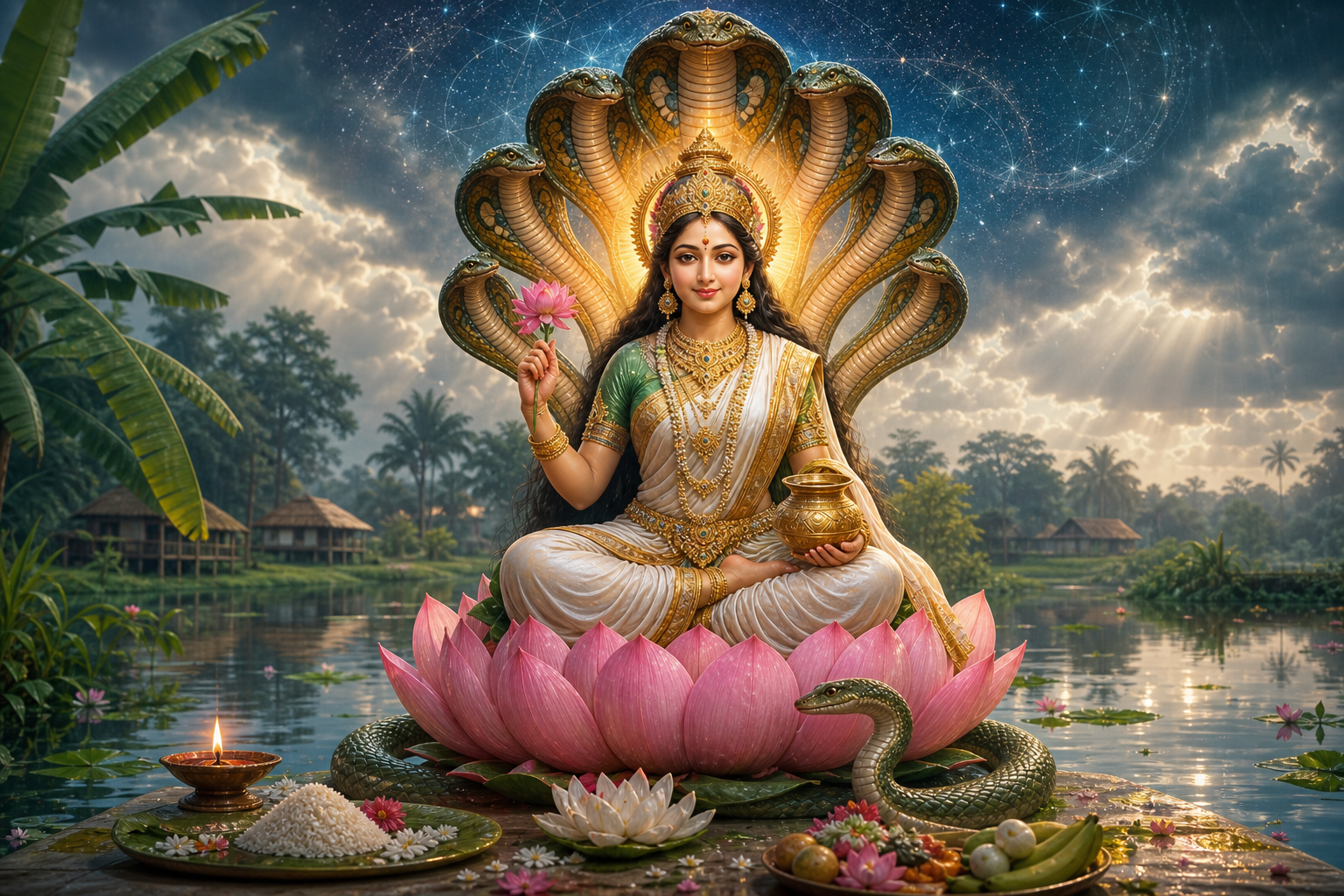
Goddess Manasa occupies a distinctive and deeply layered place within the devotional culture of eastern India. Venerated especially in Bengal, Assam, Odisha, Bihar, Jharkhand, and parts of Bangladesh, she is remembered as the serpent goddess, the protector from snakebite, the healer of poison, the granter of fertility, and a compassionate form of Devi Shakti. Her worship emerges from the meeting point of ecology, folk memory, Puranic imagination, village ritual, and the wider Hindu reverence for the sacred feminine.
The name Jagadgauri, often associated with Goddess Manasa, is rich in theological and poetic meaning. It may be understood through two Sanskritic elements: Jagat, meaning the world or the moving universe, and Gauri, a name associated with radiance, auspiciousness, purity, and the fair, luminous form of the Divine Mother. Jagadgauri therefore suggests “the Gauri of the universe,” “the radiant beauty of the world,” or “the auspicious mother whose grace extends across creation.” When applied to Manasa, the title elevates her beyond a regional serpent deity and presents her as a universal maternal force who protects life wherever danger, fear, fertility, and healing intersect.
In popular devotion, Manasa is not merely a goddess connected to snakes; she is a divine presence who transforms the serpent from an object of dread into a symbol of sacred power. In agrarian societies, especially in humid riverine landscapes such as Bengal and Assam, encounters with snakes were part of daily life. Fields, ponds, monsoon-soaked courtyards, granaries, and village pathways made the serpent both a real biological presence and a powerful religious symbol. Manasa’s worship offered a devotional grammar through which fear could be ritualized, nature could be respected, and human vulnerability could be placed within a larger sacred order.
The title Jagadgauri becomes particularly meaningful when this ecological background is considered. Beauty in this context does not mean ornament alone. It refers to the deeper beauty of cosmic balance: the beauty of a world in which danger has a place, poison can become medicine, fear can become reverence, and the hidden forces of nature can be approached with humility. Manasa is beautiful because she reveals the sacred pattern inside what appears threatening. She is Jagadgauri because she makes the universe intelligible as a field of interdependence rather than a battlefield between human beings and nature.
Traditional accounts of Manasa vary across regions and texts, which is one reason her theology is so compelling. In some narratives, she is described as the mind-born daughter of Lord Shiva, a detail that connects her name Manasa with manas, the mind. In other traditions, she is linked with the sage Kashyapa and associated with the serpent lineage through Vasuki, the great Naga king. She is also remembered as the wife of the sage Jaratkaru and the mother of Astika, the wise child who intervenes in the serpent sacrifice of King Janamejaya. These overlapping genealogies are not contradictions in the modern sense; they show how different communities integrated Manasa into wider Hindu sacred history.
The Astika narrative is especially important for understanding Manasa’s dharmic significance. In the Mahabharata tradition, King Janamejaya performs a great snake sacrifice to avenge the death of his father Parikshit, who died after being bitten by Takshaka. The ritual threatens to annihilate the serpent race. Astika, born through the lineage connected with Manasa, stops the sacrifice through wisdom, restraint, and timely intervention. This episode is not only about serpents; it is about the restoration of dharma when vengeance begins to exceed justice. Through Astika, Manasa becomes associated with preservation, moral balance, and the refusal to let anger consume an entire order of beings.
This dimension makes Manasa’s title Jagadgauri more than devotional praise. She stands for a universe in which even feared beings have a role. The serpent is not romanticized as harmless, nor is it demonized as evil. It is recognized as potent, dangerous, mysterious, and necessary. Such a view resonates with broader dharmic traditions in which life is understood through interdependence, restraint, and reverence. Hinduism, Buddhism, Jainism, and Sikhism each develop distinct theological languages, yet all emphasize in different ways that human life becomes nobler when it is disciplined by compassion, awareness, and responsibility toward other beings.
In Bengal, Manasa is most famously celebrated through the Manasamangal tradition, a body of medieval Bengali devotional literature that narrates her struggle for recognition and worship. The stories of Chand Saudagar, Behula, and Lakhindar are central to this tradition. Chand Saudagar, a wealthy merchant and devoted worshipper of Shiva, resists worshipping Manasa. The dramatic conflict that follows is not merely a tale of divine demand and human stubbornness; it reflects the historical integration of local goddess traditions into broader Sanskritic and Puranic religious frameworks. Through poetry, performance, and ritual memory, Manasa becomes both regional and universal.
Behula’s role in the Manasamangal cycle is particularly powerful. After Lakhindar dies from a serpent bite on their wedding night, Behula undertakes a difficult journey marked by grief, fidelity, courage, and spiritual endurance. Her devotion eventually leads to the restoration of life and the recognition of Manasa’s power. For many devotees, Behula’s story remains emotionally resonant because it gives sacred form to ordinary human experiences: love, loss, helplessness, perseverance, and the longing for divine justice. In this sense, Manasa worship is not abstract theology alone; it is a ritual and literary world that speaks directly to suffering households.
The epithet Jagadgauri also reflects Manasa’s connection with fertility and continuity. In many communities, she is worshipped for children, family welfare, agricultural prosperity, and protection from disease. Snakebite may be the most visible danger associated with her, but her blessings extend to the continuity of life itself. Serpents, because they shed their skin, have long been associated with renewal, rebirth, hidden vitality, and cyclical time. Manasa’s serpent imagery therefore carries a technical symbolic meaning: it points to transformation, survival, and the mysterious regenerative power of nature.
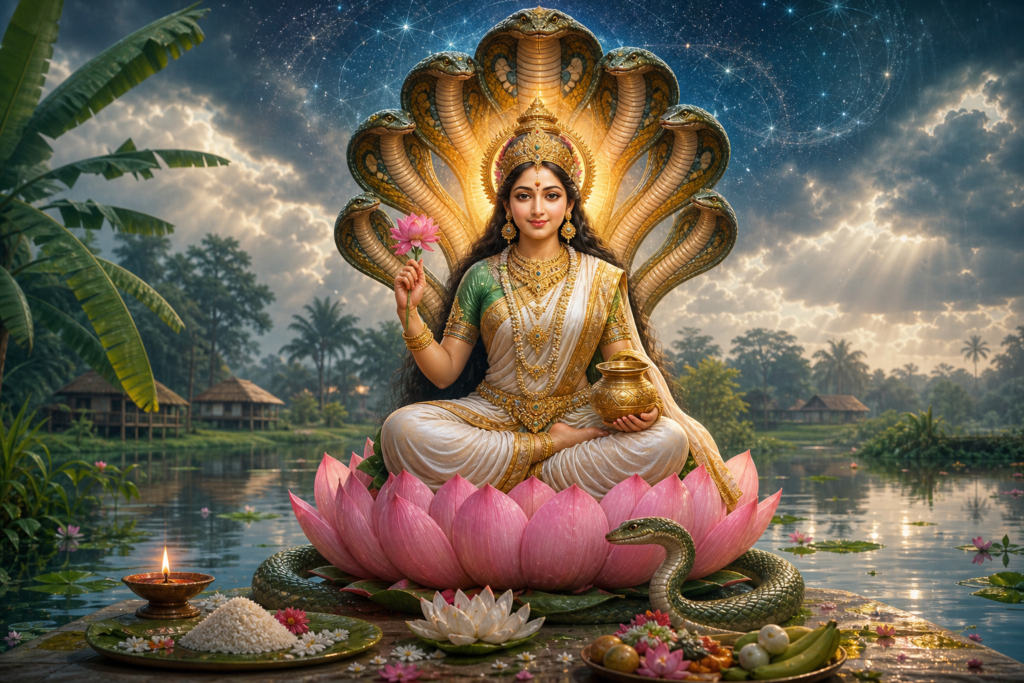
Iconographically, Goddess Manasa is commonly shown seated on a lotus or accompanied by serpents. A canopy of snakes may rise above her head, indicating sovereignty over the Naga realm and mastery over poison. Sometimes she holds a child, sometimes she appears with a pot, a lotus, or other auspicious symbols. The lotus indicates purity arising from difficult conditions, while the serpent canopy marks both protection and divine authority. These visual elements teach a compact theological lesson: the goddess who governs poison also grants shelter; the deity associated with danger also becomes the mother who protects.
The association with Gauri deepens this symbolism. Gauri is widely connected with Parvati, auspicious womanhood, maternal grace, and the luminous power of Shakti. When Manasa is called Jagadgauri, her serpent aspect is not separated from the gentle and auspicious qualities of the Divine Mother. Instead, the title unites both dimensions. She is fierce because she governs poison; she is compassionate because she removes it. She is feared because serpents obey her; she is loved because devotees seek her for protection. This union of fear and tenderness is one of the defining features of Hindu goddess traditions.
Manasa’s worship is often seasonal and closely tied to the monsoon, when snakes become more visible and agricultural life intensifies. Ritual observances may include offerings of milk, flowers, fruits, rice, clay images, sacred songs, and vows undertaken for family protection. In some regions, she is worshipped during Nag Panchami or related serpent festivals; in Bengal, her worship may be connected with the rainy months and with local household traditions. These practices reveal how Hindu ritual life often arises from direct engagement with land, climate, livelihood, and community memory.
From an academic perspective, Manasa represents a significant example of how folk goddess traditions are absorbed, reinterpreted, and dignified within wider Hindu religious culture. Rather than erasing local forms, Hindu practice has often allowed regional deities to flourish through layered identities. Manasa can be a village guardian, a serpent mother, a form of Shakti, a figure in Bengali literature, a Puranic-linked goddess, and Jagadgauri, the luminous beauty of the universe. These identities coexist because Hindu tradition is not built around a single mode of sacred expression.
This plurality is important for the unity of dharmic traditions. The story of Manasa demonstrates that diversity need not weaken spiritual life; it can deepen it. A household ritual, a village song, a Sanskritic name, a literary epic, and a philosophical idea can all participate in the same sacred ecosystem. In a broader Indic setting, this approach encourages respect for different paths of worship, different community memories, and different forms of religious discipline. Manasa’s rise from regional serpent goddess to Jagadgauri shows how unity can be created without flattening diversity.
Theologically, Manasa may also be understood through the lens of poison and purification. Poison is not only a physical substance; it is also a metaphor for fear, anger, jealousy, revenge, disease, and social disorder. In the Astika narrative, the poison of vengeance is checked. In the Behula narrative, the poison of loss is transformed through devotion and endurance. In household worship, the poison of uncertainty is met through ritual trust. Manasa’s power lies in this movement from danger to restoration. Jagadgauri is therefore the beauty that appears after fear has been disciplined by faith.
Her connection with the mind is equally significant. If Manasa is linked with manas, the mind, then her worship suggests mastery over inner serpents as well as outer ones. The human mind can coil around anxiety, suspicion, grief, and attachment. It can also awaken into wisdom, alertness, and devotion. The serpent, in yogic and symbolic traditions, may represent latent power, hidden danger, or awakened consciousness depending on context. Manasa’s name invites reflection on the disciplined mind that learns to face fear without hatred and to respect power without arrogance.
In social terms, Manasa’s stories often center women’s endurance and agency. Behula is not a passive figure; she becomes the one who journeys, negotiates, suffers, persists, and restores life. Manasa herself seeks recognition in a world where established hierarchies resist her. These narratives preserve an important memory of feminine authority: the mother, wife, goddess, and devotee are not ornamental figures but active forces in the restoration of order. This is one reason Manasa remains emotionally powerful in communities where women have carried household vows, ritual songs, and seasonal observances across generations.
The name Jagadgauri also carries aesthetic force. In Indian thought, beauty is rarely only visual; it is connected with auspiciousness, order, proportion, compassion, and spiritual radiance. Manasa’s beauty is paradoxical because it includes serpents, poison, monsoon uncertainty, and mortality. Yet this paradox is precisely what makes the title profound. The universe is not beautiful because it is free of danger. It is beautiful because dharma allows danger to be understood, respected, restrained, and transformed into wisdom.
For contemporary readers, Manasa’s worship offers a meaningful ecological lesson. Modern life often treats nature either as a resource to exploit or as a threat to control. The serpent goddess presents another possibility: coexistence through reverence. Snakes play an important ecological role by controlling rodent populations and maintaining balance in agricultural landscapes. Traditional worship does not replace practical caution or medical treatment for snakebite, but it can cultivate a cultural attitude in which fear does not automatically become violence. This is a valuable insight for environmental ethics today.
It is also important to distinguish devotional meaning from medical practice. Manasa is worshipped as a protector from snakebite and poison, yet responsible communities must still treat snakebite as a medical emergency requiring urgent clinical care. The sacred and the practical need not be opposed. A dharmic approach can honor the goddess through reverence, ecological awareness, and ritual continuity while also recognizing the importance of antivenom, public health education, and timely treatment. In this balanced approach, devotion supports life rather than replacing necessary action.
The enduring reverence for Manasa across Bengal, Assam, Odisha, and neighboring regions shows how religious memory is preserved through both text and lived practice. Scriptures, Puranic associations, folk songs, clay images, household vows, seasonal festivals, and oral storytelling all contribute to her presence. Her worship belongs to farmers, poets, mothers, healers, singers, ritual specialists, and ordinary families. This wide social reach explains why she cannot be confined to a narrow category. She is local and cosmic, folk and theological, intimate and universal.
Calling Goddess Manasa Jagadgauri is therefore an act of recognition. It recognizes the radiance of a goddess who protects the vulnerable, governs serpents, heals poison, grants fertility, and restores balance. It recognizes the beauty of a universe where even feared beings are woven into dharma. It recognizes the spiritual intelligence of communities that transformed anxiety about snakes, disease, and death into rituals of reverence and hope. Above all, it recognizes Manasa as a luminous form of Devi whose grace belongs not only to one region but to the living world itself.
Goddess Manasa is known as Jagadgauri because she reveals beauty at the very point where human beings most often feel fear. Her serpents are not merely symbols of danger; they are signs of hidden wisdom, renewal, ecological balance, and divine protection. Her stories teach restraint in the face of vengeance, devotion in the face of loss, humility before nature, and reverence for the many forms through which Shakti appears. In that sense, Jagadgauri is not only a title. It is a theological insight: the universe becomes beautiful when it is seen through the eyes of dharma.
Inspired by this post on Hindu Blog.








Leave a Reply
You must be logged in to post a comment.