
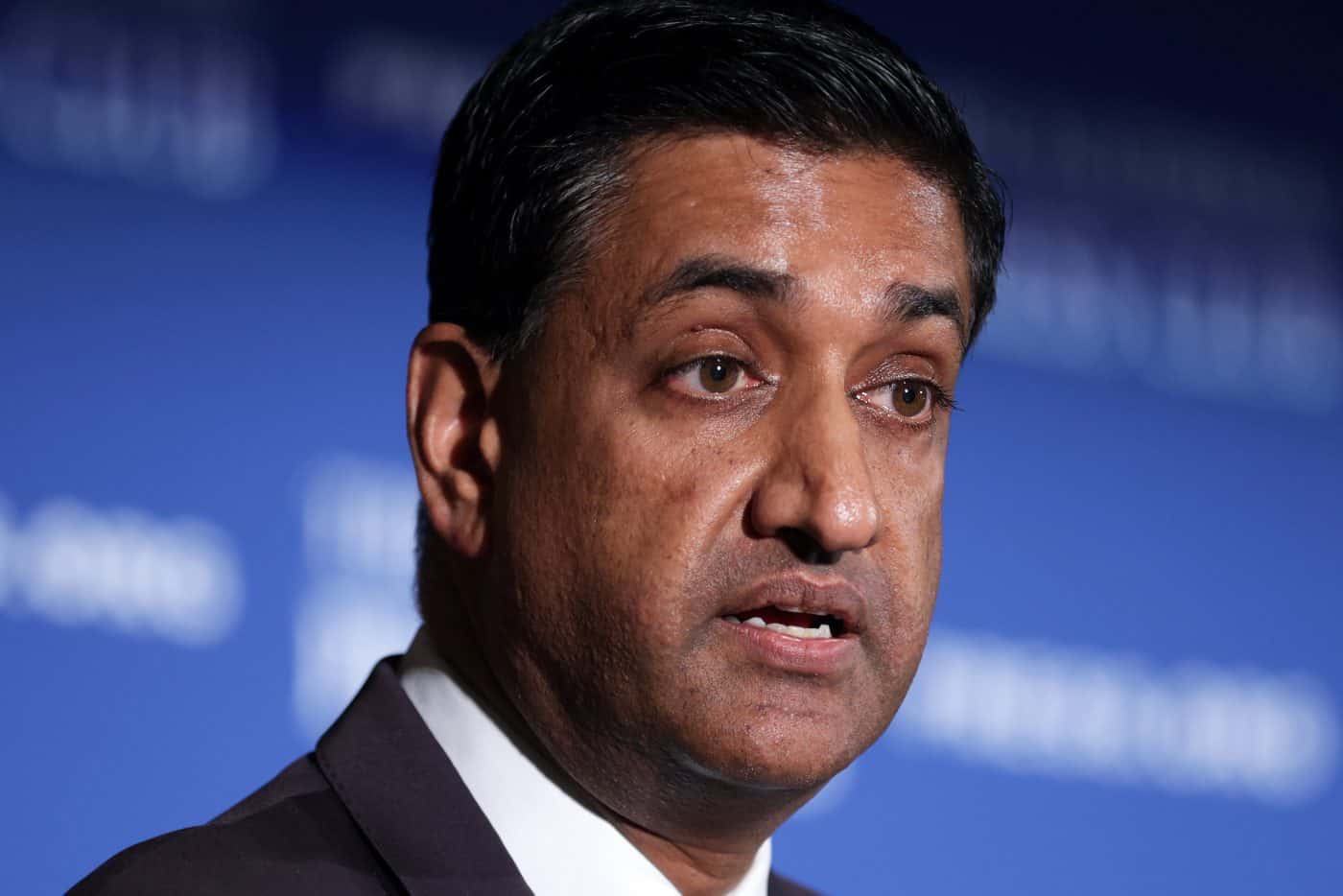
A recent Washington Free Beacon investigation has placed Rep. Ro Khanna, the Democratic congressman from California’s Silicon Valley, at the center of a difficult debate about political ethics, wealth, inheritance, and public credibility. The report argues that Khanna’s public image as a progressive critic of concentrated wealth sits uneasily beside the substantial assets disclosed by his household, including trust structures, luxury real estate, private golf club interests, hedge fund exposure, and a high-value vehicle purchase. Because Khanna is an elected official who regularly speaks about economic inequality, congressional stock trading, and the moral obligations of the wealthy, the details matter beyond personal curiosity. They raise a broader institutional question: how should voters evaluate a politician whose policy language challenges elite wealth while the family balance sheet appears deeply embedded in elite wealth systems?
The Free Beacon report, published on June 30, 2026, describes Khanna as a potential future Democratic presidential contender and frames the story around the tension between his rhetoric and his family’s financial position. According to the report, Khanna has criticized the ultra-rich for hoarding wealth and participating in financial speculation. At the same time, the article states that his immediate family benefits from assets structured through trusts, corporations, and foundations, the very kinds of legal and financial vehicles that often define modern high-net-worth estate planning. This does not, by itself, establish illegality or misconduct. It does, however, create a political and ethical problem because public trust depends not only on compliance with disclosure rules but also on perceived consistency between stated principles and lived arrangements.
The central factual foundation of the controversy is Khanna’s congressional financial disclosure. Members of Congress are required to disclose assets, transactions, liabilities, and income ranges for themselves, spouses, and dependent children. These disclosures are not designed to provide a precise net-worth calculation; they use broad valuation bands, which can make the difference between minimum and maximum estimates extremely large. The Free Beacon says Khanna’s 2024 disclosure ran to hundreds of pages and listed thousands of assets. It estimated that the disclosed assets of Khanna, his wife Ritu Ahuja Khanna, and their children ranged from more than $103 million to more than $340 million, while noting that the true figure could be higher because some assets are reported only as exceeding $1 million with no upper cap.
That technical detail is important. A disclosure system built around ranges can satisfy legal transparency while still leaving citizens without a clear picture of scale. For ordinary families, the difference between $103 million and $340 million is not a rounding error; it is the difference between wealth and generational dynastic power. For a democracy, the question is not whether such wealth is inherently wrong. The question is whether elected officials who speak in the language of economic justice should be expected to explain how their households interact with the tax, trust, investment, and estate-planning systems that preserve elite wealth across generations.
The report traces much of the family wealth to Monte Ahuja, Khanna’s father-in-law, an Indian-born entrepreneur associated with the Cleveland auto parts industry and later investment and philanthropy. Ahuja’s story includes the familiar immigrant-entrepreneur arc: arrival in the United States with limited money, business creation, sale of major business interests, investment management, and philanthropic engagement. That arc deserves to be separated from partisan caricature. Wealth created through enterprise is not automatically unethical. Philanthropy is not automatically hypocrisy. The sharper issue is how inherited and trust-managed wealth can reshape the public meaning of political advocacy when the elected official’s own policy identity is built around resisting concentrated economic power.
The Free Beacon report states that Khanna’s household has been associated with high-end real estate in Washington, D.C., including an 8,000-square-foot home listed for more than $6 million, and that the family was preparing to move to a more expensive home in McLean, Virginia. The article also says the D.C. property includes luxury features such as a multi-story elevator and extensive marble finishes. Such details are politically vivid because they convert abstract wealth into visible symbols. Yet the more serious issue is not marble counters or square footage. It is whether a public servant can convincingly present himself as a critic of oligarchic privilege while inhabiting, through family wealth, the residential and institutional world of the very elite being criticized.
Another prominent detail concerns a $190,000 Range Rover purchased by Ritu Ahuja Khanna, followed by litigation under the District of Columbia’s Lemon Law. The Free Beacon reports that the case later settled for an undisclosed amount. In isolation, a luxury vehicle purchase by a spouse is not a public-policy scandal. But in political communication, symbols matter. A vehicle worth more than a congressional salary becomes an emblem in a broader argument about class, privilege, and the distance between progressive rhetoric and elite consumption. The ethical question remains less about consumer choice and more about whether voters receive enough candor about the material world surrounding their representatives.
The most technically significant portion of the controversy involves trusts and investment vehicles. The report says Khanna’s minor children hold substantial assets through irrevocable trusts, including interests in private golf clubs, a wealth management firm, and hedge funds. Irrevocable trusts are common tools in estate planning. They can transfer assets outside a taxable estate, protect wealth over time, and separate legal control from beneficial ownership. The fact that such trusts exist is not unusual among wealthy families. What makes the matter politically sensitive is that these structures are associated with the long-term preservation of inherited privilege, while Khanna’s public rhetoric emphasizes economic fairness, shared prosperity, and resistance to the power of the ultra-rich.
The Free Beacon also highlights alleged family exposure to hedge funds, including a fund focused on distressed debt. Khanna has publicly criticized hedge funds and has spoken about their role in deepening economic inequality. Distressed-debt investing is a sophisticated strategy in which investors purchase the debt of financially troubled entities, often at a discount, with the expectation of recovery, restructuring, or legal leverage. Supporters view it as a way to price risk, supply liquidity, and discipline markets. Critics argue that it can profit from hardship and intensify pressure on workers, creditors, and distressed communities. If a lawmaker criticizes such finance while the family portfolio benefits from it, the public has a legitimate interest in understanding the boundaries between personal non-involvement, family benefit, and political accountability.
Congressional stock trading is another major point of scrutiny. Khanna has been one of the more visible advocates for restricting or banning individual stock trading by members of Congress, arguing that such trading damages public confidence and creates the appearance of insider advantage. The Free Beacon report, citing public disclosures and third-party tracking, says trusts associated with Khanna’s wife and children engaged in thousands of trades in 2025. Khanna’s own position, reported elsewhere and repeated in coverage of the issue, is that he personally does not trade stocks and has no control or knowledge of trades made by his wife’s trust, which he says was established by his father-in-law before the marriage.
That distinction is important but not complete. A legal separation between a member of Congress and a spouse’s or child’s trust may reduce direct culpability. It does not erase the democratic concern. Public ethics is not only about whether a lawmaker pressed the buy or sell button. It is also about whether the public can reasonably believe that legislative judgment is insulated from household wealth, social networks, donor circles, and family financial interests. When elected officials ask citizens to trust them on tax policy, financial regulation, antitrust enforcement, or wealth taxation, the structure of family benefit becomes part of the public record citizens must evaluate.
The Free Beacon’s account also includes the family’s alleged interests in private golf clubs in Ohio, including Barrington Golf Club, Sand Ridge Golf Club, and Mayfield Country Club. Golf club ownership may sound like a cultural detail, but it is politically revealing because private clubs have long functioned as social infrastructure for wealth: places where capital, philanthropy, law, politics, and business relationships quietly overlap. A politician need not reject such spaces to be ethical. But when the children of a prominent progressive lawmaker reportedly hold valuable interests in such institutions, the issue again becomes one of alignment between public moral vocabulary and private economic location.
There is also a caution that must govern any fair analysis. The article comes from the Washington Free Beacon, a conservative publication with an adversarial posture toward Democratic politicians. Its reporting should therefore be read critically, with attention to documents, disclosures, and attribution. At the same time, the partisan origin of a report does not automatically invalidate the facts it cites. Financial disclosures, real estate records, court filings, and public statements are legitimate materials for scrutiny. The responsible approach is neither to accept every rhetorical flourish nor to dismiss the entire investigation as partisan attack. The responsible approach is to examine the record and ask what it reveals about the relationship between power and money.
This controversy also shows why public life needs a more mature vocabulary for wealth. A person may support higher taxes on the wealthy while being wealthy. A person may inherit wealth while advocating redistribution. A person may live comfortably while opposing extreme inequality. Those positions are not automatically contradictory. The contradiction emerges when transparency is thin, when moral language is severe, and when the household’s financial arrangements appear to benefit from the same systems being publicly denounced. Voters are capable of nuance, but nuance requires disclosure, explanation, and a willingness to answer uncomfortable questions.
For Indian-origin communities and the wider Hindu, Sikh, Jain, and Buddhist diaspora, the episode should not be reduced to identity politics. Khanna’s heritage is not the issue, and neither success nor wealth should be treated as shameful. Dharmic traditions have long recognized the legitimate pursuit of artha, or material prosperity, when bounded by dharma, responsibility, restraint, and social obligation. The ethical question is therefore not whether a public figure’s family has wealth. The question is whether wealth is held, disclosed, defended, and governed in a manner consistent with the public duties the office demands.
That distinction matters because democratic societies suffer when political debate becomes merely theatrical. It is easy to condemn billionaires while exempting centimillionaires. It is easy to denounce speculation while benefiting from professional investment structures. It is easy to demand sacrifice from the abstract rich while leaving one’s own inherited structures untouched. None of this proves bad faith. But it does create a burden of explanation. A politician who campaigns on economic justice must be prepared to address not only opponents’ wealth but also the mechanisms of wealth closest to home.
The broader policy lesson is that congressional disclosure rules remain inadequate for a financial age defined by trusts, private funds, limited liability companies, family offices, and complex ownership layers. Traditional disclosure categories were not built to give citizens a clear view of modern dynastic finance. When a public filing can contain thousands of assets but still leave the public uncertain about true scale, control, risk, and conflicts, transparency becomes formal rather than meaningful. Reform should focus on searchable digital filings, clearer asset ranges for high-value holdings, better identification of beneficial ownership, and stronger rules for blind trusts or diversified vehicles that reduce the appearance of conflict.
Khanna’s office reportedly declined to comment to the Free Beacon. Silence may be legally prudent, but politically it leaves unresolved questions. A more complete public response would explain the extent of Khanna’s control or lack of control over family trusts, the governance of trading decisions, the relationship between policy positions and family investment exposure, and whether he supports reforms that would affect households structured like his own. The public does not need personal humiliation. It needs clarity.
The lasting significance of this story is not the price of a vehicle or the design of a house. It is the credibility of reform politics in an era when elite wealth can be preserved through technical instruments most citizens never encounter. If leaders condemn the "New Gilded Age," they must be willing to show how their own households relate to that age. If they advocate a ban on congressional stock trading, they must address the trading activity of spouse and dependent-child trusts. If they speak of shared prosperity, they must show whether shared sacrifice applies to their own financial ecosystems.
Public ethics is ultimately about trust. The Khanna controversy reminds citizens that trust cannot rest on slogans, party affiliation, or personal biography alone. It must rest on transparent conduct, coherent principles, and the willingness of public officials to submit their own privileges to the same scrutiny they apply to others. That standard is not anti-wealth. It is pro-accountability. In a democracy, especially one shaped by widening economic inequality, that distinction is essential.
Inspired by this post on Hindu Post.







Leave a Reply
You must be logged in to post a comment.