
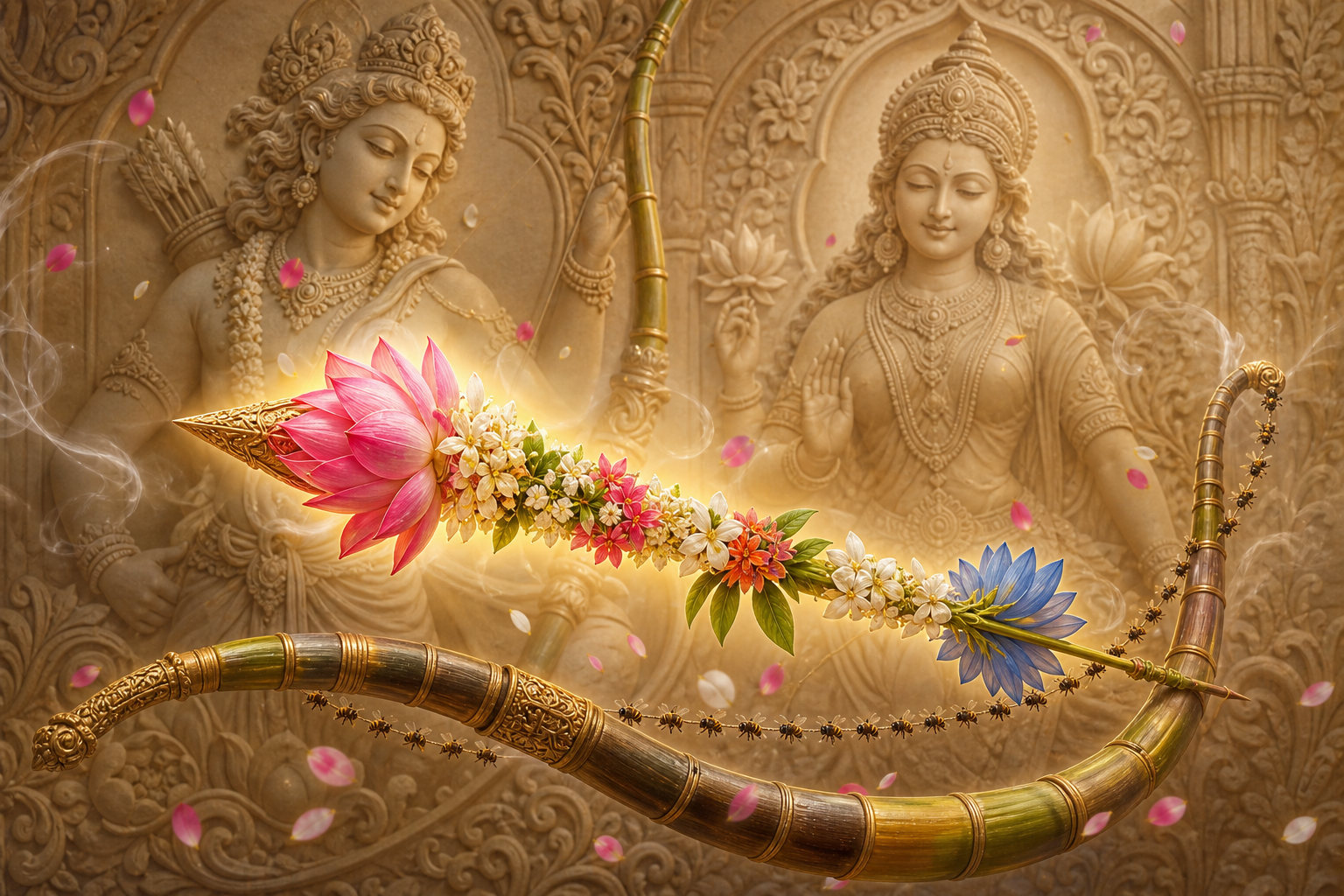
Among the many sacred attributes found in Hindu sculpture and iconography, the pushpa bana, or flower arrow, holds a rare and deeply suggestive position. It is an ayudha, yet it does not belong to the language of battlefield violence. It is a weapon of fragrance, touch, longing, beauty, and inward transformation. Its force is not measured by bloodshed or conquest, but by its ability to stir consciousness, soften pride, awaken devotion, and redirect human desire toward a higher spiritual purpose.
In Hindu sacred art, weapons are rarely merely weapons. The trident of Shiva, the discus of Vishnu, the bow of Rama, the mace of Hanuman, and the sword of Devi all carry philosophical meanings that extend beyond physical action. The pushpa bana belongs to this same symbolic world, but it introduces a gentler theological vocabulary. It shows that divine power can pierce without wounding, command without aggression, and transform without destruction.
The term pushpa bana combines two Sanskrit ideas: pushpa, meaning flower, and bana, meaning arrow. This pairing is deliberately paradoxical. An arrow is normally associated with direction, speed, impact, and penetration. A flower is associated with fragrance, tenderness, impermanence, beauty, and offering. When these two are joined, Hindu thought creates a symbol that can speak simultaneously about desire, devotion, aesthetic experience, and the subtle workings of the mind.
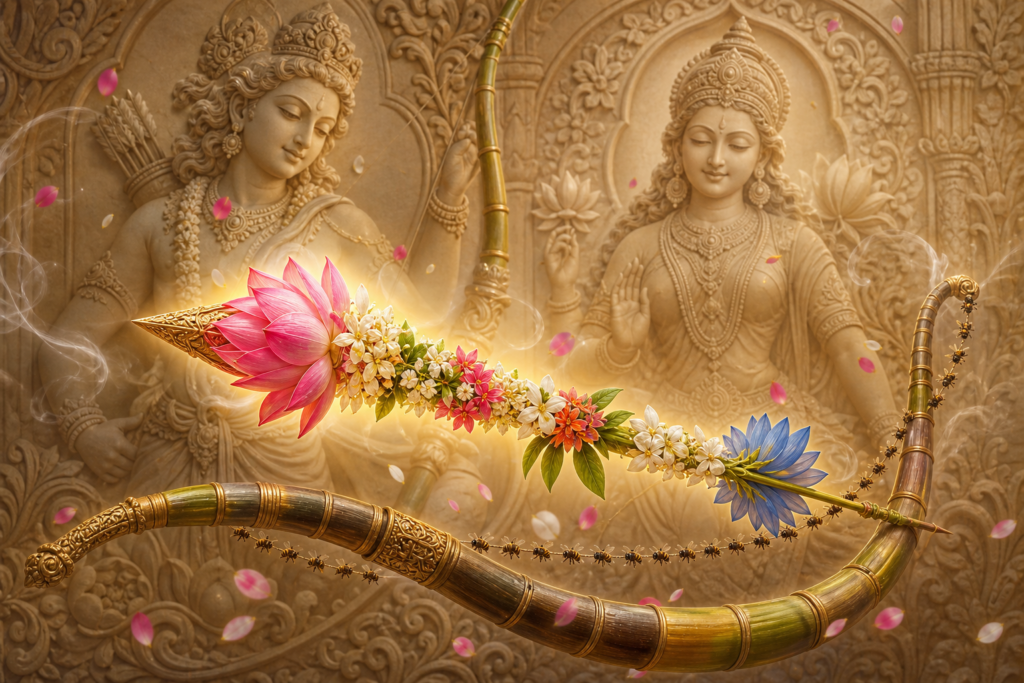
The flower arrow is most closely associated with Kamadeva, also known as Kama, Manmatha, Madana, or Kandarpa, the deity of desire and attraction. In classical Hindu iconography, Kamadeva is often shown holding a sugarcane bow strung with bees and carrying arrows tipped with flowers. The image is delicate, almost playful, yet it represents one of the most powerful forces in embodied existence: the impulse that draws beings toward one another, sustains worldly life, and, when refined, can become the emotional foundation of bhakti.
The pushpa bana therefore cannot be dismissed as a decorative motif. It belongs to a sophisticated Hindu understanding of kama, one of the purusharthas, or recognized aims of human life. Dharma, artha, kama, and moksha together form a broad vision of human flourishing. Kama is not automatically condemned; it is to be understood, disciplined, elevated, and harmonized with dharma. The flower arrow makes this point visually. Desire is real, powerful, and penetrating, but it need not be crude or destructive when guided by sacred order.
Textual traditions often speak of five flower arrows associated with Kamadeva, though the exact list of flowers and their emotional effects varies across sources and regions. References commonly include blossoms such as aśoka, mango flower, jasmine, blue lotus, and lotus. These variations are not accidental weaknesses in the tradition; they reflect the regional, poetic, and ritual richness of Hindu culture. The core idea remains stable: the senses are moved not by iron but by beauty, fragrance, memory, and suggestion.
Iconographically, Kamadeva’s flower arrows are usually read together with his sugarcane bow. Sugarcane suggests sweetness, fertility, and the sensory attraction of life. The bee-string suggests restlessness, vibration, and the hum of desire. The arrows of flowers suggest the five sensory pathways through which attraction enters human experience. Together, these elements create an image of psychological precision. Hindu sculpture turns the inner movement of longing into a visible sacred form.
The pushpa bana also appears in the iconography of Lalita Tripura Sundari, one of the most refined forms of the Divine Mother in Shakta traditions. In many depictions, she holds a sugarcane bow and five flower arrows, along with the noose and goad. Here the symbolism becomes more explicitly metaphysical. The bow can represent the mind, while the flower arrows are often understood in relation to the five tanmatras or subtle sensory potentials. The Goddess does not merely attract; she governs the subtle structure through which perception itself arises.
This Shakta interpretation deepens the meaning of the flower arrow. In the hands of Lalita Tripura Sundari, the pushpa bana is not limited to romantic desire. It becomes an emblem of cosmic creativity, aesthetic power, and spiritual magnetism. The universe is drawn into manifestation through attraction, relationship, and awareness. What seems like beauty in sculpture is also a statement about ontology: existence itself is woven through subtle forces that bind, move, and awaken consciousness.
In temple sculpture, the pushpa bana often appears within a wider visual field of divine couples, attendants, celestial beings, and auspicious motifs. Such imagery should not be reduced to sensual ornament. Hindu temple art frequently places human emotion, cosmic order, and spiritual aspiration within the same sacred environment. The flower arrow belongs to this integrated worldview. It acknowledges that human beings do not approach the divine as abstract minds alone; they come with longing, affection, memory, vulnerability, and the desire to be transformed.
The story of Kamadeva and Shiva gives the pushpa bana one of its most dramatic theological contexts. When the gods seek to disturb Shiva’s meditation so that he may unite with Parvati and bring forth the power needed to defeat adharma, Kamadeva releases his flower arrow. Shiva, disturbed from yogic absorption, opens his third eye and burns Kama. On the surface, the story appears to oppose desire and asceticism. At a deeper level, it shows the purification of desire in the presence of supreme consciousness.
Kamadeva’s burning does not mean that love is rejected. Rather, ungoverned desire cannot stand before the fire of jnana. Yet the world still requires relationship, creation, fertility, and affection. In later devotional imagination, Kama’s bodiless state points to the subtle nature of desire itself. Desire may not always be visible, but it continues to move hearts, societies, and spiritual journeys. The pushpa bana thus becomes a symbol of invisible influence: soft, fragrant, and difficult to resist.
This is why the flower arrow is philosophically more complex than a simple love symbol. It teaches that the strongest impulses in life often arrive gently. A word, a glance, a fragrance, a melody, or a memory can redirect the mind more effectively than force. Hindu iconography captures this psychological truth with remarkable economy. The pushpa bana pierces because beauty has direction; it is not passive. It enters perception, awakens response, and shapes action.
From an aesthetic perspective, the pushpa bana belongs to the world of rasa. Classical Indian thought recognizes that art does not merely imitate emotion; it refines emotion into contemplative experience. The flower arrow evokes śṛṅgāra rasa, the mood of love and beauty, but it can also lead toward bhakti when affection is directed toward the divine. In this movement, desire becomes devotion, attraction becomes surrender, and beauty becomes a pathway to transcendence.
The connection between pushpa bana and bhakti is especially important. Devotional traditions often speak of the heart being pierced by divine love. This piercing is not violent; it is awakening. The devotee feels drawn toward Krishna, Shiva, Devi, Rama, or the chosen Ishta with an intensity that ordinary language struggles to describe. The flower arrow offers a visual grammar for that experience. It helps explain why sacred love can be sweet and unsettling at the same time.
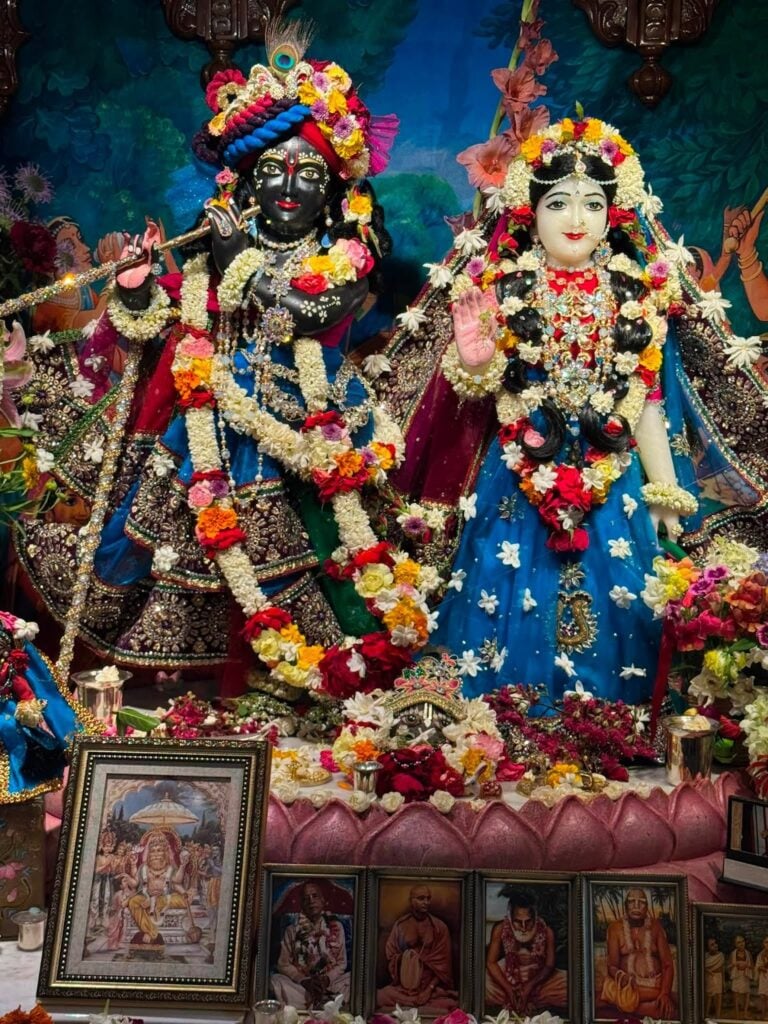
In Vaishnava contexts, the language of divine attraction is central to Krishna bhakti. Krishna’s beauty, flute, compassion, and līlā draw devotees inward. Although the pushpa bana is not always physically shown in Krishna iconography, the principle behind it is present: divine beauty attracts the soul. The highest love is not coercive. It invites, enchants, and transforms. This makes the flower arrow a useful symbolic bridge between iconography and lived devotional experience.
The same broad insight can support unity among dharmic traditions. Hinduism, Buddhism, Jainism, and Sikhism differ in theology, practice, and scriptural frameworks, yet all recognize the need to discipline craving, cultivate compassion, and refine the inner life. The pushpa bana, when interpreted responsibly, does not celebrate indulgence. It points toward the transformation of impulse into awareness, affection into service, and attraction into a more ethical relationship with the world.
For Buddhist readers, the image may evoke reflection on desire as a force that must be understood and transformed rather than blindly obeyed. For Jain readers, the softness of the flower arrow can resonate with the ethic of non-injury and restraint. For Sikh readers, the movement from attachment toward loving remembrance of the Divine offers a meaningful parallel. Such comparisons should be made with care, but they show how dharmic traditions can converse through shared concerns about consciousness, discipline, compassion, and liberation.
The pushpa bana is also significant because it challenges modern assumptions about power. Contemporary culture often equates power with domination, speed, volume, and visible control. Hindu sacred art offers a subtler proposition. A flower can be more persuasive than a blade. Fragrance can travel where command cannot. Love can transform where fear merely suppresses. The flower arrow therefore becomes a critique of crude power and a reminder that the deepest transformations are often interior.
In sculptural terms, the flower arrow also demonstrates the technical intelligence of Hindu artists. The challenge is not only theological but visual. How does a sculptor show an arrow that is soft? How does stone convey fragrance, tenderness, and psychological force? Through posture, gesture, attribute, proportion, and contextual placement, the artist makes the invisible visible. The result is not merely an object held by a deity, but a compact philosophical statement carved into sacred form.
Hindu iconography often uses such attributes as teaching devices. A devotee standing before a murti may not receive a formal lecture on metaphysics, psychology, or aesthetics. Yet the visual arrangement communicates these ideas quietly. The pushpa bana teaches that the senses can bind, but they can also become instruments of refinement. Flowers offered in worship, flowers worn in the hair, flowers decorating the deity, and flowers forming divine arrows all participate in the same symbolic field of beauty, impermanence, and sacred offering.
The contrast between metal arrows and flower arrows is therefore central. Metal arrows belong to the grammar of protection, conflict, and decisive action. Flower arrows belong to the grammar of attraction, persuasion, and inward stirring. Hindu sacred art has room for both because life requires both strength and tenderness. Dharma is protected by courage, but it is sustained by love, beauty, restraint, and the capacity to recognize divinity in relationship.
This duality is visible across Hindu traditions. Shiva’s ascetic fire, Vishnu’s sustaining compassion, Devi’s sovereign power, Krishna’s irresistible sweetness, and Rama’s disciplined virtue all show different modes of divine presence. The pushpa bana belongs especially to the mode of sweetness and attraction, but it does not stand outside discipline. Its true meaning emerges only when kama is placed within dharma and ultimately oriented toward moksha.
Modern readers may find the symbol personally relatable because human life is constantly shaped by subtle arrows. Attraction to beauty, longing for companionship, attachment to memory, the pull of music, the comfort of fragrance, and the desire for belonging all influence conduct. Hindu philosophy does not deny these forces. It asks that they be observed, purified, and directed toward a life of responsibility and spiritual maturity.
The emotional depth of the pushpa bana lies in this recognition. Love is not always dramatic. It may arrive like a flower: gentle, fragrant, temporary, and transformative. Yet its effect can be lasting. A devotee may remember the sight of a temple image, the scent of sandalwood and flowers, or the stillness of a sanctum long after leaving the shrine. Such experiences reveal why sacred art matters. It does not merely decorate religious life; it shapes memory, feeling, and aspiration.
As a symbol of divine love, the pushpa bana invites a disciplined reading of tenderness. It is not sentimental in a shallow sense. It is tender because it recognizes that the human heart is vulnerable, impressionable, and capable of elevation. It is divine because the force it represents can move beyond personal desire into devotion, compassion, and the longing for union with the sacred.
In this way, the flower arrow remains one of the most refined symbols in Hindu sculpture and sacred philosophy. It unites art, psychology, theology, and devotion in a single image. It reminds viewers that not every divine weapon destroys; some awaken. Not every arrow wounds; some open the heart. The pushpa bana endures because it expresses a truth central to Hindu spirituality: love, when guided by dharma and illumined by wisdom, becomes a path toward the Divine.
Inspired by this post on Hindu Blog.



Leave a Reply
You must be logged in to post a comment.