

ISKCON New Goloka in Hillsborough, North Carolina, stands as a significant Hare Krishna Bhakti Yoga Center where temple worship, scriptural study, education, music, prasadam, and community service are woven into one living institution. Its story is not merely the story of a temple building; it is the story of how a rural wooded site became a spiritual, cultural, and educational home for thousands of families across the American Southeast.
The center belongs to the International Society for Krishna Consciousness, commonly known as ISKCON, a global Gaudiya Vaishnava movement introduced to the Western world by His Divine Grace A. C. Bhaktivedanta Swami Srila Prabhupada. New Goloka was incorporated in Hillsborough in 1985 and has since grown into one of the many ISKCON centers serving seekers interested in Bhagavad Gita study, Krishna consciousness, mantra meditation, vegetarian devotional culture, and the disciplined practice of bhakti-yoga.
Historically, New Goloka began with a vision brought to North Carolina in 1982 by His Holiness Bir Krsna Das Goswami. The initial purpose was pedagogical as much as devotional: to create a place where the teachings of the Bhagavad-gita and related Vedic literature could be studied, practiced, and transmitted in a community setting. This matters because ISKCON temples are not only ritual sites; they function as educational, social, and cultural institutions where philosophy is translated into daily practice.
The early history of the temple reveals a pattern familiar to many diaspora dharmic institutions: a small group, limited material means, a demanding physical environment, and a large spiritual aspiration. The original site was a wooded five-acre parcel. Devotees cleared land, built basic facilities, gathered modest resources, and endured difficult conditions while keeping alive a disciplined hope that a more stable temple community would eventually emerge.
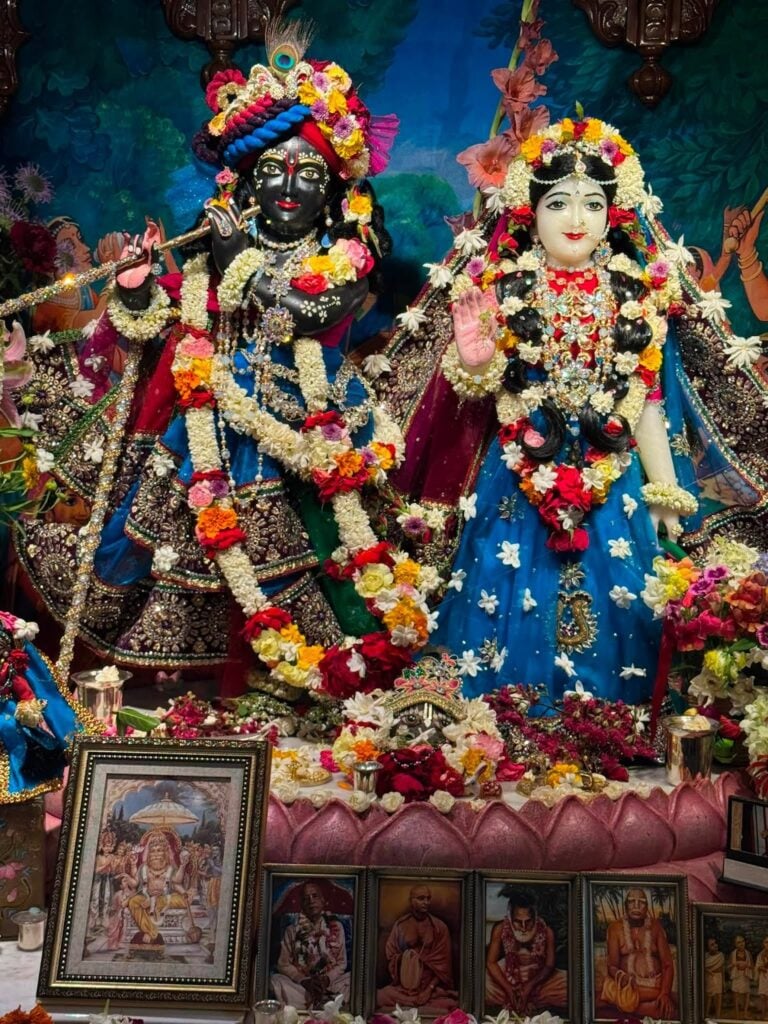
The memory of those early years is important because it anchors the present institution in sacrifice rather than convenience. The first worship space was simple and fragile, and the community was small. Yet from that setting arose a culture centered on Sri Sri Radha Golokananda, whose installation on Janmastami 1985 marked a defining moment in the life of the temple. In devotional communities, such an installation is not treated as symbolic ornamentation; it becomes the organizing center of liturgy, discipline, aesthetics, time, food, education, and social belonging.
Today, the temple’s worship culture is notably structured. New Goloka describes its deity seva as a high standard of worship for Sri Sri Radha Golokananda, with five aratiks beginning at 4:30 a.m. and five daily bhoga offerings prepared according to authorized Vaishnava standards such as the Narada Pancharatrika tradition. This daily rhythm is a technical feature of temple life: sacred time is divided into offerings, darshan, music, recitation, food preparation, and community participation.
From an academic perspective, such ritual regularity gives a temple its stability. A visitor may see lamps, flowers, incense, music, and prasadam, but behind those visible elements is a complex system of training, cleanliness, scheduling, theology, agricultural ethics, culinary discipline, and scriptural reference. The sensory beauty of worship is sustained by a rigorous practical infrastructure.
The philosophical center of New Goloka is Krishna consciousness, understood within the Gaudiya Vaishnava tradition. This worldview teaches that living beings are eternal spiritual selves, distinct from the temporary body, and that the highest fulfillment of human life lies in the awakening of loving service to Krishna. In this framework, bhakti-yoga is not merely emotional devotion; it is a disciplined path involving hearing, chanting, remembrance, worship, ethical conduct, association, and service.
The Hare Krishna mantra occupies a central place in this practice: Hare Krishna Hare Krishna Krishna Krishna Hare Hare Hare Rama Hare Rama Rama Rama Hare Hare. In ISKCON’s theology, chanting is both meditative and relational. It trains attention, purifies consciousness, and brings the practitioner into a devotional relationship with the Divine through sacred sound. For many modern seekers, this makes mantra meditation especially accessible because it requires sincerity and repetition rather than social status, birth identity, or specialized intellectual background.
New Goloka’s public identity emphasizes openness. Its stated mission invites people regardless of caste, creed, or color to participate in chanting, dancing, philosophical discussion, and prasadam. This inclusive language is especially significant in the context of a dharmic unity-oriented reading of the temple. While New Goloka is specifically Gaudiya Vaishnava, its broader values of seva, ahimsa, spiritual education, disciplined self-cultivation, and reverence for sacred life resonate across Hindu, Buddhist, Jain, and Sikh civilizational traditions.
This shared dharmic vocabulary should not erase theological distinctions. Vaishnavism has its own scriptures, ritual forms, lineage structures, and devotional theology. Yet a mature understanding of dharmic traditions recognizes that unity does not require uniformity. A Krishna temple can remain deeply Vaishnava while also contributing to a larger culture of pluralism, ethical living, vegetarian hospitality, spiritual inquiry, and respect for multiple paths of self-transformation.
The temple’s festival calendar demonstrates how theology becomes public culture. Janmashtami, Diwali, Govardhan Puja, Gaura Purnima, Holi, Balarama Purnima, and Jagannath Ratha Yatra are not treated only as commemorative dates; they become immersive experiences involving kirtan, discourse, abhishek, dance, drama, prasadam, and intergenerational participation. New Goloka reports that Janmashtami celebrations have served more than 5,000 people, while other major festivals often draw hundreds.
Such festivals are central to diaspora Hindu temple life because they transmit memory through embodied experience. Children remember colors, music, lamps, food, stories, and the emotional atmosphere of gathering. Adults often find in these festivals a continuity with ancestral culture that might otherwise be weakened by migration, professional pressure, and the fragmentation of modern family life.
The weekly Sunday program performs a similar role on a more regular scale. New Goloka describes its Sunday gatherings as including kirtan, aratika, classes on Vedic books, and prasadam. Around 150 participants have been associated with these weekly programs. In community terms, this is where temple life becomes ordinary rather than occasional. Families meet, children observe devotional practice, newcomers ask questions, and spiritual learning becomes part of a weekly rhythm.
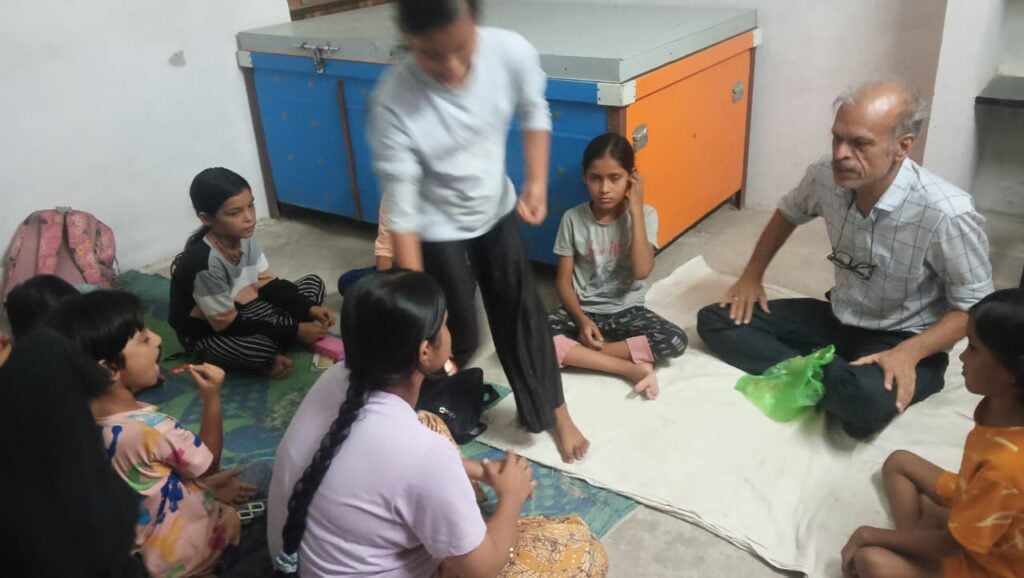
Education is one of the strongest dimensions of the New Goloka model. The temple offers children’s education rooted in the Bhagavad Gita, Srimad Bhagavatam, Mahabharata, Puranas, slokas, bhajans, moral reasoning, games, projects, skits, and interactive activities. The stated concern is that modern education often trains technological competence while neglecting purpose, character, self-mastery, and spiritual literacy.
This critique has wider relevance. Many dharmic families in the United States face the challenge of raising children who are academically capable yet culturally unmoored. A temple-based educational program attempts to address that gap by giving children a vocabulary for duty, gratitude, discipline, humility, compassion, and the sacred. When taught carefully, such education need not isolate children from the modern world; it can equip them to engage it with moral clarity.
BKG Academy extends this educational mission through individualized bhakti-based learning. It is described as a homeschool cooperative operating at New Goloka under the guidance of Bir Krishna Goswami and the legacy of Srila Prabhupada. Its model combines standard academics, devotional arts, practical life skills, scripture, kirtan, japa meditation, nature, and close parent-community collaboration.
The academy’s approach is technically interesting because it treats education as integrated formation rather than mere information transfer. Academic proficiency remains important, but the institution also asks how a child develops socially, spiritually, ethically, and aesthetically. The educational environment near the temple and woods reinforces a sense that learning is not confined to desks and tests; it includes nature, worship, service, food, music, and relationship.
New Goloka’s outreach also extends beyond temple grounds. Devotees have engaged universities such as UNC, Duke, and NC State through prasadam distribution, vegetarian cooking instruction, bhakti-yoga teaching, and mantra meditation rooted in the Bhagavad Gita. This form of outreach reflects a classic ISKCON pattern: philosophy is shared not only through lectures but through food, music, books, and accessible practices.
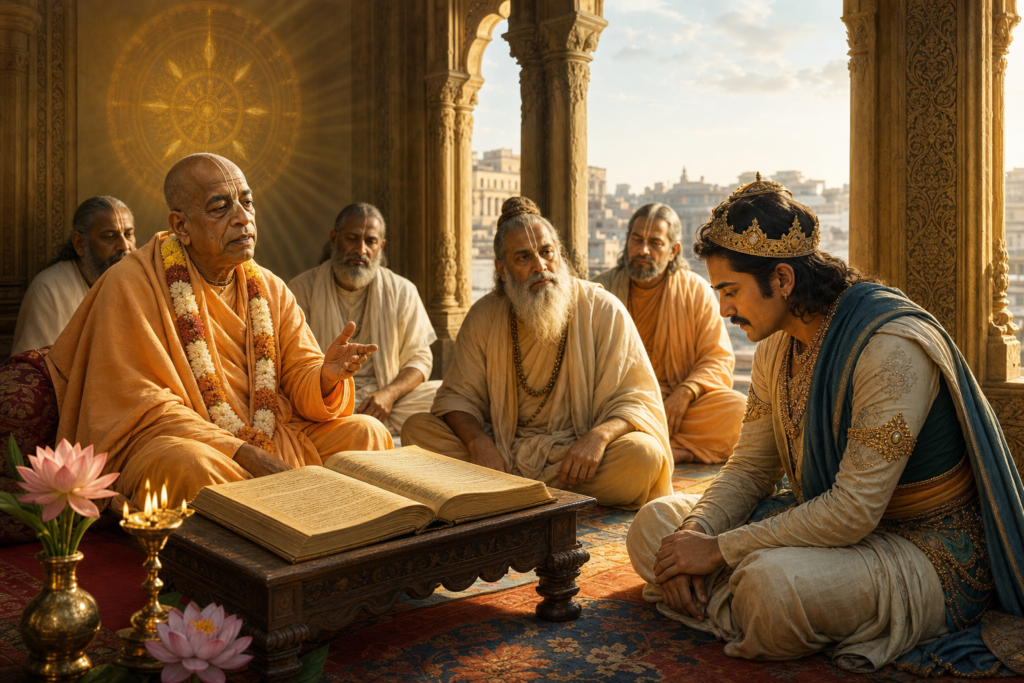
The distribution of spiritual literature remains another defining feature. New Goloka reports annual distribution of more than 20,000 spiritual books to places such as universities, hospitals, and motels. In ISKCON history, book distribution has always been more than a publishing activity; it is treated as a form of knowledge-sharing, carrying the Bhagavad Gita, Srimad Bhagavatam, and Vaishnava thought into spaces where formal religious instruction may not otherwise occur.
The temple’s physical infrastructure has also developed in response to community growth. A commercial-grade kitchen was inaugurated in 2018, enabling cooking for more than 500 people at a time. A 4,000-square-foot pavilion was converted into a multipurpose congregational hall around 2019-2020, supporting cultural programs, yajnas, marriage ceremonies, stage events, prasadam service, and large gatherings. A Tulasi greenhouse and children’s play area further show how ritual, ecology, and family life are being accommodated.
Food deserves special attention in any serious study of ISKCON New Goloka. Prasadam is not ordinary vegetarian cuisine in the Vaishnava understanding; it is food prepared and offered to Krishna with devotion before being shared. This practice links theology, agriculture, kitchen discipline, hospitality, and community care. It also creates one of the most relatable entry points for newcomers, because shared food often communicates welcome before doctrinal language is fully understood.
The mention of Brajboro Gaushala as a community project further expands the temple’s dharmic ecology. Cow protection and compassionate care for animals have long held importance in Vaishnava culture and broader Hindu ethics. When approached responsibly, such projects connect ahimsa, sustainability, food ethics, sacred ecology, and practical service in a way that can speak to both traditional devotees and modern ecological concerns.
New Goloka is also a case study in Hindu diaspora institution-building. Located at 1032 Dimmocks Mill Road in Hillsborough, it serves families from southern Virginia to northern South Carolina. This geographic range indicates that many devotees and visitors are willing to travel significant distances for temple worship, festivals, education, and association. A temple therefore becomes not simply a local religious site but a regional cultural anchor.
Its location in North Carolina is meaningful. Unlike older Hindu population centers in major coastal cities, regional dharmic institutions in the American South often grow through patient congregation-building, home programs, student outreach, and festival visibility. New Goloka’s family bhakti groups in areas such as Cary, Morrisville, Hillsborough, Holly Springs, Fuquay Varina, Greensboro, Winston-Salem, Raleigh, and Charlotte reflect this decentralized model of spiritual community formation.
For visitors, the emotional significance of such a place may be immediate. The sound of kirtan, the fragrance of prasadam, the sight of children learning slokas, and the discipline of early morning worship can create a sense of continuity that feels rare in a distracted age. Yet the deeper value of New Goloka lies in how it converts that feeling into practice: regular chanting, study, service, education, and community responsibility.
Academically, ISKCON New Goloka can be understood through three overlapping lenses. First, it is a Gaudiya Vaishnava temple centered on Sri Sri Radha Golokananda and the teachings of Srila Prabhupada. Second, it is a diaspora cultural institution preserving and adapting Hindu devotional practices in the United States. Third, it is an educational and social ecosystem that uses festivals, food, music, scripture, children’s programs, and service to form a durable community.
The most constructive way to understand New Goloka is to see it as a living dharmic institution rather than a static religious monument. Its history includes hardship, local resistance, volunteer labor, ritual dedication, educational experimentation, and steady expansion. Its present form reflects the accumulated effort of devotees who turned a wooded property into a temple-centered community with regional reach.
In the broader landscape of Hindu temples abroad, ISKCON New Goloka offers a powerful example of how Krishna consciousness can be practiced as worship, learning, hospitality, and disciplined community life. Its significance is not limited to those already within ISKCON. For anyone interested in Hindu temples, Vaishnava theology, dharmic education, diaspora identity, or the practical meaning of bhakti-yoga, New Goloka provides a compelling case of devotion made institutional, visible, and generational.
Factual details in this profile are grounded in ISKCON New Goloka’s published pages on its mission and programs, temple history, basic philosophy, children’s education, BKG Academy, and new temple project.
Inspired by this post on Dandavats.








Leave a Reply
You must be logged in to post a comment.