

The title HG Daivi Shakti Mataji || Srila Prabhupada Lilamrita || 05.07.2026 points toward a devotional reflection on the life and mission of His Divine Grace A. C. Bhaktivedanta Swami Prabhupada, the founder-acharya of the International Society for Krishna Consciousness, commonly known as ISKCON. Since the available source material contains only the episode title and thumbnail, the safest and most faithful approach is to develop the subject through the known historical, theological, and cultural context of Srila Prabhupada-lilamrta, the respected biographical work associated with Satsvarupa dasa Goswami, and through the wider Gaudiya Vaishnava tradition that shaped Srila Prabhupada’s life.
Srila Prabhupada’s life is often studied not merely as the biography of a religious teacher, but as a case study in spiritual discipline, intercultural communication, scriptural transmission, and institution building. Born as Abhay Charan De in Calcutta in 1896, he belonged to a world in which colonial India, Bengali devotional culture, Vaishnava learning, and modern global exchange were beginning to intersect in new ways. His later journey to the West in 1965, at an advanced age and with limited material resources, has become one of the most frequently remembered episodes in modern Hindu spiritual history.
The phrase Srila Prabhupada Lilamrita carries two important ideas. Lila points to divine activity, sacred movement, and the meaningful unfolding of a life dedicated to Krishna. Amrita suggests nectar, that which nourishes and gives spiritual vitality. Together, the title frames biography as more than chronology. It invites readers and listeners to consider how devotion, hardship, discipline, scholarship, and compassion can become spiritually instructive when viewed through the lens of bhakti.
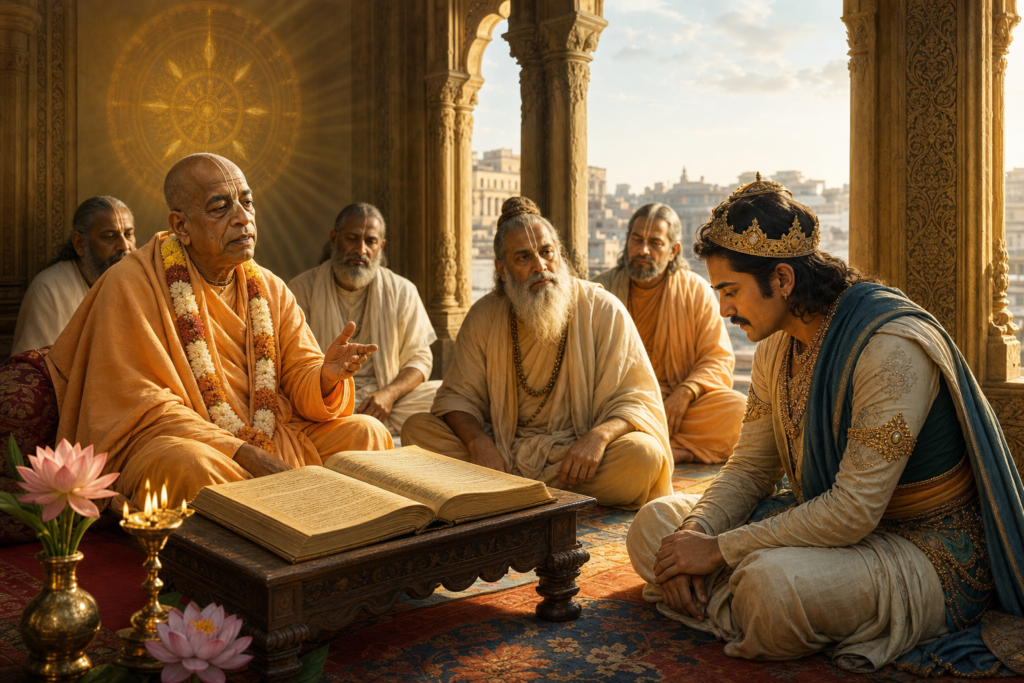
In Gaudiya Vaishnavism, the guru is not treated as an isolated charismatic figure, but as a servant within a parampara, a living chain of transmission. Srila Prabhupada’s own mission was rooted in the instruction he received from Bhaktisiddhanta Sarasvati Thakura: to present Krishna consciousness in the English language and carry the teachings of Chaitanya Mahaprabhu beyond regional and linguistic boundaries. This historical point is crucial, because it prevents the study of Srila Prabhupada from becoming personality-centered in a shallow sense. His work becomes intelligible only when placed within the larger guru-shishya tradition.
That tradition emphasizes obedience, but not blind imitation. It requires disciplined hearing, thoughtful inquiry, ethical conduct, and practical service. Srila Prabhupada’s life demonstrates this balance. He translated and commented on major Sanskrit texts, especially the Bhagavad Gita and Srimad Bhagavatam, while also building communities, training students, encouraging kirtan, teaching prasadam distribution, and establishing a practical rhythm of worship and study. His contribution therefore belongs simultaneously to scripture, philosophy, public religion, and lived culture.
The academic significance of Srila Prabhupada’s mission lies partly in its method of transmission. He did not present Hindu dharma as a private ethnic inheritance unavailable to others. He presented Krishna bhakti as a disciplined spiritual path grounded in shastra, practice, and transformation of consciousness. This was especially important in the second half of the twentieth century, when many young people in Europe and North America were questioning materialism, institutional religion, social fragmentation, and the limits of consumer culture.
Yet the emotional force of his story comes from the simplicity of the beginning. An elderly Vaishnava sannyasi travelled by cargo ship from India to America, carrying books and faith. He had no institutional machinery waiting for him in New York, no guaranteed audience, and no cultural advantage in the environment he entered. Such details have become central to devotional memory because they make perseverance visible. For many seekers, this is where history becomes personally relatable: spiritual work often begins without certainty, applause, or comfort.
Srila Prabhupada’s early preaching in New York is also a powerful example of cultural translation. He did not dilute the core of the tradition, yet he communicated it through accessible practices: chanting the Hare Krishna maha-mantra, hearing from the Bhagavad Gita, honoring prasadam, and associating with devotees. These practices did not require prior Sanskrit training or inherited ritual expertise. They opened a doorway through sound, food, discipline, and community.
This accessibility helps explain why the Hare Krishna movement became globally recognizable. Kirtan entered public parks, streets, temples, homes, and universities. The maha-mantra became both a form of meditation and a public expression of devotion. From a sociological perspective, this was a remarkable expansion of a traditional Vaishnava practice into modern global public space. From a devotional perspective, it was sankirtana, the collective glorification of Krishna, continuing the mission of Chaitanya Mahaprabhu.
The study of Srila Prabhupada-lilamrta is therefore not only about reverence. It also asks readers to think carefully about discipline, authorship, memory, and institutional formation. Hagiographical literature, when approached responsibly, preserves the inner meaning of a saintly life while also offering concrete historical details. It records journeys, conversations, struggles, instructions, conflicts, and turning points. In this way, it becomes both devotional literature and a resource for understanding modern Hindu history.
A mature reading of Srila Prabhupada’s life should also recognize that spiritual institutions operate in human history. They grow, face pressures, make decisions, encounter criticism, and require reform. This does not diminish the importance of the spiritual ideal. Rather, it highlights a central dharmic lesson: institutions need humility, accountability, and continuous alignment with their founding principles. The life of a guru is best honored when followers cultivate integrity, not merely admiration.
One of the most important principles in Srila Prabhupada’s teaching is that bhakti is not sentimentalism. Devotion includes feeling, but it is trained feeling. It is shaped by hearing, chanting, remembering, worship, service, friendship with the Divine, and surrender. In this framework, love is not reduced to emotion. It becomes a disciplined reorientation of the self toward Krishna, toward dharma, and toward compassionate engagement with other beings.
This has wider relevance for unity among dharmic traditions. Hinduism, Buddhism, Jainism, and Sikhism differ in theology, metaphysics, ritual practice, and historical formation, yet they share a civilizational concern for self-mastery, ethical conduct, disciplined practice, liberation from egoic bondage, and reverence for realized teachers. Srila Prabhupada’s example can be read within this broader dharmic ecology: a life of sadhana, teaching, service, and sacrifice offered for the spiritual upliftment of society.
In that sense, guru-seva is not narrow sectarian loyalty. At its highest, it is participation in a lineage of responsibility. It asks the student to receive wisdom, embody it, and transmit it without arrogance. A dharmic culture remains strong when reverence for one’s own tradition is joined with respect for other sincere paths. This is especially important in the modern world, where religious identity can easily become defensive, performative, or politicized. The deeper task is to cultivate character.
Srila Prabhupada repeatedly emphasized the transformative power of sound, especially the chanting of the holy name. Within Gaudiya Vaishnavism, the Hare Krishna maha-mantra is not merely symbolic language. It is understood as a direct devotional invocation of the Divine. This theological claim rests on the Vaishnava understanding that the name of Krishna and Krishna Himself are spiritually non-different. Such a view gives chanting a central place in both personal practice and communal worship.
The practical genius of this teaching is that it makes spiritual life portable. A person may chant in a temple, at home, while travelling, in solitude, or in congregation. The practice does not depend on wealth, social status, academic achievement, or geographical location. This universality helps explain why Krishna consciousness crossed borders. It offered a method of inner discipline at a time when many people were searching for meaning beyond material success.
Another major contribution of Srila Prabhupada was his commitment to books. He treated scriptural translation and commentary as a sacred duty. His editions of the Bhagavad Gita, Srimad Bhagavatam, and other Vaishnava texts became central to ISKCON’s educational mission. In an age dominated by quick impressions and fragmented attention, this book-centered model remains significant. It reminds spiritual communities that durable transformation requires study, not only enthusiasm.
For students of Indian philosophy, Srila Prabhupada’s work also opens a path into core concepts such as atman, karma, dharma, bhakti, maya, guna, avatara, and moksha. His presentations are rooted in the Gaudiya Vaishnava reading of Vedanta, especially the theology of Krishna as the Supreme Personality of Godhead and the soul as an eternal servant of Krishna. Even readers who approach these claims comparatively can recognize the systematic nature of the worldview being presented.
The life of Srila Prabhupada also raises an enduring question: what makes a teacher effective across cultures? The answer cannot be reduced to charisma. His effectiveness came from austerity, clarity of purpose, scriptural grounding, personal discipline, and the ability to give students concrete practices. He did not merely speak about spirituality as an idea. He created a daily structure through which people could live it: rising early, chanting, studying, honoring prasadam, serving, and associating with others on the same path.
This daily structure is one reason devotees continue to return to Srila Prabhupada Lilamrita. Biography becomes a mirror. It asks whether spiritual aspiration has become practical. It asks whether devotion has entered speech, diet, time management, relationships, and service. Such questions are uncomfortable in a useful way. They move devotion from admiration to accountability.
HG Daivi Shakti Mataji’s association with a discourse title on Srila Prabhupada Lilamrita also points to the important role of women teachers, practitioners, and narrators in preserving devotional memory. Within living traditions, history is not preserved only by archives. It is preserved by classes, retellings, songs, festivals, family memories, temple communities, and the disciplined speech of those who teach with sincerity. Such narration keeps sacred biography alive for new generations.
In many devotional settings, hearing about a saint’s life has a distinct psychological effect. It reduces the distance between ideal and practice. A listener may not be able to imitate Srila Prabhupada’s austerity, scholarship, or world mission, but can still learn from his steadiness. One can begin with a simpler question: how can daily life become more truthful, more disciplined, more compassionate, and more centered on the Divine?
This is where the emotional connection becomes strongest. Srila Prabhupada’s story speaks to anyone who has felt that meaningful work is too large, that time is too late, or that resources are too few. His life challenges those assumptions. It suggests that spiritual seriousness can turn limitation into service. It also suggests that age, geography, and social unfamiliarity do not prevent a person from becoming an instrument of dharma when conviction is deep and disciplined.
At the same time, the study of his life should remain factual and balanced. Reverence does not require exaggeration. The historical record already contains enough remarkable material: his journey to America in 1965, the founding of ISKCON in New York in 1966, the publication and distribution of major Vaishnava texts, the establishment of temples and communities, and the global spread of kirtan and Krishna bhakti. These facts are substantial without embellishment.
The enduring relevance of Srila Prabhupada lies in the union of scholarship and practice. He did not separate philosophy from food, music, worship, ethics, or community. He offered a complete devotional culture. That culture included Sanskrit texts, Bengali Vaishnava songs, temple worship, vegetarian prasadam, public chanting, printing presses, farms, schools, and festivals. This integrated model is one of the reasons ISKCON became a recognizable global Hindu movement.
From a broader Hindu perspective, Srila Prabhupada’s mission also contributed to the global visibility of Sanatana Dharma. He entered environments where Hindu traditions were often misunderstood, exoticized, or academically reduced, and he presented a confident devotional vocabulary rooted in shastra. His work helped many people encounter the Bhagavad Gita, Krishna, bhakti-yoga, prasadam, japa, kirtan, and Vaishnava philosophy not as museum subjects, but as living practices.
For dharmic unity, this point matters deeply. A living tradition is not preserved only by argument. It is preserved by practice, education, and character. When Hindus, Buddhists, Jains, and Sikhs honor disciplined practice within their own paths while respecting the sincerity of others, dharmic civilization becomes stronger. Srila Prabhupada’s life can therefore be studied as part of a larger conversation on how ancient wisdom travels into modernity without losing its spiritual center.
The lesson of Srila Prabhupada Lilamrita is ultimately not confined to the past. It asks what kind of future spiritual communities wish to build. A community shaped by bhakti must value humility, learning, service, compassion, and fidelity to truth. It must avoid reducing devotion to performance or identity. It must remember that the purpose of spiritual practice is transformation of consciousness and loving service to the Divine.
When approached in this way, the life of Srila Prabhupada becomes both inspiring and demanding. It inspires because it shows what one determined servant of Krishna could accomplish. It demands because it asks followers and admirers to embody the teachings rather than merely repeat them. The real tribute to a guru is not nostalgia. It is disciplined practice, ethical conduct, and sincere service carried forward with intelligence and humility.
The most enduring message of such a reflection is clear: bhakti is a path of remembrance, responsibility, and transformation. Srila Prabhupada’s life demonstrates how devotion can travel across oceans, languages, and cultures while remaining anchored in parampara. For modern readers, that legacy offers both scholarship and solace: a reminder that spiritual seriousness still matters, that sacred sound still heals, and that service to dharma can begin wherever one stands.
Sources consulted for factual orientation include the official Vedabase library at https://vedabase.io/en/, the ISKCON tradition’s public biographical materials on A. C. Bhaktivedanta Swami Prabhupada, and standard reference summaries on Srila Prabhupada and Satsvarupa dasa Goswami’s Srila Prabhupada-lilamrta. These sources support the historical framing of Srila Prabhupada’s birth in 1896, his journey to the West in 1965, the founding of ISKCON in 1966, and the centrality of book publication, kirtan, and bhakti-yoga in his mission.
Inspired by this post on Dandavats.







Leave a Reply
You must be logged in to post a comment.