
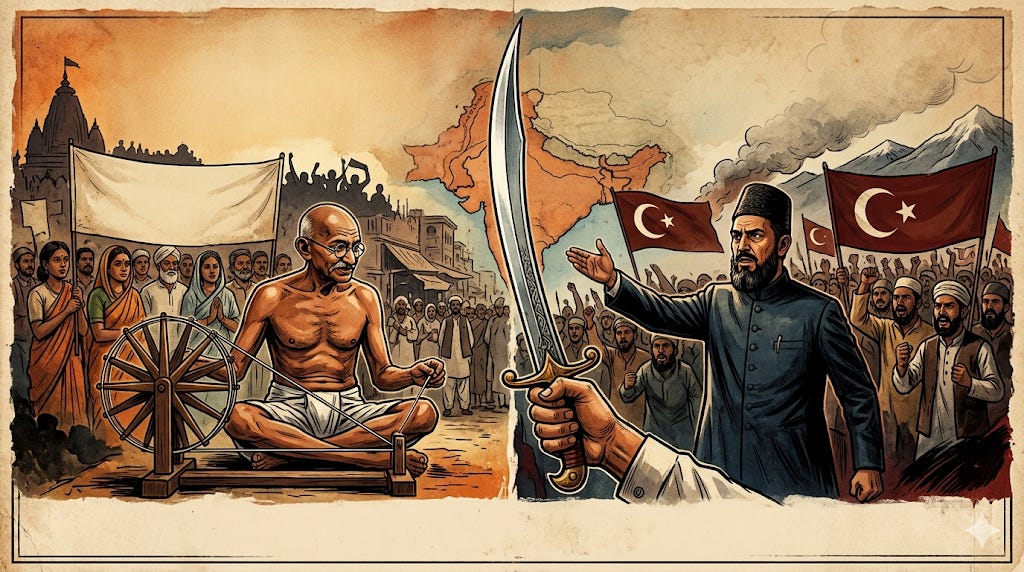
Gandhi, Ahimsa, and the Problem of Political Security
The controversy over Mahatma Gandhi’s doctrine of non-violence cannot be understood merely as a moral disagreement. It belongs to the turbulent political world of the 1920s, 1930s, and 1940s, when British rule, the Khilafat movement, the Indian National Congress, the Muslim League, and competing visions of Swaraj were reshaping public life in India. In that atmosphere, the question was not only whether Ahimsa was spiritually noble, but whether absolute non-violence could serve as a practical doctrine for national defence, constitutional order, and civilisational continuity.
The source text under examination belongs to a polemical historical tradition that strongly criticised Gandhi’s political pacifism. Its central concern was that a nation, especially one facing ideological separatism, imperial manipulation, communal mobilisation, and possible external aggression, could not safely reject armed preparedness. Stripped of its sharper rhetoric, the argument raises a serious issue in political philosophy: can a state survive if its public ethics discourage even defensive force?
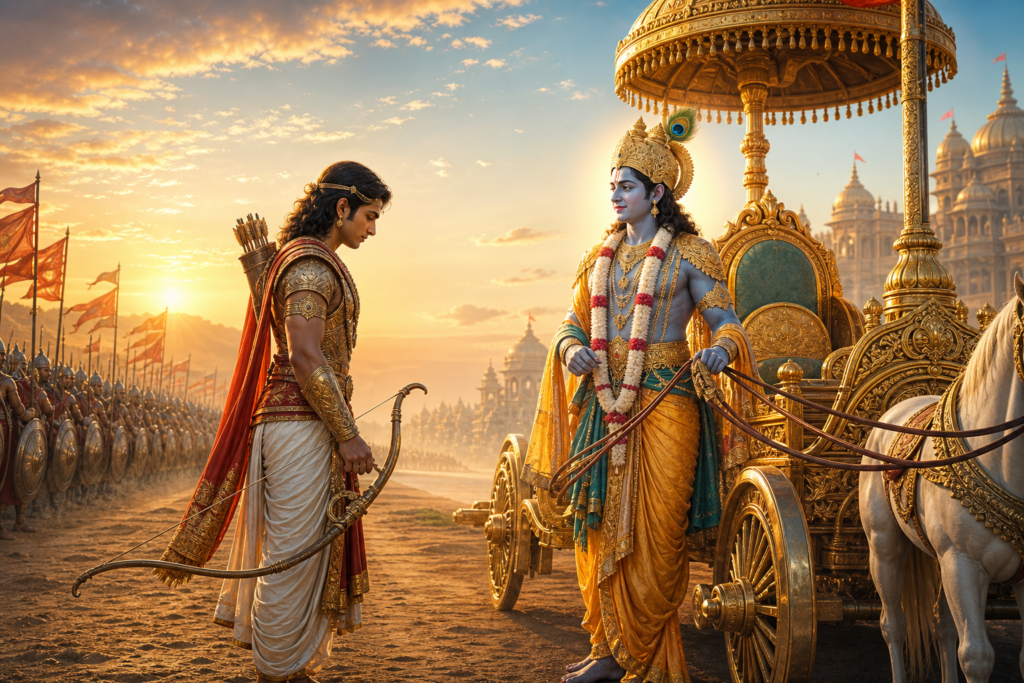
This question remains emotionally charged because it touches both Dharma and statecraft. Dharmic traditions honour compassion, restraint, self-discipline, and the refusal to harm unnecessarily. Yet the same broad civilisational inheritance also recognises Rajadharma, Kshatra Dharma, Dharma-Yuddha, and the duty to protect society from disorder. The Bhagavad Gita does not celebrate violence as an ideal; it confronts the tragic necessity of action when justice, social order, and protection of the vulnerable are at stake.
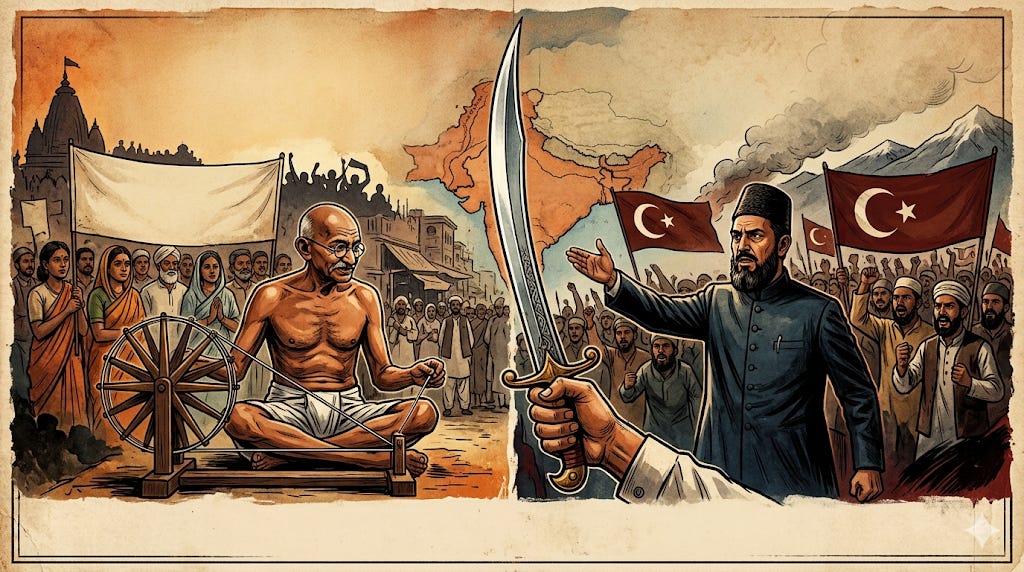
The Khilafat Context and the Language of Sovereignty
A key episode cited in the source concerns a 1921 exchange involving Shaukat Ali, a prominent Khilafat leader, in the presence of Gandhiji. A correspondent of The London Times reportedly asked whether, in certain Islamic political formulations, the world was divided into Dar-ul-Islam and Dar-ul-Harb, and where a future self-governing India would stand. The reported exchange matters because it shows how religious vocabulary, anti-colonial politics, and the idea of sovereignty were intertwined in the Khilafat period.
The original passage argues that Shaukat Ali’s answer did not sufficiently reassure critics who feared that constitutional methods would be subordinated to religiously framed political claims. In an academic reading, this should not be converted into a judgment on all Muslims or on Islam as a lived faith. It is more precise to say that certain political actors and ideological movements used religious language to define loyalty, sovereignty, and power in ways that created anxiety among Hindu nationalists and other observers of the period.
The distinction is essential. India’s civilisational fabric has long included Hindus, Buddhists, Jains, Sikhs, Muslims, Christians, Jews, Zoroastrians, and many other communities. The historical problem was not the existence of religious diversity. The problem was the political use of religious identity as a basis for separatist mobilisation, competitive communal power, or rejection of shared constitutional norms. That distinction allows the discussion to remain factual without turning history into collective blame.
Jinnah, Congress Ministries, and the Politics of Deliverance
The source also refers to Muhammad Ali Jinnah’s call for Muslims to observe a “Day of Deliverance” after Congress ministries resigned in 1939. Historically, this episode reflected the growing distance between the Indian National Congress and the All India Muslim League. The Congress resignation followed the Viceroy’s decision to involve India in the Second World War without consulting Indian political representatives. Jinnah used the moment to argue that Muslim political interests had been constrained under Congress provincial governments.
To critics of Congress, this episode seemed to confirm that India’s constitutional future was becoming entangled with communal bargaining. To supporters of Congress, the resignations were part of a broader anti-colonial protest. To the Muslim League, the occasion became a political opportunity to consolidate a separate representative claim. The emotional force of the controversy came from this collision of interpretations: freedom from British rule was no longer the only question; the deeper question was what kind of nation would emerge after British power receded.
The source interprets the episode as a warning that appeasement and moral idealism could weaken the Hindu community and, by extension, the national project. A more balanced formulation would say that political concessions, if made without reciprocal commitment to shared citizenship, can produce insecurity among communities. At the same time, a durable nation cannot be built through suspicion alone. It requires equal law, cultural confidence, civic trust, and firm resistance to separatist coercion from any quarter.
Gandhi’s Respect for Islam and the Critique of Asymmetry
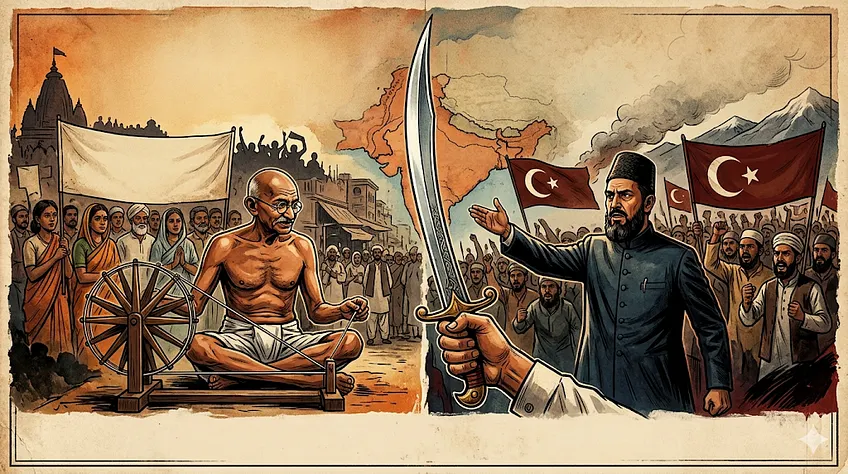
The source quotes Gandhi from Young India, dated 23-10-1924: “I am speaking to you as though I was a Mussalman, because I have cultivated that respect for Islam which you have for it.” This sentence is presented in the original as evidence that Gandhi’s sympathy toward Muslim concerns had gone too far. In a more careful historical reading, the statement can be understood as part of Gandhi’s effort to cultivate interfaith empathy and moral trust during a period of communal tension.
However, the criticism cannot be dismissed entirely. The practical question is whether Gandhi’s interfaith language was matched by an equally firm defence of Hindu civilisational interests, temple rights, cultural self-respect, and security concerns. Many critics believed that Gandhi demanded extraordinary restraint from Hindus while offering excessive moral accommodation to Muslim political leadership. Whether one accepts or rejects that criticism, it became a major theme in Indian political history and shaped later debates on secularism, minority politics, and national integration.
For contemporary readers committed to unity among Dharmic traditions, the lesson is not to imitate the bitterness of earlier polemics. The lesson is to recognise that respect for another tradition must not require shame toward one’s own. Hindu, Buddhist, Jain, and Sikh traditions all contain profound resources for compassion, courage, ethical self-restraint, and social responsibility. Genuine harmony grows when civilisational self-confidence and interfaith fairness stand together.
Congress, Swaraj, and the Question of Foreign Policy
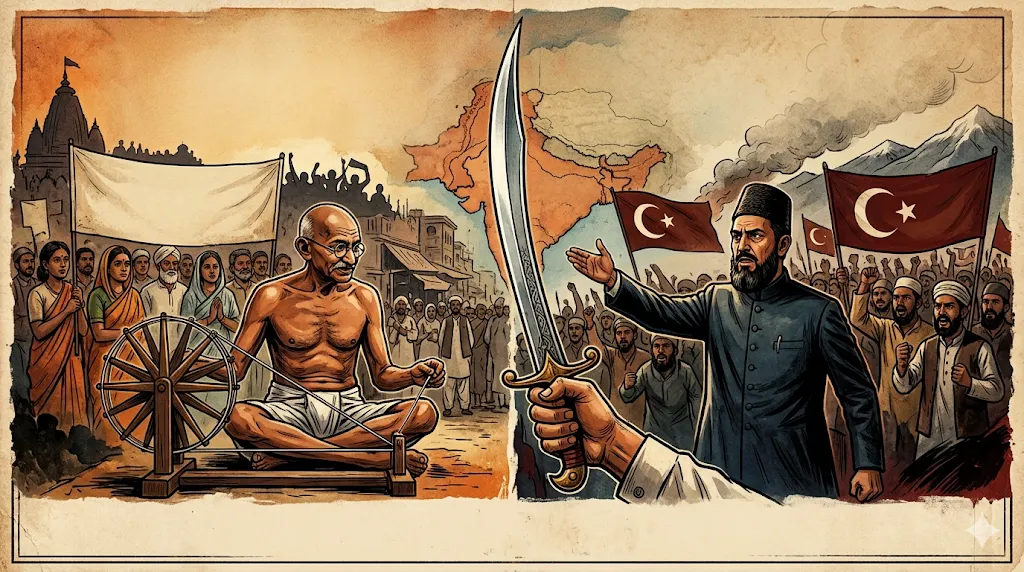
The source next cites an extract attributed to the History of the Congress published by the Maharashtra Congress Committee. The passage suggested that, after Swaraj, India would formulate policy toward independent Muslim nations in a way compatible with the tenets of Muslim religion. The original polemic treats this as proof that Congress leadership had become excessively deferential to Islamic political sentiment.
In political terms, this raises a technical question about sovereignty. A modern state may maintain friendly relations with religiously defined or culturally distinct neighbours, but its foreign policy cannot be subordinated to the theology of another political community. National interest, constitutional values, territorial integrity, security, and reciprocal diplomacy must remain central. Any policy that appears to privilege one religious bloc over the equal citizenship of all Indians risks creating distrust.
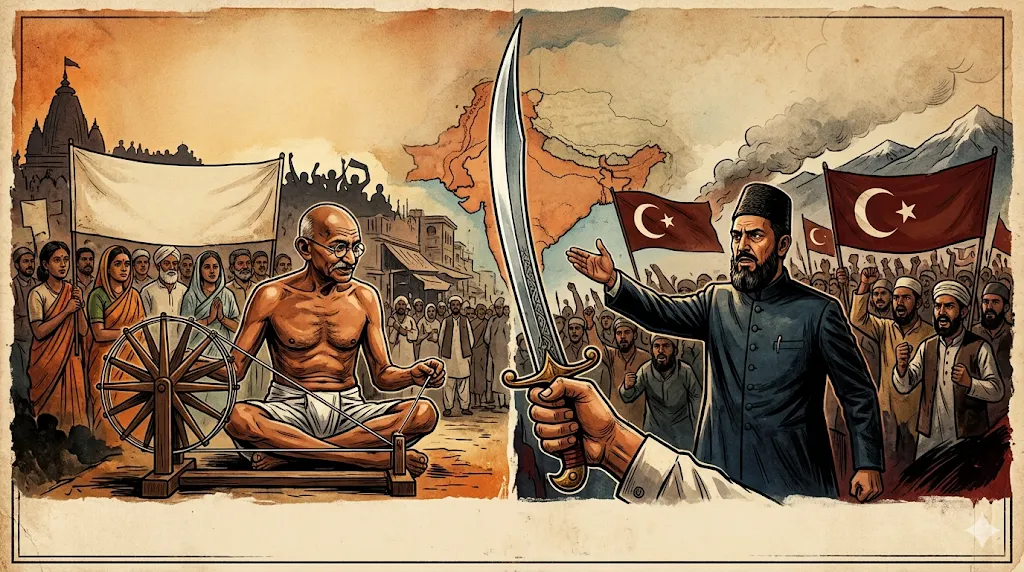
This is where Rajadharma becomes relevant. In Dharmic political thought, governance is not merely administration; it is the protection of order, justice, and the conditions in which communities can pursue ethical life. A ruler or state that confuses compassion with surrender fails in duty. A ruler or state that confuses strength with cruelty also fails in duty. The hard task is disciplined power: firm enough to protect, restrained enough to remain just.
Abdul Ghaffar Khan and the National Army Debate
The later part of the source turns to Khan Abdul Ghaffar Khan, often called Frontier Gandhi, and his opposition to the idea that independent India required a national army. The issue reportedly arose around Congress debates in 1940, including discussions linked to Wardha and Poona. The source argues that opposition to a national army, especially under conditions of geopolitical danger, amounted to a dangerous weakening of India’s future sovereignty.
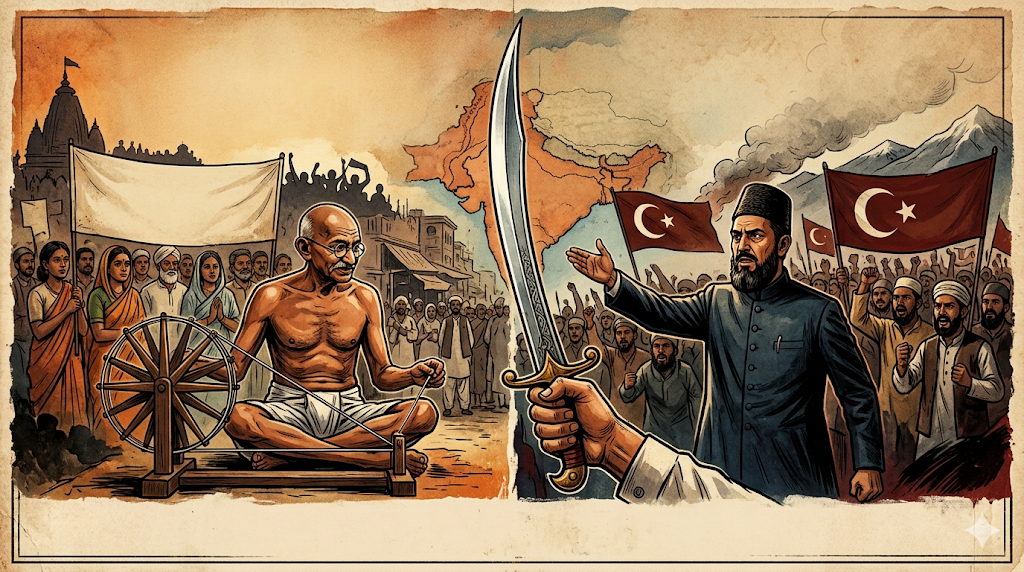
Here the underlying concern is strategically significant. A modern nation-state requires institutions capable of maintaining internal order and defending borders. Police, courts, legislatures, civil services, intelligence systems, and armed forces perform different but related functions. Non-violence may guide civil protest against unjust rule, but the abolition of defensive capacity is a different proposition. A society may admire saints, but a state must also secure roads, borders, citizens, temples, monasteries, gurdwaras, libraries, schools, and homes.
The original text presents Abdul Ghaffar Khan’s stance as evidence of a broader attempt to weaken Hindus through non-violence. A more responsible formulation is that absolute pacifism, when translated into state policy, can unintentionally empower aggressive actors. This is not a criticism of peace as a value. It is a criticism of peace without enforcement, dialogue without deterrence, and moral aspiration without institutional strength.
Ahimsa, Minimum Violence, and the Dharmic View of Force
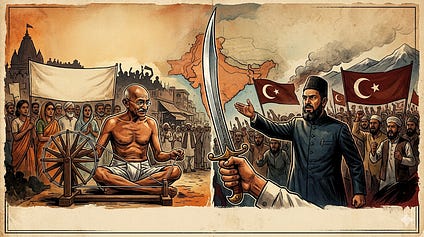
The deepest philosophical issue is the meaning of Ahimsa. In Hinduism, Buddhism, Jainism, and Sikhism, non-harm is not a shallow slogan. Jainism gives Ahimsa one of its most rigorous ethical expressions. Buddhism emphasises compassion and the reduction of suffering. Hindu traditions include both renunciatory non-violence and the Kshatra duty to protect. Sikh tradition honours saintliness and martial responsibility through the ideal of the saint-soldier. These traditions differ in metaphysics and discipline, but they share a serious concern for ethical action.
Therefore, the question is not whether violence is desirable. It is not. The real question is whether failure to restrain aggression can itself become a form of harm. If a community refuses to protect the innocent, allows lawlessness to spread, or abandons national defence in the name of purity, the result may be greater suffering. This is why many Dharmic discussions distinguish between aggression, punishment, defence, sacrifice, and necessary force under lawful authority.
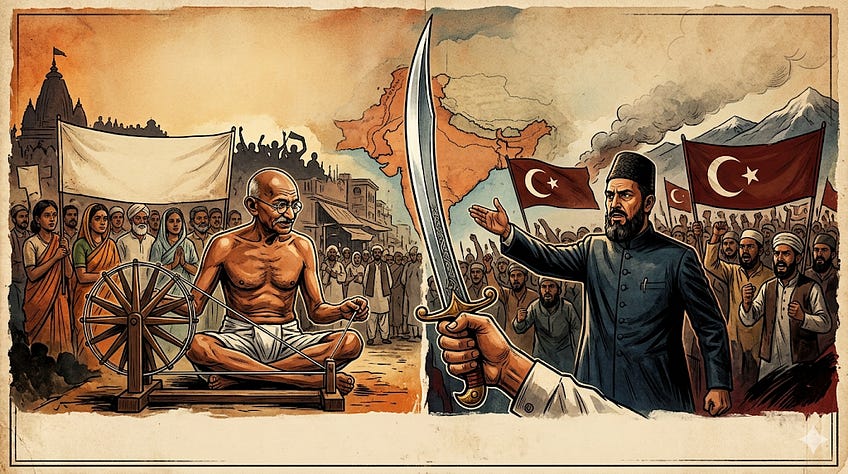
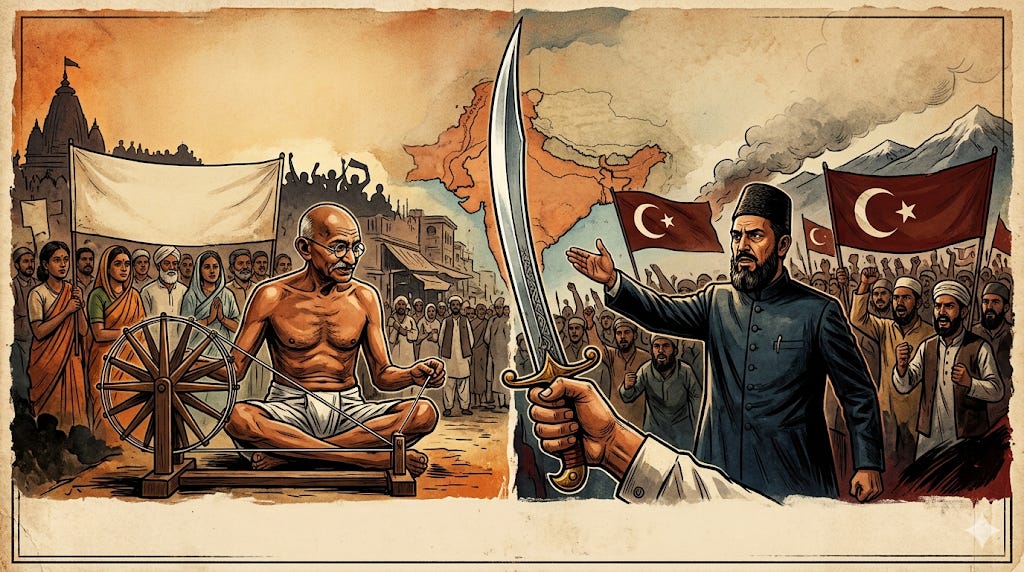
The phrase “Non-violence means treason to one’s nation,” attributed in the source to Shrinivas Iyangar, should therefore be read as a severe political warning rather than a universal rejection of Ahimsa. It attacks absolutist pacifism when applied to national survival. It does not invalidate compassion, restraint, interfaith respect, or the moral discipline of non-injury. Its continuing relevance lies in the tension between private virtue and public duty.
Historical Memory Without Communal Hostility
The source text uses language that reflects the anxieties and anger of its time. A contemporary treatment must preserve the historical argument while removing collective hostility. It is legitimate to examine the Khilafat movement, Muslim League politics, Congress strategy, Gandhi’s moral influence, and the debate over national defence. It is not legitimate to convert the conduct of political leaders or ideological groups into suspicion toward ordinary communities.
India’s national life depends on a mature distinction between historical analysis and social resentment. The failures of Congress policy, the rise of separatist politics, the tragedy of Partition, and the limits of Gandhian idealism deserve rigorous study. Yet the purpose of such study should be clarity, not hatred. Dharmic unity requires courage to remember painful history and discipline to avoid dehumanising language.
For readers shaped by Hindu, Buddhist, Jain, and Sikh inheritances, the practical lesson is especially sharp. A civilisation that forgets self-defence becomes vulnerable. A civilisation that forgets compassion becomes morally diminished. The task is not to choose between strength and ethics, but to integrate them. That integration is the heart of responsible statecraft.
Conclusion: Strength, Restraint, and National Responsibility
The historical debate over Gandhi’s non-violence remains unresolved because it addresses a permanent problem: how should a moral society confront organised power, ideological hostility, and political coercion? Gandhi’s Ahimsa inspired mass mobilisation and gave India a distinctive ethical language. Yet critics argued that the same doctrine, when absolutised, risked weakening national resolve and obscuring the duties of sovereignty.
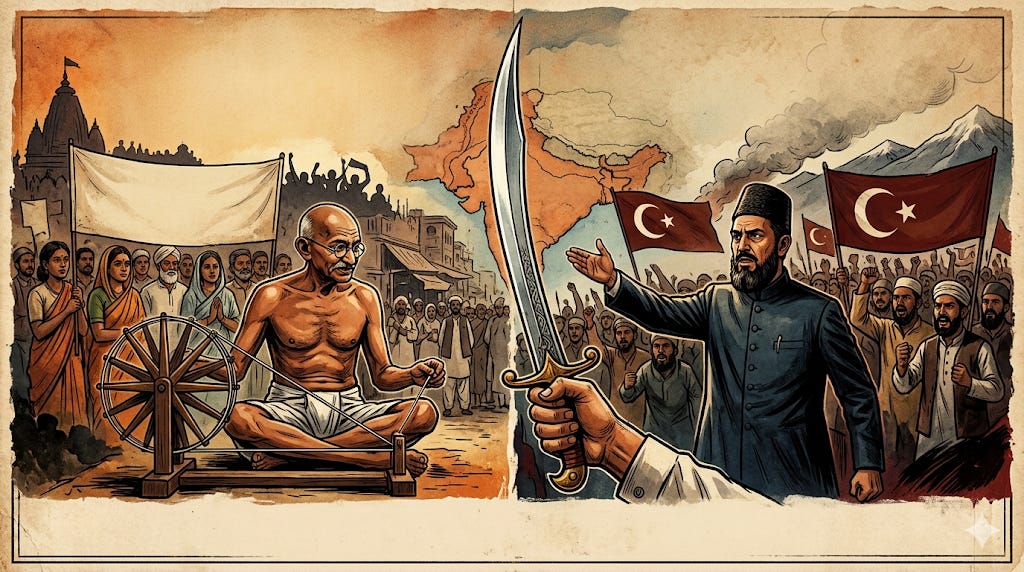
A balanced reading recognises both truths. Non-violence can be a powerful method of civil resistance against unjust authority. It can awaken conscience, discipline public protest, and prevent needless bloodshed. But national security requires more than moral protest. It requires institutions, law, deterrence, strategic clarity, and the will to defend citizens without hatred.
The most constructive conclusion is neither blind pacifism nor reckless militancy. It is Dharmic realism: peace as the goal, strength as the safeguard, law as the method, and justice as the measure. In that framework, Ahimsa remains a noble principle, but it must be interpreted alongside Rajadharma, Kshatra Dharma, and the responsibility to protect the nation’s civilisational life.
Inspired by this post on Dharma Dispatch.





Leave a Reply
You must be logged in to post a comment.