
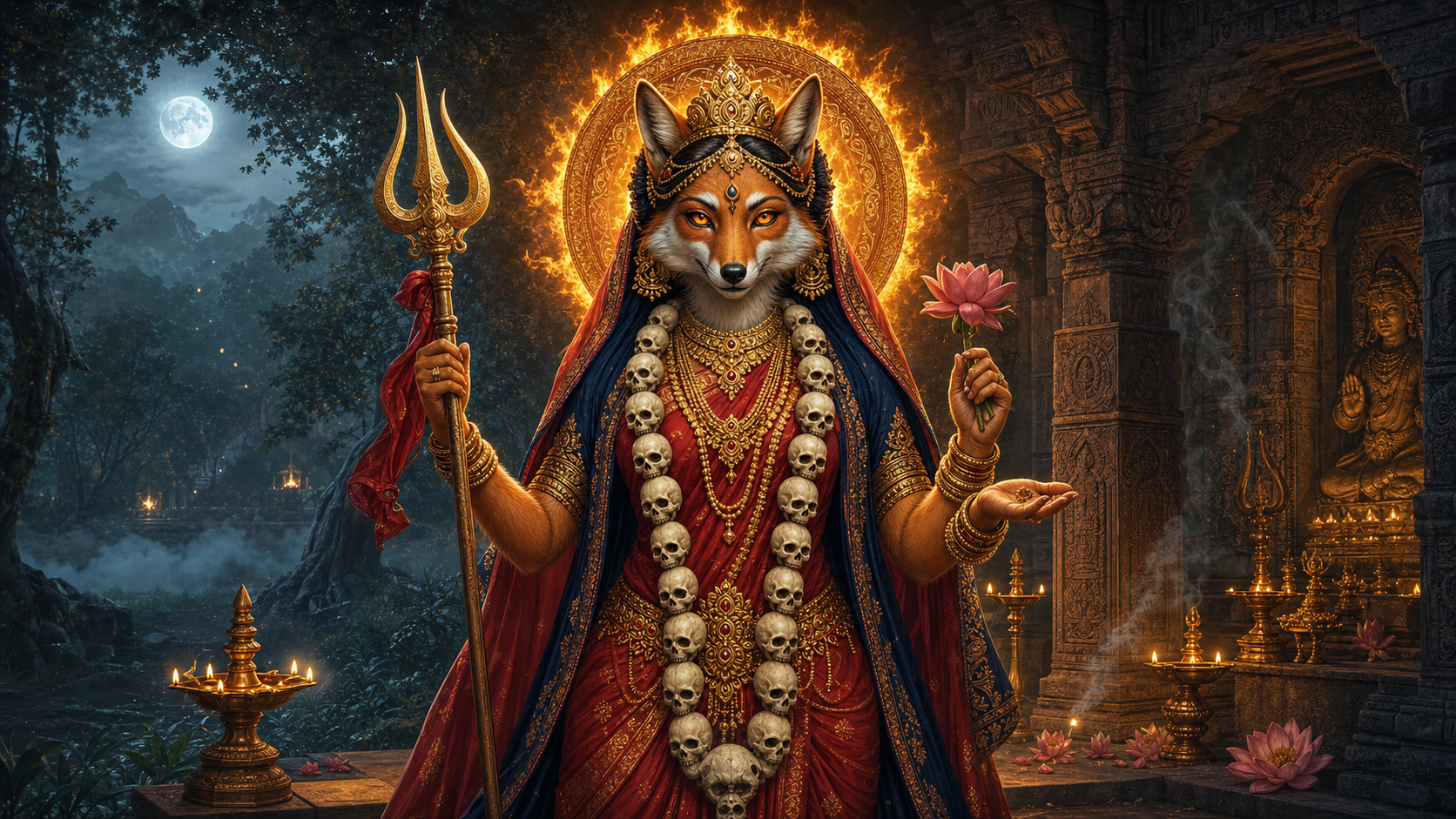
Kapalamalini belongs to the fierce and esoteric stream of Hindu Goddess symbolism, where the Divine Mother is not limited to tenderness, fertility, prosperity, or social order. She appears as a form of primal Shakti: unsettling, protective, liminal, and deeply transformative. Her name itself is a compact theological statement. Kapala means skull, and Malini means one who wears a garland. Kapalamalini, therefore, is “the skull-garlanded one,” a goddess whose iconography places death, impermanence, power, and liberation at the center of contemplation.
The title “skull-garlanded” immediately connects Kapalamalini with a wider Shaiva and Shakta vocabulary of fierce sacred imagery. In Hindu traditions, skulls are not merely signs of horror. They can represent the conquered ego, the passing nature of the body, the cycle of birth and death, and the awakened wisdom that arises when attachment is stripped away. This is why fierce goddesses such as Kali, Chamunda, and other Tantric forms may wear skulls, bones, or garlands of severed heads. Their forms do not celebrate violence for its own sake; they dramatize the destruction of ignorance, arrogance, and false identity.
Kapalamalini is best approached within this symbolic universe rather than through the expectations of gentle devotional iconography alone. Her form speaks from the cremation ground, the forest edge, the night, the threshold, and the places where ordinary categories become unstable. Such imagery can feel difficult at first encounter, yet it has a precise religious logic. The goddess who stands near death is also the goddess who reveals what cannot die. The one adorned with skulls is also the one who teaches that the body is transient, while consciousness and dharma require deeper recognition.
The fox-faced aspect attributed to Kapalamalini adds another layer of meaning. In South Asian sacred imagination, animals associated with wilderness, night, scavenging, and sharp perception often appear near fierce goddesses. The fox, like the jackal in many related traditions, belongs to the margins between settlement and forest, purity and impurity, life and death. It is alert, adaptive, difficult to domesticate, and capable of surviving in neglected spaces. A fox-faced goddess therefore suggests not weakness or strangeness, but instinctive intelligence, survival power, and the fierce grace of nature beyond social polish.
In the larger Shakta framework, the Divine Feminine is not a single mood. She is mother, warrior, teacher, queen, ascetic, lover, destroyer, nourisher, and liberator. Kapalamalini represents a side of the Goddess that refuses sentimental reduction. She does not appear to comfort the ego; she appears to expose it. She does not beautify impermanence; she compels attention toward it. For practitioners and students of Hindu iconography, this is precisely why such a form matters. She widens the understanding of Shakti from a soft abstraction into a total cosmic force.
The skull garland is central to this reading. A garland is normally an object of honor, devotion, and beauty. When the garland is made of skulls, beauty is relocated from ornament to truth. Kapalamalini’s adornment reminds the viewer that every embodied life moves through time, decay, and death. Social status, pride, beauty, learning, and wealth all end at the skull. Yet the skull is also the seat that once held thought, speech, memory, and identity. To wear skulls is to wear the history of human limitation and to stand beyond it.
This is why fierce goddess traditions often become powerful tools for philosophical reflection. Kapalamalini’s iconography can be read alongside the Hindu concern with avidya, or ignorance, and with the bondage created by false identification. The skull is a direct image of what remains when personal vanity collapses. It is not nihilistic. Rather, it is pedagogical. It forces attention toward the question that appears in many Hindu, Buddhist, Jain, and Sikh contemplative contexts: what is the human being when ego, possession, and bodily pride are no longer sufficient answers?
Kapalamalini also reflects the Tantric willingness to work with difficult symbols instead of rejecting them. Tantra, in its many Hindu forms, does not always divide reality into neat categories of acceptable and unacceptable. It often asks whether fear, desire, mortality, and shadow can become instruments of awakening when approached with discipline, guidance, and sacred intention. This does not mean that every fierce image is an invitation to casual experimentation. It means that such images belong to traditions where spiritual transformation may involve facing what ordinary life avoids.
Her association with the skull also evokes the kapala as a ritual object in certain Shaiva and Shakta contexts. The skull-bowl, known in various Tantric traditions, symbolizes the reversal of ordinary perception. What society may regard as impure can become, within strict ritual and philosophical discipline, a reminder of non-attachment and transcendence. Kapalamalini’s name therefore suggests more than decoration. It places her in a field of meaning where death, renunciation, power, and gnosis are woven together.
At the same time, care is necessary. Kapalamalini is not as widely documented in popular devotional literature as Durga, Lakshmi, Saraswati, Kali, or Parvati. Public references to her are often brief, regional, esoteric, or iconographic rather than supported by a single universally known narrative. This makes responsible interpretation important. The most reliable approach is to understand her through the symbolic grammar of Shakta iconography: skulls, animal features, wilderness energy, fierce protection, and the Goddess as the force that both creates and dissolves forms.
Within this grammar, the fox face should not be dismissed as merely unusual. Hindu sacred art frequently uses animal forms to communicate spiritual qualities beyond ordinary human expression. Narasimha’s lion form expresses protective ferocity and divine immediacy. Varaha’s boar form reveals the rescue of the Earth. Ganesha’s elephant head expresses intelligence, strength, auspiciousness, and the ability to remove obstacles. Similarly, a fox-faced goddess can communicate a form of Shakti that is sharp, nocturnal, elusive, instinctive, and sovereign in the wild spaces of existence.
The fox also invites reflection on the difference between domesticated morality and primal wisdom. Social life requires order, manners, and predictable conduct, but spiritual life often demands a deeper confrontation with reality. Kapalamalini’s fierce form suggests that the sacred is not always polite. It may arrive as a cry in the night, as the memory of mortality, as the collapse of pride, or as an inner force that refuses to let the soul remain asleep. Her fox-like quality points to awareness that is quick, unsentimental, and difficult to deceive.
In this sense, Kapalamalini can be understood as a goddess of thresholds. She stands where civilization meets wilderness, where life meets death, where fear meets insight, and where the devotee’s constructed identity meets the deeper Self. Threshold deities and liminal goddesses are significant because transformation rarely happens in comfortable certainty. It occurs at edges. It occurs when an old way of seeing fails. Kapalamalini’s iconography makes that edge visible.
The fierce Divine Mother is often misunderstood by modern readers who encounter her through isolated images. Without context, skulls, fangs, animal faces, blood-red imagery, or cremation-ground motifs may seem frightening or even contradictory to spirituality. Yet Hindu traditions have long understood that compassion and terror are not always opposites. A surgeon may cut to heal. A mother may appear fierce to protect a child. A teacher may break a harmful illusion to reveal truth. Fierce goddess imagery expresses this difficult compassion in visual form.
Kapalamalini’s power therefore should not be reduced to aggression. Her fierceness is protective, revelatory, and purifying. She symbolizes the destruction of inner enemies: arrogance, delusion, fear, inertia, cruelty, and attachment to false identity. In this respect, her skull garland is not a trophy of outer violence but a sign of inner conquest. The heads or skulls in fierce goddess imagery often represent the severing of limiting thought patterns and the liberation of consciousness from habitual bondage.
This interpretation aligns with a broader dharmic understanding shared across Hinduism, Buddhism, Jainism, and Sikhism: spiritual life requires discipline over ego, awareness of impermanence, and movement toward truth. The forms, doctrines, and practices differ across traditions, yet the ethical and contemplative concern with self-mastery is widely recognizable. Kapalamalini’s imagery can therefore be read as part of a larger dharmic conversation about courage, mortality, humility, and liberation.
For Hindu devotees, the Goddess is not merely an object of distant worship. She is also a mirror. Gentle forms mirror the longing for protection, abundance, learning, beauty, and maternal care. Fierce forms mirror the realities that human beings often suppress: anger, fear, death, grief, instinct, and the need for radical transformation. Kapalamalini’s mirror is particularly intense. It does not flatter the viewer. It asks whether one can face the skull beneath ornament and still recognize the sacred.
The emotional power of such a goddess lies in her honesty. Many people encounter spiritual practice during moments of vulnerability: illness, loss, betrayal, anxiety, aging, or the collapse of certainty. A purely decorative spirituality may not speak adequately to those experiences. Kapalamalini’s presence suggests that the Divine Mother is not absent from frightening places. She is present precisely there, among endings and shadows, holding the possibility that even fear can become a doorway to wisdom.
Her form also challenges narrow ideas of beauty. Classical Hindu aesthetics includes grace, symmetry, ornament, and radiance, but it also includes the terrible, the awe-inspiring, and the sublime. A skull-garlanded, fox-faced goddess is beautiful in the mode of the storm, the flame, the night forest, and the cremation ground. This is not beauty meant for passive enjoyment. It is beauty that awakens. It unsettles because it points toward truths that cannot be softened without losing their force.
The connection between Kapalamalini and the forest imagination is especially important. Many fierce forms of the Goddess are tied to spaces outside the polished center: mountains, caves, rivers, borders, village boundaries, battlefields, and cremation grounds. These spaces are not spiritually empty. They are charged with power because they expose the limits of human control. The fox-faced Kapalamalini belongs naturally to this terrain. She is not a courtly goddess of settled order alone; she is the Mother as wilderness intelligence.
Such symbolism has social meaning as well. Hindu Goddess traditions have preserved both Sanskritic and regional forms, temple-based and folk forms, refined philosophical forms and intensely local forms. This diversity is not a weakness. It is one of the great strengths of Sanatana Dharma. Kapalamalini reminds students of religion that the Hindu sacred world is not a flat system of standardized images. It is a living, layered field where village memory, Tantric symbolism, Puranic imagination, yogic insight, and artistic tradition may all meet.
The name Kapalamalini may also be understood through comparison with other skull-bearing goddesses. Kali’s garland of heads is often interpreted as the letters of the Sanskrit alphabet, the powers of speech, or the passing forms of creation. Chamunda’s emaciated and cremation-ground form confronts decay and the destruction of demonic forces. Bhairavi embodies terrifying spiritual intensity. Kapalamalini belongs to this family resemblance of fierce Shakti, though her specific fox-faced identity gives her a distinct atmosphere of cunning, wilderness, and nocturnal awareness.
Theologically, such goddesses prevent a simplistic view of divinity. If the Divine Mother is the power behind the universe, then she cannot be confined only to comfort. She must also be present in dissolution, time, hunger, instinct, death, and renewal. This is why Shakta thought can be so philosophically expansive. It allows the Goddess to be both the sweetness of devotion and the force that tears illusion apart. Kapalamalini stands on the latter side of this spectrum, yet she remains Mother.
In devotional psychology, fierce forms often help practitioners confront fear. Fear loses some of its power when it is placed before the deity and given symbolic shape. A skull-garlanded goddess gives form to mortality. A fox-faced goddess gives form to alertness and survival. A wild goddess gives form to energies that polite society may repress but spiritual life must refine. Through reverence, the terrifying is not denied; it is integrated into a sacred order.
This integration is essential. Kapalamalini should not be read as an endorsement of chaos, cruelty, or antisocial behavior. Dharmic traditions consistently distinguish between disciplined transformation and uncontrolled impulse. The fierce goddess is not a license for violence; she is a symbol of the power required to overcome violence within and around oneself. Her energy is meaningful when understood through dharma, self-control, reverence, and ethical awareness.
Her imagery also speaks to feminine power beyond domestication. Many cultures prefer the feminine when it is nurturing, agreeable, decorative, or sacrificial. Shakta traditions preserve a more complete vision. The Goddess may nurture, but she may also hunt. She may bless, but she may also destroy injustice. She may smile, but she may also roar. Kapalamalini’s fox-faced ferocity belongs to this wider celebration of the Sacred Feminine as autonomous cosmic power rather than merely a passive companion to male divinity.
The skull garland can also be read as a meditation on time. Every skull once belonged to a person with desires, memories, conflicts, and ambitions. Kapalamalini wears them all without preference. Kings and commoners, scholars and warriors, the proud and the humble all pass through time. This vision can produce humility. It can also produce urgency: if life is brief, then the pursuit of dharma, wisdom, compassion, and self-knowledge cannot be postponed indefinitely.
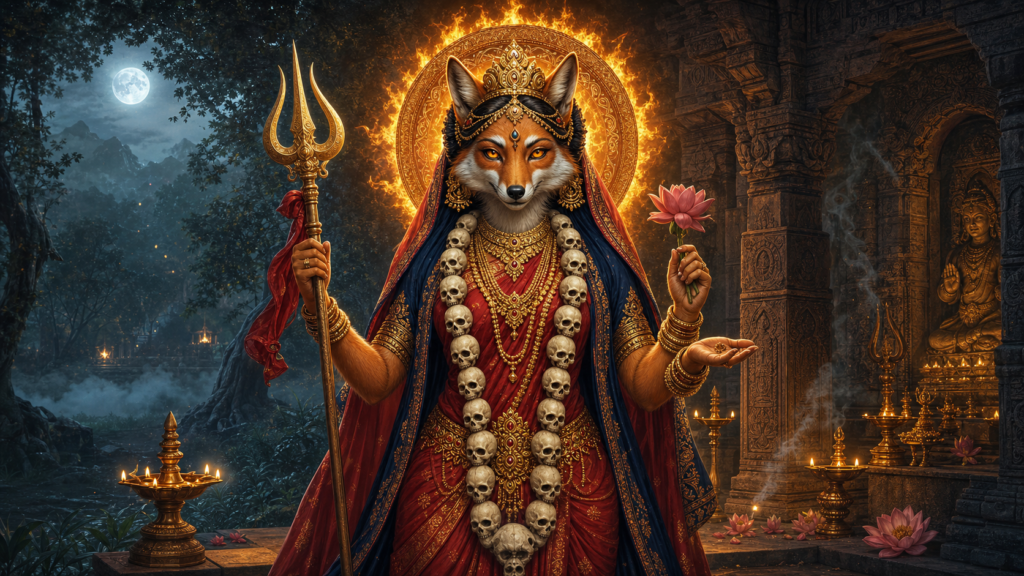
From an academic perspective, Kapalamalini illustrates how Hindu iconography communicates complex religious ideas through concentrated visual signs. Her name, face, ornaments, and implied setting create a theological language. The skulls speak of mortality and ego-transcendence. The garland speaks of power and mastery. The fox face speaks of instinct and liminal awareness. The fierce feminine form speaks of Shakti as cosmic agency. Together, these signs produce a complete symbolic portrait.
For contemporary readers, Kapalamalini may be especially relevant because modern life often hides death while intensifying fear of it. Consumer culture celebrates youth, productivity, image, and possession, while pushing decay and grief out of sight. A goddess like Kapalamalini reverses that habit. She places impermanence directly before the mind and asks for a deeper kind of courage. Her lesson is not despair, but clarity. What is temporary should be honored without being mistaken for the eternal.
Her symbolism also resonates with ecological reflection. The fox is a creature of adaptability, boundary zones, and survival within changing landscapes. The fierce goddess of the wild reminds human beings that nature is not merely scenery. It is power, intelligence, hunger, birth, decay, and renewal. Reverence for such a form can cultivate respect for the non-human world and for the sacredness of ecosystems that modern society often treats as disposable.
Kapalamalini’s presence in the broader field of Hindu Goddess traditions therefore invites multiple readings: theological, psychological, ecological, artistic, and philosophical. She can be studied as an icon of Shakti, contemplated as a reminder of mortality, understood as a fierce protector, and respected as a symbol of the wild feminine. None of these readings cancels the others. Like many Hindu deities, her meaning is layered rather than single.
The most responsible way to approach such a goddess is with reverence and interpretive humility. Not every form has a widely available narrative, and not every symbol should be forced into a modern category. Kapalamalini’s power lies partly in her resistance to simplification. She belongs to the older and deeper imagination of the Goddess, where divinity is allowed to be strange, fierce, beautiful, frightening, protective, and liberating at once.
Ultimately, Kapalamalini is a reminder that Hindu spirituality contains more than devotional sweetness. It also contains the courage to face death, the discipline to confront ego, and the wisdom to find the sacred in places that appear dark or marginal. Her skull garland teaches impermanence. Her fox face teaches alert intelligence. Her fierce Shakti teaches that transformation is rarely comfortable but can be profoundly liberating when guided by dharma.
To study Kapalamalini is to stand before a form of the Divine Mother that refuses to be reduced to sentiment. She is ancient, fierce, and demanding, yet not devoid of compassion. Her compassion is the kind that burns illusion, strips pride, and awakens the soul to reality. In that sense, the skull-garlanded and fox-faced Goddess remains a powerful symbol of primal wisdom: the Mother who waits at the edge of fear and turns it into knowledge.
Inspired by this post on Hindu Blog.









Leave a Reply
You must be logged in to post a comment.