
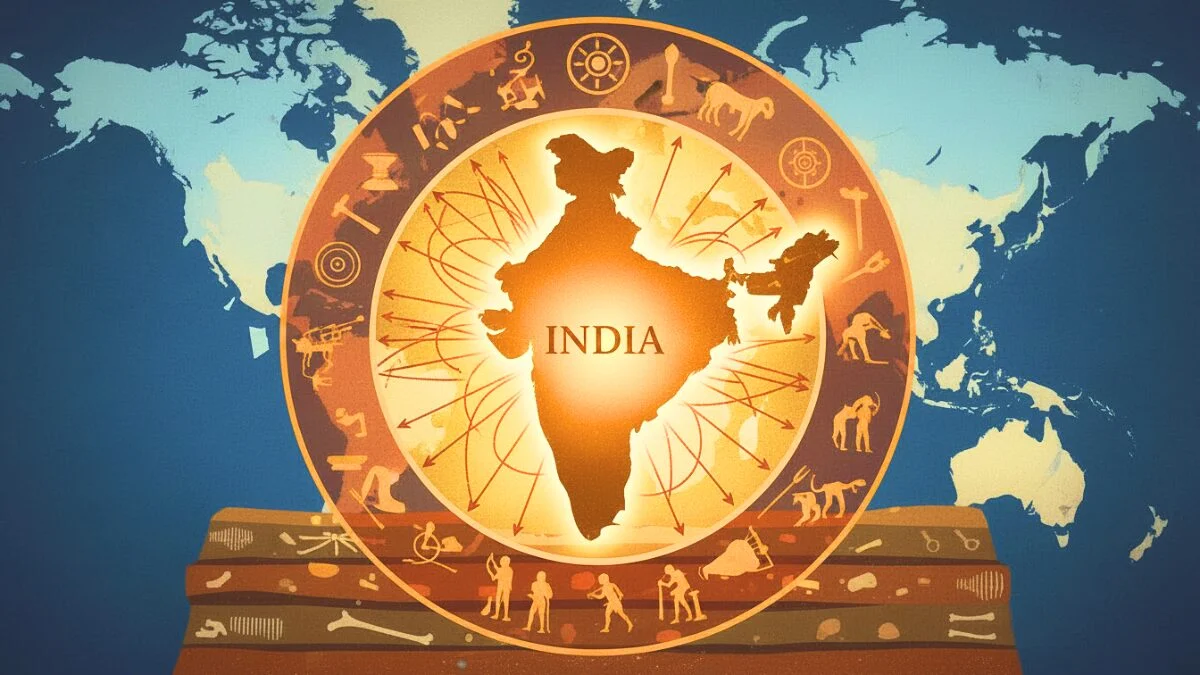
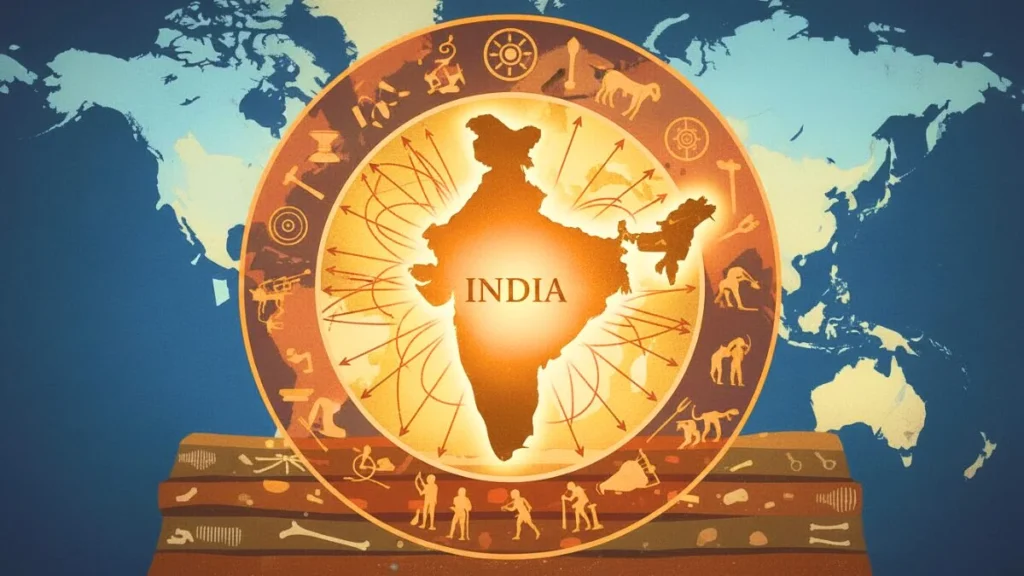
The cited report in The Australia Today, published on June 30, 2026, places Bharat at the centre of a renewed discussion on ancient human history, genetics, archaeology, and colonial historiography. Its central claim is that the Indian subcontinent must be studied not as a passive recipient of civilization, but as one of the most important zones in the early story of non-African human populations.
This subject is not merely technical. It affects how generations understand Indian civilization, Hindu Dharma, and the wider Dharmic family of Hinduism, Buddhism, Jainism, and Sikhism. When history is narrated through imported racial categories, communities inherit suspicion rather than continuity. When evidence is studied carefully, the picture becomes more balanced: Bharat appears as an ancient, internally diverse, and deeply connected civilizational space whose people, languages, rituals, ideas, and genetic lineages evolved through long periods of interaction.
The colonial-era idea of an “Aryan race” was never a neutral academic category. It emerged within nineteenth-century European racial thinking, where language, ethnicity, culture, and biology were often wrongly collapsed into one another. Sanskrit’s relationship with Indo-European languages became the basis for large claims about race and conquest, even when archaeology and textual traditions did not support a simple story of violent civilizational replacement. In this sense, the older “Aryan invasion” model must be treated with caution, because it often carried assumptions shaped by imperial politics rather than by evidence alone.
The comparison with Rwanda is significant because colonial administrations across the world frequently hardened social identities into racial hierarchies. In Rwanda, European theories such as the Hamitic hypothesis recast Hutu and Tutsi identities through artificial racial narratives, contributing to dangerous political divisions over time. The lesson for Bharat is clear: scholarship becomes harmful when it converts fluid social, linguistic, or cultural realities into weaponized origin stories.
Genetics has now become an important tool in reassessing these inherited narratives. Paternal Y-chromosome lineages, maternal mitochondrial DNA, and autosomal genome-wide studies all help reconstruct ancient population history. These methods do not speak in slogans; they reveal patterns of ancestry, continuity, mixture, isolation, migration, and demographic change across long spans of time. Their value lies in replacing racial myth with measurable evidence.
The report highlights ancient paternal lineages in India, including discussions around C clade markers and R1a. It presents India as a region with deep antiquity in non-African genetic history and argues that some lineages show substantial diversity within the subcontinent. Such observations matter because genetic diversity in a region can indicate long-term presence, complex local development, or repeated layers of interaction. However, responsible interpretation requires caution: the age of a lineage, the place where it diversified, and the cultural identity of its carriers are related questions, but they are not the same question.
R1a is especially debated because it appears in South Asia, Central Asia, and Europe and has often been tied to arguments about Indo-European languages. Older studies emphasized high diversity and antiquity of some R1a lineages in India, while several recent ancient-DNA studies have argued for Bronze Age movements from the steppe into parts of South Asia. The technical point is that genetics does not support crude racial narratives. Whether one emphasizes indigenous continuity, later admixture, or a combination of both, the evidence does not justify colonial claims of a superior outside “race” civilizing Bharat.
Maternal ancestry adds another important layer. Mitochondrial DNA studies have long identified South Asia as a major region of early non-African maternal diversity, especially in relation to macro-haplogroup M and its many branches. This supports the broader idea that the Indian subcontinent played a major role in early human dispersals after the Out-of-Africa movement. Bharat was not peripheral to early human history; it was one of the major corridors and settlement zones through which ancient populations moved, adapted, and diversified.
Ancient DNA from the Indus-Sarasvati or Harappan cultural sphere has made the debate more precise. The 2019 study of a genome from Rakhigarhi reported that the individual lacked steppe pastoralist ancestry and also lacked ancestry from Anatolian farmers, while showing ancestry related to ancient Iranian-related groups and deeply rooted South Asian hunter-gatherer-related ancestry. This finding complicates simplistic claims and points toward a more nuanced model of local development, interaction with neighboring regions, and deep continuity in the subcontinent.
At the same time, the large 2019 study on South and Central Asian population formation found that modern South Asians carry ancestry shaped by multiple ancient components, including deep South Asian ancestry, Iranian-related ancestry, and, in varying degrees among groups, later steppe-related ancestry. This does not revive the colonial invasion myth. Rather, it shows that the ancient world was mobile, layered, and interconnected. The difference between measured migration and racialized conquest is central to any responsible discussion.
Archaeology also matters because a true civilizational rupture normally leaves visible signs: sudden destruction layers, abrupt replacement of material culture, new settlement patterns, or sharply different burial and ritual systems. The archaeology of the Indian subcontinent, especially around the Harappan and post-Harappan periods, shows complexity and change, but not a simple picture of wholesale replacement by an invading population. Cultural forms adapted across regions and centuries, which is what one would expect in a vast and internally diverse civilization.
This continuity is visible not only in material remains but also in symbols, ritual habits, sacred geography, and philosophical memory. The persistence of yogic imagery, reverence for rivers, fire rituals, sacred sound, cosmology, and the centrality of dharma-based ethical life cannot be reduced to a single migration event. Civilizations are not created by one gene, one tribe, or one linguistic label. They grow through disciplined memory, sacred practice, social institutions, and inherited knowledge systems.
The term “Aryan” itself requires careful handling. In many Indic contexts, words related to ārya carry ethical, cultural, or noble connotations rather than a biological racial meaning. Colonial scholarship often transformed such terms into racial categories, which then distorted debates on Indian history. A more accurate approach is to separate language families, cultural identities, genetic lineages, and spiritual traditions instead of forcing them into one racial story.
This is also why Dharmic unity is essential in interpreting the past. Hindu, Buddhist, Jain, and Sikh traditions all emerged from the civilizational soil of Bharat, even while developing distinct philosophical, ritual, and institutional identities. Their shared concepts of karma, dharma, tapas, ahimsa, liberation, self-discipline, sacred learning, and guru-shishya transmission reflect a deep Indic ecosystem. Any historical theory that turns these traditions against one another or divides Indian communities into hostile racial blocks should be examined critically.
The emotional weight of this debate comes from the fact that history is never only about the past. For many Indians and members of the diaspora, the “Aryan invasion” narrative was encountered not as a cautious academic hypothesis, but as a civilizational insult: a claim that India’s sacred literature, social memory, and intellectual achievements were essentially imported by outsiders. Even where modern scholarship discusses migration, it must not repeat the colonial habit of denying indigenous agency.
A balanced reading of the evidence therefore leads to three conclusions. First, Bharat has very deep genetic antiquity and played a major role in early non-African human population history. Second, the colonial racial framing of “Aryans” as an invading civilizing race is historically and scientifically unsound. Third, ancient India’s population history was complex, involving continuity, regional diversity, and interaction rather than a single simplistic event.
The most productive path forward is not to replace one dogma with another. Genetic evidence should be read with archaeology, linguistics, textual studies, anthropology, and traditional knowledge. No single discipline can fully explain Indian civilization. But together, these fields increasingly weaken the old colonial habit of portraying Bharat as derivative, fragmented, or dependent on external validation.
In this broader view, Bharat stands as one of humanity’s great ancient civilizational centres: a region of early settlement, genetic depth, cultural continuity, and philosophical creativity. The scientific study of ancestry should deepen humility, not prideful exclusion. It should remind communities that the people of the subcontinent are bound by long histories of shared life, shared sacred geography, and shared civilizational responsibility.
The debate over genetics and the Aryan theory is therefore not only about correcting a historical model. It is about restoring intellectual balance after centuries of colonial distortion. The evidence invites a more mature understanding of Indian history: one that recognizes movement without accepting invasion mythology, acknowledges diversity without encouraging division, and honours the civilizational continuity of Bharat without turning scholarship into propaganda.
Inspired by this post on Hindu Post.






Leave a Reply
You must be logged in to post a comment.