
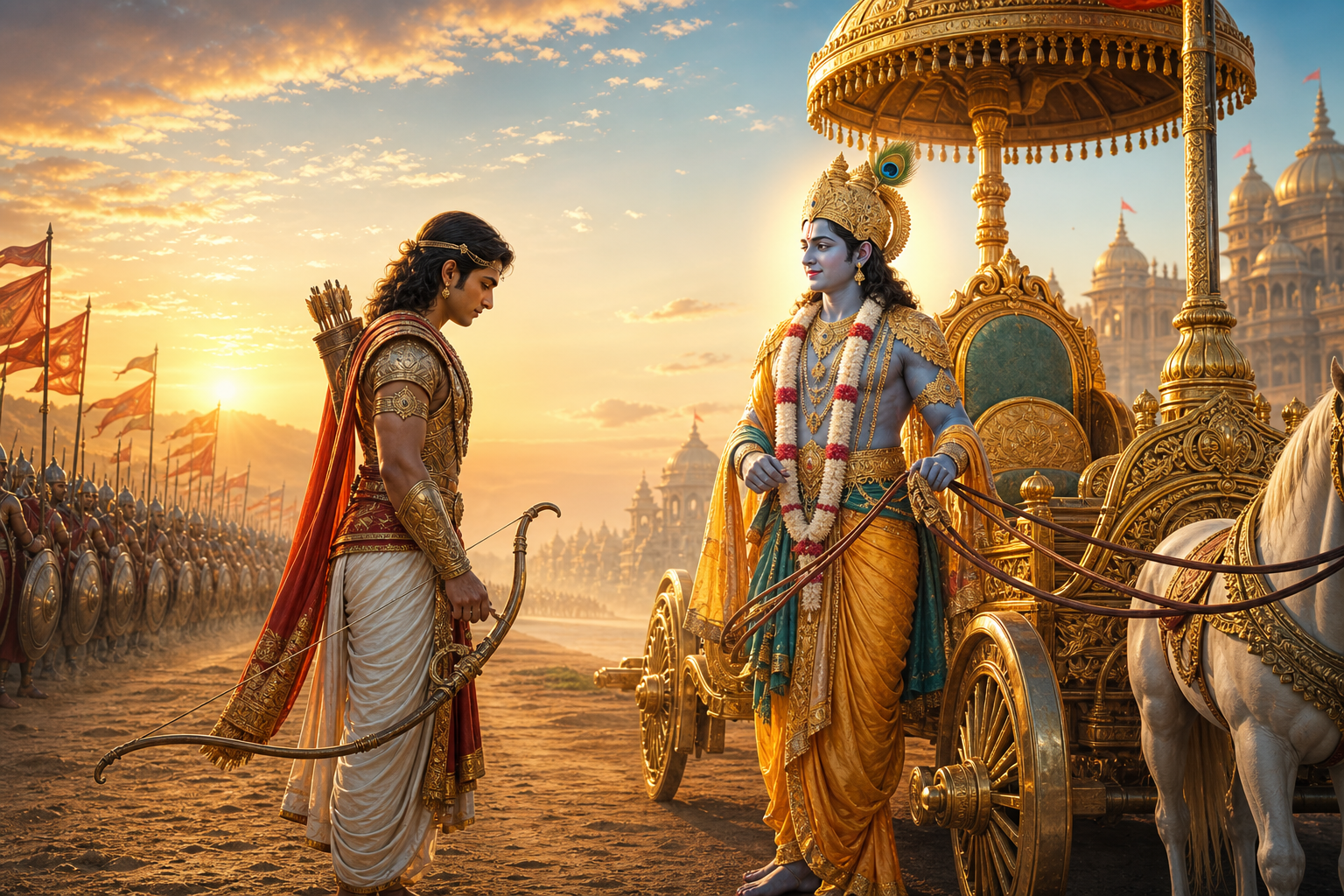
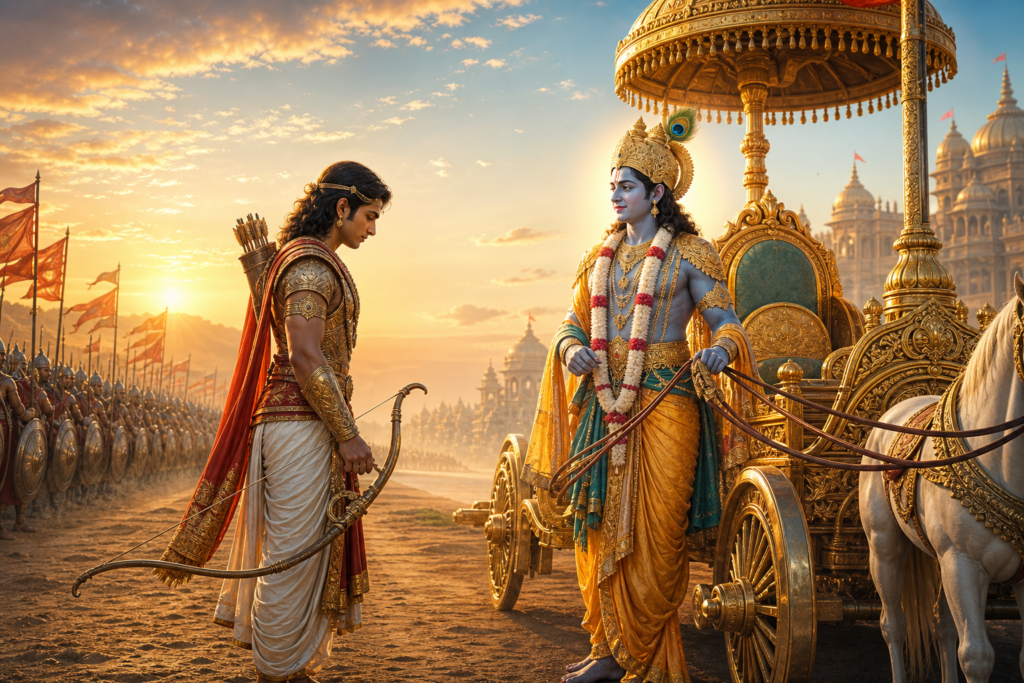
Before the Kurukshetra War began, the Mahabharata presents one of its most revealing moments of political judgment, spiritual clarity, and human psychology. Both Duryodhana and Arjuna approached Vasudeva Krishna at Dwaraka, seeking support for the coming conflict. The request was not ordinary, because Krishna was not merely a powerful Yadava leader; he was a statesman, strategist, kinsman, spiritual guide, and the moral center around whom the epic’s deepest questions would unfold.
The scene is usually remembered in simple terms: Duryodhana chose Krishna’s army, while Arjuna chose Krishna himself. Yet this episode is far more than a dramatic contrast between greed and devotion. It is a technical study in discernment, known in the dharmic vocabulary as the capacity to distinguish appearance from essence, strength from wisdom, and immediate advantage from lasting alignment with dharma.
According to the traditional account, Krishna offered a clear and unusual choice. On one side stood the mighty Narayani Sena, his formidable army, equipped for battle and valuable in any military calculation. On the other side stood Krishna himself, but with one binding condition: he would not take up weapons or fight in the war. The offer was therefore not between two armies, but between material force and living guidance. It was a test of vision.
Duryodhana evaluated the situation like a ruler committed to visible power. He saw numbers, weapons, formations, and battlefield utility. From his standpoint, an army that could immediately fight had greater practical value than a non-combatant Krishna. His choice was not irrational in a narrow military sense. Armies win battles, soldiers hold ground, and weapons decide tactical engagements. Duryodhana’s error lay not in recognizing the usefulness of force, but in assuming that force alone could secure victory.
Arjuna’s decision operated at a deeper level. He chose Krishna without hesitation, even after Krishna declared that he would remain unarmed. This was not passivity, sentimentality, or disregard for strategy. It was a form of higher strategy rooted in discernment. Arjuna understood that a charioteer who could guide the mind, interpret dharma, steady the will, and illuminate the field of action was more valuable than an army that could only execute commands.
The significance of the charioteer should not be underestimated. In ancient warfare, the charioteer was not a decorative assistant. He controlled movement, timing, positioning, retreat, advance, and survival. He observed the field while the warrior focused on combat. In symbolic terms, the charioteer also represented the guiding intelligence that directs human energy. By choosing Krishna as charioteer, Arjuna chose guidance over possession, clarity over accumulation, and dharma over domination.
This is why the episode becomes central to understanding the Bhagavad Gita. Arjuna’s choice made the Gita possible. Had Krishna been merely a distant ally or a commander of troops, the dialogue between Krishna and Arjuna on duty, action, self-knowledge, detachment, and liberation would not have emerged in the same intimate form. The battlefield became a classroom because Arjuna placed wisdom at the front of his chariot.
The Mahabharata repeatedly shows that adharma often appears powerful before it collapses. Duryodhana had allies, wealth, influence, political confidence, and military strength. Yet his judgment was clouded by possessiveness and entitlement. Arjuna, though a great warrior, was still capable of humility. He knew that skill without right guidance can become dangerous, and courage without discernment can become destructive.
The contrast between Duryodhana and Arjuna is therefore not merely a contrast between evil and good in a simplistic sense. It is a contrast between two modes of decision-making. Duryodhana measured value externally: how many soldiers, how much power, how much visible advantage. Arjuna measured value internally and ethically: who can guide action, who can protect dharma, who can help the warrior remain anchored when the mind trembles.
Such discernment is a recurring principle across dharmic traditions. Hinduism, Buddhism, Jainism, and Sikhism each emphasize, in their own philosophical languages, that outer strength must be governed by inner clarity. A mind without discipline misuses power. A life without ethical orientation turns even abundance into confusion. The story of Arjuna’s choice therefore speaks not only to Hindu scriptural study, but to a broader dharmic understanding of wisdom, restraint, and right action.
In the Mahabharata, power is never treated as automatically corrupt, nor is renunciation treated as automatically superior. The epic is more subtle. It asks whether power is aligned with dharma. Arjuna was not rejecting warfare as such, because he would fight when required by duty. He was rejecting the illusion that victory depends only on force. He wanted his action to be guided by Krishna’s presence, not by ambition, fear, or anger.
This distinction is technically important. Dharma-yuddha is not a celebration of violence; it is a grave framework in which force becomes legitimate only under disciplined ethical conditions. Arjuna’s dependence on Krishna ensured that the war would not be reduced to revenge or conquest. It would remain connected to a larger question: how does one act when withdrawal from duty would empower injustice, yet action itself carries suffering?
The emotional power of the episode lies in its realism. Many decisions in life resemble Arjuna’s choice. The visible option often looks stronger: status, money, numbers, institutional power, or immediate security. The quieter option may appear weaker: counsel, conscience, patience, truth, or spiritual alignment. Yet lives are often shaped less by what is possessed and more by the guidance one accepts at decisive moments.
Arjuna’s choice also reveals humility as an advanced form of intelligence. He was already a master archer, trained by Drona, blessed with celestial weapons, and respected as one of the greatest warriors of his age. Still, he did not assume that technical skill was enough. This is a lesson for any field of human effort: expertise becomes dangerous when separated from wisdom, while humility allows expertise to mature into service.
Duryodhana’s selection of the Narayani Sena illustrates a common failure of leadership. He mistook control for security. He believed that owning more instruments of power meant controlling the outcome. The Mahabharata challenges this assumption repeatedly. Human beings may command resources, but they do not command consequences. Without ethical alignment, even a large coalition can become unstable.
Arjuna’s selection of Krishna shows the opposite principle. He did not control Krishna; he surrendered to Krishna’s guidance. This surrender was not weakness. In the dharmic sense, surrender means aligning the individual will with a higher order of truth. It is not an escape from responsibility, because Arjuna still had to fight. It is the purification of responsibility, so that action emerges from clarity rather than ego.
The chariot symbolism deepens this reading. The warrior represents human capacity for action. The horses represent energy, senses, and movement. The battlefield represents the complexity of life. The charioteer represents guiding intelligence. When Krishna holds the reins, action is not abandoned; it is directed. This image remains one of the most enduring spiritual metaphors in Indian civilization because it unites psychology, ethics, and action in a single dramatic frame.
Arjuna’s decision also clarifies the meaning of devotion in the Mahabharata. Bhakti is not presented as blind emotion. It is relational trust grounded in knowledge of character. Arjuna knew Krishna not merely as a relative, but as one whose counsel had repeatedly protected dharma. Trust was therefore not sentimental dependence; it was informed confidence built through relationship, observation, and shared commitment.
This makes the episode highly relevant to modern decision-making. In personal life, professional life, governance, education, and community leadership, the question often arises: should one choose the larger resource or the wiser guide? The Mahabharata does not deny the importance of resources. It simply teaches that resources without right direction can magnify confusion. Guidance gives resources their proper purpose.
The episode also speaks to the difference between influence and authority. Duryodhana wanted an army that could be deployed. Arjuna wanted Krishna, whose very presence would shape perception, morale, and ethical direction. Influence rooted in wisdom often outlasts authority rooted in force. The later unfolding of the war confirms this: Krishna’s counsel shaped critical moments, from Arjuna’s crisis in the first chapter of the Gita to the strategic decisions required throughout the conflict.
There is also a psychological dimension. Arjuna’s greatest crisis was not lack of weapons, but collapse of inner certainty. On the first day of battle, he saw teachers, elders, cousins, and friends arrayed against him. His bow slipped, his limbs trembled, and his mind recoiled from the consequences of war. No army could solve that crisis. Only wisdom could. This retrospectively proves the depth of his earlier choice.
The Bhagavad Gita begins precisely where military confidence ends. Arjuna had weapons, training, allies, and a just cause, but he still needed philosophical clarity. Krishna’s teaching did not remove the tragedy of war; it transformed Arjuna’s understanding of action. Duty had to be performed without selfish attachment, courage had to be purified by knowledge, and grief had to be placed within a larger vision of the self.
This is why the phrase choosing Krishna over his army carries a lasting spiritual meaning. It is the choice of wisdom over accumulation, presence over possession, and dharma over numerical advantage. It teaches that the most powerful ally is not always the one who fights in one’s place, but the one who helps one see clearly enough to do what must be done.
The lesson also corrects a shallow reading of success. Modern culture often rewards visible scale: larger organizations, louder platforms, stronger networks, and faster victories. The Mahabharata asks whether scale has direction. A large force moving in the wrong direction creates greater damage. A guided force, even if smaller, can serve justice, stability, and long-term order.
Arjuna’s discernment is therefore not only religious but civilizational. It reflects a broader Indian intellectual tradition in which knowledge, counsel, self-mastery, and ethical order are treated as conditions for legitimate power. Rajadharma, the dharma of leadership, requires more than ambition. It demands advisers who speak truth, rulers who listen, and warriors who understand the moral weight of action.
The story also offers a unifying dharmic message. Whether expressed through the Hindu idea of dharma, the Buddhist emphasis on right view and right action, the Jain discipline of restraint and responsibility, or the Sikh commitment to righteous courage and seva, the shared principle is clear: strength must be guided by wisdom. Power becomes noble only when it serves truth, compassion, and justice.
Arjuna’s decision remains compelling because it does not romanticize weakness. He did not choose Krishna in order to avoid struggle. He chose Krishna so that struggle would not corrupt him. This distinction matters. The Mahabharata does not present spiritual life as withdrawal from difficult duties. It presents spiritual maturity as the ability to perform difficult duties without losing inner alignment.
In practical terms, the lesson is direct. Before major decisions, one must ask what is being chosen: appearance or substance, control or counsel, victory or righteousness, short-term advantage or long-term truth. Arjuna’s choice teaches that the right guide can be more decisive than the largest resource. When the mind is guided by dharma, even conflict becomes a field of learning.
The episode at Dwaraka therefore stands as one of the Mahabharata’s most profound studies in discernment. Duryodhana walked away satisfied with an army. Arjuna walked away with Krishna. On the surface, Duryodhana seemed to have secured the stronger bargain. In the deeper architecture of the epic, Arjuna had chosen the source of strength itself.
For readers today, the enduring message is not merely that Krishna was greater than the Narayani Sena. The deeper lesson is that wisdom must sit at the front of the chariot. Without it, power becomes restless, ambition becomes destructive, and action becomes confused. With it, even the most difficult path can become an opportunity for dharma, self-knowledge, and purposeful courage.
Inspired by this post on Hindu Blog.








Leave a Reply
You must be logged in to post a comment.