
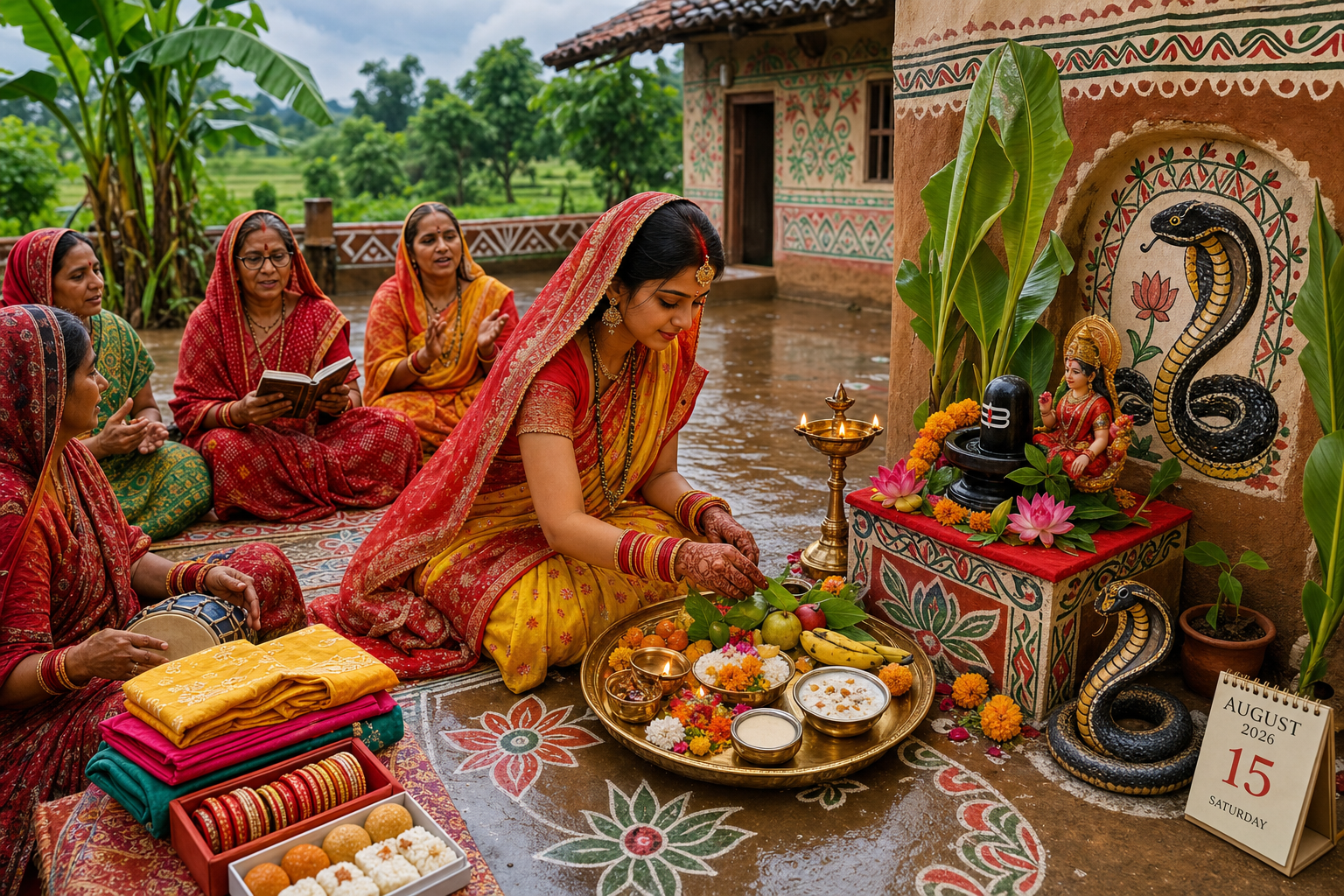
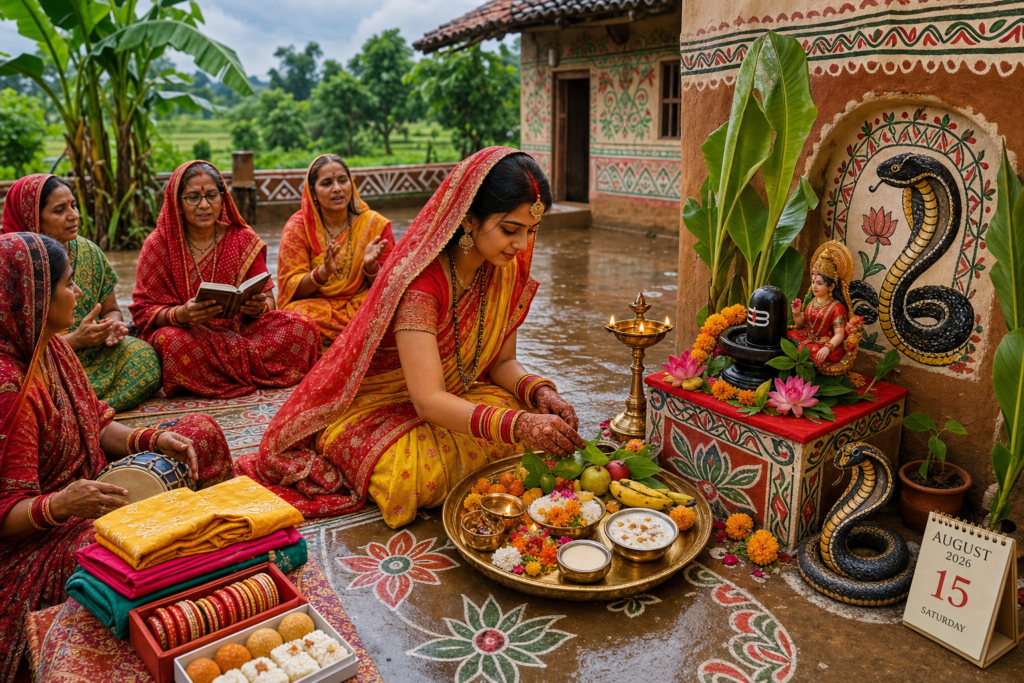
Madhushravani Tritiya, also known as Madhusravani Vrat or Madhushravani Puja, is observed in 2026 on August 15. The observance belongs especially to the cultural and ritual life of the Mithila region, including parts of Bihar and adjoining areas of Nepal, and it is closely connected with Shravani month, the monsoon season, the worship of Shiva and Parvati, and the reverence offered to Nag Devata. Although the festival is often introduced simply as a vrat date, its significance is wider: it preserves oral storytelling, family bonds, ecological memory, women’s ritual agency, and the continuity of Hindu traditions within the broader Dharmic civilizational framework.
In the Hindu calendar, Madhushravani Tritiya falls on the Tritiya tithi associated with the Shravana cycle. Because Hindu observances are calculated by tithi rather than by a fixed Gregorian date, the festival shifts each year. For 2026, the commonly noted Madhushravani Tritiya vrat date is August 15, though families should still consult their local panchang for sunrise-based tithi, regional calendar practice, and local temple custom. This is especially important because observances connected with Shravana can vary according to purnimanta and amanta month-reckoning systems, as well as according to family sampradaya.
The festival is most strongly associated with newly married women in Maithil households. In many communities, a newly married bride observes Madhushravani during her early married life, often while staying at her parental home. This custom is not merely sentimental; it reflects a traditional social structure in which marriage joins two families while still honoring the emotional world of the bride. The daughter’s return to her parents’ home during the vrat becomes a gentle cultural bridge between childhood, marriage, responsibility, and continuity.
Traditional accounts describe Madhushravani as a vrat connected with the blessings of Goddess Parvati and Lord Shiva. Parvati’s tapas, devotion, patience, and union with Shiva form the theological background of the observance. In this context, the vrat is not only about marital auspiciousness; it is also about discipline, sacred intention, and the cultivation of steadiness. Parvati is revered not as a passive figure but as a source of Shakti, self-mastery, and spiritual resolve. Through her example, the festival affirms that devotion in Hindu Dharma is an active, conscious, and transformative practice.
In several places, Madhushravani is observed over a multi-day period rather than on a single day. Some traditions speak of a 13-day observance beginning in Shravan Krishna Paksha and ending with Madhushrava Tritiya, while other regional descriptions refer to a longer cycle from Krishna Paksha Panchami to Shukla Paksha Tritiya. These differences are not contradictions in the lived religious sense. They show how Hindu festivals often exist through local practice, family memory, and regional panchang traditions. The essential structure remains the same: daily puja, vrata discipline, katha recitation, offerings, and the concluding worship on Madhushravani Tritiya.
The Madhusravani Vrat katha is central to the observance. The stories recited during the vrat commonly include themes connected with Shiva Vivah, Gauri Tapasya, Nag worship, household dharma, moral conduct, and auspicious married life. In oral traditions, these stories are not treated as entertainment alone. They work as ethical instruction, cultural education, and emotional formation. Younger women hear the inherited language of family duty, restraint, reverence, and sacred companionship, while elders transmit knowledge in a setting that feels intimate rather than institutional.
Nag Devata worship is another important feature of Madhushravani. Serpent worship in Hindu tradition has deep symbolic and ecological meanings. The serpent is associated with fertility, subterranean waters, ancestral memory, protection, and the mysterious forces of nature. During the monsoon, when the earth is wet, agricultural life is renewed, and snake encounters become more common in rural regions, Nag worship also expresses respect for non-human life. The ritual therefore carries an ecological lesson: human well-being depends on humility before nature, not domination over it.
In many households, offerings are made to Nag Devata with milk, lava, flowers, fruits, sweets, and other ritual items according to local custom. Some traditions also include the worship of Bishari Mata, Nag Nagin, Gauri, and symbolic forms associated with the natural world. The details vary, but the underlying principle is consistent: the household recognizes visible and invisible forms of life as part of a sacred order. This is one reason the festival remains meaningful beyond its immediate ritual context. It teaches that dharma begins with reverence.
The role of the bride’s marital family is also significant. Traditional descriptions note that special items, clothes, ornaments, sweets, and ritual materials may be sent from the bridegroom’s home to the bride’s parental home. This exchange is more than a social formality. It acknowledges the bride’s dignity and the continuing relationship between the two families. In a society where rituals often carry emotional weight, these gestures help reduce distance, strengthen trust, and mark the new household relationship with sweetness and responsibility.
Food practices form an important part of the vrata discipline. In some traditions, women eat simple arava food once a day during the observance. Kheer and other sweet preparations may be offered as prasad on particular days. Such dietary restraint is not merely a rule of fasting; it shapes the rhythm of the festival. Food becomes sanctified through simplicity, offering, and sharing. The household kitchen becomes a ritual space, and daily cooking is lifted from routine labor into sacred participation.
Folk songs are another living dimension of Madhushravani. In Mithila, the festival is often remembered through Maithili songs, women’s gatherings, and the sound of collective recitation. These songs preserve cultural memory in a way that written texts alone cannot. They carry affection, humor, longing, reverence, and the emotional intelligence of women’s community life. For many families, the memory of Madhushravani is not only the calendar date or the formal puja; it is the sound of elders singing, the fragrance of offerings, and the quiet seriousness with which the vrat is performed.
The festival also reflects the larger sacredness of Shravana month. Shravana is traditionally associated with Shiva worship, vrata, pilgrimage, monsoon renewal, and devotional discipline. Across India, the month includes observances such as Shravan Somvar, Nag Panchami, Kanwar Yatra, and other regional festivals. Madhushravani belongs to this wider Shravana atmosphere, but it has a distinct Maithil character. Its emphasis on newly married women, Gauri-Shiva devotion, Nag worship, and household katha gives it a unique place in Hindu cultural traditions.
From an academic perspective, Madhushravani may be understood as a festival where ritual, gender, ecology, and kinship intersect. It is a women-centered observance, but not in a narrow or isolated sense. It depends on mothers, daughters, sisters, in-laws, priests, storytellers, singers, and the wider community. It brings together the personal and the cosmic: a bride’s married life is linked with Parvati’s tapas, the household is linked with Nag Devata, and the monsoon landscape is linked with sacred time.
The emotional appeal of Madhusravani Vrat lies in this integration. Modern life often separates religion from family, ecology from spirituality, and ritual from daily life. Madhushravani resists that separation. It teaches that a festival can be a calendar event, a family reunion, an ecological reminder, a moral lesson, and a spiritual discipline at the same time. This layered nature is one of the strengths of Hindu festivals and one reason they continue to survive across generations.
At the same time, contemporary readers should approach the festival with sensitivity. Some older customs may be practiced differently today, softened, reinterpreted, or omitted according to family values, health, safety, and local guidance. The heart of the observance is not hardship for its own sake. Its deeper purpose is auspiciousness, devotion, gratitude, restraint, and the strengthening of dharmic family life. A thoughtful observance can preserve tradition while also honoring compassion and dignity.
Madhushravani also contributes to the broader goal of unity among Dharmic traditions. Although it is a specifically Hindu and Maithil observance, its values resonate with wider Dharmic ideas: reverence for life, respect for nature, discipline of the body and mind, gratitude toward ancestors and family, and the ethical power of self-restraint. Hinduism, Buddhism, Jainism, and Sikhism each express these values in distinct ways. Madhushravani’s emphasis on devotion, non-harm, sacred ecology, and community continuity can therefore be appreciated as part of the larger Dharmic inheritance of the Indian subcontinent.
For 2026, devotees marking Madhushravani Tritiya on August 15 may prepare by confirming the local tithi, arranging puja materials in advance, identifying the family katha tradition, and creating a calm environment for worship. Newly married women observing the vrat may follow the instructions of elders and family priests where applicable. Families living outside Mithila or outside India can still observe the day meaningfully through simple puja, Shiva-Parvati remembrance, Nag Devata reverence, recitation of Madhusravani Vrat katha, and the sharing of prasad.
The continuing relevance of Madhushravani Tritiya is found in its ability to make sacred time intimate. It does not require spectacle to be meaningful. Its power lies in the household courtyard, the puja space, the spoken katha, the remembered song, the offerings prepared with care, and the renewed bond between families. In 2026, Madhusravani Vrat offers not only a date to observe but a tradition to understand: a disciplined, tender, and deeply rooted celebration of Shravana, Shiva-Parvati devotion, Nag worship, and the enduring cultural wisdom of Mithila.
Inspired by this post on Hindu Pad.




Leave a Reply
You must be logged in to post a comment.