
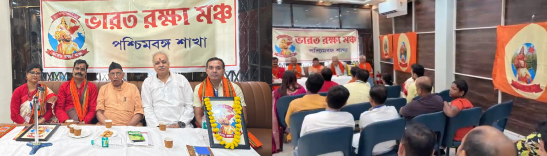
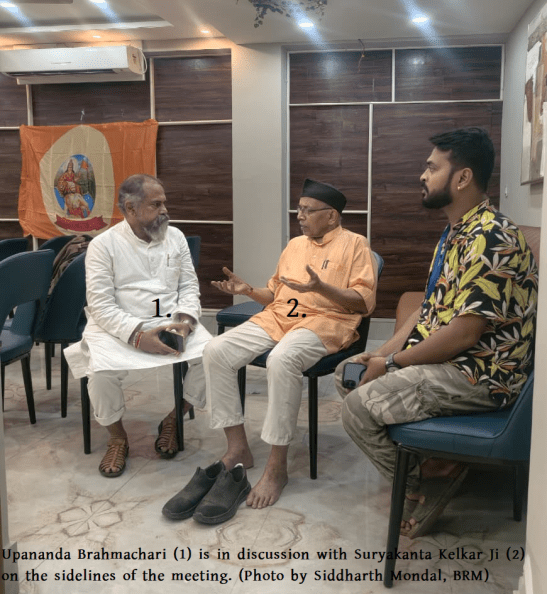
Bharat Raksha Manch’s extended West Bengal state-level meeting in Kolkata, reported from Kolkata on July 2, has placed the questions of illegal cross-border infiltration, demographic change, border security, and Hindu social protection at the centre of a wider public debate. The meeting was presented as a call for vigilance in a border state where geography, migration, electoral politics, religious identity, and humanitarian realities intersect in unusually complex ways.
The central concern raised by Bharat Raksha Manch was that West Bengal’s demographic balance is changing in ways that the organisation links to illegal infiltration from Bangladesh. This claim has long been part of political and civil-society discourse in eastern India, especially in districts adjoining the India-Bangladesh border. The matter cannot be reduced to slogan or suspicion; it requires careful separation between lawful migration, refugee movement, ordinary internal mobility, and illegal entry across an international border.
West Bengal’s location makes the issue structurally important. The state shares a long and varied border with Bangladesh, including riverine stretches, agricultural land, densely populated settlements, and areas where social and linguistic ties predate the modern border. Such geography can make enforcement difficult even when security agencies are alert. The problem is therefore not only administrative; it is historical, economic, social, and deeply human.
Demographic concern in Bengal is usually discussed through census trends, district-level religious composition, fertility patterns, migration histories, and local political change. The 2011 Census recorded West Bengal as a Hindu-majority state with a significant Muslim minority, and some districts near the Bangladesh border showed higher Muslim population shares than the state average. These figures are real, but the interpretation of their causes requires discipline. Population change can arise from birth rates, economic mobility, inter-district migration, historical settlement patterns, and cross-border movement; attributing all change to infiltration would be analytically weak.
At the same time, dismissing all public concern as prejudice would also be unwise. Border communities often experience pressures that are not visible in metropolitan discussion: land competition, documentation disputes, changes in local political mobilisation, trafficking networks, illegal cattle movement, forged identity papers, and anxieties over cultural continuity. When such concerns are expressed responsibly, they deserve institutional attention rather than rhetorical escalation.
The Bharat Raksha Manch meeting appears to have framed infiltration as a national-security and civilisational issue. In that formulation, the protection of Hindu society is not merely a matter of electoral arithmetic but a question of social confidence, temple protection, cultural continuity, and the security of vulnerable communities. A balanced academic reading should note both the urgency felt by such organisations and the need for evidence-based policy that does not stigmatise Indian citizens on the basis of religion.
Any serious response to illegal infiltration must begin with due process. Citizenship and residency questions cannot be handled through mob pressure, social profiling, or communal suspicion. They require lawful documentation checks, transparent investigation, accountable policing, and judicial safeguards. The constitutional framework of India requires that national security and civil rights be held together, not treated as mutually exclusive.
For Hindu families in border regions, the emotional dimension is also significant. Cultural belonging is not an abstract idea when local festivals, temple routes, burial and cremation spaces, school language, market networks, and village leadership structures change within a generation. Many people experience demographic debate through daily life rather than through statistics. That lived experience should be heard without allowing it to become hostility toward lawful neighbours or Indian Muslim communities.
The dharmic approach to this issue must be firm without becoming reckless. Hinduism, Buddhism, Jainism, and Sikhism all contain traditions of social responsibility, protection of the vulnerable, restraint in speech, and respect for lawful order. A dharmic public ethic can support border security, documentation integrity, and cultural protection while rejecting indiscriminate hatred. This distinction is essential for preserving social unity.
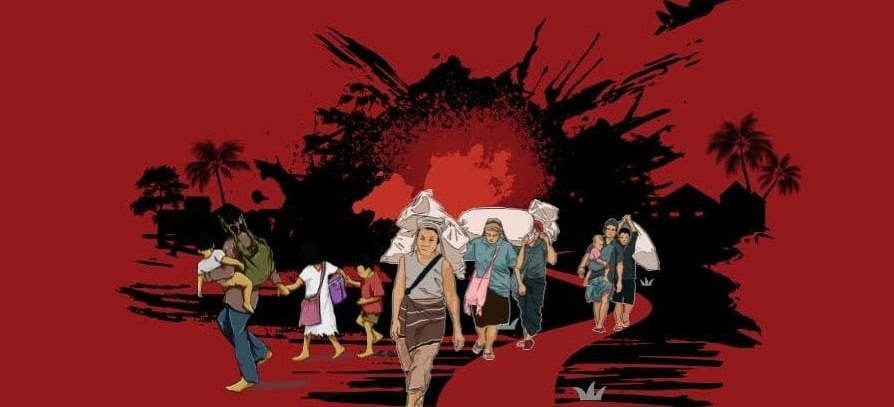
Bengal’s history makes the subject especially sensitive. The region has witnessed partition, refugee displacement, communal violence, linguistic reorganisation, and the creation of Bangladesh after the 1971 Liberation War. Hindu refugees from East Pakistan and later Bangladesh have carried memories of dispossession and persecution. Their experiences remain morally important and should not be erased from public memory. At the same time, historical trauma must be channelled into lawful advocacy, rehabilitation, research, and policy reform rather than collective blame.
Infiltration debates also raise the question of documentation. Ration cards, voter identity cards, Aadhaar numbers, land records, birth certificates, and school documents are often treated as proof of belonging, yet each has different legal value. Weak local verification systems can create opportunities for fraud, while excessive suspicion can harm poor citizens who lack paperwork because of poverty, displacement, floods, or administrative neglect. A credible solution must improve documentation without punishing the vulnerable unfairly.
Border management is another key policy area. Fencing, surveillance, riverine patrols, better coordination between state police and central forces, anti-trafficking operations, and faster prosecution of document fraud can all contribute to a more secure environment. However, enforcement alone is not enough. Borderland economies require lawful livelihood options, because poverty and informal trade often create the conditions in which illegal networks thrive.
The meeting’s emphasis on protecting Hindu society should therefore be read within a wider institutional agenda: community confidence, temple safety, women’s security, legal literacy, education, and local self-organisation. Social protection cannot be sustained only through protest. It also requires schools, hostels, legal aid, documentation camps, cultural institutions, youth training, and economic resilience among vulnerable Hindu communities.
There is also an important distinction between illegal infiltration and the status of religious minorities fleeing persecution. Hindu, Sikh, Buddhist, Jain, Christian, and Parsi minorities from neighbouring Islamic republics have often argued that their migration is different from ordinary economic movement because it is linked to religious vulnerability. Indian public policy has debated this distinction through the Citizenship Amendment Act and related controversies. Whatever position is taken, the debate must remain legally precise and morally coherent.
For West Bengal, the political context cannot be ignored. Demographic claims influence electoral strategy, party mobilisation, minority outreach, border-district campaigning, and debates over welfare distribution. This makes accuracy even more important. Exaggerated numbers can inflame society, while denial of genuine security concerns can deepen mistrust. Responsible public discourse should demand district-wise data, transparent government reporting, and independent research.
The question of Hindu unity in Bengal has a cultural dimension beyond politics. Bengal’s Hindu inheritance includes Shakta worship, Vaishnava bhakti, Shaiva traditions, folk practices, Sanskrit learning, kirtan, pilgrimage, and reform movements. It also has deep connections with Buddhist, Jain, and Sikh histories across eastern India. Protecting this inheritance means strengthening cultural education and community institutions, not merely reacting to demographic fear.
Academic clarity also requires acknowledging that Indian Muslims are not foreigners by default. Many Muslim families in Bengal have lived in the region for centuries and are part of India’s constitutional order. The issue raised by Bharat Raksha Manch concerns illegal cross-border infiltration and demographic transformation, not a licence to question the citizenship or dignity of lawful Indian communities. This distinction protects both national security and social peace.
A stronger public response would include several elements: accurate census and migration data, stronger border enforcement, action against forged documents, protection for persecuted minorities, transparent voter-roll auditing, and local development in vulnerable districts. It would also include inter-community peace mechanisms so that law-abiding citizens are not drawn into polarisation created by political rhetoric or criminal networks.
The Bharat Raksha Manch meeting in Kolkata should therefore be understood as part of a broader contest over Bengal’s future: who belongs, how borders are protected, how refugees are treated, how religious communities maintain confidence, and how the state preserves both security and justice. These are not small questions. They touch the foundations of citizenship, cultural memory, and national sovereignty.
The most constructive way forward is neither denial nor panic. Bengal needs lawful vigilance, credible demographic research, administrative integrity, and dharmic social responsibility. Hindu society’s legitimate concerns about security and continuity can be expressed with firmness, but they become more persuasive when grounded in evidence, constitutional process, and compassion for all lawful citizens. In that balance lies the possibility of protecting Bharat without weakening the ethical foundations that make Bharat worth protecting.
Inspired by this post on Struggle for Hindu Existence.






Leave a Reply
You must be logged in to post a comment.