
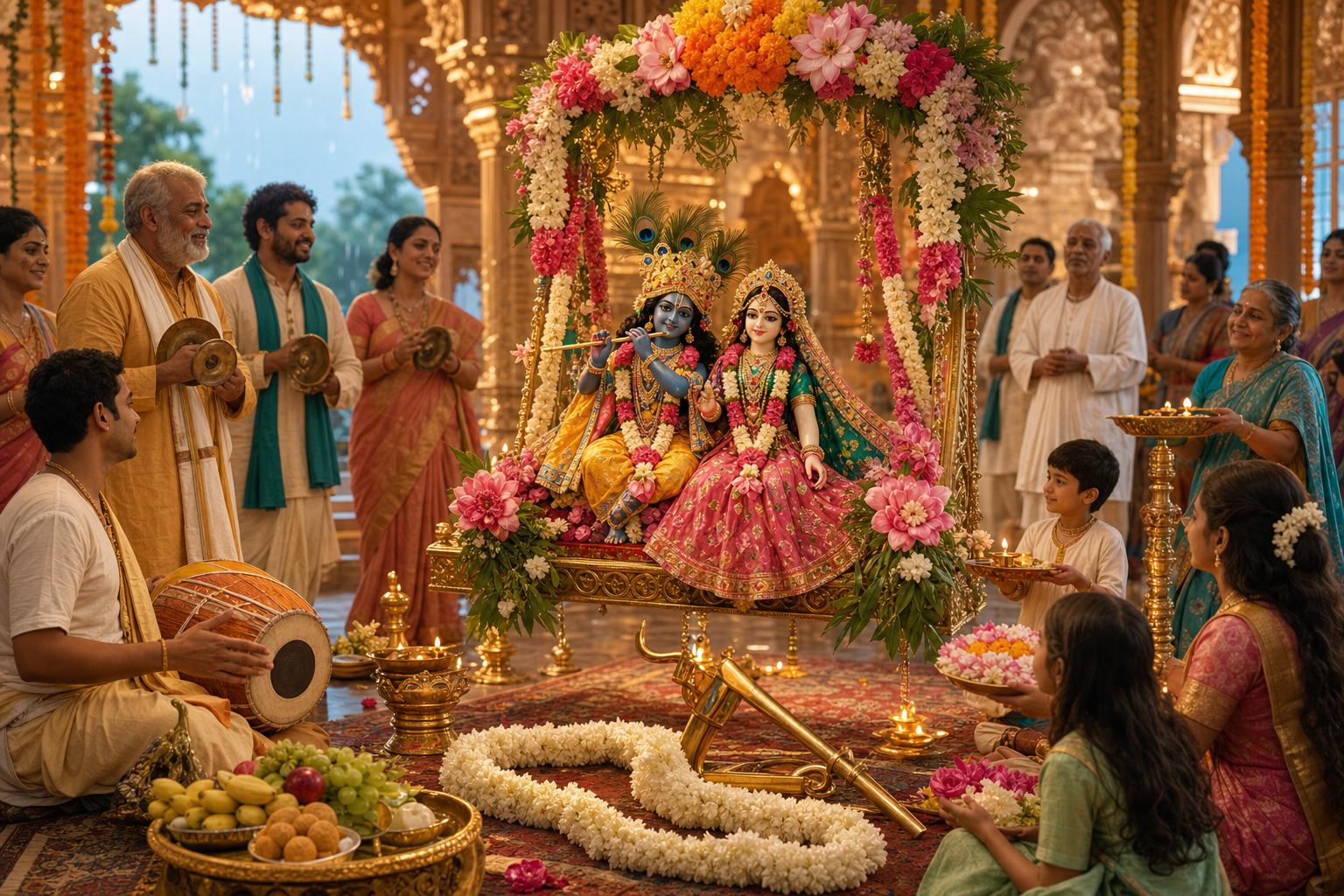
The central community news for this festival season is the forthcoming observance of Jhulan Yatra, scheduled from 23-28 August, culminating with Balarama Purnima on Friday, 28 August. These dates mark an important devotional period in the Vaishnava calendar, bringing together worship, music, ritual hospitality, and shared remembrance of Sri Krishna, Srimati Radharani, and Lord Balarama. The temple celebration will include a special feast, while additional gatherings at Casey and Werribee will extend the festival atmosphere into the wider community.
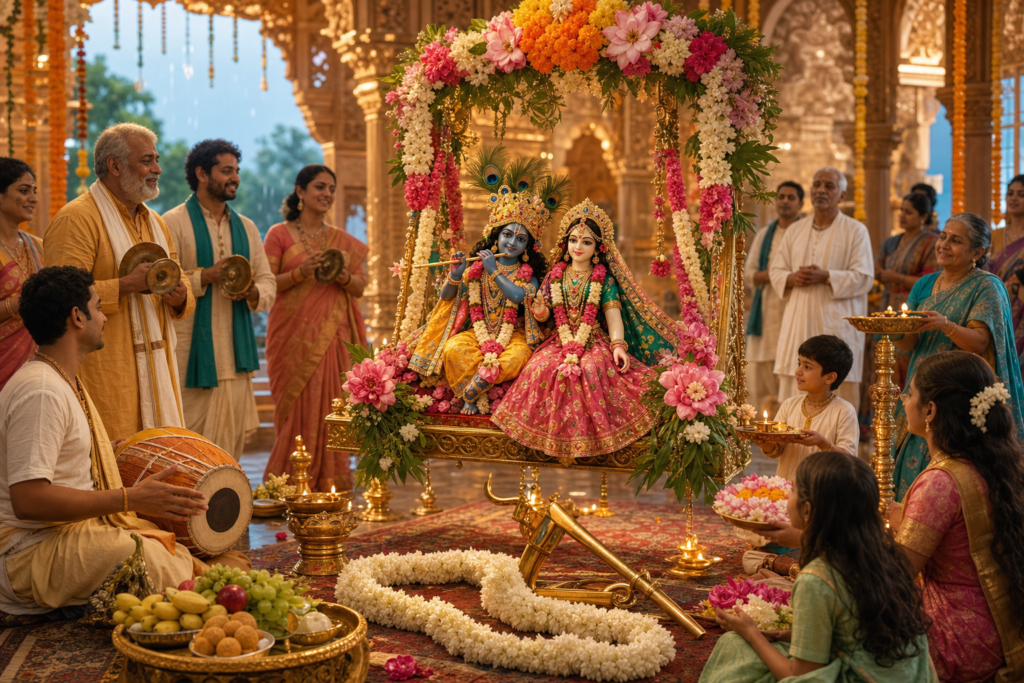
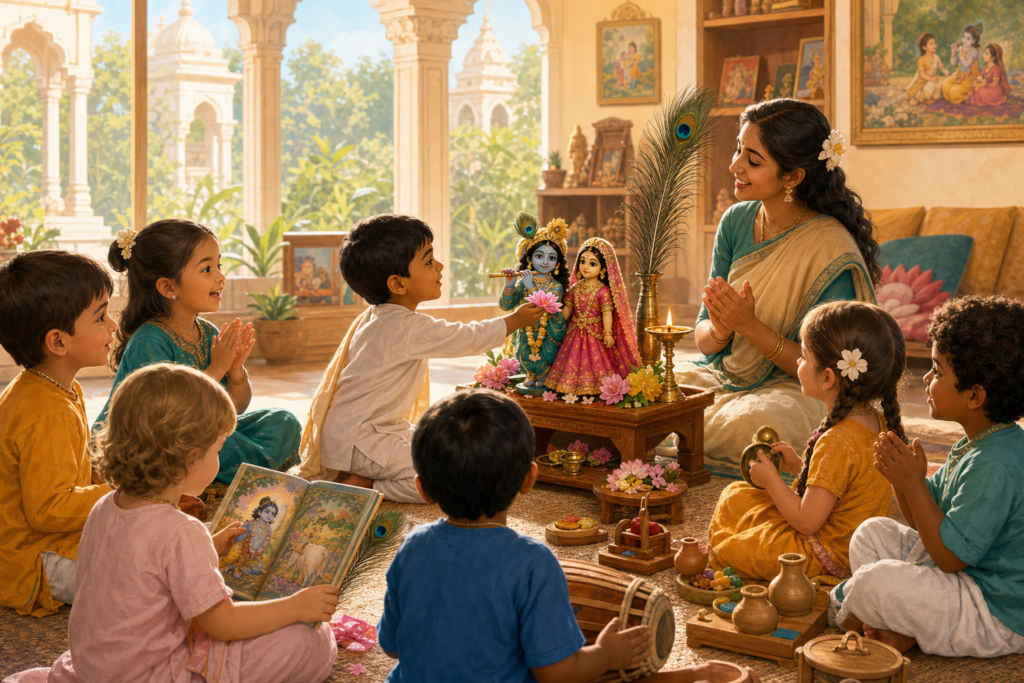
Jhulan Yatra, often described as the swing festival, is associated with the devotional celebration of Radha and Krishna during the monsoon season. In temple practice, the festival commonly includes the ceremonial placement of the divine couple on a decorated swing, accompanied by kirtan, offerings, flowers, lamps, and devotional singing. Its beauty lies not only in visual ornamentation but also in its theological message: divine love is contemplated through movement, rhythm, intimacy, and service. The swing becomes a sacred focal point where the community participates through simple acts of devotion, each gesture carrying symbolic meaning.
From a ritual perspective, the festival demonstrates how Hindu traditions use embodied practice to communicate philosophy. Decoration, fragrance, sound, food offerings, and congregational singing are not ornamental additions; they are part of a coherent devotional structure. The senses are drawn toward sacred remembrance, allowing participants of different ages and backgrounds to engage meaningfully. For families, children, elders, and new visitors, Jhulan Yatra offers an accessible entry into temple culture because participation does not require specialized learning before one can feel included.
The culmination on Balarama Purnima gives the observance a distinct spiritual emphasis. Lord Balarama is revered as the elder brother of Sri Krishna and is traditionally associated with strength, service, protection, humility, and spiritual support. His appearance day invites reflection on the principle that genuine strength is not domination but service aligned with dharma. In a community setting, this teaching becomes especially relevant: festivals are sustained by volunteers, cooks, singers, organizers, cleaners, donors of time, and devotees who quietly create an atmosphere of welcome.
The special feast at the temple is therefore more than a social meal. In Hindu temple culture, prasadam expresses the transformation of food through offering, gratitude, and distribution. It turns hospitality into theology. Sharing prasadam after worship allows the festival to move from the altar into the life of the community, reinforcing bonds across families, generations, and cultural backgrounds. Such moments often become the memories that keep younger generations connected to Hindu festivals and Vaishnava devotional practice.
The additional celebrations at Casey and Werribee also carry social importance. Diaspora communities often preserve sacred traditions through local nodes of participation rather than a single centralized space. When festivals are celebrated across suburbs and community centres, access improves for families who may face travel, time, or work constraints. This wider participation helps maintain cultural continuity while also presenting Hindu spirituality in a welcoming, community-oriented form.
Academically, festivals such as Jhulan Yatra can be understood as living institutions of cultural transmission. They preserve liturgy, music, food practices, seasonal memory, Sanskritic and vernacular narratives, and community ethics. Yet their continuity depends on repetition with meaning. A festival remains alive when participants understand not only the schedule but also the inner logic of the celebration: why the swing is decorated, why kirtan matters, why prasadam is shared, and why Balarama Purnima is linked with service and spiritual strength.
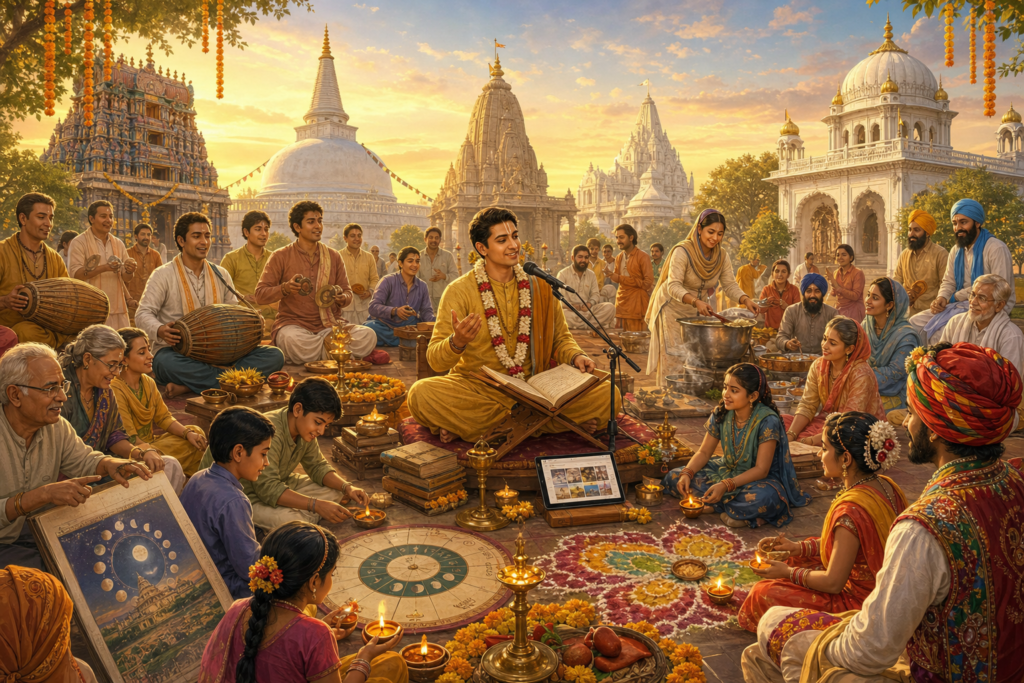
There is also a wider dharmic value in such observances. Hinduism, Buddhism, Jainism, and Sikhism all give importance, in different ways, to discipline, compassion, community, remembrance, and the refinement of human conduct. While Jhulan Yatra and Balarama Purnima belong specifically to Vaishnava Hindu practice, their public celebration can encourage mutual respect among dharmic traditions by emphasizing shared virtues rather than sectarian division. The festival becomes an occasion for unity, education, and cultural confidence.
For devotees and visitors alike, the upcoming observances from 23-28 August offer an opportunity to experience Hindu festivals as both sacred worship and community formation. The temple feast, the Casey gathering, and the Werribee celebration together show how devotional traditions continue to adapt without losing their core. In this sense, the news of the month is not merely a calendar announcement. It is an invitation to participate in a living tradition where beauty, devotion, service, and shared belonging come together.
Inspired by this post on Dandavats.


Leave a Reply
You must be logged in to post a comment.