
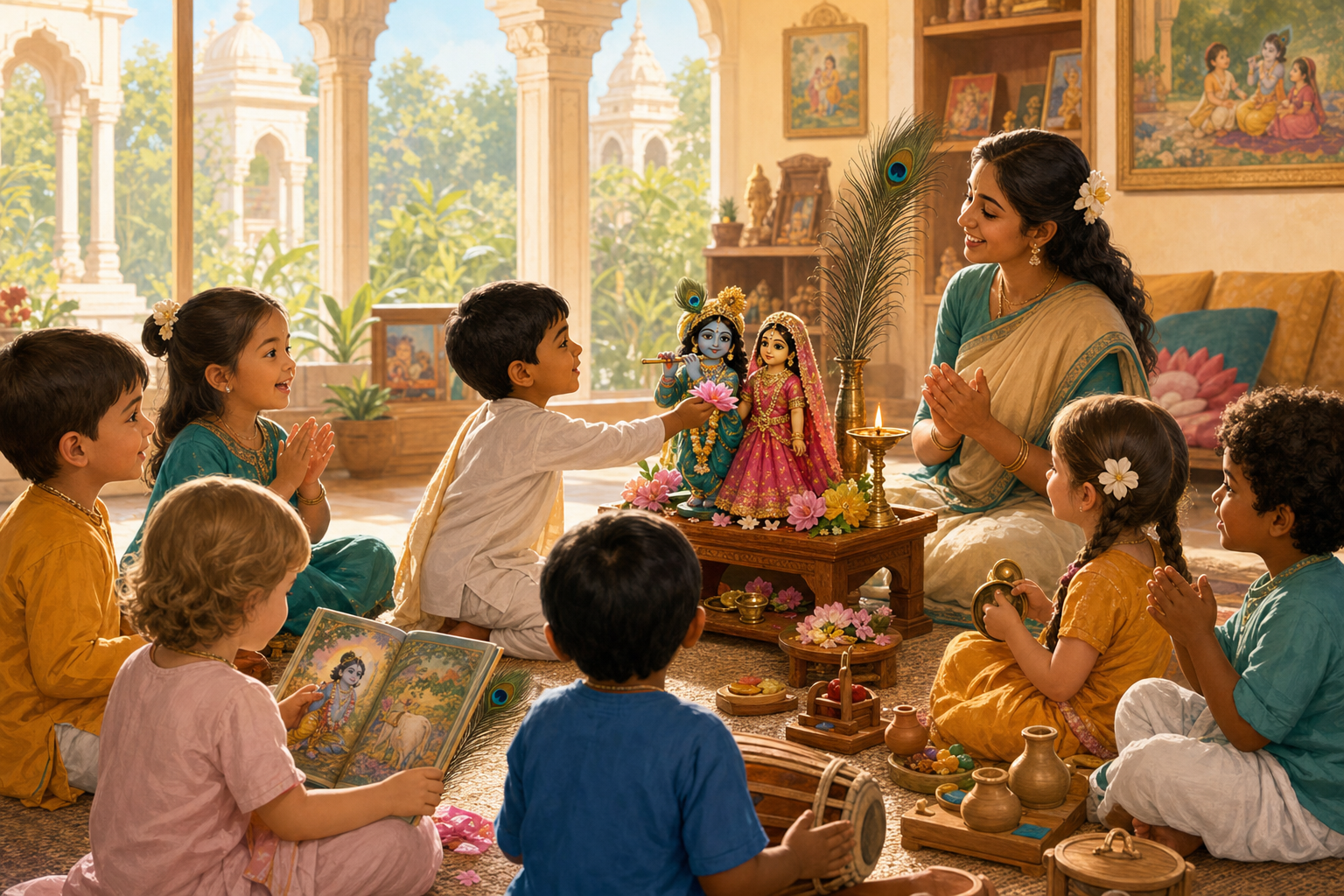
Krishna Consciousness education in early childhood rests on a simple but profound principle: the spiritual life of a child is not merely preparation for adulthood, but a living field of devotion in the present moment. In the Vaishnava tradition, childhood is understood as a sacred period in which impressions, habits, relationships, and forms of worship can become deeply rooted. When young children are surrounded by devotional association, sacred sound, temple culture, meaningful stories, and opportunities for service, Krishna Consciousness becomes not an abstract doctrine but a familiar way of seeing, feeling, and acting.
Srila Prabhupada emphasizes in the purport to Srimad-Bhagavatam 3.25.25 that devotee association is essential for understanding the personal nature of the Lord, His pastimes, and the practice of devotional service. Association with devotees is not treated as a secondary support; it is presented as a direct form of association with the Lord. This theological idea has major implications for Hindu education, particularly for parents and teachers who wish to nurture bhakti in children from the earliest years.
The same principle applies to children with special urgency. Adults may seek spiritual company, choose a temple community, read scriptures, or intentionally organize their devotional practice. Children, however, depend largely on the environment created by parents, teachers, and community elders. They cannot independently choose the association that will shape their inner life. For this reason, early Krishna Consciousness education requires deliberate care: the child’s surroundings must make devotional life visible, joyful, relational, and age-appropriate.
Vrajalila Devi Dasi, in a personal communication dated January 14, 2019, expressed this point through the experience of motherhood. Krishna Consciousness, in her view, should not be delayed until adult life. Children are also capable of awakening love for the Lord, developing affection for sacred forms, and participating in devotional service. Yet because they cannot select their own spiritual environment, parents carry a serious responsibility to offer both education and association that help them serve Krishna in ways suited to childhood.
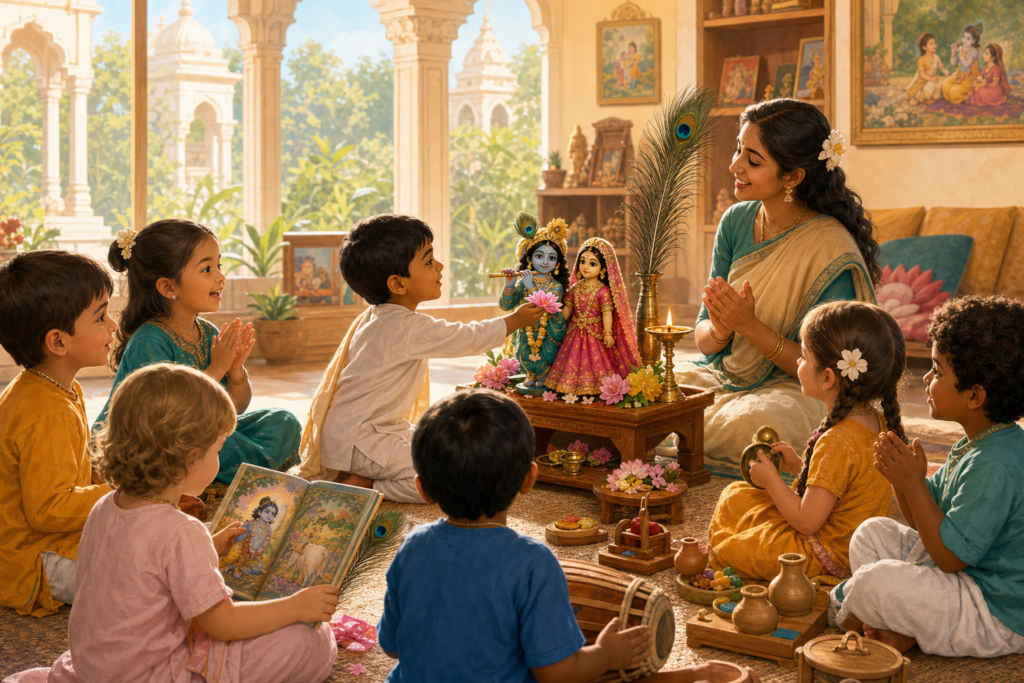
This insight reveals why devotee association from an early age is more than social convenience. It is part of spiritual formation. Children need devotional friends, devotional play, devotional language, and devotional materials. When a child plays at serving Radha Krishna, Sita, Ram Lakshman, Hanuman, or Goura-Nitai, the activity is not merely entertainment. It becomes a child-sized entrance into the world of seva, imagination, reverence, and relationship with the Divine.
For Vaishnava teachers and parents, the educational task is therefore not to force adult forms of religious instruction upon children. The task is to present Krishna Consciousness through the natural grammar of childhood: play, song, rhythm, story, touch, repetition, imitation, beauty, and community. A meaningful Vaishnava curriculum must move with children’s interests while gently expanding those interests toward the Holy Name, the Deities, sacred narratives, prasadam, kirtan, service, and compassion toward all living beings.
Devotional play is especially important because play is one of the primary ways young children organize experience. A child who cooks imaginary bhoga for Radha and Krishna dolls with small pots, plates, and cups is not simply pretending in a shallow sense. Within Krishna Consciousness, intention has spiritual significance. Srimad-Bhagavatam 3.28.18 supports the broader understanding that the mind can become a sacred space of meditation and worship. When a child offers something lovingly for the pleasure of the Lord, that gesture may be small in visible form but meaningful in devotional consciousness.
Modern developmental research also helps explain why devotional play can be effective in early education. Lillard, Pinkham, and Smith (2011), in their work on pretend play and cognitive development, note that the boundary between imagination and perceived reality is often thin in early childhood. This does not make children irrational; rather, it shows that their imaginative life is highly active and formative. In a devotional context, this quality can help children relate naturally to Deities, sacred stories, and ritual actions without the skepticism that often emerges later in life.
When young children visit a temple, they may accept the Deities as the Lord with directness and simplicity. When they play with Radha-Krishna dolls or Goura-Nitai dolls, they may spontaneously bow, offer food, sing, decorate, or speak lovingly. These gestures should not be dismissed as childish imitation. Imitation is one of childhood’s most powerful learning pathways. Through repeated devotional action, children develop memory, emotional association, bodily familiarity, and reverence. In time, what begins as play may mature into conscious sadhana.
The Gurukula of the Bhaktivedanta Manor offers an example of how this approach can be practiced within an educational institution. Its early-years environment allows young devotee children to meet one another, form friendships, and participate in devotional service. Classroom Deities are worshiped daily, and children learn simple practices such as acamana and arati. Worship articles are offered by turns, making participation embodied, orderly, and communal rather than passive.
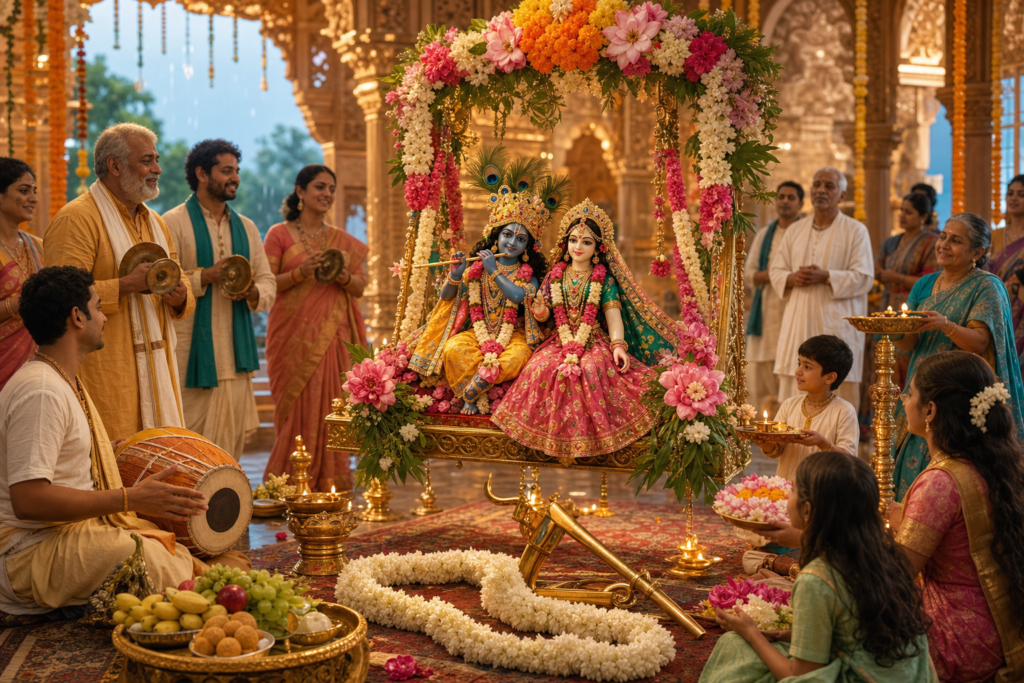
Such practices matter because children learn devotion not only through explanation but also through rhythm and belonging. Daily worship gives spiritual life a stable place in the child’s schedule. Kirtan introduces sacred sound through music, movement, and collective joy. Devotional instruments allow children to contribute actively. Visits to the Goshala at Bhaktivedanta Manor cultivate love for mother cow and connect religious learning with care, gratitude, and ecological sensitivity. In this way, bhakti becomes linked with both worship and ethical feeling.
The educational model described here also shows that Krishna Consciousness education need not be separated from formal learning. The British National Curriculum for the early years includes seven major learning areas: Personal Emotional Development, Communication and Language, Literacy, Mathematical Development, Knowledge and Understanding of the World, Physical Development, and Creative Development. These domains can coexist with a Vaishnava curriculum when planning is thoughtful and developmentally sound.
The Faith and Nurture curriculum for early years, as incorporated into the school’s planning, follows Vaishnava celebrations and introduces children to central themes of Krishna Consciousness. These include the Holy Name and Srila Prabhupada, Lord Krishna and His pastimes, Lord Chaintanya and His pastimes, Lord Rama and His pastimes, the Avatars of the Lord, the Deities of the Lord, and the devotees of the Lord. This structure allows religious learning to unfold through the calendar, linking memory, festival, story, and practice.
From an academic perspective, this integration is significant. A child’s spiritual education is strengthened when it is not treated as an isolated subject taught only through occasional lessons. Instead, Krishna Consciousness can become part of language development through stories and songs, part of creative development through art and devotional play, part of personal development through service and cooperation, and part of knowledge of the world through festivals, food, nature, animals, and sacred geography.
The role of the teacher is central. Vaishnava teachers do not merely transmit information about Krishna, bhakti, or scripture; they model the devotional disposition that gives those teachings credibility. Children observe how adults speak about the Lord, how they handle sacred objects, how they sing, how they correct behavior, how they show patience, and how they respond to difficulty. In early childhood, the emotional tone of the teacher often becomes inseparable from the child’s first impressions of religion.
This is why Krishna Consciousness education must be gentle, warm, and disciplined without becoming mechanical. Worshiping the Deity, praying to the Lord, singing kirtan, meditating upon the Lord’s forms, hearing stories from scripture, and serving others should be presented as meaningful practices that cultivate love, responsibility, humility, and resilience. Children facing the ordinary burdens of life need more than information; they need an inner vocabulary of trust, gratitude, courage, and sacred relationship.
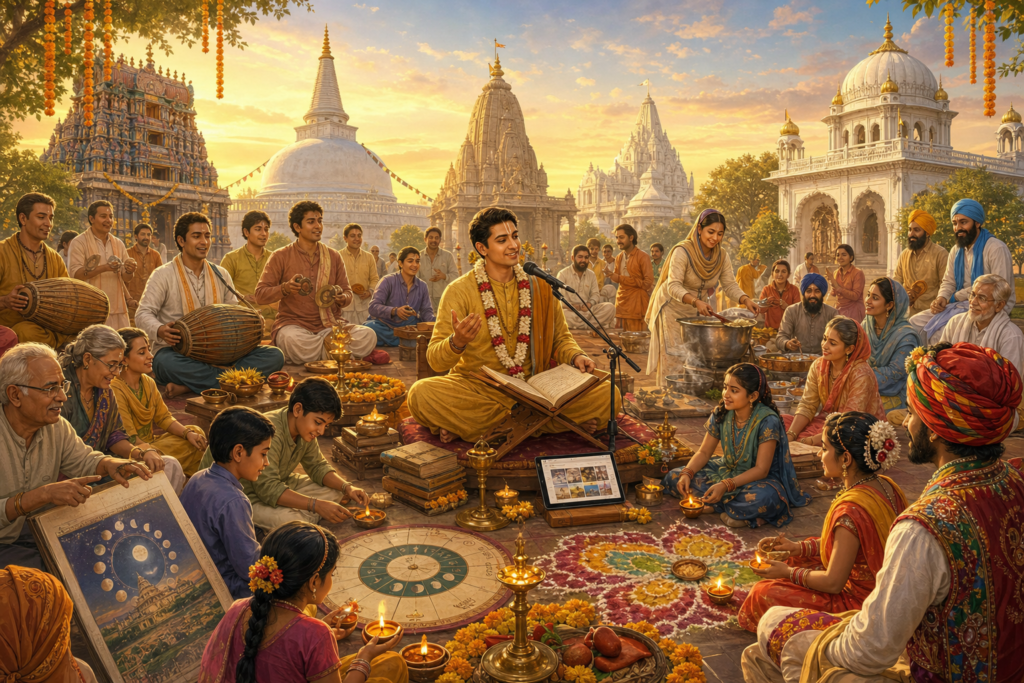
The broader dharmic value of this approach is also important. Hindu education, when rooted in bhakti, does not have to create narrowness. Properly taught, devotion to Krishna can deepen respect for the many paths of Sanatana Dharma and for the wider family of dharmic traditions, including Buddhism, Jainism, and Sikhism. A child who learns reverence, non-harm, self-discipline, sacred sound, service, and respect for spiritual teachers is being prepared not for sectarian hostility but for a life of principled devotion and cultural confidence.
At its best, Krishna Consciousness education in childhood creates continuity between home, school, temple, and community. The child hears the Holy Name, watches elders serve, plays with devotional symbols, shares prasadam, learns stories of Lord Krishna and Lord Rama, participates in festivals, and develops friendships with other children who recognize the same sacred world. These repeated experiences form samskaras, impressions that can support spiritual growth long after early childhood has passed.
The central conclusion is clear: early childhood is not too early for Krishna Consciousness. It may be one of the most receptive stages for nurturing devotion, provided the method is developmentally appropriate and emotionally nourishing. Devotional association, imaginative play, Deity worship, kirtan, scriptural stories, compassionate conduct, and a thoughtful Vaishnava curriculum can together help children experience bhakti as natural, joyful, and intimate.
Reference: Lillard, A., Pinkham, A., and Smith, E. (2011). Pretend play and cognitive development. Chapter 11 in The Wiley-Blackwell Handbook of Childhood Cognitive Development.
Inspired by this post on Dandavats.








Leave a Reply
You must be logged in to post a comment.