
Kanga Ajima of Kathmandu Valley stands among the most powerful and enduring maternal divinities of Nepal Mandala. Long before Kathmandu was described through maps, municipalities, and modern heritage language, the valley was understood through sacred presence, ritual boundaries, and protective mothers. Kanga Ajima belongs to this older imagination of place. She is remembered not merely as a deity in a shrine, but as a guardian force whose presence helped communities understand safety, kinship, disease, fertility, fear, death, and renewal.
In the Newar religious world, Ajima is a profoundly intimate word. It is commonly explained through Nepal Bhasa roots associated with grandmother and mother, and that meaning is essential to understanding the tradition. The Ajimas are not distant abstractions. They are ancestral, local, embodied, and protective. They stand at the meeting point of household devotion and civic guardianship, where the mother of a family expands into the mother of a neighborhood, and the mother of a neighborhood becomes the fierce protector of a city.
Kanga Ajima is traditionally identified with Chamunda, one of the fierce forms of Devi and one of the Matrikas. Chamunda is not fierce in a shallow or merely violent sense. In Hindu iconography and Shakta theology, fierceness often signifies the power to face what ordinary consciousness avoids: decay, danger, ego, disorder, disease, and death. Kanga Ajima therefore represents a sacred mother whose protection does not depend on softness alone. Her compassion is inseparable from vigilance, discipline, and the ability to confront destructive forces.
The story of Kanga Ajima is best understood within the broader Ajima tradition of Kathmandu. The old city is associated with a network of mother goddesses, often linked with the Astha Matrika, who are placed in relation to the city and its boundaries. These goddesses are not ornamental additions to urban life. They form a ritual geography. Their shrines, festivals, and processional routes create a sacred map through which the city remembers that protection is not only military or political, but also spiritual, communal, and ethical.
In this protective mandala, Kanga Ajima appears as one of the mother goddesses whose presence helps hold Kathmandu together. The idea is technically important: the sacred city is not only built with streets, markets, palaces, and temples; it is also built with directions, thresholds, pithas, processions, vows, offerings, and inherited memory. Kanga Ajima belongs to that older urban science in which religion, architecture, social order, and local ecology were woven into one living system.
As a form of Chamunda, Kanga Ajima carries the theological weight of Shakti. Shakti is the active power of the divine, the energy through which creation moves, protects, dissolves, and renews itself. In gentle forms, Shakti nourishes. In fierce forms, Shakti cuts through stagnation, illusion, and danger. Kanga Ajima brings both dimensions together. She is a mother, but not a passive mother. She is a protectress, but not a remote guardian. She is fierce because the world she protects is fragile.
The emotional power of Kanga Ajima lies in this combination of nearness and awe. For devotees, such a goddess can be approached with fear, reverence, affection, and dependence at the same time. This is one reason the Ajima tradition remains meaningful. It gives sacred language to experiences that ordinary categories cannot easily hold: the fear of illness, the hope for children, the vulnerability of families, the anxiety of cities, and the need for a force greater than the individual to stand watch over human life.
Newar tradition is especially significant because it preserves a deeply layered form of Dharmic culture. Hindu Shakta worship, Shaiva elements, Vajrayana Buddhist practice, local ancestral reverence, and civic ritual coexist in ways that resist narrow classification. Kanga Ajima is part of this living synthesis. She is revered within a Hindu framework as Chamunda, yet the Ajima tradition is also honored by Newar Buddhist communities. This shared reverence demonstrates the civilizational strength of Nepal Mandala: diversity is not treated as weakness, but as a disciplined and inherited way of life.
This point is crucial for understanding the wider Dharmic significance of Kanga Ajima. The tradition does not demand the erasure of difference. Instead, it shows how Hindu and Buddhist communities could share sacred space while maintaining their own ritual identities. Such a model is valuable for all Dharmic traditions, including Jainism and Sikhism, because it affirms a broader principle: spiritual life can be plural, locally rooted, and mutually respectful without becoming empty or confused.
The Kathmandu Valley has long been a meeting ground of trade, kingship, monastic culture, temple ritual, artisan guilds, and household devotion. In such a place, protection had to be understood at many levels. A city needed walls, soldiers, rulers, water systems, markets, and laws, but it also needed ritual guardians. Kanga Ajima belongs to this second but equally serious category of protection. Her presence suggests that a city survives not only by administration, but by keeping faith with its sacred obligations.
The Ajima shrines also reveal how the sacred feminine shaped urban consciousness. Modern readers often separate religion from planning, architecture, public health, and social cohesion. Kathmandu’s older ritual culture did not make such a rigid separation. A mother goddess could be linked to a neighborhood boundary, a procession could renew civic bonds, and a festival could bring dispersed families into shared rhythm. In this sense, Kanga Ajima is not only a subject of mythology; she is also a key to understanding the cultural design of Kathmandu.
Her association with Chamunda adds another layer. Chamunda is often represented in a terrifying form, reminding devotees that the divine mother is not limited to beauty, abundance, or domestic auspiciousness. She also rules the cremation ground, the battlefield of the inner life, and the frightening edge where human pride collapses. The fierce goddess teaches that protection sometimes requires the destruction of arrogance, negligence, and spiritual forgetfulness. Kanga Ajima therefore embodies a difficult but necessary compassion.
Within Hindu thought, this does not contradict motherhood. It deepens it. A mother who protects a child must sometimes be stern. A society that protects its sacred inheritance must sometimes be alert. A civilization that honors life must also recognize mortality. Kanga Ajima’s fierceness can therefore be read as a theological statement: love is not always gentle in form, but its purpose may still be preservation, awakening, and restoration.
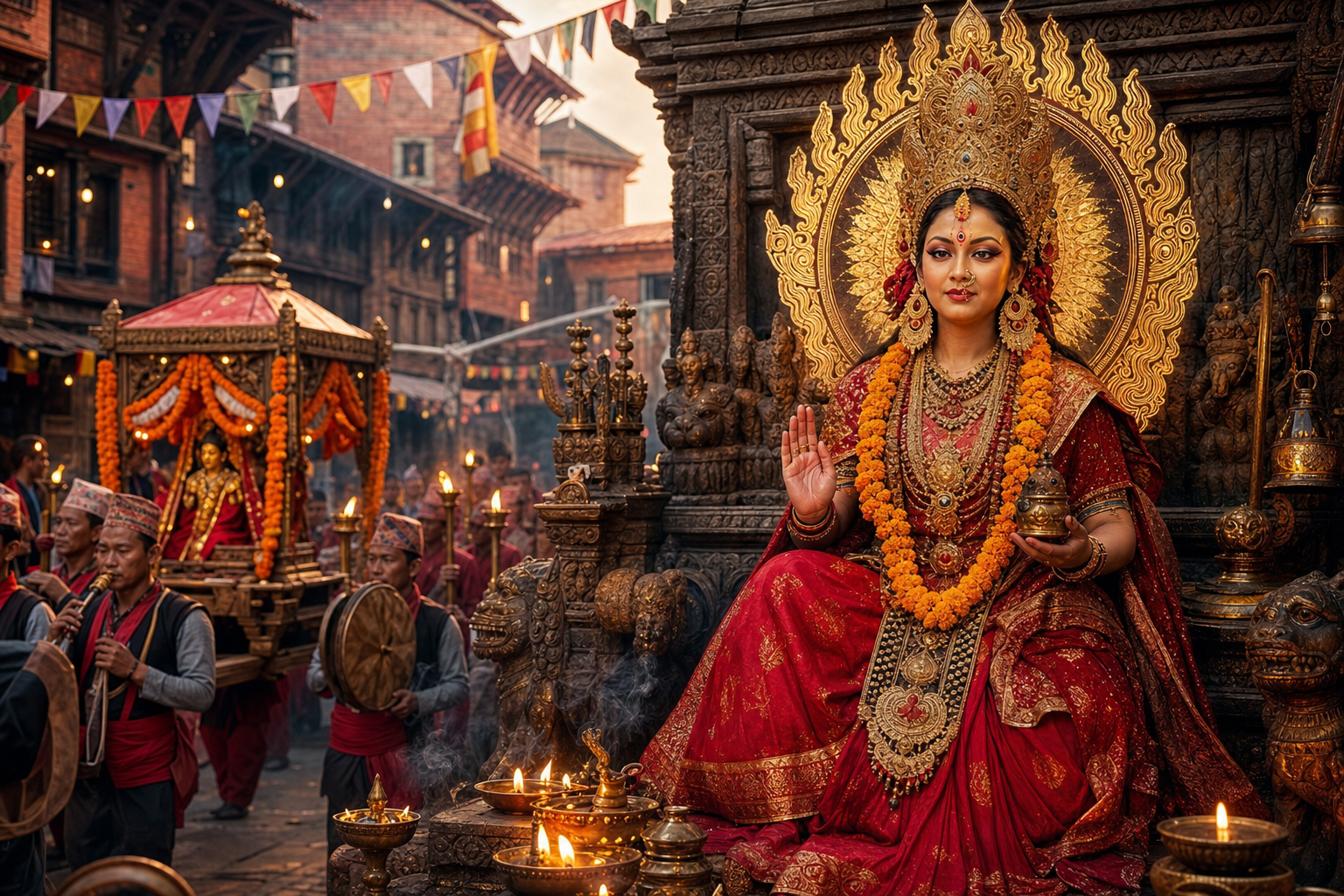
The living importance of Kanga Ajima is visible in the festival culture of Kathmandu, especially in the wider Pahan Charhe cycle associated with the Ajima goddesses. During these observances, portable shrines of mother goddesses are taken through the city, accompanied by music, community participation, offerings, and ritual encounters. These processions are not simple performances for spectators. They are acts of renewal through which the city reintroduces itself to its guardians.
The Dyah Lwakegu ceremony, in which goddess processions meet and ritual torches are exchanged, is especially meaningful. The meeting of the Ajimas dramatizes kinship among the goddesses, and by extension, kinship among the communities who serve them. In a dense city of different neighborhoods, castes, guilds, lineages, and ritual responsibilities, such festivals offer a sacred grammar of togetherness. Kanga Ajima’s presence in this ritual world reminds devotees that protection is collective; the city is guarded when its people remember their bonds.
The gathering at places such as Asan also shows how sacred geography and market life overlap in Kathmandu. Asan is not only a commercial square; it is a ceremonial center where roads, communities, shrines, and memories converge. When mother goddesses are brought into such a space, the bazaar becomes more than a place of exchange. It becomes a ritual theater of belonging. Kanga Ajima’s movement through the city transforms ordinary streets into sacred pathways.
For a visitor walking through old Kathmandu, the Ajima tradition can be felt even before it is fully understood. Small shrines, carved doorways, oil lamps, bells, offerings, and sudden bursts of festival music create an atmosphere in which the sacred is not hidden away from daily life. Kanga Ajima belongs to this immediacy. Her story is not locked in a manuscript alone. It is carried in processions, remembered by families, preserved by ritual specialists, and renewed by devotees who may not express theology in academic language but live it with precision.
Technically, the Ajima tradition also shows the importance of pitha worship. A pitha is not merely a temple site; it is a seat of divine presence. In many Newar contexts, the goddess may be represented through stone, metal image, or local sacred form, and the power of the place matters as much as the image. This is consistent with broader Hindu and Tantric understandings of sacred geography, where the divine is encountered through location, direction, lineage, mantra, and ritual continuity.
Kanga Ajima’s worship also preserves the memory of feminine ancestry. The Ajimas are often understood as deified mother figures connected with the ancestral life of the Newars. This does not reduce them to human ancestors; rather, it shows how ancestral reverence and goddess theology can interpenetrate. The grandmother becomes more than a family elder. She becomes a symbol of transmitted life, accumulated wisdom, and protective power. In Kanga Ajima, that ancestral warmth is intensified into the fierce force of Chamunda.
This layered identity helps explain why the Ajima goddesses are both loved and feared. Sacred fear is not the same as superstition. In traditional religious cultures, fear can mean recognition of power, seriousness, and moral consequence. Kanga Ajima is approached with reverence because she is not trivial. She stands close to the realities that human beings cannot control. That is precisely why her protection matters.
The protective role of Kanga Ajima may also be read in relation to disease and misfortune, themes often associated with mother goddesses across South Asia and Nepal. Communities historically lived with epidemics, infant mortality, food insecurity, earthquakes, and political upheaval. A fierce mother goddess provided more than psychological comfort. She gave ritual structure to fear, creating ways for communities to respond through offerings, vows, festivals, and collective remembrance.
Such traditions should not be dismissed as primitive responses to uncertainty. They are sophisticated cultural systems that bind emotion, ethics, ecology, and public life. Kanga Ajima’s worship allowed the community to name vulnerability without surrendering to despair. The goddess became the center around which danger could be faced, shared, and ritually transformed. This is one of the reasons ancient goddess traditions remain relevant even in modern life.
In contemporary Kathmandu, rapid urbanization, migration, tourism, and economic pressure have changed the valley dramatically. Yet the presence of Kanga Ajima and the Ajima goddesses continues to challenge a purely modern reading of the city. They remind residents and observers that heritage is not only architecture. It is also practice. A temple without worship becomes a monument; a procession without memory becomes a spectacle. The Ajima tradition survives because it remains attached to living communities.
The academic study of Kanga Ajima must therefore avoid two errors. The first is to romanticize the tradition as a beautiful relic of the past. The second is to reduce it to folklore without theological depth. Kanga Ajima is both culturally specific and spiritually profound. She belongs to Newar Kathmandu, yet she also expresses a universal Dharmic insight: the divine feminine protects the world through forms that may be nurturing, terrifying, graceful, and uncompromising at once.
The story also offers a corrective to simplified ideas of Hinduism as a single, uniform system. Hindu Dharma has always included village goddesses, philosophical schools, temple traditions, domestic rituals, Tantric lineages, bhakti devotion, Sanskritic theology, and local sacred geographies. Kanga Ajima stands at the intersection of several of these streams. Her worship shows how Sanatana Dharma becomes deeply local without losing its connection to larger ideas of Shakti, Devi, protection, and cosmic order.
At the same time, her place in a shared Hindu-Buddhist Newar environment expands the discussion beyond sectarian boundaries. The Kathmandu Valley demonstrates that Dharmic traditions have often lived through relationship rather than isolation. Shared festivals, overlapping sacred spaces, and mutual reverence do not erase doctrinal distinctions. Instead, they show a mature cultural confidence in which difference can coexist under a wider umbrella of sacred responsibility.
Kanga Ajima is also important for understanding the sacred feminine as civic power. Modern discussions of goddess worship often focus on individual devotion, but the Ajima tradition shows a public dimension. The goddess guards roads, neighborhoods, children, markets, and the city as a whole. She is not confined to the private altar. Her presence expands into collective space, making public life accountable to sacred memory.
This civic dimension is one reason the Ajima processions remain so evocative. When the goddess moves through the streets, the city briefly sees itself as a sacred organism. Musicians, bearers, priests, families, onlookers, and neighborhood groups all participate in a choreography inherited across generations. Kanga Ajima’s journey is therefore not only a ritual journey; it is a renewal of social identity.
The symbolism of torches, palanquins, offerings, music, and meeting goddesses carries a powerful message. Protection is not static. It must be renewed. Community is not automatic. It must be enacted. Sacred geography is not maintained by memory alone. It must be walked, sung, carried, cleaned, repaired, and honored. Kanga Ajima’s tradition teaches that continuity requires disciplined participation.
For readers outside Nepal, Kanga Ajima offers a gateway into the religious genius of the Kathmandu Valley. She reveals a world where the grandmother is divine, the city has a ritual body, and fierce motherhood is a form of grace. She also shows how Hindu Stories are often not linear tales alone, but living networks of shrine, festival, lineage, image, land, and emotion. To understand her is to understand that sacred stories can be inhabited, not merely read.
Her continued relevance lies in the questions she raises for the present. What protects a city when its old communities are displaced? What happens to sacred geography when streets are treated only as traffic routes? How does a society remember its mothers, grandmothers, and feminine guardians in an age of speed and abstraction? Kanga Ajima does not answer these questions through argument. She answers them through presence.
That presence is why Kanga Ajima remains more than an ancient name. She is a living symbol of Kathmandu’s sacred resilience. As Chamunda, she confronts danger. As Ajima, she shelters the community with ancestral intimacy. As a mother goddess of Nepal Mandala, she links Hindu Shakti worship, Newar identity, Buddhist participation, and the larger Dharmic respect for plural spiritual paths. Her story is ultimately the story of a valley that learned to imagine protection in the form of the Mother.
Inspired by this post on Hindu Blog.








Leave a Reply
You must be logged in to post a comment.