
Sant Kanhopatra Palkhi 2026: Context and Significance
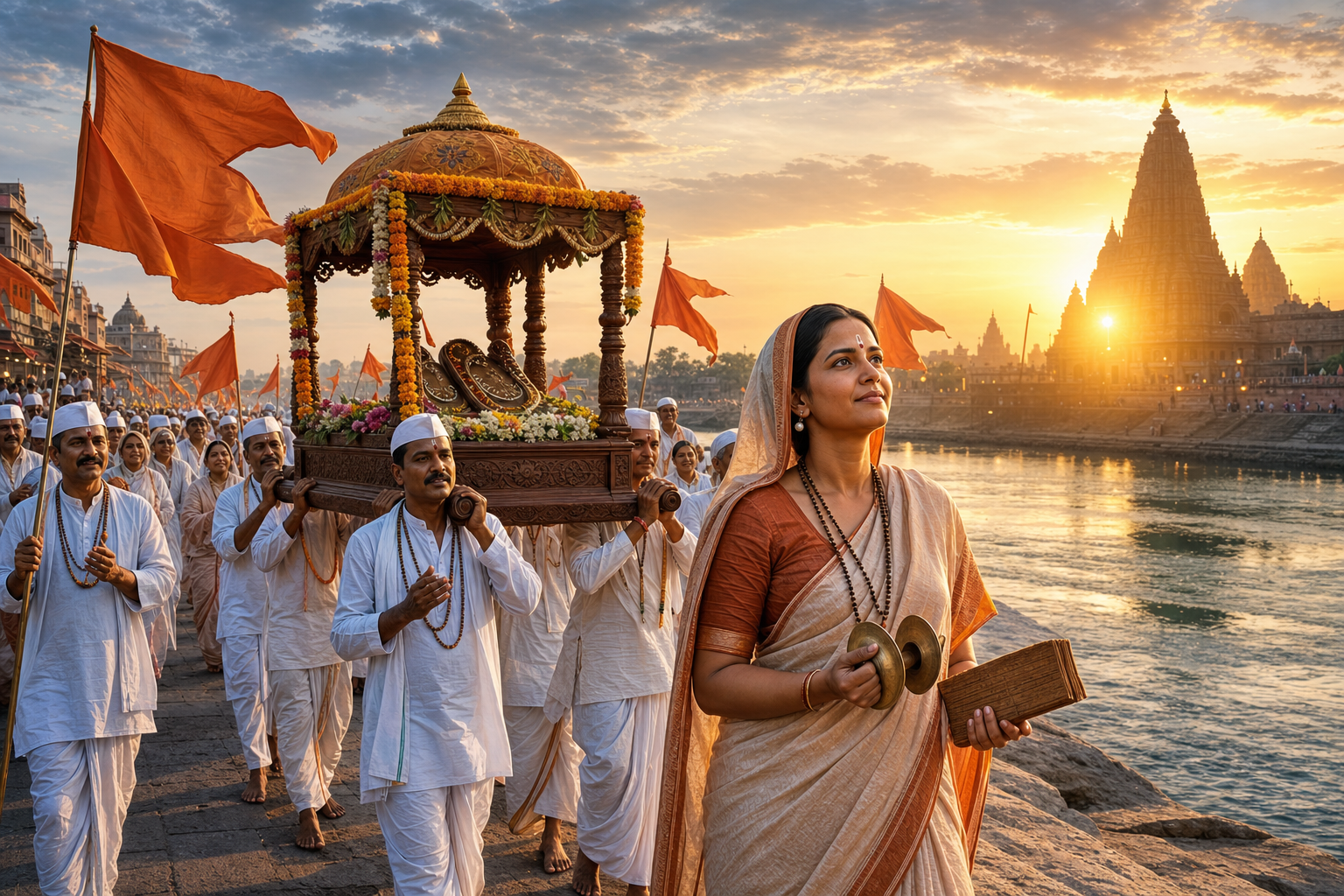
Sant Kanhopatra Palkhi 2026 belongs to the sacred atmosphere of the Ashadhi Wari, the annual devotional movement toward Pandharpur in Maharashtra. Ram Krishna Hari! The phrase immediately evokes the rhythm of cymbals, the discipline of walking pilgrims, the saffron flags of dindis, and the intensely personal longing for Vithoba, the deity of Pandharpur revered as Vitthal, Panduranga, Krishna, and Vishnu in the Warkari tradition. Yet Sant Kanhopatra occupies a distinctive place in this landscape. Her remembrance is not primarily known through a massive, long-distance palkhi comparable to the celebrated processions of Sant Dnyaneshwar from Alandi or Sant Tukaram from Dehu. It is instead concentrated around memory, song, samadhi, and the moral power of a woman saint whose life continues to challenge social hierarchy, gendered vulnerability, and the assumption that spiritual authority must arrive through formal lineage.
For 2026, Ashadhi Ekadashi, also called Devshayani Ekadashi, falls on Saturday, 25 July 2026, with the Ekadashi tithi beginning on 24 July 2026 and ending on 25 July 2026 according to published festival calendars. This date is the major culmination point for the Pandharpur Wari, when devotees reach the sacred town to seek darshan of Vithoba and Rakhumai. In this context, Sant Kanhopatra Palkhi 2026 should be understood as a devotional observance linked to the larger Warkari pilgrimage cycle and to the continuing remembrance of Kanhopatra at Pandharpur, rather than as a single universally documented route with a widely standardized public timetable. That distinction matters because it preserves accuracy while still honoring the emotional reality of the tradition.
The Meaning of Palkhi in the Warkari World
In the Warkari sampradaya, a palkhi is far more than a palanquin. It is a moving shrine, a portable field of memory, and a disciplined public form of bhakti. A palkhi generally carries the paduka, or symbolic sandals, of a saint from the place associated with that saint to Pandharpur. Around it gather dindis, organized groups of devotees who walk, sing abhangas, observe devotional discipline, and support one another with food, shelter, and collective order. The Wari is therefore simultaneously a pilgrimage, a social institution, a performative archive of Marathi devotional literature, and a living school of equality.
The best-known palkhis of Maharashtra travel long routes over many days and attract lakhs of devotees. Their public schedules are often carefully planned around halts, food arrangements, rest points, medical support, traffic coordination, and temple ceremonies. Sant Kanhopatra’s remembrance follows a quieter pattern. Her spiritual presence is not diminished by the absence of a large autonomous route. On the contrary, the quieter form sharpens the central message of her life: the deepest pilgrimage is not always measured in kilometers. It can be measured in the distance between social rejection and divine acceptance, between fear and surrender, between being seen as an object and being recognized as a soul.
Who Was Sant Kanhopatra?
Sant Kanhopatra, also remembered as Kanhupatra in some accounts, was a 15th-century Marathi saint-poet associated with the Warkari tradition. Her life is known mainly through hagiography, oral memory, devotional literature, and later retellings rather than through conventional archival biography. This is common in the study of medieval bhakti saints, where history, lived devotion, community memory, and sacred narration often overlap. The academic task is not to flatten those accounts into mere legend, nor to treat every detail as modern documentary fact, but to understand how the tradition preserves ethical truth through narrative form.
Most traditional accounts place Kanhopatra’s birth in Mangalwedha, a town in present-day Solapur district of Maharashtra, not far from Pandharpur. Mangalwedha itself is remembered as a land of saints, associated not only with Kanhopatra but also with Sant Chokhamela, Sant Damaji, and other devotional figures. The cultural geography is significant. The soil from which Kanhopatra’s story emerges is not a royal court or an elite scholastic monastery, but a region where agrarian life, devotional singing, temple culture, and social struggle shaped the emotional texture of bhakti.
Traditional narratives describe Kanhopatra as the daughter of Shama or Shyama, a courtesan and dancer. From childhood she was trained in music and dance, and her beauty became a subject of public fascination. The story repeatedly emphasizes that society admired her external grace while denying her inner dignity. This is the central wound in her hagiography. Kanhopatra’s life exposes the contradiction of a society that could celebrate artistic talent and physical beauty while still confining a woman within inherited stigma. Her turn toward Vithoba was therefore not escapism. It was an act of spiritual self-definition.
Her Refusal and Her Freedom
The most powerful element in Kanhopatra’s story is her refusal. She refused to be reduced to the profession expected of her. She refused to submit to worldly power. She refused to accept that birth, gender, social reputation, or public desire had the final authority over her life. In several accounts, she is pursued by powerful men, including a ruler associated with Bidar. Instead of yielding, she turns to Pandharpur and to Vithoba, whom she accepts as her true refuge.
This is why Kanhopatra’s story remains emotionally unsettling even today. It is not merely a devotional tale of a saint longing for God. It is also a narrative of bodily vulnerability, social coercion, and the search for inviolable dignity. Many devotees and readers encounter in her life a deeply relatable question: where does a person go when social structures fail to protect the soul? In the Warkari answer, the path leads to Vithoba, the divine presence who stands on the brick for the devotee, accessible not only to ritual specialists but to farmers, artisans, women, laborers, marginalized communities, and seekers with wounded hearts.
Kanhopatra’s surrender to Vithoba should not be misread as passivity. In the language of bhakti, surrender is often the highest form of agency. It means choosing the deepest truth over social compulsion. Her devotion was not inherited through a formal guru-parampara, nor legitimized by marriage to a male saint, nor authorized by elite institutional status. The tradition remembers her as attaining sainthood through intense devotion alone. That makes her one of the most striking female voices in the Varkari world.
Pandharpur, Samadhi, and Sacred Memory
Pandharpur is the devotional center of Vithoba worship and the destination of the Ashadhi Wari. The sacred geography of the town is shaped by the Chandrabhaga or Bhima river, the Vithoba-Rakhumai temple, the memory of Pundalik, the Namdev Payari, the samadhis and shrines associated with saints, and the pathways walked by generations of Warkaris. Within this geography, Sant Kanhopatra holds an extraordinary place: tradition remembers her samadhi as being within the precincts of the Vithoba temple itself. This is not a minor detail. It gives her memory a spatial intimacy with Vithoba that few figures possess.
Accounts of her final moments vary. Some traditions describe her merging with Vithoba in the temple. Others speak of her body being placed at the feet of Vithoba and then buried near the southern part of the temple. The details differ because sacred memory is transmitted through devotional communities, performance, poetry, and retelling. What remains constant is the theological meaning: Kanhopatra is remembered as one who chose divine refuge over worldly possession. Her samadhi and the associated sacred tree become signs of a devotee whose body, voice, and memory were finally held by Vithoba, not by the forces that tried to claim her.
For pilgrims in 2026, this remembrance can deepen the experience of Pandharpur. The Wari is often seen through its visible scale: long roads, disciplined processions, public chanting, and vast crowds. Kanhopatra invites attention to the interior scale of pilgrimage. A devotee may stand before her memory and recognize that bhakti is not only collective celebration; it is also the courage to stand before God without disguise, without social privilege, and without the protection of worldly status.
Abhanga as Theology, Poetry, and Social Testimony
Kanhopatra’s surviving literary presence is small in quantity but immense in significance. About thirty of her abhangas or ovis are traditionally associated with her, and a number are included in anthologies of Warkari saint-poetry. The abhanga is not merely a song form. It is a theological statement in the vernacular, a poetic practice of remembrance, and a social document. Through abhangas, saints spoke in the language of ordinary people, making spiritual insight available beyond the boundaries of Sanskritic learning and formal scholastic institutions.
Kanhopatra’s poetry is marked by simplicity, urgency, and personal vulnerability. Her compositions do not present devotion as decorative sentiment. They speak from the edge of fear, shame, longing, and moral clarity. She addresses Vithoba as savior, protector, beloved, motherly refuge, and the one who must prove divine compassion by accepting the fallen. The titles associated with her devotional memory, such as Nako Devaraya Anta Aata and Patita tu pavanahe, continue to carry emotional force because they express a direct, almost juridical appeal to divine mercy. If God is truly the protector of the vulnerable, then the vulnerable have the right to call upon that protection.
In this sense, Kanhopatra’s bhakti is technically sophisticated even when expressed in simple language. It contains a theology of grace, a critique of social objectification, a meditation on the body, and a devotional anthropology in which every person is more than social label. Her poetry belongs beside the voices of Janabai, Chokhamela, Namdev, Dnyaneshwar, Eknath, Tukaram, and other saints who made the Warkari movement a vast moral conversation across caste, gender, occupation, and regional identity.
Why Sant Kanhopatra Matters in 2026
The year 2026 gives contemporary devotees an opportunity to revisit Kanhopatra not as a distant figure trapped in hagiography, but as a living ethical presence. Her story speaks directly to questions that remain urgent: dignity of women, the social treatment of performers, the spiritual rights of marginalized communities, the burden of inherited stigma, and the possibility of self-transformation through devotion. The Warkari tradition never reduces holiness to social respectability. It repeatedly insists that Vithoba receives the sincere heart, whether that heart belongs to a scholar, a potter, a gardener, a barber, a laborer, a woman servant, a saint from a stigmatized community, or a courtesan’s daughter who refuses to surrender her soul.
This inclusive principle is one of the reasons the Warkari movement contributes to the wider unity of dharmic traditions. Its emphasis on naam-japa, seva, humility, ahimsa, compassion, disciplined conduct, pilgrimage, and respect for the inner worth of all beings resonates with broader dharmic values also cherished in Hindu, Buddhist, Jain, and Sikh contexts. Each tradition has its own theology and practice, yet all recognize in different ways that spiritual life must refine conduct and deepen compassion. Kanhopatra’s story strengthens that shared ethical field because it refuses contempt and affirms dignity.
For a modern reader, the emotional force of Kanhopatra lies in the fact that she does not begin from comfort. She begins from constraint. Her sanctity is not presented as an ornament added to an already respected life; it arises as a transformation of pain into devotion. This is why her remembrance during the 2026 Ashadhi Wari can be especially meaningful. In an age of speed, image, public judgment, and social anxiety, Kanhopatra reminds devotees that the soul is not defined by the gaze of others. The soul finds its measure in its relationship with the divine and in the ethical courage it develops through that relationship.
Ritual Practice and Devotional Preparation for 2026
Those observing Sant Kanhopatra Palkhi 2026 or participating in the wider Ashadhi Wari may approach the occasion through both outer discipline and inner reflection. The outer discipline includes planning travel carefully, respecting local temple procedures, following public health and safety guidance, maintaining cleanliness, supporting fellow pilgrims, and avoiding behavior that disturbs the devotional atmosphere. The Warkari path values simplicity, vegetarian discipline, avoidance of intoxicants, humility in speech, and service to others. These are not peripheral customs; they are the ethical infrastructure of pilgrimage.
The inner discipline may include chanting the name of Vithoba, listening to abhangas, reading about Sant Kanhopatra’s life, reflecting on the dignity of all beings, and offering prayer for those who live under social pressure or exploitation. A devotee who cannot travel to Pandharpur can still participate meaningfully by observing Ekadashi with sincerity, singing or listening to Varkari abhangas, supporting community service, studying the lives of saints, and remembering that pilgrimage begins with the purification of intention.
Because Ashadhi Ekadashi 2026 falls on 25 July 2026, devotees should verify local temple timings, regional panchang details, and any official announcements before making travel plans. Lunar observances can vary by location, local tradition, and calculation method. Published 2026 calendars list Devshayani Ekadashi tithi from the morning of 24 July to late morning on 25 July, with parana on 26 July. For pilgrims, this timing frames the spiritual climax of the Wari, but local rituals connected to specific saints or temples may follow their own arrangements.
The Academic Value of Kanhopatra’s Memory
From an academic perspective, Sant Kanhopatra is important for several reasons. First, she expands the study of bhakti beyond male saints and formal religious teachers. Second, she demonstrates how Marathi devotional literature preserved female experience in a world where women’s voices were often mediated or silenced. Third, she shows how hagiography can function as social critique. Her life narrative exposes the fragility of social honor and the moral strength of devotional selfhood. Fourth, her memory complicates any simplistic view of medieval religious life as only hierarchical or only liberating. The tradition contains both social constraint and spiritual resistance, and Kanhopatra stands precisely at that point of tension.
Her remembrance also contributes to the study of sacred geography. The fact that she is associated so intimately with the Vithoba temple precincts changes the way Pandharpur is read. The temple is not only a site of ritual darshan; it is also a layered archive of devotional struggles. Namdev, Chokhamela, Kanhopatra, Pundalik, and countless unnamed Warkaris together create a sacred map in which memory is walked, sung, touched, and renewed. The 2026 pilgrimage therefore belongs to a much older continuum rather than to a single calendar event.
A Legacy of Dignity, Bhakti, and Unity
Sant Kanhopatra’s legacy is powerful because it refuses easy categorization. She is a saint, poet, devotee, woman of resistance, symbol of social dignity, and voice of wounded longing. Her story does not ask devotees to ignore suffering. It asks them to transform suffering into remembrance, courage, and compassionate vision. In the Warkari imagination, Vithoba is not remote. He stands waiting, arms on hips, on the brick of Pundalik’s devotion, available to those who arrive with sincerity. Kanhopatra arrived with everything society tried to use against her, and the tradition remembers that Vithoba accepted her.
That is the enduring message of Sant Kanhopatra Palkhi 2026. Whether one walks in a formal procession, visits Pandharpur, remembers her at home, observes Ashadhi Ekadashi, or studies her abhangas, the heart of the observance remains the same. Bhakti is not the privilege of the socially secure. It is the birthright of every sincere seeker. The remembrance of Sant Kanhopatra affirms that devotion can restore dignity, that sacred memory can heal social wounds, and that the dharmic path becomes stronger when it embraces compassion, humility, and unity across communities.
Research references for further reading include the background on Sant Kanhopatra, the Varkari tradition, the Pandharpur Vari, the Vithoba Temple at Pandharpur, and 2026 Devshayani Ekadashi calendar details reported by The Economic Times.
Inspired by this post on Hindu Pad.






Leave a Reply
You must be logged in to post a comment.