
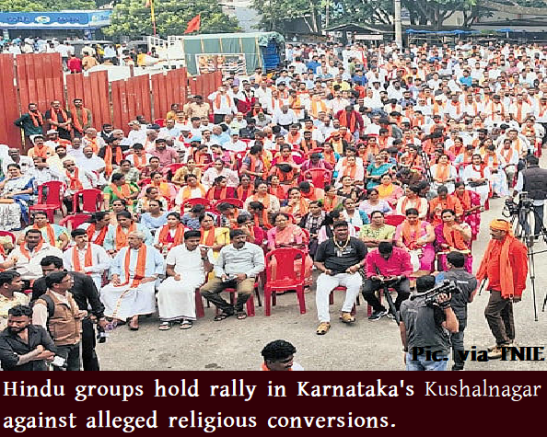
The large Hindu rally reported from Kushalnagar in Karnataka’s Kodagu region on July 1, 2026, must be understood as more than a local protest. It reflects a wider debate in India over religious conversion, constitutional freedom, social trust, and the responsibility of the state to investigate allegations of coercion or inducement without allowing public anger to become communal hostility.
According to the report, thousands of Hindu community members gathered in Kushalnagar to demand stronger action against alleged religious conversions said to be increasing in the region. The original account framed the protest as a response to concerns among local Hindu groups, who claimed that vulnerable families and rural communities required greater protection from conversion campaigns allegedly involving pressure, deception, or material incentives.
The most important word in this discussion is “alleged.” In a constitutional democracy, allegations require investigation, evidence, and due process. At the same time, the anxiety expressed by local communities should not be dismissed as merely symbolic. When a community believes that its religious continuity, family structures, and cultural practices are being disrupted through unequal power relationships, the social consequences can be serious even before a court reaches any conclusion.
Karnataka has seen repeated public debate over religious conversion, missionary activity, interfaith relationships, and the limits of religious propagation. The legal and political background includes the Karnataka Protection of Right to Freedom of Religion Act, 2022, commonly described as an anti-conversion law, along with continuing debate over whether such laws protect vulnerable citizens or risk over-policing private conscience. This makes the Kushalnagar rally part of a larger state-level and national conversation.
Article 25 of the Constitution of India protects freedom of conscience and the right freely to profess, practise, and propagate religion, subject to public order, morality, health, and other constitutional provisions. This framework is often misunderstood. It protects sincere belief, worship, teaching, and persuasion, but it does not create a license for coercion, fraud, threats, or exploitation. Equally, it does not permit the state or society to punish a person merely for changing faith by free choice.
The constitutional balance is therefore delicate. A person must be free to remain Hindu, Buddhist, Jain, Sikh, Christian, Muslim, or of any other faith without intimidation. A person must also be free to make an inward spiritual decision without mob pressure. The state’s duty is to protect conscience from both sides: from coercive conversion and from coercive prevention of voluntary belief.
Indian courts have long distinguished between the right to propagate religion and the use of force, fraud, or inducement to secure conversion. In Rev. Stainislaus v. State of Madhya Pradesh, the Supreme Court upheld state authority to regulate conversions brought about by force, fraud, or allurement. That legal principle remains central to the current debate: the objection is not to dialogue or religious teaching as such, but to methods that compromise free consent.
For families in rural and semi-urban regions, the issue is rarely abstract. Religious identity is tied to festivals, ancestral shrines, temple networks, marriage customs, funeral rites, local memory, and the moral education of children. When residents hear claims that conversions are linked to promises of healing, schooling, money, employment, marriage, or social advancement, the concern becomes not only theological but also social and economic.
Those concerns, however, need careful handling. Broad accusations against an entire religious community can damage social harmony and create fear among ordinary citizens who have not broken any law. The better approach is evidence-based: identify specific incidents, record statements from affected individuals, examine financial or institutional links where legally relevant, and allow police and courts to determine whether any offence occurred.
A factual approach also protects Hindu society from emotional overreach. If a conversion is truly coerced or fraudulent, it should be investigated and prosecuted under the applicable law. If it is voluntary, then the dignity of conscience must be respected. Dharma is not strengthened by anger alone; it is strengthened by truthfulness, discipline, service, education, and institutions that help people live with confidence in their own tradition.
The Kushalnagar rally also raises a deeper question for Dharmic communities. Hinduism, Buddhism, Jainism, and Sikhism have distinct doctrines and histories, yet each places ethical self-cultivation above aggressive proselytism. Their shared civilisational vocabulary values sadhana, seva, ahimsa, compassion, restraint, and the freedom of the seeker. This does not mean passivity. It means that public action should remain rooted in dignity and clarity rather than resentment.
From a policy perspective, local administrations should respond to such protests through transparent mechanisms. Police should invite written complaints, provide witness-protection safeguards where needed, verify claims without public spectacle, and publish legally appropriate updates. District officials can also hold community consultations involving Hindu, Buddhist, Jain, Sikh, Christian, Muslim, and civil society representatives so that rumours do not replace facts.
Schools, health services, and welfare delivery are also relevant. Where poverty, illness, debt, or lack of access to education makes people vulnerable, religious tension often becomes a symptom of wider administrative failure. A community that receives fair schooling, medical care, livelihood support, and legal awareness is less likely to feel abandoned or pressured. Protecting religious freedom therefore also requires strengthening public institutions.
Hindu organisations that wish to respond constructively can do more than protest. They can support Sanskrit and regional-language education, temple-based social service, youth mentoring, women’s safety networks, rural health camps, legal literacy drives, and transparent charitable work. Such initiatives help families remain rooted in Hindu culture by making the tradition visible as care, knowledge, and lived responsibility.
The same principle applies across Dharmic traditions. Buddhist, Jain, and Sikh institutions have long histories of education, compassion, community kitchens, non-violence, and disciplined public service. A united Dharmic response to anxiety over conversion should not be hostility toward others; it should be a renewal of ethical strength within one’s own communities.
The language used in public discourse matters. Terms that portray every Christian, every missionary, or every minority institution as suspect are neither legally sound nor socially helpful. The proper distinction is between lawful religious expression and unlawful coercive conduct. This distinction preserves justice for complainants while preventing innocent citizens from being stigmatized because of their faith identity.
For Karnataka, the challenge is to maintain peace while taking community complaints seriously. A rally of thousands indicates a significant level of local concern, but democratic seriousness requires documentation, not only slogans. If the allegations involve specific villages, institutions, funding channels, or vulnerable persons, those details should be placed before competent authorities in a form that can withstand legal scrutiny.
Religious freedom is strongest when it protects everyone equally. Hindus have the right to preserve their ancestral traditions without manipulation. Christians and other minorities have the right to worship and serve without collective blame. Individuals have the right to conscience. The state has the duty to prevent coercion. These principles are not contradictory when applied with fairness.
The Kushalnagar protest should therefore be read as a call for institutional clarity. It asks whether allegations of forced conversion are being investigated properly, whether vulnerable communities are receiving protection, and whether Karnataka’s public order framework is capable of handling religious tension without bias. These are serious questions and deserve serious answers.
The most constructive path forward is neither silence nor inflammatory rhetoric. It is a disciplined model of civic action: document complaints, demand lawful investigation, strengthen Dharmic education, support vulnerable families, preserve interfaith civility, and insist that conscience can never be bought, threatened, or manipulated. In that balanced approach, cultural confidence and constitutional morality can stand together.
Inspired by this post on Struggle for Hindu Existence.







Leave a Reply
You must be logged in to post a comment.