
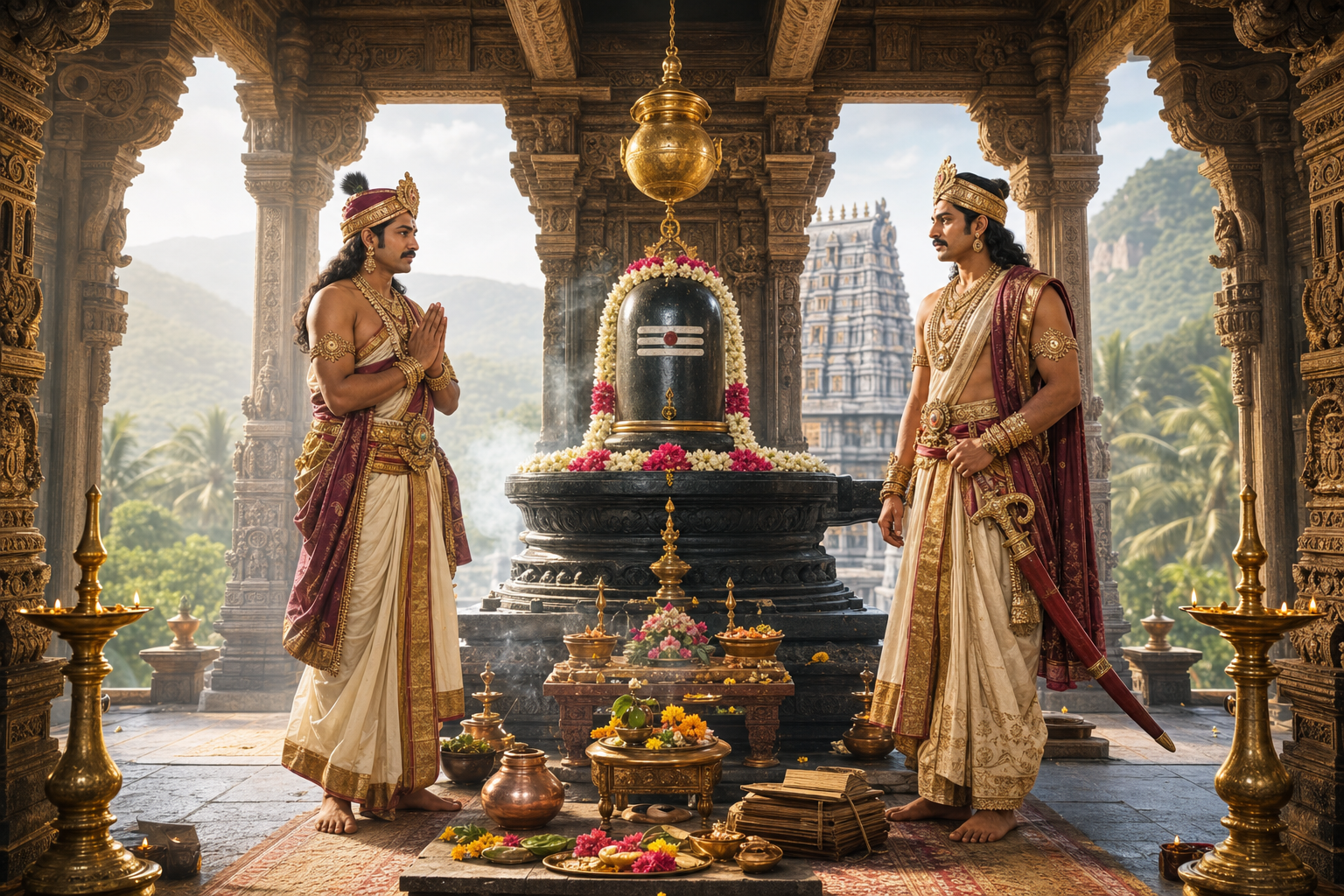
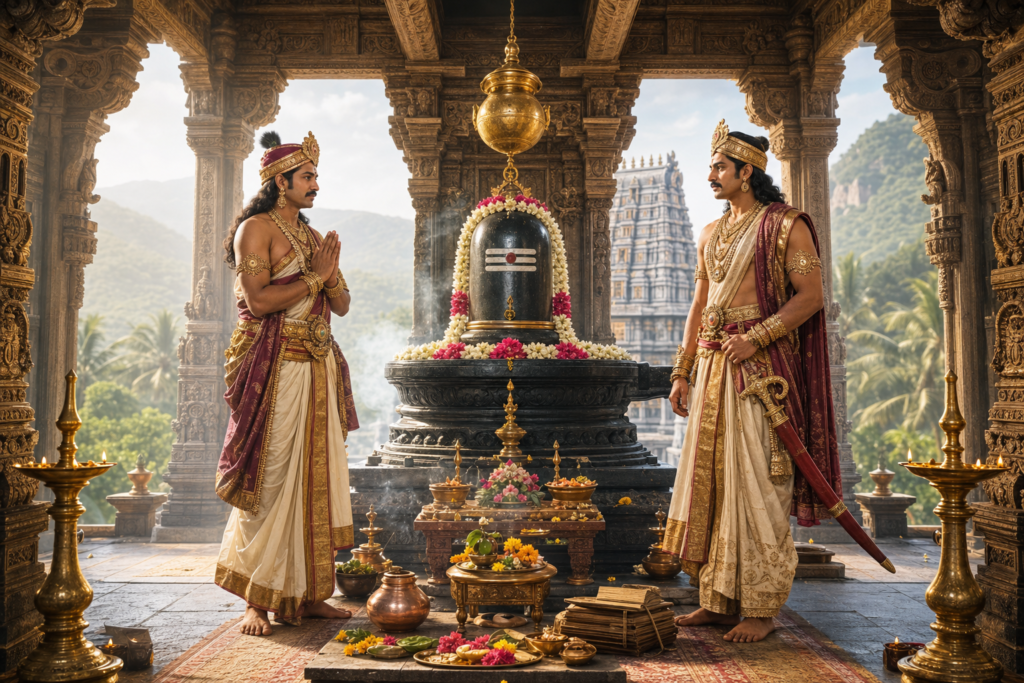
The story of Varathunga Pandian and Athivirarama Pandian belongs to the later Pandya world of South India, especially the sacred and political landscape around Tirunelveli and Tenkasi. It is remembered not merely as a royal anecdote, but as a meditation on devotion, pride, family duty, and reconciliation. In the traditional telling, two brothers stand at the centre of the narrative: Varathunga Pandian, described as the elder brother and a deeply committed devotee of Kasi Viswanatha, and Athivirarama Pandian, a powerful Pandya ruler whose name evokes valour, royal confidence, and command.
Historically, the later Pandyas of Tenkasi and Tirunelveli emerged after the older Pandya power centred on Madurai had weakened. The Pandya inheritance did not disappear; it shifted southward, adapted to new political realities, and preserved its identity through temple patronage, inscriptions, literature, and local memory. Available historical lists place Cataiyavarman Adiveerama Pandyan in the sixteenth century and Varathunga Pandyan in the late sixteenth to early seventeenth century. The devotional story, however, remembers them primarily as brothers, and that memory is important because it presents politics through the lens of dharma rather than through chronology alone.
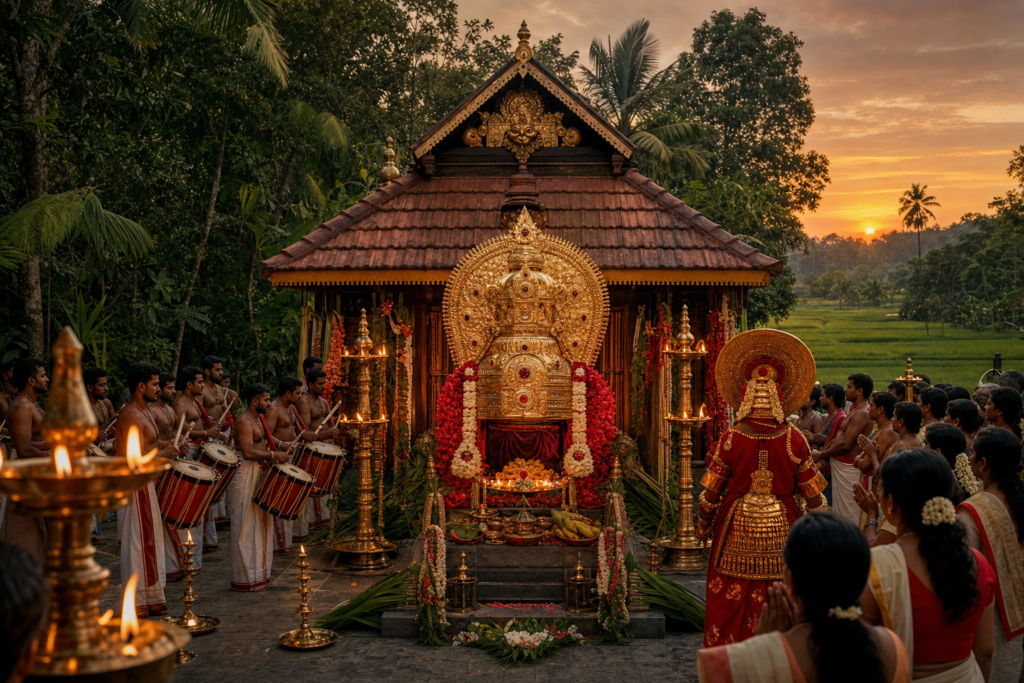
The setting matters. Tirunelveli and Tenkasi were not ordinary administrative centres. They formed a region in which sacred geography, agricultural prosperity, Tamil literary culture, and temple-centred public life intersected. The Kasi Viswanathar temple tradition at Tenkasi connected southern Tamil country with the spiritual prestige of Kashi, allowing devotees to experience the sanctity of Vishwanatha without undertaking the long northern pilgrimage. In that sense, the worship of Kasi Viswanatha was not only a private act of piety; it was also a public statement that Tamil sacred space was fully capable of carrying pan-Indian spiritual significance.
Varathunga Pandian is remembered as a ruler whose heart was anchored in Shiva bhakti. His devotion to Kasi Viswanatha gave his kingship a contemplative quality. The image is striking: a king surrounded by the responsibilities of rule, yet inwardly drawn toward the stillness of the lingam. Such devotion did not require withdrawal from the world. In the Hindu understanding of rajadharma, the ruler was expected to protect, administer, give, listen, and restrain personal ego. Worship was meant to refine authority, not escape it.
Athivirarama Pandian appears in the story with a different temperament. His name itself suggests heroic force, and the tradition presents him as a ruler conscious of royal dignity. He belonged to the same Pandya line, shared the same civilisational inheritance, and stood within the same dharmic universe. Yet the story turns on a very human problem: brothers who share blood, culture, and faith can still be divided by pride, misunderstanding, and the pressure of status. This makes the tale enduringly relatable, because family conflict often begins not with hatred but with wounded honour.
The phrase “twin kingdoms of Tirunelveli” captures the emotional architecture of the tale. The brothers are not shown as strangers from hostile worlds. They are near enough to belong to one another, yet powerful enough to injure one another. Their conflict reflects a recurring theme in Hindu stories: power becomes unstable when it is separated from humility. A crown can protect a kingdom, but it cannot protect the mind from ego. A sword can defend territory, but it cannot heal a wounded relationship.
In the devotional narrative, the tension between Varathunga and Athivirarama grows from pride and royal assertion. Whether the issue is read as precedence, political rivalry, or the invisible competition that often arises among siblings, the moral meaning remains clear. The brothers represent two dimensions of human life: inward devotion and outward power. When these two become separated, conflict follows. When they are brought into alignment, reconciliation becomes possible.
Varathunga’s devotion to Kasi Viswanatha becomes the stabilising force in the story. Shiva is not portrayed as a sectarian symbol of exclusion, but as the divine centre before whom royal ego is made small. This is an important point for any dharmic reading of the tale. Hindu, Buddhist, Jain, and Sikh traditions all preserve, in different vocabularies, the warning that ego distorts perception. In this story, Shiva bhakti becomes the path through which ego is softened and relationship is restored.
The story also reveals the social role of temples in South Indian history. A temple such as Kasi Viswanathar was never only a place of ritual. It was a centre of memory, endowment, art, music, food distribution, learning, festivals, and political legitimacy. A king who honoured the temple entered into a larger moral order. He acknowledged that sovereignty did not begin and end with personal will. The deity, the community, the land, the priestly and artistic traditions, and the inherited law of dharma all placed limits on royal self-importance.
Seen from that perspective, the brothers’ conflict is not a simple quarrel. It is a test of whether royal authority can submit to sacred truth. Varathunga’s worship teaches that devotion must be more than external ceremony. Athivirarama’s strength teaches that valour must be disciplined by wisdom. The reconciliation of the brothers therefore becomes a reconciliation between bhakti and kshatra, between temple and throne, between inner surrender and outer duty.
One of the most moving features of the tale is its refusal to reduce either brother to a villain. Varathunga is devout, but devotion itself can be tested by attachment to honour. Athivirarama is strong, but strength itself can become restless when guided by pride. The story gains depth because both brothers require transformation. Reconciliation in dharmic literature is rarely a shallow gesture; it requires recognition, humility, and a willingness to see the divine presence in the person one has opposed.
For many readers, the emotional power of this story lies in its family realism. Siblings often know one another’s virtues and weaknesses more intimately than outsiders do. That closeness can produce affection, but it can also sharpen rivalry. The Pandian brothers are royal figures, yet their struggle mirrors ordinary domestic life. A household, like a kingdom, can be disturbed by comparison. A relationship, like a temple, requires maintenance, reverence, and daily discipline.
The tale’s theological message is equally significant. Kasi Viswanatha represents the still point before which both kingship and conflict lose their arrogance. Shiva, in the form of the lingam, is an image of presence without aggression. The devotee approaches, offers water, flowers, lamps, mantra, and silence, and gradually remembers proportion. In that act, the ruler is reminded that he is not the final owner of power. He is a trustee.
This trustee model of kingship is central to Hindu political imagination. The ideal ruler protects temples, cultivates justice, restrains exploitation, and honours learning. He does not treat the kingdom as private property. The story of Varathunga and Athivirarama Pandian therefore becomes a lesson in governance. It suggests that political order begins in the moral order of the ruler’s own mind. If the ruler is divided by pride, the kingdom absorbs that division. If the ruler returns to dharma, the kingdom regains balance.
The story also belongs to the larger heritage of Tamil bhakti. Tamil sacred culture has long joined intense devotion with literary beauty, temple architecture, music, and public festival. The later Pandyas inherited a world shaped by the Nayanmars, Alvars, Jain scholars, Buddhist memories, Sanskritic learning, and Tamil poetic refinement. A mature reading of the tale should therefore avoid narrowness. It is a Hindu story, but its ethical centre is spacious: humility, self-correction, reverence, and unity among dharmic paths.
Athivirarama Pandian is also associated in Tamil memory with literary culture, which is important for understanding the royal environment of the period. South Indian kingship was not only military. It was also textual and aesthetic. Rulers sought legitimacy by supporting poetry, temple renovation, ritual life, and learned communities. In this context, the brothers are not simply political actors. They are figures within a civilisational ecosystem where language, devotion, and kingship reinforced one another.
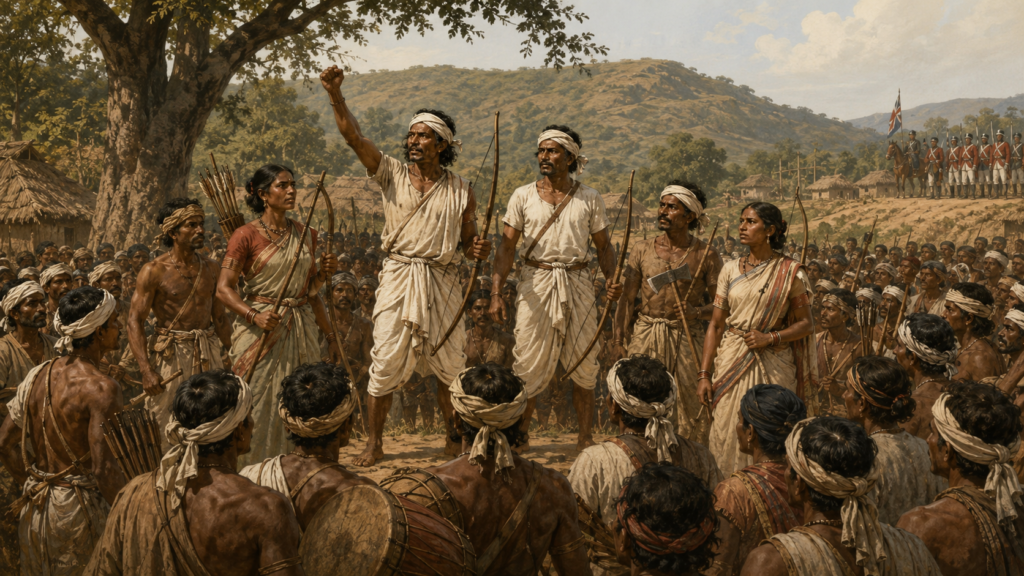
The reconciliation between the brothers should be understood as more than private peace. In a royal family, reconciliation carries public consequences. When brothers in power are divided, officers, feudatories, priests, soldiers, and ordinary people are drawn into uncertainty. When they reconcile, social life becomes steadier. The story therefore teaches that personal ego can become a public burden, while personal humility can become a public blessing.
The devotional conclusion of the tale is that the grace of Kasi Viswanatha restores clarity. Grace, in this context, does not erase responsibility. It awakens it. The brothers must still choose humility. They must still recognise one another. They must still allow devotion to overcome pride. This is a deeply dharmic vision of transformation: the divine opens the way, but human beings must walk through it with sincerity.
The story’s relevance is not limited to the sixteenth century. Modern life has its own forms of royal pride: professional status, family prestige, institutional authority, ideological certainty, and the desire to be seen as right. The Pandian brothers remind readers that conflict often becomes destructive when winning matters more than truth. A person may possess learning, influence, wealth, or courage, yet still require the softening discipline of devotion.
For communities committed to dharmic unity, the tale offers a constructive model. It does not ask people to abandon their chosen form of worship. Varathunga remains devoted to Kasi Viswanatha. Athivirarama retains his royal personality and strength. Unity does not mean sameness. It means allowing dharma to govern difference. This principle is valuable across Hindu, Buddhist, Jain, and Sikh traditions, where diverse disciplines point toward self-mastery, compassion, truthfulness, and liberation from ego.
The story also cautions against reading history only as a sequence of wars and successions. Inscriptions and dynastic lists provide essential structure, but sacred narratives preserve another kind of truth: how communities understood virtue, failure, repentance, and grace. The brothers may be studied as later Pandya figures, but they are remembered because their story speaks to the inner life of power. That is why the tale remains meaningful beyond the details of court politics.
In the end, Varathunga Pandian and Athivirarama Pandian stand as mirrors. Varathunga reflects the need for devotion that humbles authority. Athivirarama reflects the need for strength that submits to wisdom. Their conflict reflects the fragility of human relationships, and their reconciliation reflects the healing power of dharma. The worship of Kasi Viswanatha gives the story its sacred centre, but the moral lesson reaches every household and community: pride divides, devotion clarifies, and humility restores what power alone cannot repair.
Research note: this retelling draws on the traditional narrative supplied in the source excerpt and on historical orientation from public references on the later Tenkasi Pandyas and Kasi Viswanathar temple traditions, including https://en.wikipedia.org/wiki/List_of_Tamil_monarchs and https://en.wikipedia.org/wiki/Kasi_Viswanathar_Temple,_Tenkasi. Because the supplied source text was incomplete, the account has been framed carefully as a devotional and cultural interpretation rather than as a fully documented court chronicle.
Inspired by this post on Hindu Blog.




Leave a Reply
You must be logged in to post a comment.