
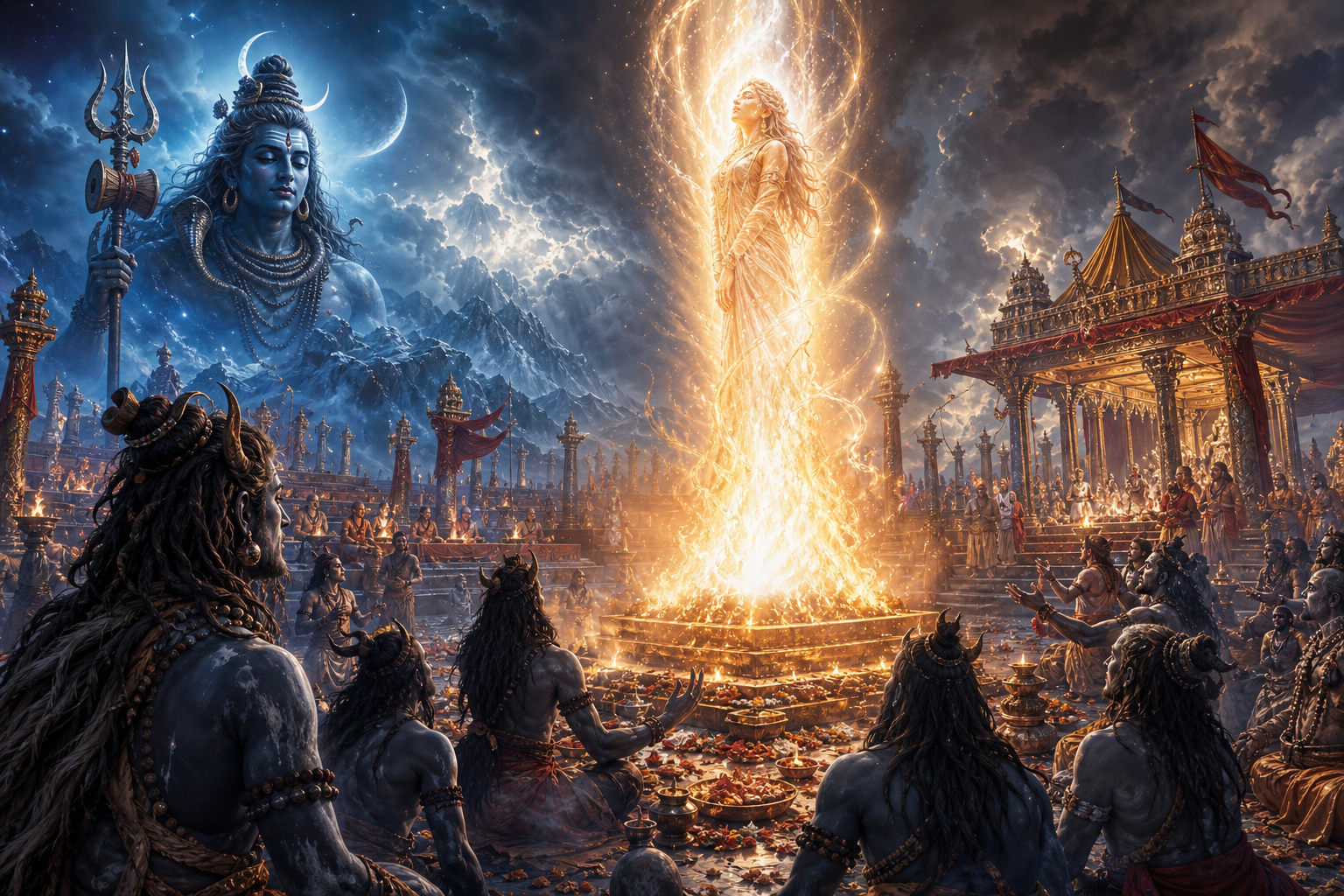
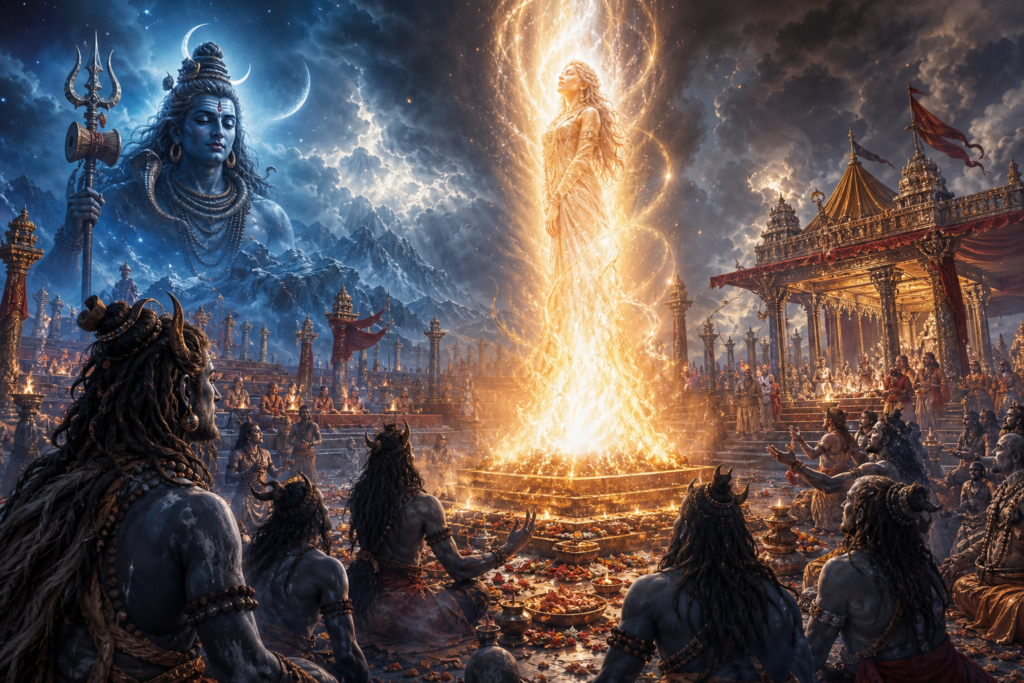
The episode of Sati’s death at Daksha’s yajna is one of the most emotionally charged moments in the Puranic imagination. In the Skanda Purana, especially in the Kedara Khanda sequence associated with Chapter 3, verses 24 to 30, the narrative does not treat the event merely as a domestic quarrel between a daughter and her father, nor as a simple conflict between rival ritual authorities. It presents a profound theological crisis: dharma is publicly wounded, devotion is humiliated, Shakti withdraws from an unworthy space, and Shiva’s ganas respond with a grief so absolute that it seems to cross the boundary between life and death.
This sacred episode must be approached with care. The self-sacrifice of Shiva’s ganas after Sati’s death is not a recommendation of literal self-harm, nor should it be read as an ethical model for modern life. It belongs to the symbolic and mythic language of Hindu sacred literature, where extreme actions often communicate cosmic truths. In this context, the ganas’ act expresses the collapse of ordinary order when the divine feminine is dishonoured and when devotion is forced to witness the desecration of what it holds most sacred.
The tragedy begins with Daksha’s yajna, a royal and ritual assembly that should have embodied sacred order. A yajna, in the Vedic and Puranic imagination, is not only a fire sacrifice; it is a disciplined act of alignment between human society, cosmic rhythm, divine presence, and moral responsibility. Yet Daksha’s sacrifice becomes spiritually disordered because it is shaped by pride, exclusion, and resentment. Shiva, though one of the supreme realities of the Hindu sacred universe, is deliberately insulted and denied honour. Sati, Daksha’s daughter and Shiva’s consort, arrives at the gathering and finds not the warmth of kinship, but the cold violence of contempt.
Sati’s anguish is not merely personal hurt. In Puranic theology, she is not only a daughter humiliated by her father; she is Shakti, the living power of consciousness, dignity, and divine presence. Daksha’s insult toward Shiva is therefore not a harmless social slight. It represents a deeper failure: the refusal to recognise the sacred when it appears outside respectable convention. Shiva stands beyond social polish, royal vanity, and ritual pride. He is the ascetic of Kailasha, the lord of yogis, the friend of beings who are rejected by orderly society, and the supreme consciousness before which status loses its meaning.
The ganas occupy a crucial place in this theological world. They are Shiva’s attendants, but they are not merely servants in a royal court. They represent beings drawn into Shiva’s orbit because he receives what others exclude. The ganas are liminal figures: fierce, loyal, unconventional, and often associated with cremation grounds, thresholds, wildness, and the margins of social life. Their closeness to Shiva reveals one of the deepest principles of Shaiva traditions: the divine is not confined to sanitized spaces. Shiva embraces the broken, the fierce, the strange, the rejected, and the spiritually intense.
When Sati gives up her body, the ganas do not merely observe the death of their lord’s consort. They witness the apparent rupture of the cosmic bond between Shiva and Shakti. Their grief is therefore metaphysical. The one who is the power of Shiva has withdrawn from a corrupted ritual field. The fire that should have carried offerings to the divine becomes associated with unbearable loss. The assembly that should have produced merit becomes the stage upon which adharma exposes itself. The ganas’ sacred fury is born from this recognition.
The phrase “sacred fury” is important because the Puranic text does not describe ordinary anger. Human anger is often rooted in ego, possession, insecurity, or wounded pride. The fury associated with Shiva and his attendants is different in its literary function. It arises when sacred balance has been violated. It is terrifying because it is not domesticated by social manners, yet it is not random. It moves toward the exposure and correction of a disorder that polite ritualism has tried to conceal.
This distinction is central to understanding the ganas’ self-sacrifice. Their response is not reducible to despair. It is a dramatic statement that life without fidelity to the divine is, for them, emptied of meaning. In devotional language, the devotee does not possess an independent identity apart from the beloved Lord. For Shiva’s ganas, Sati’s death is not an external event; it strikes at the very center of their being. Their bodies become instruments through which the text communicates the extremity of bhakti, loyalty, and cosmic grief.
In many Hindu narratives, the body is not dismissed as meaningless, yet it is also not treated as the highest identity. The body is a vehicle for dharma, tapas, seva, and spiritual realization. When Puranic literature describes a being giving up the body, the act often signals a transition in cosmic order rather than a mere biological ending. Sati herself does not die as an ordinary mortal. She rejects a body born from Daksha because that body has become associated with a lineage that dishonours Shiva. Her self-immolation is a theological refusal: she will not continue to inhabit a form connected to contempt for the divine.
The ganas’ self-sacrifice follows this symbolic logic. They are bound to Shiva not by contract but by total belonging. Their action communicates that devotion, when described in its most extreme sacred form, can transcend even the instinct of self-preservation. This does not make the act socially imitable. Instead, it reveals the intensity with which Puranic literature imagines divine relationship. Bhakti is not casual admiration. It is a reorientation of identity, emotion, memory, and purpose toward the divine center.
At the same time, the episode invites a more nuanced ethical reading. The ganas’ grief is not the end of the story. Their fury becomes part of a larger movement that culminates in Shiva’s response, the emergence of Virabhadra in many versions of the Daksha yajna narrative, the destruction of Daksha’s arrogance, and finally restoration. This pattern matters. Puranic literature often moves from rupture to correction, from correction to humility, and from humility to renewed order. The purpose is not endless violence; it is the re-establishment of truth after pride has corrupted sacred life.
Daksha’s failure is especially instructive because he is not presented as an ignorant outsider. He is a Prajapati, a figure associated with creation, authority, and ritual status. His downfall therefore becomes a warning against spiritual arrogance within the religious world itself. The danger is not only irreligion; the danger is religion emptied of humility. A yajna may have priests, fire, mantras, offerings, and social prestige, yet still become spiritually hollow if it is animated by contempt. The Skanda Purana’s treatment of this crisis shows that ritual without reverence can become a stage for adharma.
Sati’s role also deserves careful attention. She is sometimes remembered primarily through her grief, but the episode is equally about agency. She speaks, protests, judges the moral atmosphere of the assembly, and refuses complicity. Her act is devastating, yet it is not passive. In the sacred narrative, she becomes the one who exposes Daksha’s yajna as spiritually defective. Her withdrawal reveals that no ritual order can remain whole when Shakti is insulted. Without the feminine divine, sacrifice becomes heat without grace, form without life, and authority without wisdom.
The emotional power of the story comes from its recognisable human pattern. Many readers know the pain of seeing someone beloved mocked in public, or the ache of entering a family space that should offer protection but instead delivers humiliation. The Puranic narrative magnifies this human experience into cosmic scale. Sati’s pain is the pain of loyalty wounded by kinship. The ganas’ grief is the grief of a community that cannot remain neutral when love and reverence are insulted. The text therefore speaks not only to theology but also to the moral psychology of honour, belonging, and devotion.
Yet the narrative also cautions against confusing honour with ego. Daksha believes he is defending status, hierarchy, and ritual propriety. In reality, he is defending pride. Shiva, by contrast, does not need social validation. He remains the supreme ascetic, inwardly complete, untouched by the measures that govern royal assemblies. The insult affects the cosmic order not because Shiva is insecure, but because Daksha’s contempt reveals a disorder in the sacrificer himself. The yajna fails because the sacrificer’s consciousness is impure.
This is where the story offers a lasting philosophical insight. In Hindu thought, external action and inner disposition cannot be permanently separated. A ritual act gains meaning through intention, discipline, humility, and alignment with dharma. If the inner condition is poisoned by envy or arrogance, the outer ritual cannot fully conceal it. Daksha’s fire burns, but it does not illumine. Sati’s fire, by contrast, becomes a terrible form of truth. It reveals what the assembly refuses to see.
The ganas’ sacrifice can therefore be interpreted as the collapse of the protective circle around Shiva’s household. They are attendants, guardians, participants in the sacred world of Kailasha. Their inability to continue after Sati’s death expresses the intensity of rupture. In literary terms, their act prepares the emotional ground for Shiva’s later response. The universe cannot simply proceed as if nothing has happened. The death of Sati demands recognition, and the grief of the ganas makes that demand visible.
The broader Daksha yajna cycle is found in several Puranic traditions, including accounts associated with the Shiva Purana, Bhagavata Purana, Vayu Purana, Kurma Purana, and Skanda Purana. Details vary across texts, as is common in Hindu sacred literature. Some versions emphasize Sati’s yogic self-immolation, some emphasize the destructive intervention of Virabhadra and Bhadrakali, and some focus on the later restoration of Daksha. These variations should not be treated as contradictions in a simplistic sense. They show how different traditions meditate on the same sacred crisis through distinct theological lenses.
In Shaiva traditions, the episode magnifies Shiva’s paradoxical nature. He is the silent yogi and the terrible lord of dissolution. He is beyond insult, yet his cosmic order responds fiercely when dharma is violated. He is associated with cremation grounds, yet he is also the source of renewal. He destroys pride, not existence itself. The fury that follows Sati’s death is therefore inseparable from grace. It burns what is false so that humility can return.
In Shakta readings, the focus shifts toward Sati as the self-manifest power of the divine feminine. Her departure from Daksha’s body anticipates her return as Parvati, the daughter of Himavan, who will again unite with Shiva. This movement from Sati to Parvati is not merely reincarnation as biography; it is a theological affirmation that Shakti cannot be destroyed. She withdraws from dishonour and reappears in a form worthy of union. The cosmos suffers when Shakti departs, but it is not abandoned forever.
The story also has significance for the unity of dharmic traditions. Hinduism, Buddhism, Jainism, and Sikhism differ in theology and practice, yet all give serious attention to ego, discipline, compassion, truth, and the danger of hollow religiosity. Read in that broader dharmic spirit, Daksha’s yajna becomes a warning against pride disguised as piety. The ganas’ grief becomes a reminder that communities are shaped by what they honour. Sati’s refusal becomes a meditation on dignity. Shiva’s eventual restoration of order becomes a model for transforming rupture into a deeper recognition of truth.
The episode should not be used to glorify rage as a social habit. Sacred fury in Puranic literature is not permission for cruelty, resentment, or impulsive retaliation. It is a symbolic force that appears when ordinary mechanisms of moral correction have failed. In everyday dharmic life, the lesson is more disciplined: one must defend dignity without becoming consumed by hatred, honour devotion without losing discrimination, and preserve sacred tradition without turning ritual identity into arrogance.
For contemporary readers, the ganas’ sacrifice may be most fruitfully understood as a metaphor for total spiritual identification. They cannot imagine themselves apart from Shiva’s world. Their grief teaches that devotion is not entertainment, ornament, or occasional sentiment. It is an existential bond. Yet mature spiritual interpretation must carry that insight inward. The devotee is called to sacrifice ego, vanity, cruelty, and indifference, not the physical body. The highest offering is the transformation of consciousness.
This inward reading is consistent with the larger movement of Hindu philosophy. The battlefield, the forest, the sacrificial ground, and the cremation ground are often outer images of inner realities. Daksha’s yajna can be seen as the mind performing respectable actions while secretly preserving pride. Sati’s protest is the awakening of conscience. The ganas’ agony is the shock of devotion when it sees truth dishonoured. Shiva’s fury is the force of spiritual correction. Restoration comes only when arrogance bows.
The narrative’s technical structure also deserves notice. It moves through a sequence of ritual inversion. A yajna meant to nourish divine order becomes a site of exclusion. A daughter’s visit becomes a confrontation. Fire, normally sacrificial, becomes the medium of Sati’s departure. Attendants, normally protectors of divine presence, become embodiments of grief. The sacrificial arena, supposedly controlled by Daksha, becomes the place where his lack of control is exposed. This inversion is a common feature of Puranic storytelling, where the surface order collapses so that a deeper order may emerge.
The presence of the ganas also expands the social imagination of the story. Shiva’s community is not built around conventional respectability. It includes beings who may frighten polite society, yet their loyalty is profound. Daksha’s assembly may appear refined, but it is morally compromised. The contrast is deliberate. The Puranic narrative asks whether sacred worth should be judged by appearance, status, and ritual polish, or by truth, devotion, and alignment with the divine. Its answer is unmistakable.
This is why the humiliation of Shiva is so consequential. Shiva represents the sacred reality that refuses to be domesticated by social vanity. To exclude Shiva from yajna is to exclude the very principle that dissolves ego and sanctifies transformation. Daksha wants ritual without surrender, authority without humility, and order without transcendence. Such an order cannot endure. Sati sees this clearly, and the ganas feel it with unbearable intensity.
The aftermath of Sati’s death also reveals the relationship between grief and cosmic responsibility. Shiva’s sorrow is not sentimental weakness; it is the sorrow of consciousness witnessing the violation of Shakti. In many retellings, this sorrow becomes the force that generates Virabhadra, the terrifying agent who disrupts Daksha’s sacrifice. The symbolism is precise: when arrogance refuses correction through wisdom, correction appears through force. Yet even this force ultimately serves restoration, not nihilism.
Daksha’s later restoration in several traditions is essential to the story’s ethical balance. The narrative does not end by celebrating humiliation for its own sake. Daksha is corrected, humbled, and in many accounts restored with a goat’s head, a striking symbol of diminished pride and transformed identity. The one who misused speech and authority must live with a visible sign of his fall. But restoration remains possible. Hindu sacred literature often allows even the arrogant to return to dharma through recognition and humility.
The ganas’ sacrifice, then, should be read within the full arc: devotion, humiliation, grief, fury, correction, and restoration. Isolating only the violent or tragic moment distorts the theological architecture. The story is not a cult of death. It is a meditation on what happens when sacred bonds are dishonoured and how the cosmos absorbs, judges, and transforms that violation. Its emotional intensity serves a philosophical purpose.
The relevance of this episode remains strong because religious life can still be tempted by Daksha’s error. Institutions may preserve form while losing humility. Communities may honour procedure while forgetting compassion. Individuals may mistake inherited status for spiritual maturity. The Skanda Purana’s account stands as a warning that the divine cannot be manipulated by prestige. Where reverence is absent, ritual becomes fragile. Where ego governs, even sacred fire becomes unstable.
The story also invites a compassionate understanding of grief. The ganas’ reaction is extreme because Puranic literature uses heightened imagery to express realities ordinary language cannot contain. Anyone who has experienced the loss of a revered person, a sacred relationship, or a moral world once trusted can recognise the emotional truth beneath the mythic scale. The ganas embody the moment when grief is too large for speech. Their sacrifice dramatizes the feeling that a world has ended.
Yet dharmic wisdom asks that grief be transformed rather than merely enacted. In lived practice, the devotee honours Sati not through self-destruction but through dignity, purity of intention, reverence for Shakti, and refusal to participate in contempt. The devotee honours Shiva not through uncontrolled anger but through inner steadiness, truthfulness, tapas, and compassion toward beings outside social approval. The devotee honours the ganas by recognising that loyalty must be joined with discernment.
Sources that preserve and discuss this narrative tradition include the Skanda Purana’s Kedara Khanda cycle, broader Puranic accounts of Daksha yajna, and comparative summaries of Sati’s role in Shaiva and Shakta traditions. Useful public references include Wisdom Library’s Puranic materials and overview entries on Daksha yajna and Sati, though the sacred narrative itself is best studied through full Purana translations and traditional commentarial contexts.
Ultimately, the self-sacrifice of Shiva’s ganas after Sati’s death is a symbol of devotion pushed to its most terrifying literary edge. It teaches that sacred love is not casual, that insult to the divine feminine fractures cosmic order, and that ritual pride cannot survive contact with truth. The episode remains powerful because it refuses to soften the consequences of arrogance. At the same time, it points beyond destruction toward humility, restoration, and the enduring unity of Shiva and Shakti.
Read with maturity, the story becomes a call to sacrifice what truly obstructs spiritual life: ego, contempt, false superiority, and lifeless ritualism. The ganas’ fury becomes inward discipline. Sati’s fire becomes moral clarity. Shiva’s grief becomes transformative power. Daksha’s fall becomes a warning. The restored cosmic order becomes a promise that even after rupture, dharma can reassert itself when humility returns.
Inspired by this post on Hindu Blog.







Leave a Reply
You must be logged in to post a comment.