
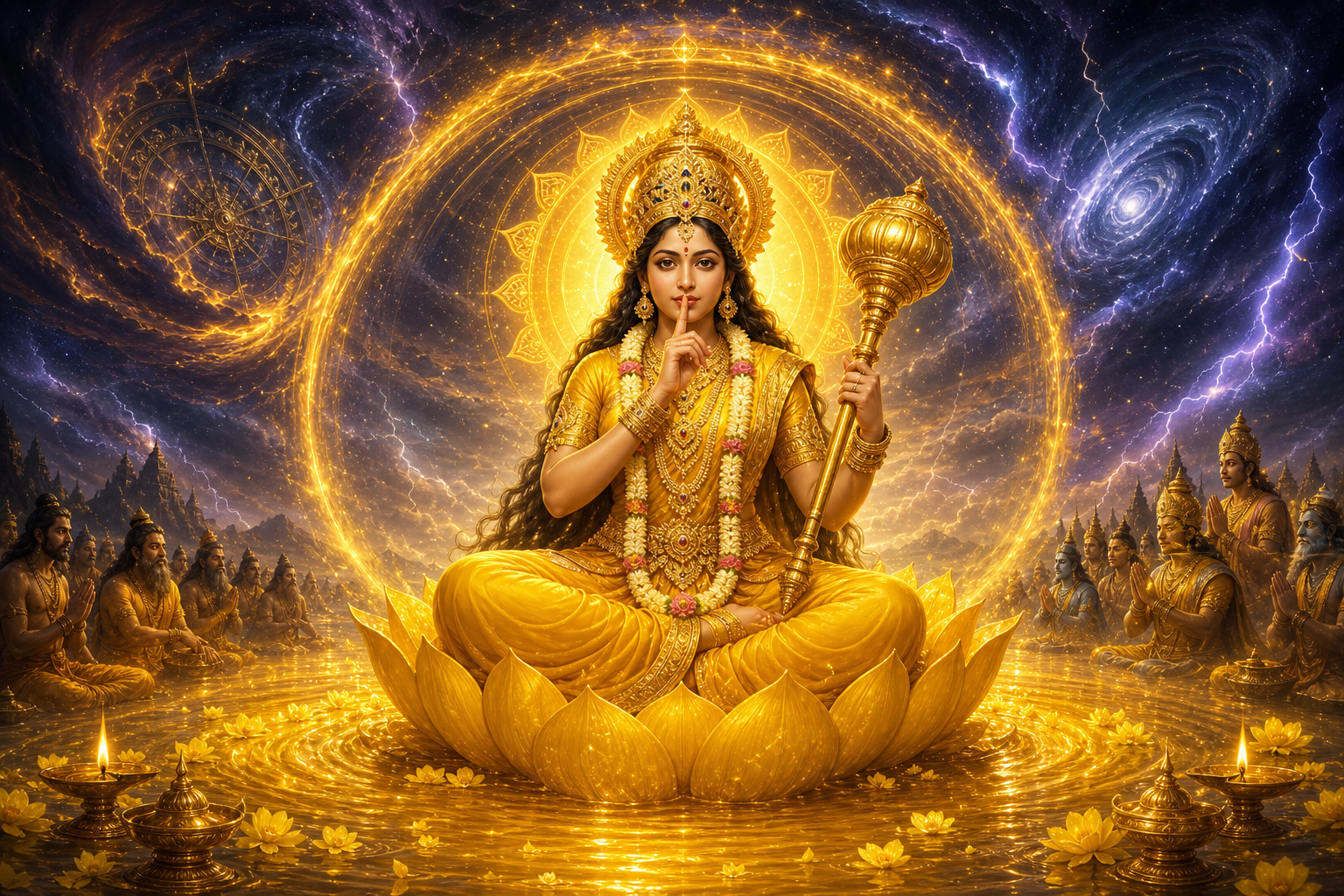
Among the sacred narratives of Shakta and Tantric Hinduism, the story of Goddess Bagalamukhi and the violent universal storm presents one of the most striking visions of divine intervention. It is not merely a mythic account of a goddess appearing during a cosmic crisis; it is a theological meditation on speech, restraint, destructive momentum, and the mysterious power by which chaos is stopped at its very source.
Bagalamukhi, also known as Pitambara Devi because of her association with the yellow or golden hue, is revered as one of the ten Mahavidyas, the great wisdom goddesses of the Shakta tradition. In popular devotion she is often invoked for protection, victory over hostile forces, mastery over speech, and the silencing of harmful intent. Yet her deeper significance is far more subtle. She represents the power of stambhana, the sacred capacity to arrest, immobilize, still, or suspend forces that have become dangerous when left uncontrolled.
The traditional account places the manifestation of Bagalamukhi in the Satya Yuga, the age of truth and cosmic balance. The setting is important. A crisis in Satya Yuga is not described as a mere local disturbance, nor as an ordinary conflict between divine and demonic beings. It is presented as a disturbance in the fabric of existence itself. The universe is shaken by a violent storm, a catastrophic force that threatens to overturn the order on which life, ritual, speech, and consciousness depend.
Some Tantric retellings describe this upheaval through the image of a terrible cosmic wind or storm, a force sometimes linked with the idea of a violent rotational disturbance, a destructive movement that begins to draw creation into instability. The term Vivata-Chakra, when used in such interpretive traditions, may be understood as a symbolic wheel of turbulent motion: a cycle in which energy loses harmony and becomes self-amplifying disorder. Whether read cosmologically, ritually, or psychologically, the image is powerful. Creation is not destroyed by absence of energy, but by energy moving without dharma, rhythm, or restraint.
The gods, sages, and guardians of cosmic order are portrayed as deeply troubled by this storm. Their anxiety is not weakness; it reflects the theological seriousness of the event. In Hindu sacred literature, even devas operate within rta, the ordered principle by which the universe is sustained. When the very pattern of order is disturbed, the devas seek the supreme source of Shakti, because only the primordial power behind creation can restore balance when creation itself is threatened.
In many devotional accounts, Lord Vishnu performs austerity and worship to invoke the Divine Mother. This detail is meaningful from a dharmic perspective because it affirms the complementary unity of Vaishnava and Shakta insights. Vishnu, the preserver, turns toward Shakti, the dynamic power through which preservation becomes possible. The story therefore should not be read as a sectarian claim, but as an expression of the broader Hindu understanding that divine functions are interdependent. Preservation requires power; power requires wisdom; wisdom requires stillness.
The sacred geography of the story is often associated with Haridra Sarovar, the yellow or turmeric-colored lake. The symbolism of haridra, or turmeric, is central to Bagalamukhi worship. Yellow is connected with auspiciousness, radiance, purification, protection, and concentrated spiritual force. In ritual practice, Bagalamukhi is commonly associated with yellow garments, yellow flowers, turmeric, and golden visualizations. These elements are not decorative details; they encode the theological identity of the goddess as Pitambara, the radiant one clothed in yellow power.
From this luminous field of sacred stillness, Bagalamukhi manifests. Her appearance is described as sudden, decisive, and transformative. The cosmic storm does not slowly weaken by natural exhaustion. It is arrested by the presence of the goddess. The force that had been moving violently is stopped. The universe, which had been trembling under the pressure of uncontrolled motion, regains the possibility of order. The theological message is precise: when motion becomes destructive, the highest compassion may appear not as expansion, but as restraint.
This is the heart of Bagalamukhi’s significance. Many divine forms in Hindu tradition create, nourish, illuminate, dissolve, or protect. Bagalamukhi protects by stopping. She does not merely defeat an enemy after battle; she immobilizes the harmful force before it can complete its destructive action. Her power is therefore preventive, surgical, and deeply disciplined. In spiritual life, this makes her a goddess of interruption: the interruption of violence, falsehood, slander, panic, aggression, impulsive speech, and inner fragmentation.
The iconography of Bagalamukhi expresses this doctrine with remarkable clarity. She is often shown holding the tongue of a hostile being while raising a club to strike or subdue. A superficial reading may see only a fierce goddess punishing an enemy. A more careful Shakta reading sees the restraint of harmful speech and destructive intention. The tongue is not merely an organ of speech; it is the visible symbol of vak, language, declaration, persuasion, mantra, argument, accusation, and command. To hold the tongue is to stop the destructive misuse of speech at its root.
In Hindu thought, speech is never treated as a casual instrument. Vak has sacred power. The Vedic and Tantric worlds understand sound, mantra, and articulation as forces that shape consciousness and reality. Speech can bless, teach, heal, invoke, and reveal truth. It can also wound, deceive, confuse, divide, and intensify adharma. Bagalamukhi’s control of the tongue therefore carries ethical and metaphysical meaning. She is the divine intelligence that prevents speech from becoming a weapon of disorder.
This point is especially relevant in contemporary life. The ancient image of the cosmic storm can be read today as a symbol of social agitation, verbal aggression, misinformation, emotional reactivity, and the speed with which unexamined words can disturb families, institutions, and communities. The story does not encourage fear of speech. It encourages reverence for speech. It asks that language be aligned with dharma before it is released into the world.
Bagalamukhi’s stambhana is sometimes misunderstood as mere magical paralysis of an opponent. Within the larger discipline of Tantra, however, stambhana has a broader and more technical meaning. It is the capacity to suspend movement so that consciousness can regain mastery over force. In ritual theory, this can refer to the arresting of hostile energies. In spiritual psychology, it refers to the moment when anger, fear, compulsion, or harmful speech is stopped before it matures into action. In metaphysical reflection, it refers to the still point at which Shakti reveals that she governs both motion and cessation.
Bagalamukhi thus occupies a distinct place among the Mahavidyas. Kali reveals time, death, and transformative dissolution. Tara rescues and guides across danger. Tripura Sundari discloses beauty, harmony, and the bliss of consciousness. Bhuvaneshwari opens the vastness of cosmic space. Chinnamasta reveals self-sacrifice and the circulation of life force. Bhairavi embodies spiritual intensity. Dhumavati reveals the wisdom hidden in loss and emptiness. Matangi sanctifies speech, art, and outsider knowledge. Kamala radiates prosperity and auspicious abundance. Bagalamukhi, in this circle of wisdom, reveals the supreme necessity of stilling what has become dangerous.
Her role should not be reduced to hostility or worldly victory, even though many devotees approach her for relief from litigation, opposition, slander, fear, and conflict. Hindu practice has always recognized that human beings bring real anxieties to the divine. A person facing injustice, public humiliation, false accusation, or sustained hostility may naturally seek the protection of Bagalamukhi. Yet the more refined spiritual lesson is that protection from harmful speech must be accompanied by discipline over one’s own speech. The goddess who silences the adversary also asks the devotee to silence inner falsehood.
This ethical dimension is essential for preserving the dharmic character of Bagalamukhi worship. Stambhana is not a license for cruelty, manipulation, or egoic domination. It is a sacred power that must be aligned with dharma. The deeper devotee does not pray merely, “May others be silenced.” The deeper prayer is, “May untruth be silenced; may harmful intention be restrained; may speech return to wisdom; may the mind become steady enough to act justly.” This interpretation keeps the practice within the larger Hindu commitment to self-discipline, truth, and cosmic harmony.
The story of the universal storm also invites a philosophical reading through the categories of movement and stillness. In Samkhya and Yoga-influenced language, prakriti is dynamic, creative, and endlessly expressive, while purusha is witnessing consciousness. In Shakta Tantra, this relationship is transformed: Shakti is not merely material nature but conscious power itself. She moves as creation, yet she also stills movement. Bagalamukhi reveals this paradox. The same Divine Mother who animates the universe can halt the universe’s destructive momentum when motion ceases to serve dharma.
This is why the storm narrative is more than a dramatic origin story. It is a metaphysical teaching about governance, both cosmic and personal. Every system requires motion, but no system survives without restraint. A society needs speech, but speech must be responsible. A mind needs thought, but thought must not become obsession. A tradition needs energy, but energy must remain guided by wisdom. Bagalamukhi stands at the threshold where power is prevented from becoming violence.
The yellow symbolism in her worship deepens this interpretation. Turmeric is purifying, protective, and auspicious in many Hindu rituals. It is connected with fertility, sanctity, healing, and social blessing. In Bagalamukhi sadhana, yellow becomes the color of concentrated restraint rather than passive gentleness. It is the brilliance of awakened discernment. It is the color of a mind that does not scatter itself in panic. The golden field of Haridra Sarovar can therefore be read as the purified consciousness from which the power to stop chaos arises.
Her mantra traditions are treated with great seriousness in Tantric lineages, and they are normally received through a qualified guru rather than approached casually. This caution is not meant to create secrecy for its own sake. It reflects the traditional recognition that mantra is a living discipline, not merely a sequence of syllables. Bagalamukhi mantras are associated with powerful intentions, especially the restraint of hostile speech and action. For that reason, dharmic responsibility, purity of motive, and guidance are emphasized.
From a broader Hindu perspective, the presence of such a goddess demonstrates the sophistication of the tradition’s understanding of power. Power is not always celebrated as conquest. Sometimes power is the ability not to react. Sometimes it is the ability to stop a harmful word before it leaves the mouth. Sometimes it is the discipline to interrupt a cycle of anger inherited from family, community, or history. Sometimes it is the courage to prevent conflict from escalating even when retaliation appears emotionally satisfying.
This makes Bagalamukhi deeply relevant to the unity of dharmic traditions. Hinduism, Buddhism, Jainism, and Sikhism each preserve powerful teachings on restraint, right speech, discipline, compassion, and mastery over harmful impulses. Buddhism emphasizes samma vaca, or right speech, as part of the Noble Eightfold Path. Jainism places extraordinary emphasis on ahimsa, including restraint in words and thoughts. Sikh teachings honor truthful living, disciplined remembrance, and speech aligned with divine wisdom. Hindu Shakta theology, through Bagalamukhi, adds the image of the Divine Mother who arrests destructive speech and restores sacred order.
Seen in this light, Bagalamukhi is not a figure of division. She is a reminder that dharma requires the protection of truth from distortion and the protection of communities from speech that inflames hostility. Her story can be received as a shared ethical lesson: the power to speak must be balanced by the wisdom to pause. The power to act must be guided by discernment. The power to oppose injustice must not become intoxicated with hatred.
The violent universal storm, then, may be understood at several levels. Cosmologically, it is a threat to creation. Ritually, it is a disturbance requiring divine intervention. Psychologically, it is the mind overwhelmed by agitation. Socially, it is the spread of disorder through uncontrolled words and actions. Spiritually, it is the condition in which energy has lost its center. Bagalamukhi’s manifestation answers all these levels at once. She does not argue with the storm. She stills it.
This stilling is not emptiness. It is not suppression in the shallow sense. It is a return to balance. In yogic life, stillness is the condition in which perception becomes clear. In ritual life, stillness allows mantra to become effective. In ethical life, stillness prevents harm. In contemplative life, stillness reveals the presence of the divine. Bagalamukhi’s power is therefore not merely negative; she does not only stop. She creates the possibility for right action to begin again.
The story also shows why Shakta theology gives such importance to the Divine Feminine as active intelligence. The goddess is not a passive consort or symbolic ornament. She is the decisive power that resolves a crisis beyond ordinary divine administration. Her manifestation is not accidental; it arises at the exact moment when existence requires a form of grace that can arrest destruction. This is why devotees approach her with reverence, caution, and deep trust.
Bagalamukhi’s fierce imagery can be unsettling to those unfamiliar with Tantric symbolism. Yet Hindu iconography often uses intense forms to communicate subtle truths. A peaceful image may teach serenity, while a fierce image may teach the urgency of spiritual discipline. The hostile being in her icon is not only an external enemy; it is also the inner force that speaks without wisdom, acts without reflection, and resists truth. The goddess grips that force and prevents it from ruling the devotee.
This inner reading does not deny the traditional devotional understanding of protection from external hostility. Rather, it expands it. A person may face harmful words from others, but also harmful words within the mind: self-condemnation, fear, resentment, envy, and compulsive judgment. Bagalamukhi’s grace may be contemplated as the power that stills both forms of violence. She protects the devotee from outer aggression while also weakening the inner habits that reproduce suffering.
In this sense, the cosmic storm becomes a mirror. Every human life experiences moments when thought, speech, and emotion become storm-like. Words circle rapidly. Fear becomes argument. Memory becomes accusation. Pain becomes reaction. The Bagalamukhi principle is the sacred pause that interrupts this chain. It is the moment when awareness takes hold of the tongue, the hand, and the mind, allowing dharma to return before damage is done.
The Satya Yuga setting reinforces the universality of the lesson. Even in an age associated with truth, disturbance can arise. Therefore, no age, community, institution, or individual is beyond the need for vigilance. Dharma is not maintained automatically. It requires active preservation, disciplined speech, ritual remembrance, and the willingness to stop what threatens harmony. Bagalamukhi is the goddess of that necessary intervention.
Her worship also reflects the Tantric insight that the sacred is not limited to gentle experiences. Fear, conflict, danger, and crisis can become doorways to divine recognition when approached with discipline. The storm does not negate the presence of the goddess; it reveals the need for her. Similarly, difficult moments in life can reveal hidden forms of grace, especially when they compel a person to seek stillness, clarity, and protection from higher wisdom.
For practitioners, Bagalamukhi’s story encourages a careful relationship with mantra, ritual, and intention. The external elements of worship, such as yellow garments, turmeric, lamps, offerings, and sacred recitation, are meaningful when joined with inner alignment. Without ethical discipline, ritual can become mechanical. With ethical discipline, even a simple remembrance of the goddess can become a powerful act of self-mastery.
The academic study of Bagalamukhi must therefore hold together several dimensions: textual tradition, oral narrative, Tantric practice, temple devotion, iconographic symbolism, and lived spirituality. Reducing her to a goddess of enemies misses her depth. Reducing her to psychology alone misses her sacred presence. Reducing her to mythology alone misses the ritual and philosophical worlds in which she remains alive. A complete understanding recognizes her as a Mahavidya whose power operates across cosmic, social, verbal, and inner domains.
The title “The Goddess Who Stilled the Cosmic Storm” captures only the beginning of her significance. She stills storms in the universe, but also in speech. She stills the momentum of hostility, but also the arrogance that misuses power. She stills panic, but also the restless compulsion to respond without wisdom. Her stillness is not weakness. It is concentrated Shakti, the force that stands between chaos and creation.
In devotional imagination, the moment of her manifestation at Haridra Sarovar is a moment of relief. The devas who feared the collapse of order witness the emergence of a form of the Divine Mother uniquely suited to the crisis. This is a recurring pattern in Hindu sacred stories: the divine appears in the form required by the need of the age. When the need is nourishment, she appears as abundance. When the need is battle, she appears as Durga. When the need is wisdom, she appears as Saraswati. When the need is to stop destructive force itself, she appears as Bagalamukhi.
This theological flexibility is one of the great strengths of Hindu spirituality. The Divine is not confined to a single emotional register. The sacred can be maternal, fierce, beautiful, silent, playful, philosophical, martial, compassionate, and corrective. Bagalamukhi’s form may appear severe, but her purpose is protective. She embodies the compassion that prevents harm before it spreads.
Her story is also a lesson in the responsible use of power for communities. When public life becomes dominated by accusation, mockery, reaction, and verbal aggression, the Bagalamukhi principle becomes especially necessary. It calls for disciplined speech, careful listening, and the refusal to let truth be drowned by noise. It also reminds spiritual communities that unity is not created by avoiding difficult subjects, but by addressing them without losing dharmic restraint.
In family life, the same principle applies. Many conflicts intensify not because the original issue is impossible to resolve, but because speech becomes uncontrolled. A harsh word spoken in anger can outlive the moment that produced it. Bagalamukhi’s symbolism asks that the tongue be held before it wounds. The ancient icon becomes a practical teaching: pause before speech becomes karma.
In personal sadhana, this teaching can be expressed as watchfulness. Before speaking, the practitioner may ask whether the words are true, necessary, beneficial, and timely. This ethical framework resonates across dharmic traditions and supports the blog’s larger aim of unity among Hindu, Buddhist, Jain, and Sikh streams of wisdom. Bagalamukhi’s fierce restraint becomes a shared invitation to cultivate speech that protects rather than divides.
The story of Bagalamukhi and the cosmic storm therefore remains enduring because it speaks to a permanent human condition. The world repeatedly produces storms: political storms, emotional storms, intellectual storms, social storms, and spiritual storms. The answer is not always louder force. Sometimes the answer is a higher stillness that stops the cycle at its root. In Shakta language, that stillness is not inert. It is Devi herself.
Bagalamukhi’s manifestation teaches that the Divine Mother protects creation not only by nurturing life, but also by restraining what threatens life. Her golden radiance does not flee from chaos; it enters the center of chaos and arrests it. Her grip on the tongue is the restoration of sacred speech. Her raised club is the authority of dharma over aggression. Her yellow brilliance is the clarity that remains when the storm has been stilled.
For this reason, the narrative should be preserved not only as a Hindu story, but as a profound spiritual teaching. It shows how mythology, Tantra, ethics, and psychology can converge in a single image. Bagalamukhi is the goddess who stills the cosmic storm, but she is also the wisdom that asks every person to still the storm within. Where harmful speech is restrained, truth can be heard. Where destructive motion is halted, dharma can stand again. Where the Divine Mother is remembered with humility, even chaos can become the doorway to order.
Inspired by this post on Hindu Blog.









Leave a Reply
You must be logged in to post a comment.