
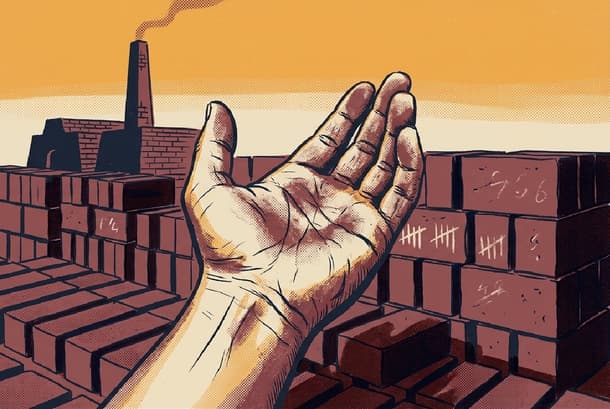
India formally abolished bonded labour through the Bonded Labour System (Abolition) Act, 1976, yet reports from rural labour markets continue to show a difficult truth: legal abolition does not automatically produce social abolition. The case of Ankush Kumar, a 26-year-old worker who reportedly escaped from a brick kiln in Patti Sandhuan village of Moga district in Punjab in January 2025, reveals how debt, migration, caste vulnerability, informal contracting, and weak local enforcement can combine to preserve a system that Parliament had already outlawed half a century ago.
The reported facts are stark. Ankush Kumar came from a background shaped by poverty and labour migration. At the kiln, 56 members of 10 Scheduled Caste families from Saharanpur and Muzaffarnagar in Uttar Pradesh were reportedly working, including 26 children. The families had been drawn into the kiln economy through advances that began at around ₹10,000. That figure, small to a formal economy accustomed to loans, contracts, and bank records, can become enormous in a rural informal setting where wages are opaque, deductions are arbitrary, movement is controlled, and the worker has little bargaining power.
Ankush’s own experience illustrates the intergenerational logic of bondage. He reportedly began working at the age of 10 after his father borrowed a few thousand rupees from a kiln owner near Harike in Tarn Taran, Punjab. Sixteen years later, he escaped. His statement, “Not one rupee,” was ever placed in his hand, captures the moral violence of bonded labour more sharply than any statute can. It is not merely underpayment. It is the conversion of a human life into an account book that the worker never controls and may never even see.
Bonded labour in India must be understood as a legal offence, an economic structure, and a social failure. Article 23 of the Constitution prohibits trafficking in human beings, begar, and other similar forms of forced labour. The 1976 Act went further by extinguishing bonded debts, freeing bonded labourers from any obligation to render labour for such debts, criminalising enforcement of bonded labour, and placing duties upon local authorities. The law is not ambiguous in its moral direction: debt cannot be used to purchase a person’s liberty.
Yet the persistence of bonded labour shows that the problem rarely announces itself in the language of slavery. It often arrives as an “advance,” a seasonal arrangement, a verbal promise, a contractor’s assurance, a family emergency, a medical expense, a marriage cost, or a desperate attempt to survive the agricultural lean season. In brick kilns, sugarcane fields, stone quarries, construction sites, and agricultural labour markets, the advance can function as the entry point into coercion. The employer or intermediary may claim that the worker is merely repaying a debt. The worker may experience something very different: no freedom to leave, no reliable wage calculation, no access to documents, no schooling for children, and no practical route to complaint.
The brick kiln sector is especially vulnerable to this pattern because it combines seasonal migration, family-based work, piece-rate payment, and weak documentation. Workers often move from poorer districts to kiln clusters in other states. Entire families may live on-site in temporary shelters. Payment is commonly tied to output, such as the number of bricks moulded, carried, or stacked. When advances, food costs, shelter, transport, medical expenses, and alleged deductions are folded into the account, the debt can become elastic. It can grow even when the family works continuously.
Children are among the most serious indicators of systemic failure. When 26 children are reportedly found among 56 workers, the issue cannot be treated only as a wage dispute between adults. It becomes a question of child labour, education, nutrition, bodily safety, and social inheritance. A child who spends formative years inside a kiln economy is not merely losing wages; the child is losing schooling, health, mobility, and the ability to imagine a life outside the debt relation. In dharmic ethical terms, a society that fails to protect the vulnerable damages its own moral order.
The caste dimension requires equal clarity. The reported families were Scheduled Caste migrants from Uttar Pradesh. Bonded labour does not affect only one community, region, or occupation, but social vulnerability is not randomly distributed. Landlessness, caste-based exclusion, low literacy, lack of access to formal credit, and dependence on labour intermediaries create conditions in which some communities face greater risk. A factual account of bonded labour must therefore avoid both fatalism and denial. The point is not to reduce workers to caste identity, but to recognise that historical disadvantage can make modern exploitation easier to conceal.
Punjab’s rural economy adds another layer of complexity. The state is often associated with agricultural prosperity, remittances, and strong village networks. Yet prosperity in one part of the rural economy can coexist with intense vulnerability in another. Migrant labourers may occupy the lowest and least visible tier of production. They may not vote locally, may not have strong kinship protection in the village, may not know the administrative system, and may fear retaliation if they complain. A village can appear socially stable while hiding coercion in worksites at its margins.
The 1976 law created a clear administrative framework, but implementation depends heavily on district-level action. Identification of bonded labourers, rescue operations, release certificates, criminal prosecution, rehabilitation support, and follow-up monitoring require coordination among district magistrates, labour departments, police, child welfare authorities, legal services institutions, and civil society organisations. When even one link fails, the survivor may be rescued physically but not restored socially or economically.
Release certificates are particularly important. They are not symbolic paperwork. They formally recognise the worker as a bonded labour survivor, extinguish the illegal debt, and open access to rehabilitation measures. Without such recognition, survivors can be pushed back into informal labour markets with the same vulnerabilities that trapped them earlier. Rescue without rehabilitation can become a temporary interruption rather than a durable liberation.
Rehabilitation must also be understood realistically. A family that has escaped a kiln may need immediate food, safe transport, medical care, wage recovery, school admission for children, identity documents, legal aid, housing support, livelihood assistance, and protection from intimidation. Financial compensation alone is rarely sufficient, especially if it is delayed. A meaningful response must rebuild autonomy. The test is not whether officials can remove workers from a site for a day; the test is whether those workers can refuse bondage in the future.
There is also a need to examine the role of labour contractors. In many cases, the direct employer is not the only actor in the chain. Contractors recruit workers from source districts, arrange advances, organise transport, and mediate between the kiln owner and the family. This creates distance between coercion and accountability. A worker may not know whom to sue, whom to report, or who legally employs him. Administrative enforcement must therefore track the entire chain of recruitment, not merely the physical site where the labour is found.
Formalising labour records is an essential reform. Every kiln and seasonal worksite should maintain verifiable registers of workers, wages, advances, deductions, working days, children on site, and payment schedules. Workers should receive written information in a language they understand. Bank payments, portable social security access, and independent wage audits can reduce the informational monopoly that allows debt to be manipulated. Transparency is not a bureaucratic luxury; in bonded labour cases, it can be the difference between wage employment and coercion.
Inspection systems also need credibility. If inspections are predictable, superficial, or dependent on prior complaints from workers who are afraid to speak, they will miss the most vulnerable households. District administrations require proactive mapping of brick kilns, agricultural worksites, and migrant labour clusters. Surprise inspections, confidential worker interviews, child welfare checks, and coordination with source-state authorities can identify patterns before a worker has to escape in desperation.
The moral question is broader than law enforcement. Bonded labour survives when surrounding society normalises coercion as “custom,” “poverty,” “advance repayment,” or “labour discipline.” Such language hides the central issue: no debt can justify the loss of liberty. A dharmic social vision, whether expressed through Hindu, Buddhist, Jain, or Sikh ethical traditions, places dignity, compassion, restraint, seva, and justice at the centre of collective life. A village that permits exploitation of the powerless does not preserve tradition; it betrays the ethical foundation that makes tradition worthy of respect.
In Sikh thought, the dignity of labour and the rejection of hierarchy are inseparable from the social ethic of sangat and langar. In Hindu traditions, dharma requires protection of the vulnerable and restraint upon exploitative power. Jain ethics foreground non-violence and non-possession, both of which challenge economic domination. Buddhist thought insists that suffering has causes and that those causes must be confronted, not romanticised. Across dharmic traditions, the exploitation of a child or debtor is not merely illegal; it is a violation of social conscience.
The Ankush Kumar case therefore matters beyond one kiln, one district, or one state. It exposes the distance between statutory India and lived India. Parliament can abolish a system through law, but village society, local administration, labour markets, and civil institutions must abolish it in practice. That requires vigilance, documentation, prosecution, rehabilitation, and a refusal to treat migrant workers as invisible.
There is an uncomfortable emotional truth in such cases. Many citizens encounter brick kilns only as part of the background of development: bricks become houses, boundary walls, roads, schools, shops, and urban expansion. The worker who moulds those bricks remains unnamed. When the supply chain is built on silence, exploitation becomes easy to ignore. A humane society must ask not only what is being built, but who is paying the hidden human cost of building it.
A serious policy response should begin with five priorities. First, every district with brick kilns and seasonal migrant labour must maintain active vigilance committees and publicly accountable inspection records. Second, labour contractors and kiln operators must be registered, traceable, and liable for wage records and worker mobility. Third, rescued workers must receive release certificates and rehabilitation support without delay. Fourth, children found in such worksites must be connected immediately to education, nutrition, and child protection systems. Fifth, prosecutions under the Bonded Labour System (Abolition) Act must be pursued with seriousness so that the law has deterrent force.
Punjab’s villages did not create bonded labour alone, and they cannot end it alone. Source districts in Uttar Pradesh, destination districts in Punjab, labour departments, police, panchayats, courts, schools, banks, civil society groups, and religious institutions all have roles to play. The movement of workers across state borders demands inter-state coordination. A family recruited in Saharanpur or Muzaffarnagar and trapped in Moga cannot be protected by a system that thinks only within district boundaries.
The central lesson is that bonded labour is not a relic of the past. It is a modern failure wearing old clothes. It adapts to informal credit, migration, weak documentation, and social indifference. It hides behind small advances and large power imbalances. It persists when the poor are told that survival requires surrendering their freedom.
The 1976 Act remains a landmark in Indian law, but its promise must be renewed in every village, kiln, field, and worksite where debt is used to control labour. The measure of justice is not the existence of a statute book. It is whether a child born into poverty can grow without inheriting a debt, whether a migrant worker can leave a job without fear, whether wages are paid transparently, and whether the weakest person in the village can still claim the protection of the law.
Ankush Kumar’s reported escape should be read as a warning and a call to administrative conscience. If Parliament abolished bonded labour in 1976, the unfinished task is to ensure that every village, employer, contractor, official, and citizen behaves as though that abolition is real. Until then, the law will remain correct on paper while the most vulnerable continue to negotiate freedom with empty hands.
Inspired by this post on Hindu Post.







Leave a Reply
You must be logged in to post a comment.