
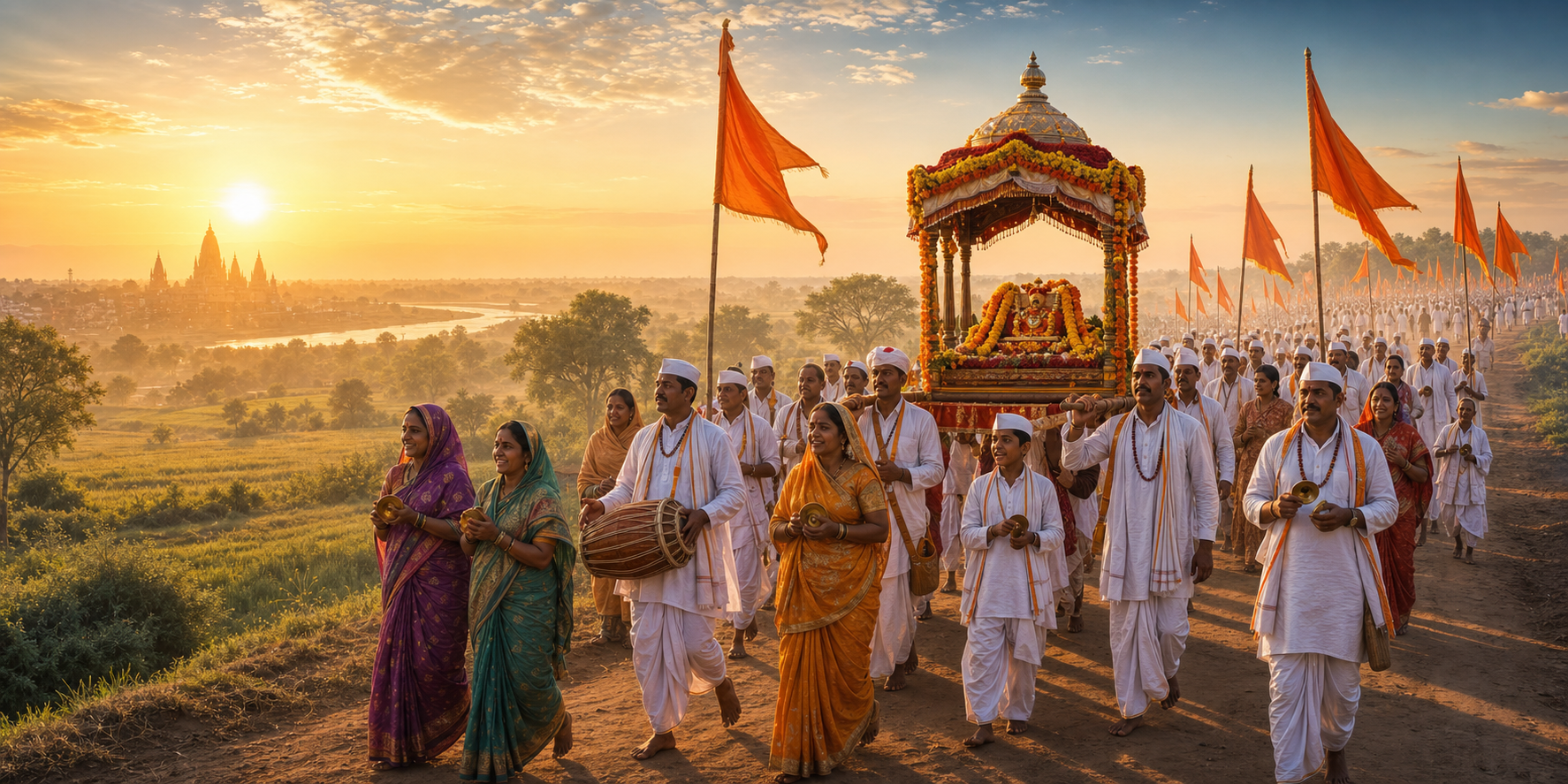
Sant Namdev Maharaj Palkhi Sohala 2026 stands within one of Maharashtra’s most meaningful pilgrimage traditions: the Ashadhi Wari to Pandharpur. The procession is associated with Sant Namdev Maharaj, the revered Varkari saint whose devotion to Vithoba shaped Marathi bhakti, strengthened collective worship, and created a spiritual language that ordinary people could sing, remember, and live. In 2026, the broader Ashadhi Ekadashi observance falls on 25 July, and the Namdev Maharaj Palkhi is traditionally understood as a walking journey from Narsi Namdev in Hingoli district toward Pandharpur, where the saint’s legacy symbolically meets Vitthal-Rakhumai at the heart of the Wari.
The significance of this palkhi cannot be reduced to a travel route or festival date. It is a moving institution of memory, discipline, music, service, and equality. The paduka or sacred representation of the saint travels with Varkaris who walk in dindis, sing abhangs, observe shared codes of conduct, and participate in a devotional culture that has remained remarkably durable across centuries. The emotional force of the procession lies in its simplicity: people walk together, eat together, sing together, and repeatedly affirm that devotion is not an isolated private sentiment but a disciplined public practice.
Sant Namdev Maharaj occupies a distinctive place in the Varkari tradition because his bhakti was both deeply rooted in Maharashtra and widely resonant across northern India. Traditionally connected with Narsi Namdev, he is remembered as a devotee of Vithoba of Pandharpur and as a composer of abhangs and devotional songs that made spiritual reflection accessible beyond elite literary or ritual circles. His teachings emphasized heartfelt devotion, humility, remembrance of the divine name, and the presence of the divine in everyday life. This is why the Sant Namdev Maharaj Palkhi is not merely commemorative; it is pedagogical, teaching through the body, the road, the song, and the community.
The Ashadhi Wari is among the most powerful examples of Hindu pilgrimage as a collective social organism. Pilgrims known as Varkaris travel toward Pandharpur during the bright fortnight of Ashadha, culminating around Ashadhi Ekadashi, also known as Devshayani Ekadashi or Shayani Ekadashi. Pandharpur, located on the banks of the Chandrabhaga or Bhima River in Solapur district, is revered as the seat of Vithoba, a form of Vishnu-Krishna worshipped with Rakhumai. The arrival of multiple palkhis at Pandharpur transforms the town into a vast devotional geography where saints, songs, vows, ritual bathing, darshan, and community service converge.
Within this sacred geography, the Namdev Maharaj Palkhi carries a special emotional weight because it begins from the saint’s associated birthplace, Narsi Namdev, and moves toward the deity to whom his life and poetry were dedicated. The journey is often described as a roughly twenty-six-day walking pilgrimage. Such a duration is not accidental in its spiritual effect. A long walking Wari slowly removes the illusion that pilgrimage is only about arrival. The walking itself becomes sadhana: each step disciplines the body, each halt builds community, and each abhang turns fatigue into remembrance.
The 2026 observance should be understood with attention to local and official announcements, because exact departure times, halts, administrative arrangements, and route management may be updated by the relevant palkhi sansthan, district authorities, and local committees. The larger Ashadhi Wari calendar for 2026 places Ashadhi Ekadashi on 25 July, while major palkhis such as those of Sant Tukaram Maharaj and Sant Dnyaneshwar Maharaj are scheduled to move toward Pandharpur in the weeks preceding that date. The Sant Namdev Maharaj Palkhi likewise belongs to this wider pilgrimage rhythm, though devotees should verify the final timetable before travel or participation.
A technical reading of the palkhi system reveals a sophisticated model of decentralized pilgrimage management. The Wari is not a loose crowd moving randomly; it is organized through dindis, route discipline, scheduled halts, devotional leadership, food distribution, medical support, sanitation planning, police coordination, and village-level hospitality. Each dindi has internal rhythm and responsibility. The procession requires crowd control, water access, temporary accommodation, traffic diversion, emergency response, and ritual timing. In this sense, the Sant Namdev Maharaj Palkhi Sohala 2026 is both a religious event and a complex civic exercise rooted in inherited social knowledge.
The Varkari code is central to this order. Varkaris traditionally cultivate virtues such as simplicity, vegetarian discipline, avoidance of intoxicants, respect for fellow pilgrims, devotion to Vithoba, and regular remembrance through naam-smaran. The external image of the Wari may be its movement across roads and villages, but its inner architecture is ethical. The pilgrimage asks participants to reduce ego, accept hardship, serve others, and honor the saintly lineages that made devotion available to common people. This is why observers often experience the Wari not as spectacle but as moral training.
Sant Namdev Maharaj’s legacy is especially important for a blog committed to unity among dharmic traditions. His devotional memory is honored within Hindu bhakti and also has a meaningful connection with Sikh tradition, as hymns attributed to Bhagat Namdev are included in the Guru Granth Sahib. This shared reverence shows how sant traditions often crossed regional, linguistic, and sectarian boundaries. Namdev’s remembrance therefore becomes a bridge: between Maharashtra and Punjab, between Marathi abhang and broader bhakti literature, between temple devotion and interior realization, and between inherited tradition and living practice.
The philosophical depth of Namdev’s bhakti lies in its ability to join form and essence. In Maharashtra, he is closely associated with saguna devotion to Vithoba, the beloved deity standing on the brick at Pandharpur. Yet his poetry and later reception also point toward the divine presence within all beings. This combination of personal devotion and universal insight is a hallmark of mature bhakti. It allows the devotee to love a chosen form without denying the spiritual dignity of other paths. Such a view strengthens dharmic pluralism rather than weakening it.
The palkhi also preserves the oral and musical dimensions of Hindu spirituality. Namdev’s abhangs and bhajans were not meant to remain confined to manuscripts. They were sung, remembered, adapted, transmitted, and embodied through collective performance. During the Wari, music is not entertainment added to religion; it is a mode of theology. The taal, mridang, veena, cymbals, and collective singing create a public soundscape of devotion. A pilgrim who may not read philosophical treatises can still absorb the essence of bhakti through repetition, rhythm, and participation.
The route from Narsi Namdev toward Pandharpur also symbolizes the movement from local memory to pan-Maharashtrian sacred identity. A village associated with a saint becomes linked to the great pilgrimage center of Pandharpur, and the road between them becomes a corridor of cultural heritage. Villages that host the palkhi do more than provide logistical support; they participate in a recurring act of civilizational continuity. Hospitality to Varkaris becomes seva, and seva becomes a way for householders, farmers, traders, students, and elders to participate even when they cannot complete the full walk.
For many families, the Sant Namdev Maharaj Palkhi Sohala is also intergenerational education. Children see elders walking barefoot or with minimal comforts, singing the names of Vithoba and remembering saints whose lives model humility. Young people encounter a form of spirituality that does not depend on abstraction alone. They see organization, endurance, cooperation, and reverence. In an age of digital distraction and social fragmentation, the Wari offers an unusually tangible lesson: community is built by shared discipline, repeated remembrance, and willingness to bear inconvenience for a higher purpose.
The historical Sant Namdev is surrounded by devotional narratives, hagiographies, regional memories, and scholarly debates. Academic caution is useful here because saintly lives were often transmitted through layered oral traditions. Yet the historical uncertainty around some biographical details does not diminish the living power of the tradition. What can be stated with confidence is that Namdev became one of the central figures of the Varkari imagination, that his name is inseparable from Vithoba bhakti, and that his songs and memory continue to animate pilgrimage practice.
The inclusive character of Namdev’s legacy is one of its most relevant features. Varkari tradition remembers saints from varied social locations, including Dnyaneshwar, Tukaram, Chokhamela, Janabai, Eknath, Savata Mali, Gora Kumbhar, and others. This constellation of saints represents a devotional society in which spiritual worth is not determined by social status alone. The Sant Namdev Maharaj Palkhi therefore carries an ethical message: bhakti opens a public space where humility, service, and remembrance are higher than pride, hierarchy, or exclusion.
Ashadhi Ekadashi itself deepens the theological meaning of the Wari. It marks the beginning of Chaturmas, the four-month period associated with Vishnu’s cosmic rest. Devotees observe fasting, prayer, and intensified spiritual discipline. In Pandharpur, however, this theology becomes embodied through darshan of Vithoba. The pilgrim does not merely read that the day is sacred; the pilgrim arrives after days of walking, stands among countless devotees, and experiences sacred time through the exhaustion and joy of the body.
The environmental and social dimensions of the Wari also deserve attention. A large walking pilgrimage tests the carrying capacity of roads, villages, water systems, waste management, and medical infrastructure. Responsible participation in 2026 should include respect for cleanliness, minimal plastic use, care for elderly pilgrims, hydration, basic first aid awareness, and obedience to local instructions. Traditional devotion and modern civic responsibility are not opposed; in a pilgrimage of this scale, they must support each other.
From a cultural heritage perspective, the Sant Namdev Maharaj Palkhi Sohala 2026 is a living archive. It preserves Marathi devotional language, Varkari discipline, village networks, oral performance, sacred geography, pilgrimage management, and intergenerational memory. Unlike a museum archive, it survives by being enacted. Every year, the same structure is renewed through new feet, new voices, and new acts of seva. This continuity gives the Wari its remarkable resilience.
The emotional appeal of the palkhi lies in its ability to make the saint feel present. The paduka, the chanting of abhangs, the saffron flags, the dust of the road, the sound of cymbals, and the sight of ordinary people walking with extraordinary resolve all create an atmosphere in which memory becomes immediate. For devotees, Sant Namdev Maharaj is not a distant medieval figure but a companion on the road to Vithoba. This devotional intimacy explains why the palkhi remains meaningful even for those who encounter it only for a few hours at a village halt.
The Sant Namdev Maharaj Palkhi also demonstrates how Hindu traditions sustain unity through diversity. The Wari includes ritual, music, philosophy, food-sharing, public service, regional identity, and personal devotion without demanding uniformity of inner experience. Some pilgrims walk for a vow, some for gratitude, some for family tradition, some for study, and some simply because the sound of Vitthal’s name has become part of their life. The tradition makes room for all these motives while directing them toward humility and remembrance.
For readers planning to follow or join the 2026 procession, the most practical approach is to treat the published date of Ashadhi Ekadashi, 25 July 2026, as the culmination point and then consult local Namdev Maharaj Palkhi organizers for the exact departure schedule, halts, and route instructions. Pilgrims should prepare physically for long walking distances, carry essential medicines, respect group discipline, avoid unnecessary luggage, and remain attentive to weather conditions. The Wari is devotional, but it is also physically demanding.
The deeper preparation, however, is inward. A palkhi journey asks whether devotion can remain steady amid heat, rain, dust, crowds, delay, and discomfort. It asks whether the name of Vithoba can be remembered when the body is tired. It asks whether a person can walk not as a consumer of religious experience but as a participant in a centuries-old discipline of service. This is the lasting challenge and beauty of Sant Namdev Maharaj Palkhi Sohala 2026.
Ultimately, the Sant Namdev Maharaj Palkhi Sohala 2026 is a sacred reminder that bhakti is both personal and collective. It begins in devotion to Vithoba, but it expresses itself through community, song, ethical conduct, and reverence for saints. From Narsi Namdev to Pandharpur, the journey preserves the living memory of Sant Namdev Maharaj and invites each generation to rediscover the path of humility, unity, and divine remembrance.
Inspired by this post on Hindu Pad.





Leave a Reply
You must be logged in to post a comment.