
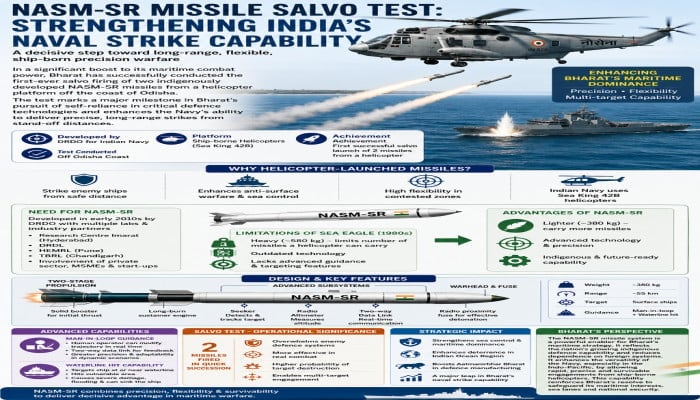
The successful salvo test of the Naval Anti-Ship Missile Short Range, widely known as NASM-SR, marks a significant step in Bharat’s evolving maritime defence posture. Conducted by the Defence Research and Development Organisation in collaboration with the Indian Navy, the trial involved the launch of two missiles in quick succession from a naval helicopter platform over the Bay of Bengal off the Odisha coast. The event is important not merely because another missile test succeeded, but because it demonstrated a more demanding operational capability: coordinated, rapid, air-launched anti-ship fire from a rotary-wing platform.
In naval warfare, the ability to strike first, strike accurately, and strike from a tactically flexible position can shape the outcome of an engagement long before opposing ships come within direct visual range. NASM-SR is therefore not just a weapon system in isolation. It represents a larger movement toward indigenous naval strike capability, maritime self-reliance, and the strengthening of India’s ability to defend its sea lanes, island territories, offshore assets, and wider Indian Ocean interests.
Why the NASM-SR salvo test matters
The term “salvo” refers to the firing of multiple weapons in quick succession, often with the aim of increasing the probability of a successful strike. Against a modern warship, a single incoming missile may be detected, tracked, jammed, decoyed, or intercepted by layered shipborne defences. Multiple missiles arriving within a short time window complicate that defensive problem. The defending ship must classify threats, allocate sensors, launch interceptors, deploy countermeasures, and manoeuvre under severe time pressure.
This is why the NASM-SR salvo launch is strategically meaningful. It shows that India is not only developing anti-ship missiles, but is also validating firing patterns that matter in real combat conditions. A missile that flies well in a controlled test is valuable; a missile that can be launched in coordinated sequence from a helicopter platform is more operationally relevant. The April 2026 demonstration therefore points to maturity in missile design, platform integration, mission planning, range instrumentation, and naval tactical doctrine.
For many Indians who follow national security developments, such tests carry an emotional resonance beyond technical data. Maritime security often appears distant from daily life, yet the sea silently sustains trade, energy flows, fisheries, coastal livelihoods, and national sovereignty. When an indigenous system like NASM-SR advances, it strengthens confidence that Bharat is steadily building the tools needed to protect its maritime civilisation in the modern era.
A helicopter-launched missile changes the tactical geometry
NASM-SR has been designed for launch from naval helicopters, especially shipborne rotary-wing platforms. This is a major advantage because helicopters extend the reach of a warship without forcing the ship itself to close in on a hostile vessel. A helicopter can operate ahead of the fleet, use its sensors or networked targeting inputs, and engage a surface target while the parent ship remains at a safer distance.
This changes the geometry of naval combat. A surface ship is constrained by its own radar horizon, signatures, speed, and exposure. A helicopter, by contrast, can rise above the sea surface, search a wider area, reposition rapidly, and attack from unexpected directions. When equipped with a short-range anti-ship missile, it becomes a mobile strike arm for the fleet, especially in littoral waters where small combatants, fast attack craft, and hostile patrol vessels may operate close to coastlines, islands, and maritime choke points.
The NASM-SR test from a helicopter platform therefore demonstrates more than a launch event. It validates the principle that naval aviation can become an integrated part of India’s anti-surface warfare network. Ship, aircraft, missile, sensor, operator, and command system must all work together. The success of such an integrated test indicates progress across multiple technical layers, not just the missile body itself.
The technical logic of NASM-SR
NASM-SR is reported as an indigenous air-launched anti-ship missile intended for short-range naval engagements. Publicly available information describes it as a sea-skimming missile with modern guidance features, including inertial navigation, radar-altimeter-assisted low-altitude flight, and terminal seeker capability. These elements are central to the missile’s battlefield relevance.
Sea-skimming flight is especially important in anti-ship warfare. A missile flying close to the surface of the sea can delay detection by enemy radar because of the curvature of the earth and sea clutter. The later a defending ship detects an incoming missile, the less time it has to respond. Even a few seconds can be decisive in a high-speed engagement involving electronic warfare, close-in weapon systems, decoys, and interceptor missiles.
A radar altimeter helps the missile maintain a precise low-altitude profile over the sea. Inertial navigation guides the missile through the mid-course phase, while terminal seeker technology supports final target acquisition. Reports have also highlighted advanced features such as imaging infra-red seeker capability and data-link-enabled retargeting in related NASM-SR trials. Such features are significant because modern maritime targets rarely remain passive. They manoeuvre, deploy countermeasures, and attempt to confuse incoming weapons.
The missile’s value therefore lies in its complete kill chain: launch, navigation, low-altitude approach, target discrimination, terminal guidance, and impact. A naval missile is not simply a projectile; it is a compact autonomous system operating in one of the most difficult environments on earth, where heat, salt, humidity, vibration, moving targets, sensor clutter, and electronic interference all impose demanding engineering requirements.
Why waterline strike capability is operationally important
Reports on the salvo launch noted the demonstration of waterline hit capability. This is a crucial detail. A hit near the waterline can be more damaging than a hit on an upper structure because it threatens buoyancy, compartment integrity, propulsion areas, and mission survivability. Even if a ship does not sink, flooding, fire, sensor damage, and loss of manoeuvrability can remove it from combat.
In anti-ship warfare, disabling a vessel may be as significant as destroying it. A ship that cannot fight, move, communicate, or protect itself becomes a liability for its fleet. It may require rescue, escort, towing, or diversion of other assets. A missile designed to attack vulnerable portions of a ship therefore contributes to tactical effectiveness even when the broader strategic aim is deterrence rather than escalation.
The waterline dimension also underlines why missile precision matters. Naval targets are moving objects in a dynamic environment. Achieving the desired impact point requires strong guidance, stable flight control, reliable sensors, and accurate terminal behaviour. The salvo test therefore suggests growing confidence in the weapon’s ability to perform not only in flight, but also at the decisive final stage.
Indigenous defence technology and strategic autonomy
The NASM-SR programme fits into Bharat’s broader pursuit of self-reliance in defence technology. For decades, India depended heavily on imported weapons, imported spares, and foreign-controlled upgrade cycles. Such dependence can create vulnerabilities during conflict, sanctions, diplomatic pressure, or supply-chain disruption. Indigenous systems reduce these risks by placing design knowledge, manufacturing capacity, testing infrastructure, and upgrade authority within the national ecosystem.
DRDO’s collaboration with the Indian Navy is especially important in this context. Naval weapons must be designed around operational realities: saltwater exposure, compact storage, shipboard safety, helicopter vibration, launch-envelope limitations, target behaviour, and fleet doctrine. When the developer and user work closely, the resulting system is more likely to evolve in a direction that matches actual service requirements.

Indigenisation also creates a deeper industrial effect. It strengthens laboratories, private industry, public-sector manufacturing, electronics suppliers, materials specialists, propulsion engineers, software teams, and test-range infrastructure. The visible missile launch is only the final moment of a much larger national effort. Behind it stand years of design reviews, subsystem trials, simulation, environmental testing, seeker validation, aerodynamic work, warhead engineering, platform integration, and flight-safety planning.
Maritime security in the Indian Ocean context
Bharat’s maritime environment is becoming more complex. The Indian Ocean carries critical energy supplies, commercial shipping, undersea cables, and strategic traffic linking West Asia, Africa, Southeast Asia, and the wider Indo-Pacific. India’s geography gives it a central position in this oceanic system, but geography alone does not guarantee security. Maritime power requires surveillance, deterrence, rapid response, and credible strike options.
Short-range anti-ship missiles like NASM-SR are especially relevant in littoral and near-sea scenarios. Not every naval threat is a large destroyer or aircraft carrier. Many real-world challenges may involve patrol vessels, missile boats, small combatants, hostile surface craft, or adversary ships operating close to coastlines and island chains. A helicopter-launched missile gives the Navy a flexible option between warning and large-scale escalation.
Such capability also supports distributed maritime operations. Instead of relying only on large ships firing heavier missiles, the Navy can use helicopters as agile missile carriers. This disperses offensive capability, complicates adversary planning, and allows commanders to choose proportionate responses according to target type, distance, rules of engagement, and operational risk.
Salvo firing and saturation logic
The operational significance of salvo firing lies in saturation. Modern warships defend themselves through layered systems: surveillance radar, electronic support measures, soft-kill decoys, hard-kill missile interceptors, close-in weapon systems, manoeuvre, and damage control. A single incoming missile gives the defender a relatively clearer problem. Two or more missiles arriving in close sequence create uncertainty and force faster decisions.
Salvo attacks can be designed to arrive from similar or different bearings, at slightly separated timings, or with coordinated profiles. Even a short-range system can impose significant stress if launched from a mobile platform that approaches from an unexpected axis. The NASM-SR salvo test therefore contributes to a realistic combat capability: not just hitting a target, but overwhelming or complicating the target’s defensive cycle.
This does not mean that every salvo guarantees success. Naval combat remains a contest of sensors, tactics, electronic warfare, crew training, weather, intelligence, and command judgement. However, the ability to launch a salvo gives commanders more tactical choices. It increases the credibility of deterrence because an adversary must assume that even smaller naval aviation assets may deliver coordinated anti-ship fire.
From test success to operational induction
A successful test is not the same as full operational induction, and this distinction is important for a factual assessment. Missile systems typically pass through multiple stages: developmental trials, guided flight tests, user-associated trials, platform integration, production validation, training, maintenance planning, safety certification, and eventual fleet deployment. Each stage reduces uncertainty and increases user confidence.
The NASM-SR salvo launch should therefore be understood as a major developmental and operational milestone rather than the end of the journey. The next important questions will concern production scale, integration with future helicopter fleets, training doctrine, maintenance infrastructure, war-stock management, and interoperability with naval sensors and command networks. These steps are less dramatic than a missile launch, but they decide whether a promising system becomes a dependable fleet weapon.
The Indian Navy’s transition from older platforms to newer helicopters will also influence how NASM-SR evolves. If integrated across relevant rotary-wing platforms, the missile can become a standard tool for anti-surface warfare. That would give fleet commanders a more flexible strike portfolio, complementing heavier ship-launched and air-launched systems.
A civilisational view of security
For a nation with a long maritime memory, naval strength is not a narrow military obsession. Bharat’s coasts have connected civilisations, carried pilgrims, traders, scholars, monks, artisans, and ideas across the Indian Ocean for centuries. Hindu, Buddhist, Jain, and Sikh traditions have all valued disciplined strength when it protects society, preserves dharma, and prevents disorder. In that broader sense, maritime security is linked to the protection of peaceful exchange, cultural continuity, and national dignity.
The NASM-SR programme may be technical in form, but its significance reaches into this larger framework. A secure coastline, a capable Navy, and an indigenous defence industry help create the stability in which commerce, culture, and civil society can flourish. Deterrence is most valuable when it prevents conflict. A credible defensive and retaliatory capability reduces the temptation for hostile actors to test national resolve.
This is where the emotional connection becomes understandable. Citizens may not follow every detail of guidance systems or launch envelopes, yet they recognise the importance of national preparedness. A successful indigenous missile test signals that scientific institutions, armed forces, and industry are working together for a purpose larger than any one organisation.
Conclusion: a measured but powerful advance
The NASM-SR salvo test strengthens Bharat’s naval strike capability in a precise and meaningful way. It demonstrates that India can develop and test an indigenous short-range anti-ship missile, integrate it with a helicopter platform, and validate rapid sequential launch against maritime targets. The capability improves tactical flexibility, supports over-the-horizon engagement, and contributes to saturation attack options against defended ships.
Its deeper value lies in the direction it represents. Bharat is moving from dependence toward self-reliance, from isolated weapon tests toward integrated combat capability, and from platform-centric thinking toward networked maritime power. The NASM-SR is not the largest or longest-range missile in India’s arsenal, but it fills an important operational niche. In naval warfare, such niches matter because battles are often decided by the right weapon, launched from the right platform, at the right moment.
As India’s maritime responsibilities expand across the Indian Ocean and Indo-Pacific, systems like NASM-SR will become increasingly important. They strengthen deterrence, improve fleet survivability, and demonstrate confidence in indigenous science and engineering. The salvo test off Odisha is therefore best understood as a disciplined, technically significant, and nationally meaningful advance in Bharat’s maritime security architecture.
Inspired by this post on Hindu Post.










Leave a Reply
You must be logged in to post a comment.