
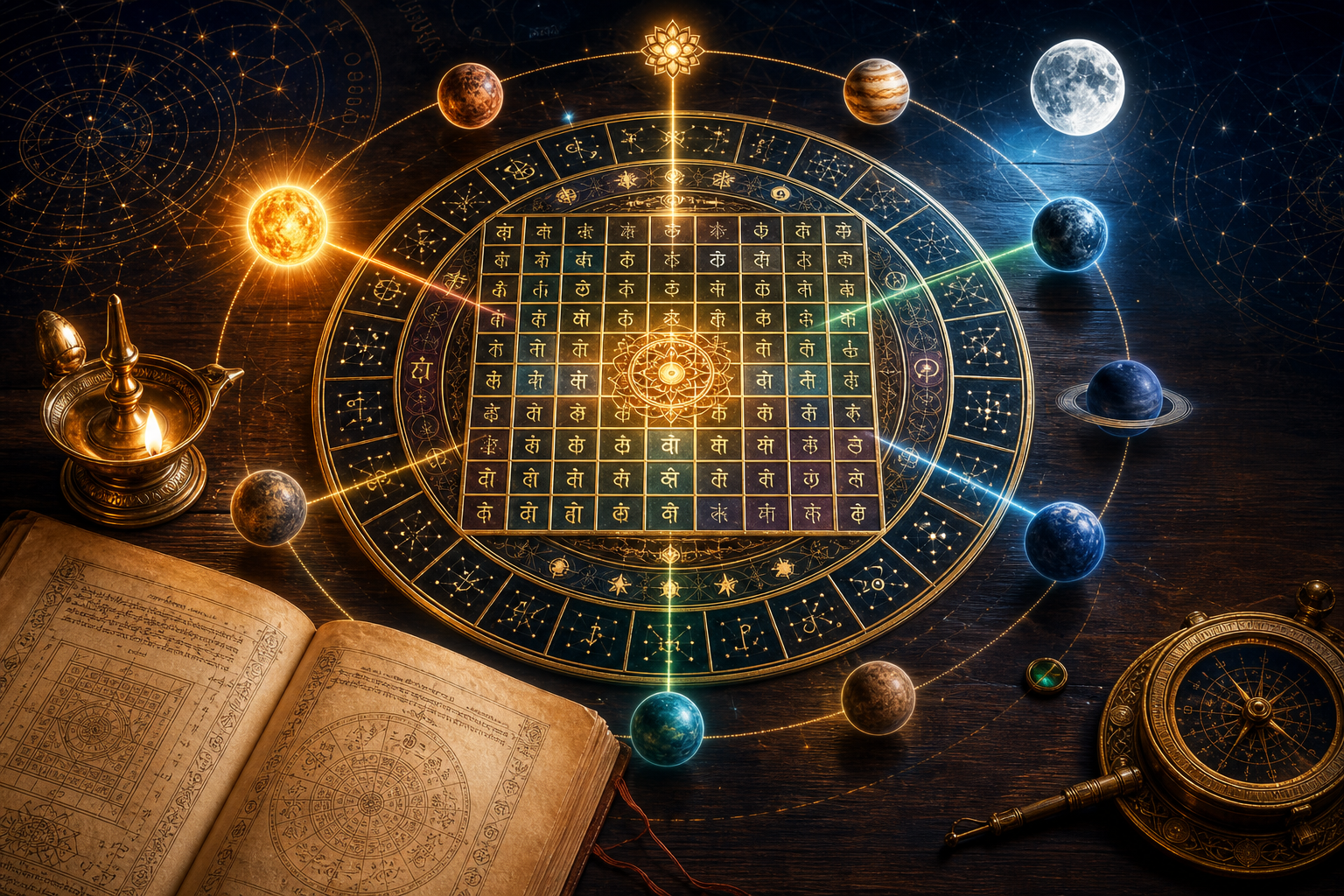
Sarvatobhadra Chakra occupies a distinctive place in Jyotisha because it attempts to read planetary movement from several directions at once. The name itself expresses the method’s ambition: Sarva means all or everywhere, while Bhadra means auspicious, wholesome, or beneficial. In traditional interpretation, the phrase suggests a chakra that examines auspiciousness from every side rather than from a single planetary placement, sign, or house.
This breadth explains why classical discussions sometimes associate the Sarvatobhadra Chakra with the expression Trilokya Deepa, a lamp that illuminates the three worlds. The phrase should not be read merely as poetic ornament. It points to the technical purpose of the system: to bring together nakshatra, rashi, tithi, vara, and akshara into one predictive grid so that a transit can be examined through multiple layers of time, identity, and action.
Within the discipline of Vedic astrology, this makes the Sarvatobhadra Chakra one of the more comprehensive tools for studying Gochara, or planetary transit. Ordinary transit analysis often begins with the movement of planets through signs and houses. Sarvatobhadra Chakra goes further by asking which nakshatra is being affected, which syllable or sound is touched, which lunar day is involved, which weekday is activated, and which rashi receives pressure or support.
The result is a compact but demanding system. It is not designed for casual prediction, nor is it meant to replace the birth chart, dasha, panchang, or muhurta principles. Its strength lies in refinement. When used carefully, it helps the practitioner understand why a transit that appears mild in one method may feel intense in lived experience, or why a visibly difficult transit may produce manageable results when protective factors are present.
The traditional structure of the chakra is a square of 9 by 9 divisions, creating 81 spaces. These spaces are not decorative. They carry the logic of the system. The outer boundary is associated with the 28 nakshatras, including Abhijit, which is one reason Sarvatobhadra Chakra is often treated as an older and more inclusive nakshatra-based method. Most modern predictive work uses 27 nakshatras, but this chakra preserves the role of Abhijit between Uttarashada and Shravana.
The inclusion of Abhijit is technically significant. It shows that Sarvatobhadra Chakra is not merely a simplified transit table. It belongs to a stream of Jyotisha that preserves subtle divisions of the zodiac and gives special weight to lunar mansions. Since nakshatras are intimately connected with the Moon, time, mind, and experience, this method often feels more immediate than broad sign-based transit interpretation.
The inner arrangement of the chakra includes the twelve rashis, the thirty tithis, the seven varas or weekdays, and the aksharas, meaning the sounds or letters used to connect a name with the chart. This is where the method becomes especially sophisticated. It does not treat a person only as a physical birth chart. It also brings in the vibration of the name, the lunar calendar, and the rhythm of weekday rulership.
In practical terms, Sarvatobhadra Chakra becomes a map of contact. Planets in transit are placed in the chakra according to their current nakshatra or relevant position. From there, their vedha, or obstructing and influencing power, is observed. Vedha is the central idea in this system. It indicates how a planet’s movement can strike, block, stimulate, or protect specific points in the chakra.
The Sanskrit word Vedha carries the sense of piercing, obstruction, or direct impact. In Sarvatobhadra Chakra, it does not always mean harm. A benefic planet can create a favourable vedha, while a malefic or difficult planet can create pressure, delay, anxiety, loss, conflict, or obstruction. The final judgement depends on the planet involved, its condition, motion, dignity, and the point that receives its influence.
This is why the system requires patience. A simplistic reading that equates every vedha with misfortune misses the deeper logic of Jyotisha. Jupiter’s influence may bring protection, learning, counsel, or gain. Mercury may sharpen intellect and communication. Venus may bring comfort but can also indicate concern through relationships or opponents, depending on context. Saturn, Mars, Rahu, and Ketu may show pressure, disruption, austerity, injury, confusion, or karmic friction, yet even these results must be interpreted within the larger chart.
Classical descriptions also distinguish the strength of vedha. A planet that is powerful by dignity, speed, or retrograde condition can make its influence more noticeable. A debilitated or weakened planet may produce a reduced effect. A favourable vedha can also soften or counteract an unfavourable one. This principle is important because it prevents fatalism. The chakra is not a rigid sentence; it is a diagnostic framework.
One of the most discussed applications concerns the Janma Nakshatra, the nakshatra occupied by the Moon at birth. If the Janma Nakshatra receives difficult vedha at the beginning of a journey, undertaking, ritual, business decision, or important event, tradition advises caution. This does not always mean abandonment of the action. It may mean delay, purification, prayer, preparation, consultation, or choosing a more suitable muhurta.
The chakra also considers other derived nakshatras counted from the Janma Nakshatra, such as Karma, Adhana, Vinasha, Samudayika, and Samghatika. These categories help identify the field of life being affected. For example, a vedha to a work-related point may indicate professional difficulty, while an affliction to a point connected with family or collective support may show strain in relationships or social cooperation.
The emotional relevance of this system becomes clear when seen through everyday uncertainty. People rarely seek Jyotisha only out of curiosity. They come when a decision feels heavy, when timing appears confusing, when repeated obstacles create anxiety, or when a family, pilgrimage, marriage, investment, relocation, or spiritual discipline needs careful alignment. Sarvatobhadra Chakra speaks to that human need for orientation without reducing life to fear.
Its association with panchang elements also gives the method a dharmic depth. Tithi, vara, nakshatra, rashi, and planetary transit are not isolated technical terms. They reflect an older Indian understanding of time as qualitative. Time is not only a number on a clock; it has texture, rhythm, and suitability. A day may be fit for worship, study, travel, negotiation, healing, silence, discipline, or restraint.
This qualitative view of time is shared across many dharmic traditions in different forms. Hindu, Buddhist, Jain, and Sikh civilizational contexts have all preserved respect for disciplined timing, sacred memory, ethical action, and inner preparation. Sarvatobhadra Chakra belongs specifically to Jyotisha, but its deeper teaching is broader: human action becomes more meaningful when it is joined with awareness, restraint, and responsibility.
The akshara component is particularly intriguing. By including letters and sounds, the chakra connects predictive work with the first sound of a name. In many Indian traditions, names are not treated as arbitrary labels. They carry memory, lineage, blessing, deity association, and psychological identity. Sarvatobhadra Chakra incorporates this cultural understanding into its technical design, making the system personal even when the full horoscope is unavailable.
This feature also explains why the chakra has been used in questions where a complete birth chart may not be available. In such cases, the name, nakshatra, weekday, tithi, and planetary transit can provide a structured basis for interpretation. This does not make the method infallible, but it makes it useful as a supplementary tool in prashna, muhurta, and transit assessment.
The technical process begins with accurate astronomical and calendrical data. The current positions of the Sun, Moon, Mars, Mercury, Jupiter, Venus, Saturn, Rahu, and Ketu must be identified. The nakshatra occupied by each planet is then marked in the chakra. From these positions, vedha lines are evaluated according to the rules of planetary motion and direction.
Motion matters because the direction of influence can change. Planets moving normally, planets moving with unusual speed, and planets in retrograde condition may produce different types of vedha. Classical rules also treat the Sun and the lunar nodes with specific patterns. This makes Sarvatobhadra Chakra more dynamic than a static diagram. It is a moving field of planetary interaction.
For a careful practitioner, the first task is not to predict dramatically but to identify concentration. If several difficult vedhas fall upon the same nakshatra, rashi, tithi, or name-syllable, the matter deserves attention. If benefic influences also protect the same point, the outcome may be moderated. If the natal chart and dasha confirm the same theme, the prediction becomes stronger. If they do not, the reading should remain cautious.
This layered approach is essential because no single Jyotisha technique should be isolated from the rest of the system. Sarvatobhadra Chakra is powerful precisely because it can confirm, nuance, or challenge conclusions reached through other methods. A responsible reading compares the chakra with the natal chart, dasha, ashtakavarga, panchang, muhurta principles, and the actual context of the person seeking guidance.
Such responsibility is especially important in modern use. Astrology can become harmful when technical language is used to generate fear. Classical terminology about obstruction, loss, illness, or danger should be handled with maturity. A factual and dharmic approach treats difficult indications as calls for awareness, discipline, prayer, ethical conduct, practical planning, and humility rather than as reasons for panic.
In this sense, Sarvatobhadra Chakra is also a spiritual teaching. It reminds the student that time is interconnected. A planetary transit does not act in isolation; it touches names, days, lunar phases, signs, nakshatras, and human choices. The person is not outside the cosmos but participates in it through action, intention, memory, and consequence.
The chakra’s value in muhurta is equally important. When beginning a marriage ceremony, journey, business venture, study, construction, worship, or public undertaking, traditional astrologers may examine whether the relevant nakshatra, tithi, vara, rashi, or name-syllable is under difficult vedha. A clean or well-supported configuration may be preferred for actions requiring stability, harmony, and success.
However, muhurta is not merely a search for perfection. In real life, circumstances often require action even when the timing is mixed. The practical strength of Sarvatobhadra Chakra lies in showing where caution is needed. If travel is indicated under pressure, one may prepare more carefully. If communication is vulnerable, speech may be restrained. If finances appear sensitive, risk may be reduced. If health is highlighted, rest and medical attention may be prioritized.
Traditional texts such as Mansagari and later commentarial traditions connected with Phaladeepika are often cited in discussions of the chakra. Modern explanations also refer to the Brahmayamal Grantha as an important source for its prognostic method. These references show that the technique stands within a larger textual culture rather than being a recent invention.
At the same time, the surviving practical instructions are not always presented in one simple place. Students often learn Sarvatobhadra Chakra through teachers, commentaries, manuals, and repeated chart practice. This explains why the method can appear intimidating. Its rules are compact, but their application requires discrimination, especially when several planets create simultaneous influences.
The 81-square layout also has symbolic elegance. The outer ring begins with the nakshatra framework, suggesting the cosmic field of time. The inner rings bring the focus toward human naming, signs, lunar days, and weekdays. Movement from the outer to the inner reflects the movement from cosmic order to personal experience. This is one reason the chakra has remained compelling to students of Hindu astrology and Vedic Knowledge.
For technical analysis, the practitioner should first identify the natal sensitivity points: Janma Nakshatra, name-syllable, relevant rashi, tithi of birth, and other derived nakshatras. Next, current planetary positions are placed into the chakra. Then vedha patterns are examined, noting whether they arise from benefic or malefic planets, whether those planets are strong or weak, and whether other protective influences are present.
After this, the reading must be translated into meaningful guidance. A chart may show pressure, but people do not live inside diagrams. They live through family obligations, financial limits, health conditions, spiritual practices, social duties, and emotional realities. A mature Jyotisha reading respects these realities. It offers clarity without exaggeration and caution without despair.
This is where the most humane use of Sarvatobhadra Chakra emerges. The method can help people pause before rushing into important actions. It can encourage preparation before travel, patience before confrontation, reverence before ritual, and self-control before financial or emotional decisions. Even for those who approach astrology culturally rather than predictively, the chakra offers a disciplined language for thinking about timing.
The method also encourages humility in interpretation. Not every difficulty in the chakra becomes an event. Not every benefic influence produces visible success. Human karma, effort, environment, health, social support, and divine grace all play roles within dharmic thought. Sarvatobhadra Chakra is therefore best understood as a tool of insight, not a mechanical guarantee.
Its continued relevance comes from its comprehensiveness. By joining nakshatra, Navagraha, Panchang factors, Rashi, Tithi, and akshara, the chakra provides a multi-dimensional view of Gochara. It helps explain the unevenness of experience: why the same transit may be auspicious for one person, stressful for another, and mixed for a third.
For students of Hindu scriptures and Vedic Tradition, Sarvatobhadra Chakra also preserves an important intellectual lesson. Ancient Indian knowledge systems often combined observation, symbolism, memory, mathematics, ritual timing, and ethical purpose. Whether one studies the chakra as a practitioner, historian, or cultural reader, it reveals a sophisticated attempt to organize cosmic time into a usable human framework.
The most balanced conclusion is that Sarvatobhadra Chakra should be approached with respect, precision, and restraint. It is advanced because it is comprehensive, not because it invites sensational prediction. Its highest value lies in thoughtful timing, careful diagnosis, and dharmic decision-making. When used in that spirit, it becomes what its name suggests: a search for auspiciousness from all sides.
Inspired by this post on Hindu Pad.






Leave a Reply
You must be logged in to post a comment.