
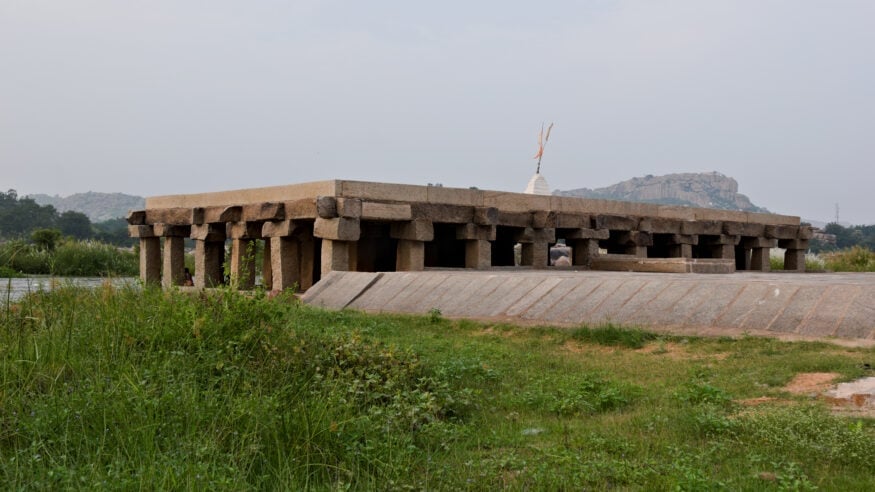
A Carnatic concert in Chennai during Margazhi often begins with a gesture that is both musical and civilisational. The tāmpurā settles into pitch, the hall becomes quiet, and Purandaradāsa’s Lambōdara Lakumikara invokes Ganesha before the musical journey proceeds. What appears to be a familiar devotional opening is, on closer examination, evidence of a remarkably durable knowledge system. A composition shaped in sixteenth-century Hampi continues to move through the voices of present-day singers, accompanists, students, householders, and temple communities.
The historical fact is striking. Hampi, the imperial centre of Vijayanagara, was devastated in 1565 after the Battle of Tālikōṭa. Yet the Kannada devotional compositions associated with Purandaradāsa, Śrī Vyāsatīrtha, Śrī Śrīpādarāja, Kanakadāsa, and later Haridāsas did not disappear with the political order that once supported them. The melodies, devotional language, theological ideas, and teaching practices survived dynastic change, regional upheaval, colonial administration, and modern institutional transformation.
This continuity invites a serious question: why did the Haridāsa tradition remain a living presence when many medieval devotional currents became fragmentary, archival, or locally confined? The answer lies not merely in poetic beauty, but in design. The Haridāsas built a pedagogical system that translated dense Madhva-Dvaita Vedānta into Kannada song, embedded it in household practice, preserved it through maṭhas, expanded it across social boundaries, and corrected it through guru-shishya transmission. Their achievement was devotional, philosophical, linguistic, musical, and institutional at once.
The first major design move belonged to Śrī Śrīpādarāja of Mulbagal, who entered Brindavana around 1480. In the Madhva sampradāya, the Brindavana marks the sacred resting place of a sannyāsi-pontiff in eternal samādhi. Śrī Śrīpādarāja inherited a sophisticated Sanskrit intellectual tradition: the Brahmasūtra Bhāṣya, the Anuvyākhyāna, the Mahābhārata Tātparya Nirṇaya, and the wider commentarial world of Śrīman Madhvācārya. These works formed the philosophical backbone of the tradition, but their direct audience was limited to those trained in Sanskrit learning.
The central problem was access. A philosophical tradition may be profound, but if its key ideas remain locked in a language unavailable to most householders, its reach becomes structurally limited. Śrī Śrīpādarāja addressed this by composing devaranāmas in Kannada. These were not generic bhakti songs detached from theology. They were vehicles of tattva, carrying Madhva-Dvaita concepts in a form that could be sung, memorised, repeated, and transmitted in daily life.
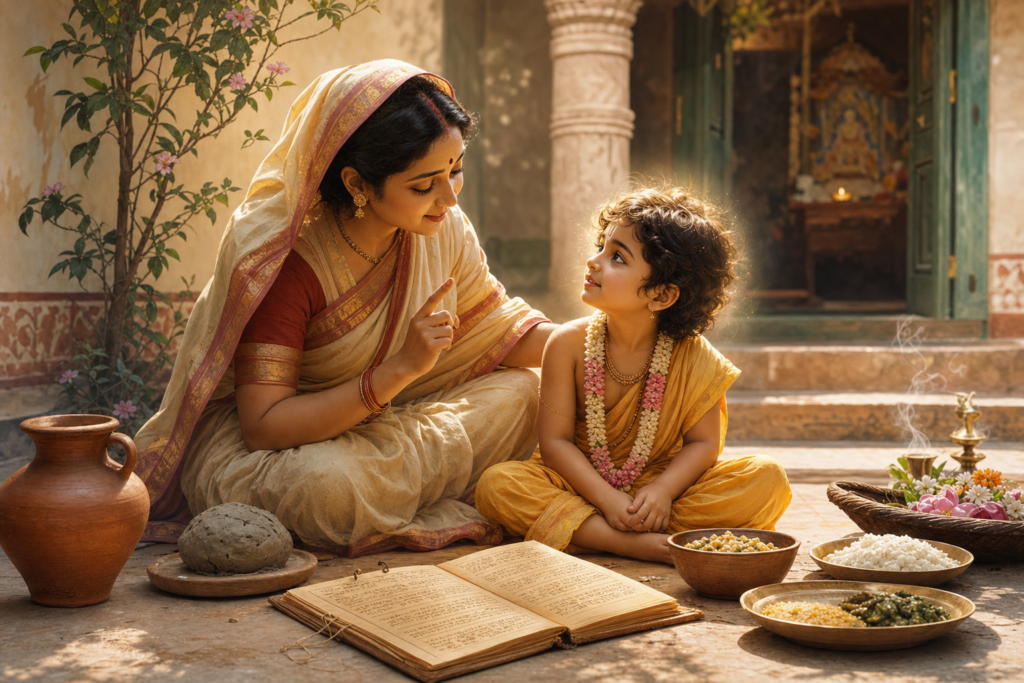
The phrase ಭೂಷಣಕೆ ಭೂಷಣ, rendered as bhūṣaṇake bhūṣaṇa, expresses this method with great economy. It makes a metaphysical claim through an image: Śrī Hari is the ornament of ornaments, the source that gives beauty its meaning. A scholar may approach the same idea through Sanskrit argumentation. A grandmother at ārati may receive it through rhythm, image, and repetition. The intellectual content reaches different audiences at different levels of technical density, without abandoning its philosophical core.
This was the vernacular access layer of the Haridāsa system. It did not replace Sanskrit śāstra; it extended its reach. Such a structure is important for all Dharmic traditions because it shows how textual precision and popular devotion can reinforce one another. A living tradition requires both intellectual depth and social circulation. Śrī Śrīpādarāja’s Kannada compositions created a bridge between the maṭha, the scholar, the singer, and the household.
The second design move came through Śrī Vyāsatīrtha, also known as Vyāsarāja, who lived from 1460 to 1539. He was a towering figure in Madhva intellectual history and served as rāja-guru to Krishnadevaraya during the emperor’s reign from 1509 to 1529. His Sanskrit works, including Nyāyāmṛta, Tarka Tāṇḍava, and Tātparya Candrikā, defended and refined the Madhva-Dvaita position in the rigorous world of philosophical debate. At the same time, he composed Kannada devaranāmas that entered the devotional bloodstream of Karnataka.
The well-known Krishna Nī Bēgane Bārō demonstrates the devotional reach of Śrī Vyāsatīrtha’s compositions. The Kannada line ಕೃಷ್ಣಾ ನೀ ಬೇಗನೇ ಬಾರೋ, ಬೇಗನೇ ಬಾರೋ ಮುಖವನ್ನು ತೋರೋ continues to be sung in homes, temples, concert halls, and cultural settings far beyond its original institutional context. Its devotional appeal is immediate, but its survival also depended on a larger framework. Śrī Vyāsatīrtha’s deeper contribution was institutional architecture.
Under Vijayanagara patronage, the Madhva maṭhas received resources without being reduced to instruments of state command. This distinction mattered. Political power could protect religious institutions, but if it controlled their inner purpose, the tradition would become vulnerable to political collapse. Śrī Vyāsatīrtha helped maintain a structure in which maṭhas trained scholars, hosted pilgrims, preserved manuscripts, taught compositions, and provided continuity beyond courtly fortunes.
The significance of this institutional layer becomes clear in the life of Śrīnivāsa Nāyaka, the wealthy merchant who became Purandaradāsa. Tradition remembers him as Navakoṭi Nārāyaṇa, a man of immense wealth who underwent a profound spiritual transformation after an encounter that revealed the emptiness of mere accumulation. Initiated by Śrī Vyāsatīrtha at Hampi in 1525, he became Purandaradāsa and dedicated the remainder of his life to composing songs that would shape the future of Carnatic music and Kannada bhakti.
Purandaradāsa’s importance cannot be measured only by the number of compositions attributed to him. Traditional accounts speak of hundreds of thousands of songs, while the surviving corpus is more modest but still substantial. The more important point is method. He worked in forms such as kīrtana, sulādi, and ugābhoga, and he used the mudra Purandara Viṭhala as a signature of devotional authorship. His songs brought Vedantic content into the emotional and practical world of ordinary people.
In Jagadoddhāraṇa, the line ಜಗದೋದ್ಧಾರನ ಆಡಿಸಿದಳೆಶೋದಾ, or jagadōddhārana āḍisidaḷeśōdā, presents a profound theological paradox through the image of Yashoda playing with the one who uplifts the world. The composition does not need to explain the relation between the divine child and the supreme reality through abstract categories. It allows the listener to perceive the truth through rasa, maternal tenderness, and bhakti. In this way, metaphysics becomes singable without becoming shallow.
Another composition presents theology as food, using the domestic language of preparation and taste. The lines ರಾಮ ನಾಮ ಪಾಯಸಕ್ಕೆ, ಕೃಷ್ಣ ನಾಮ ಸಕ್ಕರೆ and ವಿಠಲ ನಾಮ ತುಪ್ಪವ ಕಲಸಿ ಬಾಯ ಚಪ್ಪರಿಸಿರೋ compress nāma-smarana into the image of pāyasa, sugar, and ghee. The household becomes a classroom. The kitchen becomes a site of theology. A listener who understands the recipe understands the devotional structure. Such pedagogical brilliance explains why these songs could travel across age, gender, literacy, region, and social location.
This was the third design move: doctrinal compression. The Haridāsas took dense philosophical material and encoded it into memorable, melodic, emotionally accessible forms. The compression was not a rejection of śāstra. It was a transmission strategy. A Sanskrit commentary preserves precision at the highest level of analysis; a Kannada devaranāma preserves recognisable doctrine in the form most likely to be remembered, sung, and taught. Both are necessary in a civilisational knowledge system.

The fourth design move is visible in the life of Kanakadāsa. Born Vīra Nāyaka in the Kuruba community of Karnataka, he became one of the great Haridāsa composers. His corpus includes Mohanataraṅgiṇī, Rāmadhānya-caritre, Haribhaktisāra, Nalacaritre, and Nṛsiṁhastava. His place in the tradition is not ornamental or marginal. It is central to understanding how the Haridāsa movement expanded the devotional field beyond narrow social boundaries.
The Udupi episode associated with Kanakadāsa remains one of the most powerful symbols of access in the Madhva sampradāya. Denied entry by the social conventions of the time, he is said to have stood at the back wall of the Krishna temple and sung ಬಾಗಿಲನು ತೆರೆದು ಸೇವೆಯನು ಕೊಡೊ ಹರಿಯೇ, or bāgilanu teredu sēveyanu koḍo hariye. Tradition holds that an opening appeared in the wall and that Krishna turned westward to grant him darśana. That opening, Kanakana Kindi, remains a site of pilgrimage.
The episode is not merely a miracle narrative. It is an institutional statement. Śrī Vādirāja Tīrtha, the senior Madhva pontiff of the period, is remembered as preserving and formalising the opening. The result was an architectural witness to a theological principle: devotion cannot be confined by social pride. This insight is especially relevant to the wider Dharmic family of Hinduism, Buddhism, Jainism, and Sikhism, where inner discipline, humility, service, and liberation-oriented practice repeatedly challenge ego and exclusion.
Kanakadāsa’s presence demonstrates that the Haridāsa channel was not only vernacular but socially expansive. The tradition did not depend solely on elite textual spaces. It could travel through the voice of a devotee at a temple wall, through allegory, through public singing, through household memory, and through the corrective recognition of spiritual authority. The access layer opened by Śrī Śrīpādarāja reached a fuller social expression through Kanakadāsa.
The fifth design move emerged after catastrophe. In 1565, Vijayanagara’s capital was sacked after Tālikōṭa, and the political world that had supported Hampi’s religious and cultural institutions was violently altered. Yet the Haridāsa compositions continued. This survival reveals the strength of the system. A tradition dependent only on imperial patronage would have collapsed with the empire. A tradition embedded in maṭhas, teachers, songs, households, and memory could continue through disruption.
Later Haridāsas carried the movement into new centuries. Vijaya Dāsa, Gopāla Dāsa, and Jagannātha Dāsa extended the corpus through the eighteenth century. Jagannātha Dāsa’s Harikathāmṛtasāra systematised Madhva doctrine in Kannada verse and remains part of study traditions associated with Uttarādi Maṭha. Women such as Heḷavanakaṭṭe Giriyamma also entered the broader parampara, showing that the devotional-intellectual field was not frozen in one demographic form.
Political contexts changed repeatedly: post-Vijayanagara polities, Mughal influence in the Deccan, the rise and fall of regional powers, Anglo-Mysore conflicts, British administration, and independent India. Through these changes, the Haridāsa tradition did not remain static; it accumulated, adapted, and continued. Each generation added new compositions and interpretive layers while preserving the core devotional grammar of nāma, tattva, guru, and parampara.
Parampara functioned as the error-correction system. A song transmitted only by manuscript is vulnerable to copying errors, loss of context, and interpretive thinning. A song transmitted by a teacher includes pronunciation, rāga, tempo, emphasis, meaning, gesture, and devotional mood. The student receives not only a text but a way of carrying the text. This is why oral and musical traditions often preserve subtle knowledge that written records alone cannot sustain.
The Haridāsa system may therefore be understood as a multi-layered civilisational technology. Śrī Śrīpādarāja created the Kannada access layer. Śrī Vyāsatīrtha secured the institutional nodes. Purandaradāsa compressed doctrine into memorable devotional song. Kanakadāsa demonstrated social reach and spiritual inclusiveness. Later Haridāsas sustained continuity through parampara. Together, these layers explain how a tradition could remain alive for five centuries without depending on a single ruler, capital, language policy, or modern media system.
The analogy of a compiler is useful. A compiler translates high-level instruction into a form that can run on a given machine. The Haridāsas translated the high-level philosophical language of Madhva-Dvaita Vedānta into songs that could run on the processor of daily life: the voice, memory, rhythm, devotion, household practice, and communal singing. The grinding stone, the pūjā room, the temple corridor, the maṭha classroom, the concert platform, and the radio broadcast all became execution environments for the same civilisational code.
This does not reduce bhakti to mechanism. Rather, it recognises that enduring devotion needs reliable forms. Emotional intensity alone rarely survives centuries unless it is held by discipline, teaching, repetition, institutions, and shared memory. The Haridāsa achievement lies precisely in the harmony between inner devotion and external structure. It made room for scholarship without excluding the household, and it made room for the household without weakening scholarship.
For contemporary readers, the lesson is immediate. Cultural heritage is not preserved by nostalgia alone. It is preserved by systems that allow children to learn before they can analyse, adults to deepen what they inherited, scholars to maintain precision, communities to sing together, and institutions to survive political change. The Haridāsa tradition shows how bhakti, philosophy, music, and pedagogy can cooperate without fragmentation.
It also offers a broader Dharmic lesson. Hindu, Buddhist, Jain, and Sikh traditions have each preserved knowledge through layered methods: scripture, commentary, recitation, music, monastic or institutional continuity, household discipline, pilgrimage, and embodied practice. The Haridāsas stand as a powerful example of how one sampradāya can strengthen the wider civilisational understanding of transmission. Unity does not require sameness; it requires respect for the many disciplined ways in which truth, devotion, and liberation-oriented practice are carried forward.
When Lambōdara Lakumikara opens a Carnatic concert today, it is therefore more than a familiar invocation. It is the audible result of an engineered tradition that survived the ruin of Hampi, the fall of empires, the pressures of colonial administration, and the changes of modern life. The singer may stand in Chennai, the remembered composer may belong to Hampi, and the listener may come from any background. Yet the transmission remains intact because the Haridāsas built not only songs, but a system capable of carrying sacred knowledge across time.
Inspired by this post on Hindu Post.





Leave a Reply
You must be logged in to post a comment.