
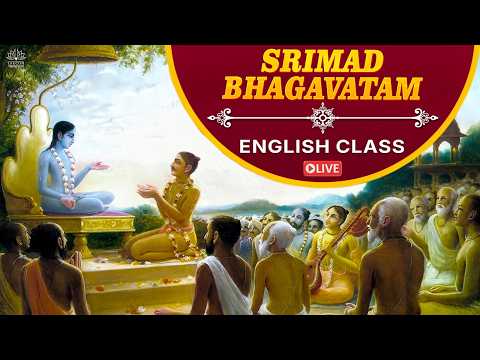
Featured video: His Grace Sarvabhauma Prabhu || SB-11.03.07 || 28-06-2026
The discourse by His Grace Sarvabhauma Prabhu on Śrīmad-Bhāgavatam 11.3.7, dated June 28, 2026, draws attention to one of the Eleventh Canto’s most serious themes: the condition of the embodied being under karma, māyā, birth, death, and cosmic time. The verse appears in Chapter Three, traditionally titled “Liberation from the Illusory Energy,” where King Nimi seeks to understand the Lord’s māyā and the way the living being may rise beyond it through spiritual knowledge and devotional discipline.
The Sanskrit verse reads: itthaṁ karma-gatīr gacchan bahv-abhadra-vahāḥ pumān ābhūta-samplavāt sarga-pralayāv aśnute ’vaśaḥ. Its central message is direct and sobering: the conditioned living being, driven by the consequences of previous actions, moves helplessly through repeated cycles of birth and death, encountering many unfavorable conditions until even the created universe reaches dissolution.
In the wider sequence of Śrīmad-Bhāgavatam 11.3, this verse is not presented as abstract fatalism. The preceding discussion explains that the embodied being acts through the organs of action under the influence of desire and then receives the results of those actions as sukha and duḥkha, happiness and distress. Verse 11.3.7 deepens that analysis by showing that karma is not merely a moral concept but a cosmic principle linking action, consequence, embodiment, memory, habit, and suffering.
The term karma-gatīḥ is especially important. It indicates destinations or conditions produced by action. In a technical sense, karma is not limited to visible social outcomes; it includes subtle impressions, tendencies, and future circumstances shaped by intentional activity. The Bhāgavata’s concern is therefore not only what a person does outwardly, but what repeated action does to consciousness. Desire becomes action, action becomes consequence, consequence becomes conditioning, and conditioning becomes further desire.
This cycle gives the verse its psychological force. A thoughtful listener may recognize the pattern even in ordinary life: habits that appear freely chosen eventually begin to feel compulsory; ambitions that promise fulfillment often produce anxiety; pleasures pursued without discernment can create dependency; and identities built on possession, status, or control remain vulnerable to time. The Bhāgavata uses cosmic language, but its diagnosis reaches deeply into everyday human experience.
The word avaśaḥ, meaning helpless or not fully in control, should be understood carefully. It does not deny moral responsibility or spiritual agency. Rather, it describes the state of one who has become bound by previous choices, habitual desires, and material identification. The tradition therefore holds two truths together: the living being is conditioned by past karma, yet human life still offers the capacity for discernment, discipline, repentance, devotion, and transformation.
This balance is vital for an accurate reading of Hindu philosophy. Karma is not a doctrine of despair, nor is it a simplistic explanation for suffering. It is a framework of moral continuity. It teaches that life is intelligible, that action matters, and that consciousness can be refined. At the same time, Śrīmad-Bhāgavatam insists that the deepest freedom is not achieved by karma alone, because action performed under egoic desire continues to generate further bondage.
The verse also introduces a vast scale of time through the phrase ābhūta-samplavāt, pointing toward dissolution at the end of cosmic manifestation. This places human anxiety in a larger metaphysical frame. Bodies, institutions, civilizations, planets, and cosmic arrangements are all subject to change. The Bhāgavata does not present this truth to create pessimism; it uses impermanence as a discipline of clarity. What is temporary should be engaged responsibly, but it should not be mistaken for the eternal self or the ultimate object of love.
Within the dharmic traditions, this teaching resonates beyond one sectarian boundary. Hindu, Buddhist, Jain, and Sikh traditions each speak in distinct vocabularies about bondage, action, attachment, discipline, and liberation. Their metaphysical conclusions are not identical, but their shared ethical seriousness is unmistakable. All encourage human beings to examine craving, ego, violence, pride, and forgetfulness, and all point toward a life shaped by restraint, compassion, remembrance, and truth.
From a Vaishnava standpoint, the solution is not merely intellectual analysis of bondage but loving reorientation toward Bhagavān. Krishna consciousness, bhakti, śravaṇam, kīrtanam, remembrance, service, and association with sādhus are presented as practices that redirect the heart from self-centered activity toward divine relationship. In this sense, liberation is not only release from suffering; it is the restoration of the soul’s natural orientation toward loving service.
The lecture theme therefore has contemporary relevance. Modern life often multiplies choices while weakening inner steadiness. Digital distraction, consumer desire, career pressure, social comparison, and emotional restlessness can create new forms of karma-like entanglement. The Bhāgavata’s analysis helps reveal that freedom is not the ability to follow every impulse. Freedom is the capacity to choose rightly, remember the sacred, and act without becoming enslaved by the fruits of action.
Śrīmad-Bhāgavatam 11.3.7 ultimately invites a serious shift in perspective. The embodied being need not remain a passive traveler through repeated birth and death. By recognizing the mechanics of karma, the instability of material existence, and the necessity of spiritual practice, human life can become a turning point. The verse is severe in diagnosis but compassionate in purpose: it awakens urgency, humility, and the longing for liberation through dharma, devotion, and disciplined consciousness.
The enduring value of this teaching lies in its capacity to transform fear into inquiry. Birth, death, suffering, and impermanence are not denied; they are studied as realities that can push consciousness toward wisdom. When heard with sincerity, the verse becomes more than a theological statement. It becomes a mirror, showing the cost of unconscious living and the possibility of a life guided by spiritual knowledge, ethical action, and devotion.
Inspired by this post on Dandavats.







Leave a Reply
You must be logged in to post a comment.