
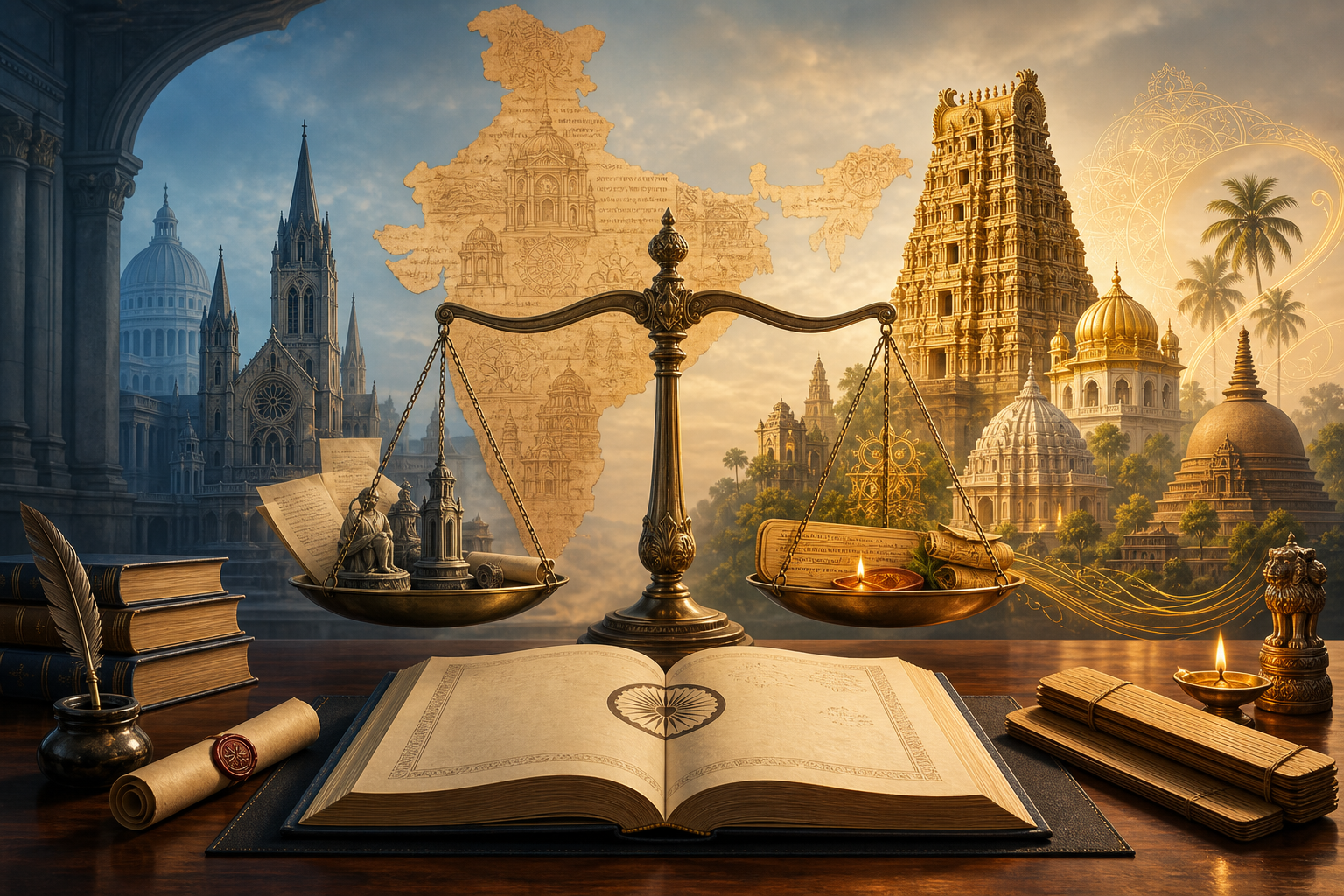
The word “secularism” is often treated in Indian public life as if its meaning were obvious, timeless, and morally self-evident. Yet a serious examination of its history suggests something more complicated. The term did not emerge from an abstract universal concern for fairness among all traditions. It arose from a particular European struggle over the authority of the Christian Church, the political state, and the management of power between them.
This distinction matters deeply for India. Bharat did not historically organize sacred life around a single church, a single clergy, a single scripture, or a single exclusive institutional claim over salvation. Hinduism, Buddhism, Jainism, Sikhism, and other dharmic traditions developed through diverse sampradayas, mathas, paramparas, darshanas, sanghas, panths, and lineages. Their relationship with society and governance cannot be understood through categories designed for medieval and early modern Europe.
The term “secular” comes from the Latin saeculum, broadly meaning an age, generation, or span of worldly time. In Christian usage, it helped distinguish temporal life from the eternal and divine realm. The division between the earthly and the sacred, between Caesar and Christ, later became central to Europe’s debates about the Church and the State. When this vocabulary is applied to India without qualification, it silently imports a civilizational assumption that did not arise from Indian history.
The political term “secularism” is commonly associated with George Jacob Holyoake, who began using it in the nineteenth century. Holyoake, remembered as one of the last men imprisoned for blasphemy in England, coined the term in a context where open atheism carried social and legal risk. His usage was a response to the authority of Christian institutions in Victorian England. It was not a concept born in the soil of Indian civilization, nor was it designed to explain the relationship between Dharma, society, and Rajadharma.
This historical background makes the insertion of the word “secular” into the Preamble of the Indian Constitution through the 42nd Amendment in 1976 especially significant. The word was not present in the original Constitution adopted in 1950. Its later insertion occurred during the Emergency, a period marked by the suspension of many democratic freedoms, detention of opposition leaders, and severe restrictions on the press. Any academic discussion of Indian secularism must therefore examine not only the meaning of the word but also the political moment in which it was constitutionally elevated.
The European Problem Behind Secularism
Secularism developed in Europe because Europe faced a specific institutional problem. During the Middle Ages, the Church and the State were distinct but interlocked powers. Both belonged to a Christian civilizational order, yet each claimed authority over people, land, wealth, and legitimacy. The Church could excommunicate rulers, and such excommunication could weaken a king’s political authority. Monarchs, in turn, struggled to control the appointment of bishops because bishops often held vast property and political influence.
Pope Gelasius I’s Duo Sunt in 494 CE articulated a distinction between priestly authority and royal power. Centuries later, Pope Boniface VIII’s Unam Sanctam in 1302 asserted a far stronger papal claim over spiritual and temporal authority. These debates were not about religion in the broad human sense. They were about competing Christian institutions and the question of who possessed ultimate authority in a Christian society.
The Protestant Reformation further fragmented Western Christendom. The Peace of Augsburg in 1555 and later developments after the Thirty Years’ War attempted to manage conflicts among Christian denominations and rulers. What later came to be called secular governance was therefore not originally a neutral arrangement among all religions. It was a political settlement within a Christian historical field.
France developed an especially radical model. The French Revolution attacked the power of the Catholic Church, seized Church property, abolished many religious institutions, and experimented with substitute civic cults. The 1905 French law on the separation of Churches and State declared that the Republic would not recognize, pay, or subsidize any religion. French laïcité was shaped by a long struggle against Catholic institutional dominance; it was not a civilizationally neutral formula for every society.
The American model emerged differently. The First Amendment prohibited Congress from establishing a state religion, but many American founders still considered religion and public morality important to republican life. Thomas Jefferson’s famous language about a “wall of separation” came in a letter to the Danbury Baptists, who sought assurance against domination by established churches. American secularism therefore reflected the concerns of Protestant pluralism, not an indifference to sacred life as such.
Thus, three major Western models grew from three Western problems: Protestant denominational conflict, French resistance to Catholic authority, and American concern about established churches. None of these histories maps cleanly onto the Indian experience. India did not have a Roman Pope, an Indian Investiture Controversy, a nationwide Church hierarchy, or a French-style revolution against a Catholic establishment.
Why Dharma Is Not “Religion” in the European Sense
The Sanskrit word Dharma is often translated as “religion,” but this translation is inadequate and frequently misleading. Dharma comes from the root dhr, meaning “to hold” or “to sustain.” It refers to the sustaining order of the cosmos, society, ethics, duty, personal conduct, and spiritual pursuit. It is not merely belief in God, membership in a church, adherence to a creed, or obedience to a single ecclesiastical authority.
Indian civilization historically accommodated multiple paths of inquiry. Samkhya-Yoga, Vedanta, Mimamsa, Shaiva, Vaishnava, Shakta, Buddhist, Jain, Sikh, and other traditions often disagreed intensely on metaphysics, ritual, authority, and liberation. Yet their disagreements did not require a Church-versus-State settlement because there was no single church claiming exclusive institutional control over salvation for the whole civilization.
This does not mean that premodern India was free of conflict. Sectarian tensions, royal patronage disputes, philosophical arguments, and social contestations certainly existed. However, those disputes were not structurally identical to Europe’s conflicts between papacy, monarchy, and rival churches. A Shaiva ruler could support Buddhist institutions; Jain merchants could patronize temples; Hindu rulers could grant protection to communities such as Zoroastrians. These examples show a civilizational pattern in which sacred plurality was often managed through patronage, custom, locality, and Dharma rather than through European secular separation.
For many Indians, this distinction is not merely theoretical. It is visible in daily life: a family may visit a Devi temple, revere a Sikh Guru, read the Bhagavad Gita, honor Jain principles of ahimsa, and respect Buddhist teachings without feeling that these commitments must cancel one another. Dharmic traditions have often lived through overlapping reverence rather than mutually exclusive institutional allegiance.
The Indian model therefore cannot be reduced to Western “tolerance,” where one dominant group permits another to exist. A more accurate description is plural sacred participation, in which multiple paths are acknowledged as legitimate modes of seeking truth, discipline, liberation, and ethical refinement. This shared civilizational sensibility is central to Hinduism, Buddhism, Jainism, and Sikhism, even where their doctrines differ.
Rajadharma and the Indian Idea of Governance
Kautilya’s Arthashastra and wider Indian political thought offer a different way to understand the relationship between governance and sacred life. The ruler was not expected to become a sectarian priest, nor was society expected to privatize Dharma into a purely individual belief. Governance was tied to order, welfare, justice, protection of institutions, and the preservation of conditions in which diverse communities could pursue their duties and disciplines.
Rajadharma, in this sense, does not mean theocracy. It means the ethical and civilizational duties of governance. The ruler must protect social order, safeguard religious and cultural institutions, support learning, preserve public welfare, and prevent oppression. Such a model can protect Hindu, Buddhist, Jain, Sikh, and other communities without forcing them into a European religious template.
The absence of an Indian Pope is not a deficiency. It is a sign that Indian sacred life developed through decentralized authority, lineage, locality, debate, practice, and community. Mathas, temples, gurudwaras, sanghas, deras, peethas, and local traditions did not function as replicas of the Catholic Church or Protestant denominations. To treat them as such is to misunderstand their inner logic.
Colonial Categories and Temple Control
British colonial rule deepened the problem by interpreting Indian traditions through Protestant categories. Colonial administrators and missionaries often assumed that every civilization must have a “religion” defined by scripture, clergy, doctrine, and church-like institutions. When India did not fit this template, they reorganized Indian life conceptually so that it would appear legible to them.
Brahmins were described as “priests” in a Protestant or Catholic sense, though their roles varied widely by region, ritual function, learning, and lineage. The Vedas were labeled as Hindu “scripture,” even though Hindu textual authority is distributed across Vedas, Upanishads, Itihasas, Puranas, Agamas, Dharmashastras, philosophical commentaries, local traditions, and oral practice. Temples were treated as if they were “churches,” despite being cultural, ritual, educational, artistic, economic, and community institutions.
Madras Regulation VII of 1817 placed many Hindu temples under colonial supervision on the stated ground of preventing mismanagement. This followed the logic of Protestant suspicion toward priestly institutions and ecclesiastical property. Over time, temple administration became an area where the colonial state inserted itself into Hindu sacred life in ways that did not apply equally across all communities.
The difficulty is that independent India retained much of this apparatus and rebranded it as secular governance. Instead of decolonizing the relationship between state and sacred institutions, the postcolonial state often continued to administer Hindu temples through bureaucratic law. This produced one of the most contested features of Indian secularism: differential treatment of religious institutions.
The Constitutional Question
The original Constitution of India did not include the word “secular” in the Preamble. This omission was not accidental. The Constituent Assembly discussed related questions, and proposals to insert terms such as “secular,” “federal,” and “socialistic” were not accepted in that form. Jawaharlal Nehru argued that the constitutional structure already reflected the relevant principles and did not require additional labels.
The 42nd Amendment of 1976 inserted “secular” into the Preamble during the Emergency. Because this was a period of suspended democratic freedoms, the amendment carries a historical burden that cannot be ignored. Even those who defend the constitutional use of the term must acknowledge that its insertion did not occur in an ordinary democratic atmosphere of open public deliberation.
The deeper question is not whether the Indian state should protect all communities equally. It must. The real question is whether the imported word “secularism” has helped India achieve equal civilizational respect, or whether it has produced inconsistent rules that disadvantage Hindu institutions while claiming neutrality.
Three Models for Three Communities
India’s contemporary model often appears to apply different principles to different communities. Hindu temples in several states, including Tamil Nadu, are subject to extensive government control through Hindu Religious and Charitable Endowments frameworks. In Tamil Nadu alone, tens of thousands of temples fall under state administration. Officials may influence finances, appointments, property, and institutional priorities.
By contrast, Muslim religious endowments are administered through Waqf institutions that provide a significant degree of community management over properties and internal affairs. Christian institutions, especially educational institutions, enjoy protections under Articles 29 and 30 of the Constitution, allowing minorities to establish and administer educational institutions while also participating in wider public funding structures. Sikh religious institutions, under the Sikh Gurdwaras Act of 1925, provide another model in which community-based elected bodies manage religious sites.
The concern, therefore, is not equal protection for minorities. Equal protection is essential. The concern is unequal control. If one community’s sacred institutions are administered by the state while others retain community autonomy, the resulting arrangement cannot easily be described as neutral. It becomes difficult to defend such asymmetry in the name of secularism.
This asymmetry has practical consequences. Temples are not merely ritual buildings. They sustain music, dance, sculpture, architecture, festivals, food distribution, scholarship, local economies, hereditary knowledge systems, and community memory. When temple revenues and administration are detached from the communities that sustain these traditions, the cultural ecosystem around Bharatanatyam, Agamic ritual, Vishwakarma crafts, Sanskrit learning, devotional music, and local seva can weaken.
The Brihadeeswara Temple in Thanjavur is a powerful example. Built in the eleventh century under Rajaraja Chola, it represents not only architecture but also the integration of sacred practice, royal patronage, inscriptional record, artistic excellence, and community continuity. A state that claims to protect cultural heritage must recognize that such institutions cannot be managed as ordinary administrative assets.
Secularism Without Civilizational Amnesia
A fair critique of Indian secularism should not become a demand for theocracy. It does not require priests to run the state, nor does it require non-Hindus to possess fewer rights. The stronger argument is that India requires a framework rooted in its own civilizational experience: one that protects every community, honors dharmic plurality, and removes discriminatory state control from sacred institutions.
France can remain culturally shaped by Catholic history while politically committed to laïcité. England can retain the Church of England while protecting minority religions. Many Islamic countries maintain Islamic legal and cultural foundations while allowing varying degrees of minority presence. In that global context, it is unreasonable to demand that Bharat alone erase its civilizational identity to prove fairness.
The dharmic alternative is not domination. It is responsible custodianship. Rajadharma requires the state to protect the freedom, dignity, and institutional autonomy of all religious and spiritual communities. It should defend temples, gurudwaras, monasteries, mathas, Jain institutions, Buddhist centers, churches, mosques, and other sacred spaces from coercion, corruption, violence, and unjust interference. It should not selectively administer one community’s sacred institutions while granting autonomy to others.
Swaraj was achieved in 1947, but intellectual Swatantra requires a deeper decolonization of categories. India must ask whether its constitutional vocabulary adequately reflects its civilizational reality. A society shaped by Dharma, plural paths, layered identities, and community-based sacred institutions deserves concepts that arise from its own experience rather than from Europe’s struggle between Church and State.
The future of Indian secularism should therefore be debated honestly. The question is not whether India should protect religious freedom; it must. The question is whether the present model protects freedom equally. A mature republic should be able to discuss temple autonomy, minority rights, Rajadharma, Articles 25 to 30, Waqf administration, gurudwara governance, and cultural heritage without reducing every disagreement to communal labeling.
A more balanced Indian framework would begin with three principles. First, all communities must enjoy equal civil and religious freedom. Second, the state must not selectively control Hindu institutions while describing that control as neutrality. Third, India’s dharmic inheritance should be recognized as a civilizational resource for pluralism, not dismissed as a threat to democracy.
The older Bharatiya vision did not require the subordination of one path to another. It allowed debate without demanding uniformity, reverence without centralization, and sacred plurality without civilizational self-denial. That inheritance remains essential for Hinduism, Buddhism, Jainism, Sikhism, and all communities that seek a just and harmonious Bharat.
Selected References
George Jacob Holyoake and nineteenth-century secularism; Pope Gelasius I’s Duo Sunt; Pope Boniface VIII’s Unam Sanctam; the Peace of Augsburg; French laïcité and the 1905 law; the First Amendment and Jefferson’s Danbury letter; Kautilya’s Arthashastra; scholarship on Dharma, Rajadharma, and Indian constitutional debates; records concerning the 42nd Constitutional Amendment; studies of temple administration, the Madras Regulation VII of 1817, the Sikh Gurdwaras Act of 1925, Waqf governance, and Articles 29 and 30 of the Indian Constitution.
Inspired by this post on Pragyata.



Leave a Reply
You must be logged in to post a comment.