
The teaching on aspiring to be born on the Glorious Copper-Colored Mountain presents a rigorous and deeply practical account of Buddhist spiritual preparation. It does not treat rebirth as an abstract doctrine to be admired from a distance. Instead, it frames rebirth, karma, intention, mantra, guru devotion, and daily practice as living disciplines that shape the direction of consciousness. In this view, the human life now being lived is not an isolated event, but one phase in a larger continuum of mind, responsibility, and spiritual possibility.
Dzigar Kongtrul Rinpoche’s central instruction is direct: spiritual practitioners should not drift passively toward death, nor should they leave the future entirely to the force of unexamined karma. The familiar image of being a feather in the wind may sound poetic, but in Dharma practice it signals a lack of clarity. Karma is powerful, yet intention is also powerful. A practitioner who renews a strong aspiration again and again is not denying karma, but learning how to work intelligently with causes and conditions.
The Glorious Copper-Colored Mountain, also known in Tibetan Buddhist tradition as the pure realm of Guru Rinpoche, occupies a special place in the Nyingma lineage. Guru Rinpoche, Padmasambhava, is revered as the great master who established Vajrayana Buddhism in Tibet and transmitted practices intended to benefit future generations. For Nyingma practitioners, aspiration toward this buddhafield is not merely devotional imagination. It is a way of aligning one’s mind with lineage, guru yoga, mantra, sadhana, and the possibility of completing the Vajrayana path under exceptionally favorable conditions.
The teaching also carries importance beyond one Buddhist school. It acknowledges that other pure realms and buddhafields have their own significance, and it does not dismiss the aspirations of other lineages or Dharmic traditions. This is essential for a broader Dharmic understanding. Hinduism, Buddhism, Jainism, and Sikhism all preserve, in different forms, the seriousness of human action, ethical consequence, discipline, remembrance, and liberation. While their metaphysical frameworks are not identical, they share a reverence for spiritual effort and a refusal to reduce human life to mere consumption, distraction, and biological survival.
At the heart of the teaching is the question of preparation. Many people prepare carefully for education, career, health, family, retirement, and social standing, yet hesitate to prepare for death. This hesitation is not only religious; it is psychological. Death interrupts the ordinary story of control. Modern life often encourages the assumption that planning ends with the body, but Buddhist practice challenges that assumption by asking whether consciousness, habit, and karmic momentum continue beyond physical dissolution. Even for readers who approach the subject cautiously, the teaching invites a sober question: if the mind is shaped by repeated tendencies, why should the final direction of those tendencies be ignored?
Rinpoche’s discussion of mind and brain is significant in this context. The brain functions as a physical organ through which mental activity appears, but Buddhist thought does not reduce mind entirely to neurological matter. Meditation research has often been used to show that disciplined mental training can reshape patterns of attention, emotion, and neural activity. From a Buddhist perspective, this supports a practical point: the mind is not fixed. It can be trained, refined, stabilized, and redirected. The course of a life can change because habits of mind can change.
This is why the statement, “We can change the entire course of our life,” has such force. It is not a slogan of self-improvement. It is a Dharma claim about causality. Every day offers an opportunity to alter the direction of one’s continuum through conduct, meditation, mantra recitation, ethical restraint, devotion, and aspiration. In ordinary life, this is easy to understand. A child becomes literate through repeated exposure to letters. A musician develops skill through practice. A person becomes more patient by repeatedly interrupting anger. In the same way, a practitioner becomes oriented toward liberation by repeatedly cultivating liberating causes.
Karma, in this teaching, is not fatalism. It is the lawful movement of cause and effect as it operates through body, speech, and mind. Negative actions and confused intentions leave imprints. Positive actions and awakened intentions also leave imprints. The practitioner is therefore not helpless. To hold a clear aspiration for a better rebirth, whether in a pure realm or under favorable conditions within samsara, is to plant a deliberate cause. This is especially important because death may come before complete realization has been attained in this lifetime.
The practical question then becomes: where should the path continue? For a Vajrayana practitioner in the Nyingma lineage, the answer given here is the Glorious Copper-Colored Mountain. There, according to the devotional and tantric vision of the tradition, the practitioner encounters Guru Rinpoche, vajra masters, realized assemblies, and the supportive conditions needed to continue practice. The significance is not escapism. The aspiration is meaningful because it is tied to practice already being undertaken in this life. The destination corresponds to the discipline.
This point is technically important. Pure realm aspiration is not presented as a substitute for present effort. It supplements practice; it does not replace it. The practitioner still needs meditation, mantra, visualization, ethical discipline, guru devotion, humility, and consistency. To aspire for the Copper-Colored Mountain while neglecting daily Dharma practice would create a contradiction between intention and behavior. Rinpoche’s instruction is therefore both devotional and demanding: the aspiration must be lived, not merely recited.
The Vajra Guru mantra stands at the center of this lived aspiration: OM AH HUNG BENZAR GURU PEMA SIDDHI HUNG. The teaching describes this mantra as a wish-fulfilling jewel for those who establish a genuine connection with it. In Vajrayana understanding, mantra is not simply sound, poetry, or symbolic language. A deity mantra is treated as an enlightened manifestation, a living mode of connection with awakened presence. To meet the mantra in faith, concentration, and continuity is, in a real spiritual sense, to meet the blessing of Guru Rinpoche.
The reference to 100 million recitations should be understood with care. It is not a mechanical claim that numbers alone produce realization. Rather, the large number expresses seriousness, repetition, stability, and lifelong commitment. Even those who cannot complete such an accumulation are encouraged to recite consistently and sincerely. The central discipline is to bind mantra to aspiration, so that sound, intention, memory, and devotion gradually reshape the practitioner’s inner world.
The E MA HO supplication carries the same principle. It is not meant to be read absentmindedly. A supplication becomes transformative only when the mind enters its meaning. To recite E MA HO while actually contemplating one’s next life, one’s dependence on Guru Rinpoche, and one’s longing for favorable conditions on the path is to convert ordinary speech into Dharma practice. The words become a mirror in which the practitioner sees both vulnerability and possibility.

One of the most relatable aspects of the teaching is its critique of vague spirituality. Many people say they wish to be awakened, peaceful, liberated, or guided, but their daily habits do not support those aims. The contradiction is familiar in every domain of life. Health is valued, yet discipline is postponed. Wisdom is admired, yet distraction is indulged. Devotion is praised, yet practice is irregular. Rinpoche’s instruction cuts through this gap by asking practitioners to make their aspirations concrete enough to influence conduct.
The teaching also emphasizes tendrel, the interdependent arrangement of causes, conditions, relationships, and opportunities. Tendrel can be understood as the meaningful web through which spiritual life unfolds. A practitioner does not arrive at Dharma by accident in a shallow sense. The presence of a teacher, a lineage, a mantra, a sangha, a human body, and a sincere longing for liberation is already a profound configuration of conditions. Recognizing this tendrel produces gratitude and responsibility. It also prevents the carelessness that treats sacred opportunities as ordinary conveniences.
This insight harmonizes with the broader Dharmic understanding that life is sustained by relationships. In Hindu traditions, the guru-shishya relationship, mantra japa, bhakti, and sadhana similarly emphasize disciplined connection. Jain traditions stress careful conduct, karmic purification, and vigilance toward the consequences of action. Sikh tradition preserves remembrance, seva, humility, and surrender to the Divine Will. Buddhism’s language and metaphysics are distinct, yet the shared civilizational lesson is clear: human beings are transformed through disciplined remembrance, ethical responsibility, and association with the wise.
Humility is therefore indispensable. The Vajrayana path is not presented as an individualistic project of spiritual conquest. Even great practitioners require support: teacher, sangha, empowerments, instructions, ritual forms, and the accumulated blessings of lineage. The refusal to rely on support may appear strong, but it can conceal self-importance. A child learning a skill needs guidance. A student needs instruction. A practitioner needs the living structure of Dharma. Spiritual maturity is shown not by isolation, but by the capacity to receive help without egoic resistance.
The emotional power of the Copper-Colored Mountain aspiration lies in its treatment of death. Instead of approaching death as annihilation, panic, or unresolved uncertainty, the practitioner trains to meet it with direction. The end of this life becomes a transition in which attachment can be released and the path can continue. This does not diminish the value of the present life. On the contrary, it makes the present life more precious because every day becomes part of preparation.
Such preparation does not require rejection of ordinary responsibilities. A practitioner can care for family, work honestly, contribute to society, and participate in community while maintaining remembrance of impermanence. In fact, awareness of death can make ordinary responsibilities more tender and ethical. It can reduce resentment, soften arrogance, and clarify priorities. When life is seen as temporary, the need to use speech carefully, act compassionately, and practice sincerely becomes more urgent.
For contemporary readers, this teaching also challenges a common imbalance: intense planning for worldly success combined with minimal planning for spiritual continuity. Education may occupy decades. Financial planning may occupy a lifetime. Reputation may consume enormous emotional energy. Yet the mind that experiences all these things is often left untrained. Rinpoche’s instruction reverses the emphasis. It asks that the deepest continuity, the stream of consciousness shaped by karma and aspiration, receive disciplined attention.
The aspiration to be born on the Glorious Copper-Colored Mountain is therefore both a devotional practice and a philosophical discipline. It trains the mind to think beyond one lifetime, to trust the efficacy of mantra, to rely on Guru Rinpoche, to value the Nyingma Vajrayana lineage, and to use present circumstances wisely. It also affirms a universal spiritual principle: the future is shaped by the intentions cultivated now.
From an academic perspective, the teaching integrates several major Buddhist themes: impermanence, rebirth, karma, dependent origination, guru devotion, mantra theory, pure realm aspiration, and the continuity of practice across lives. From a lived perspective, it offers a tender but demanding instruction: do not wait until death to decide what matters. The mind should be trained now. The aspiration should be renewed now. The mantra should be recited now. The relationship with Guru Rinpoche should be made vivid now.
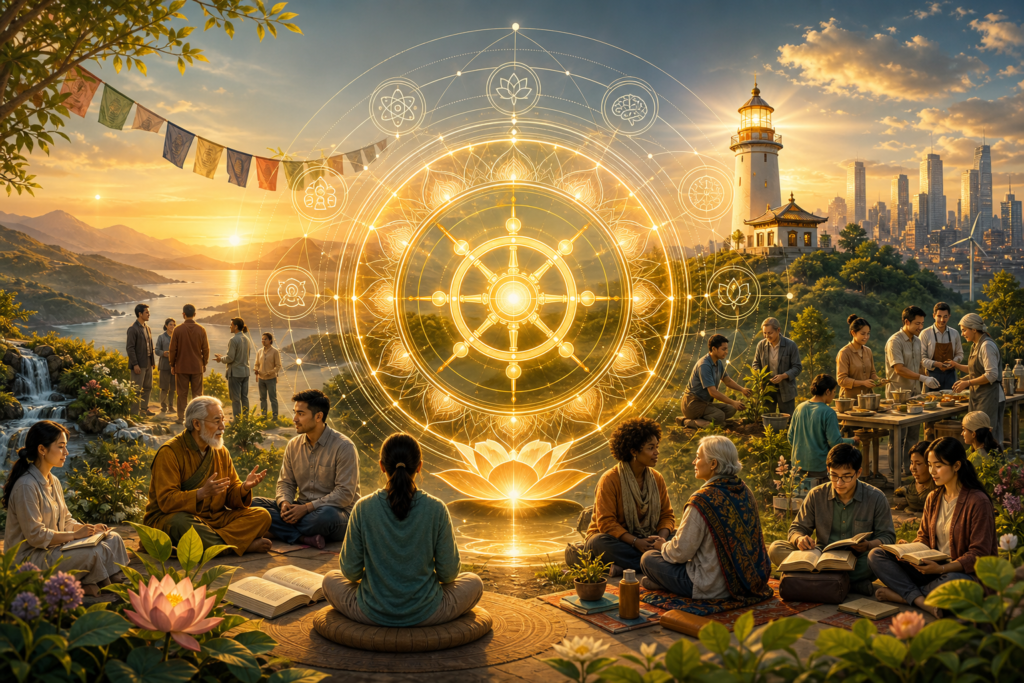
When understood in this way, the Glorious Copper-Colored Mountain is not merely a distant sacred realm. It is also a present orientation of the heart and mind. Each act of sincere practice turns the practitioner toward it. Each recitation of OM AH HUNG BENZAR GURU PEMA SIDDHI HUNG strengthens the connection. Each recollection of Guru Rinpoche interrupts passivity. Each moment of humility protects the path from self-importance. Each clear aspiration makes death less vague and life more purposeful.
The teaching finally leaves a practical conclusion. A human life connected with Dharma, mantra, lineage, and spiritual friendship is rare. To recognize that rarity is to stop wasting it. To aspire for rebirth on the Glorious Copper-Colored Mountain is to make a disciplined promise that practice will not end with changing circumstances, bodily decline, or death. It is an aspiration to continue the path until awakening is complete, supported by Guru Rinpoche, guided by realized masters, and grounded in the living force of Dharma.
Inspired by this post on Mangala Shribhuti.




Leave a Reply
You must be logged in to post a comment.