
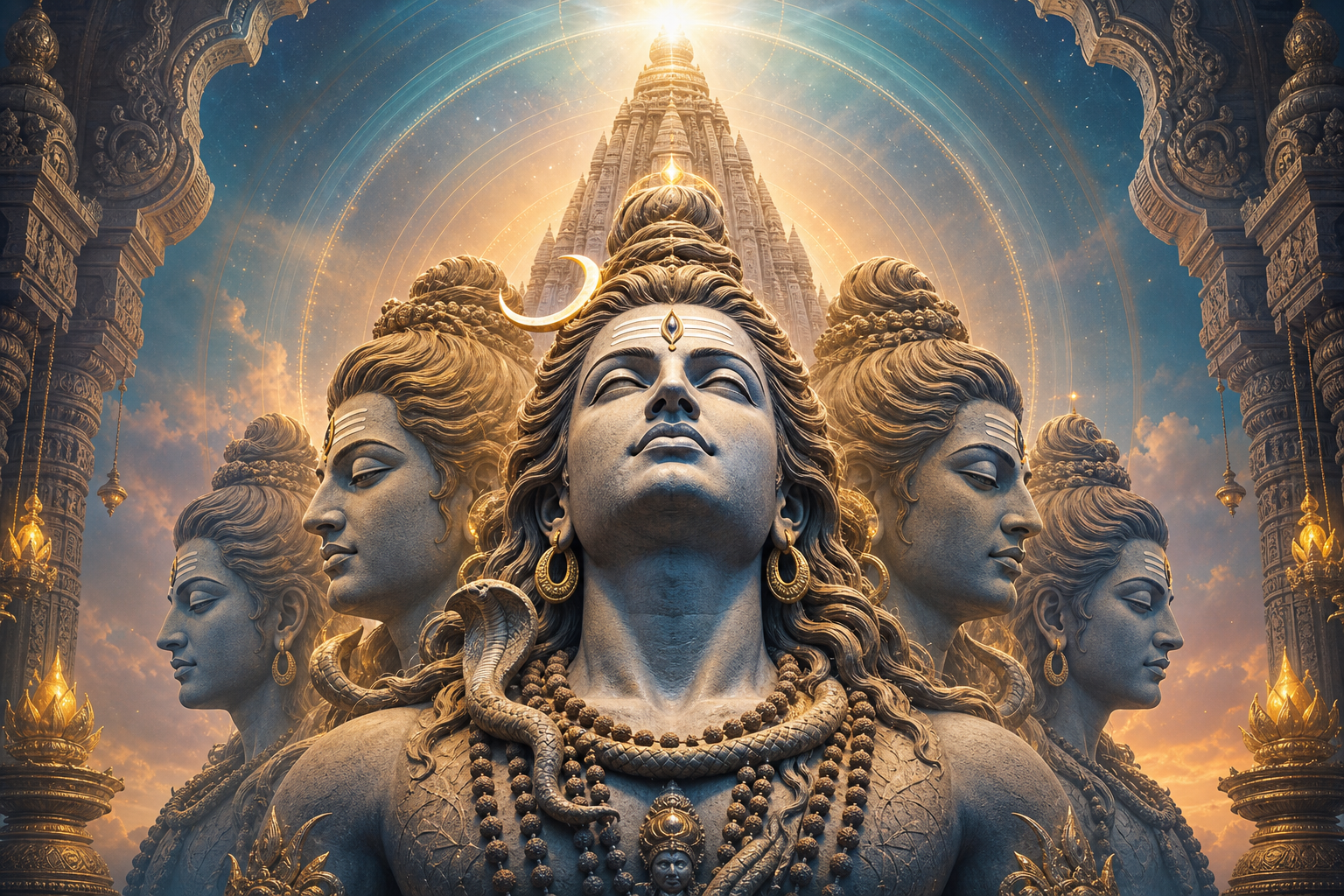
Ishana Shiva in murti form represents one of the most subtle and philosophically dense expressions of Lord Shiva in Hindu iconography. Within Shaiva traditions, Shiva is not approached merely as a deity among other deities, but as Supreme Consciousness itself, the source from which creation emerges, the presence by which it is sustained, the power by which it dissolves, the mystery by which it is veiled, and the grace by which it is liberated. This fivefold activity is known as panchakritya, and its visual theology is most clearly expressed through the doctrine of Panchabrahma, the five sacred aspects or faces of Shiva.
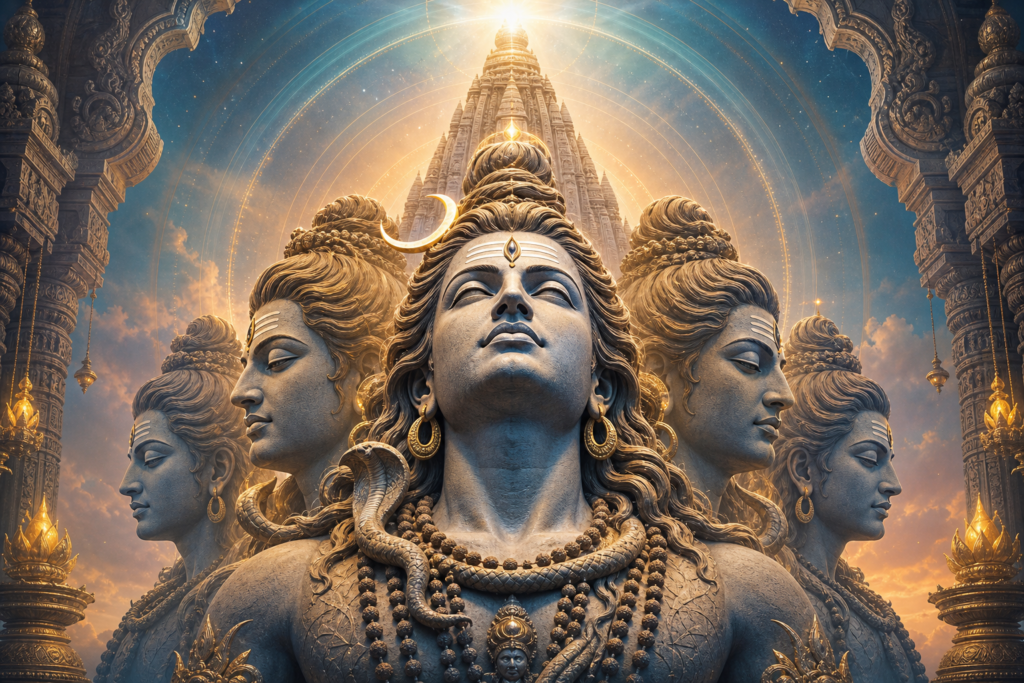
Among these five aspects, Ishana occupies a special position. While the other faces are generally associated with the cardinal directions, Ishana is associated with the upward direction, the zenith, the space above ordinary perception, and the realm of spiritual ascent. This upward orientation is not simply a sculptural detail. It is a theological statement. It reminds the devotee that the highest form of Shiva is not limited by physical direction, ritual form, or conceptual boundary. Ishana points toward transcendence, liberation, and the silent radiance of divine knowledge.
The word Ishana is connected with lordship, sovereignty, mastery, and divine rulership. In the Shaiva imagination, Ishana is the form of Shiva who presides over wisdom, sacred sound, spiritual intuition, and the movement from the visible to the invisible. In temple worship and sacred art, this aspect is often understood as the most refined and upward-facing dimension of Shiva, symbolizing the state in which consciousness rises beyond the limitations of the gross world and turns toward moksha.
The iconography of Ishana Shiva cannot be properly understood without first recognizing the Panchabrahma framework. The five aspects are usually identified as Sadyojata, Vamadeva, Aghora, Tatpurusha, and Ishana. Each aspect is associated with a direction, a cosmic function, a mantraic dimension, and a philosophical meaning. Sadyojata is commonly linked with creation, Vamadeva with preservation and beauty, Aghora with dissolution and transformation, Tatpurusha with concealment and inner discipline, and Ishana with revelation, grace, and liberation.
In this structure, Ishana is not an isolated figure but the crown of the entire symbolic system. It is the upward-facing principle that gathers the other four directions into a higher unity. The murti therefore becomes a sacred map of consciousness. It teaches that the universe is not a random collection of forces, but an ordered field of divine activity. The devotee who stands before such an image is invited to contemplate not only the visible form of Shiva, but the invisible wisdom that the form reveals.
In many representations of Panchamukha Shiva or five-faced Shiva, Ishana is placed above or understood as the upper face. This vertical placement conveys superiority in a philosophical rather than hierarchical sense. Ishana is the aspect that transcends the horizontal plane of worldly experience. The four directions symbolize the spread of existence across space, while the upward direction symbolizes the ascent of awareness beyond space. In this way, Ishana becomes the iconographic language of spiritual awakening.
The upward gaze associated with Ishana Shiva carries immense symbolic force. A human gaze usually turns outward toward objects, relationships, duties, fears, and desires. The upward gaze, however, suggests an interior reorientation. It is not a rejection of the world, but a reminder that worldly life must be illumined by higher awareness. For many devotees, the sight of an upward-facing Shiva image creates a quiet emotional impression: life may be full of obligations and uncertainty, yet the mind can still turn toward a higher center.
This is one reason the iconography of Ishana has enduring relevance. It speaks to those who seek balance between ritual, knowledge, devotion, and contemplation. The murti does not demand that the devotee abandon the world. Instead, it presents an image of divine presence that rises through the world and beyond it. Such a vision is especially meaningful within Sanatana Dharma, where the sacred is not confined to one mode of worship, one philosophical school, or one path of spiritual practice.
In Shaiva Siddhanta, Kashmir Shaivism, Puranic Shaivism, and temple-based devotional traditions, Shiva is often understood through multiple layers of meaning. He is both personal and impersonal, both form and formlessness, both the ascetic seated in meditation and the cosmic principle beyond all thought. Ishana Shiva belongs to this layered theological vision. As murti, Ishana gives form to the formless. As symbol, Ishana points beyond the form itself.
The iconographic details of Ishana Shiva often include elements associated with purity, knowledge, and subtle power. The matted hair of Shiva suggests tapas, restraint, yogic discipline, and mastery over the currents of life. The crescent moon represents time held under divine control. The third eye symbolizes spiritual perception beyond ordinary sight. The sacred ash, or vibhuti, points to impermanence and the purification of ego. When these familiar elements are read through the Ishana aspect, they become signs of liberation through knowledge and grace.
The association of Ishana with sacred sound is also important. In many Shaiva traditions, the universe is understood as arising through vibration, mantra, and consciousness. The Panchabrahma mantras connect each face of Shiva with a distinct sacred expression. Ishana, as the upward and revealing aspect, is linked with the highest knowledge that arises when sound becomes silence and mantra becomes realization. This gives the murti a contemplative depth. It is not only an object of visual devotion but a silent teaching on the movement from speech to wisdom.
From the perspective of temple architecture, the upward symbolism of Ishana also resonates with the vertical design of the Hindu temple. The garbhagriha, or sanctum, anchors divine presence in a concentrated space, while the shikhara or vimana rises upward as a symbolic mountain. The devotee moves from the outer world into the sanctum, and the temple structure itself lifts the mind toward the cosmic axis. Ishana Shiva belongs naturally to this vertical imagination, where ascent is not merely architectural but spiritual.
In murti worship, physical form is never treated as mere decoration. Hindu iconography functions as a disciplined visual language. Proportions, gestures, ornaments, directions, weapons, postures, and facial expressions all carry theological meaning. The Ishana form of Shiva should therefore be read with care. Its upwardness signifies the highest dimension of divine consciousness. Its serenity points to the stillness beyond agitation. Its connection with Panchabrahma reveals the unity behind creation, preservation, dissolution, concealment, and grace.
The fivefold activity of Shiva is central to this interpretation. Creation is not separate from preservation; preservation is not separate from dissolution; dissolution is not separate from concealment; concealment is not separate from grace. These are not competing divine actions but interdependent movements of one Supreme Consciousness. Ishana represents the liberating clarity through which the devotee begins to perceive this unity. In this sense, Ishana Shiva is both an image of divine sovereignty and an invitation to philosophical maturity.
The emotional power of the image lies in its ability to hold paradox. Shiva is terrifying and compassionate, withdrawn and intimate, beyond form and present in form. Ishana adds another dimension to this paradox by revealing Shiva as the upward pull of grace. In ordinary life, people experience fragmentation: the body moves in one direction, the mind in another, and desire in yet another. The upward gaze of Ishana gathers these scattered movements into a single aspiration toward clarity, self-discipline, and inner freedom.
This symbolism also harmonizes with broader Dharmic traditions. Hinduism, Buddhism, Jainism, and Sikhism each preserve distinct theological and philosophical identities, yet all emphasize disciplined awareness, ethical life, inner transformation, and liberation from ignorance. Ishana Shiva, when understood as the upward movement of consciousness, can be appreciated within this larger Dharmic concern for awakening. Such interpretation strengthens unity without erasing difference, allowing each tradition to retain its integrity while participating in a shared civilizational vocabulary of spiritual ascent.
The image of Ishana Shiva also challenges a purely material reading of idol worship. A murti is not merely stone, metal, wood, or paint. In Hindu religious practice, the murti becomes a consecrated focus through which divine presence is invoked, honored, and contemplated. Pran Pratishtha, ritual worship, mantra, and devotion transform the relationship between image and worshipper. The form becomes a doorway into meaning. Ishana, as the upward-facing aspect, makes this doorway especially clear because the form itself points beyond itself.
In philosophical terms, Ishana may be understood as the bridge between saguna and nirguna, the divine with attributes and the divine beyond attributes. The murti provides form, name, direction, and symbol. The upward gaze dissolves the mind’s attachment to the form as a final limit. The devotee begins with visible beauty and is gradually led toward invisible truth. This pedagogical structure is one of the great strengths of Hindu iconography: it teaches through devotion, aesthetics, memory, ritual, and contemplative insight at the same time.
The connection between Ishana and knowledge should not be reduced to intellectual learning alone. In the Dharmic context, knowledge is transformative. It is not merely the collection of information, but the removal of avidya, or ignorance. Ishana Shiva symbolizes the knowledge that liberates because it reveals the nature of the self, the cosmos, and the divine. This is why the form is associated with grace. Human effort matters, but liberation is completed through an illumination that exceeds ordinary effort.
The upward direction is also linked with subtle body symbolism in yogic traditions. Spiritual ascent is often described through the rising of awareness from the gross to the subtle, from instinct to discernment, from mental restlessness to meditative stillness. While iconography and yoga should not be carelessly collapsed into one another, their symbolic languages often illuminate each other. Ishana Shiva stands at this meeting point of image, mantra, metaphysics, and yogic aspiration.
The serenity of Ishana is equally significant. Unlike forms of Shiva that emphasize fierce transformation, such as Aghora or Bhairava, Ishana emphasizes clarity, sovereignty, and grace. This does not mean that Ishana is weak or passive. Rather, the power of Ishana is subtle. It is the authority of stillness, the mastery of knowledge, and the compassion that releases beings from bondage. In this form, divine power appears as luminous calm rather than dramatic force.
For temple visitors, scholars, artists, and devotees, Ishana Shiva offers a way to understand how Hindu art works at multiple levels. The same image may be approached through devotion, ritual practice, philosophical inquiry, aesthetic appreciation, or historical study. None of these approaches need cancel the others. A devotee may bow before the murti; an art historian may study its form; a philosopher may analyze its symbolism; a practitioner may meditate upon its meaning. The fullness of the image lies precisely in its ability to sustain all these modes of engagement.
Historically, the development of Shaiva iconography reflects the depth of Indian sacred imagination. From the aniconic Shiva linga to anthropomorphic forms such as Nataraja, Dakshinamurthy, Somaskanda, Bhairava, and Panchamukha Shiva, the tradition presents Shiva through many visual languages. Ishana belongs to this larger iconographic universe. Its purpose is not to multiply forms arbitrarily, but to help the devotee understand that the divine can be encountered through many aspects while remaining one in essence.
This plurality is central to Hindu culture and Dharmic civilization. Different forms of Shiva address different human needs: courage, wisdom, healing, discipline, protection, detachment, household harmony, yogic insight, and liberation. Ishana addresses the need for transcendence and right knowledge. In a world often dominated by noise, speed, and distraction, this aspect of Shiva remains deeply relevant. It reminds the mind to look upward, not in escapism, but in remembrance of its highest possibility.
The murti form of Ishana also carries implications for ethical life. If Shiva as Ishana represents liberating knowledge, then devotion to this form cannot remain only external. It must influence conduct. The upward gaze becomes meaningful when it is accompanied by truthfulness, restraint, compassion, humility, and reverence for life. In this way, iconography becomes ethics. The sacred image trains the eye, and the trained eye gradually disciplines the heart.
Ishana Shiva is therefore not merely a specialized topic in Hindu iconography. It is a profound theological symbol that gathers together Shaiva philosophy, temple tradition, mantra, yogic aspiration, and the emotional life of devotion. It teaches that divine grace is not only protective or forgiving, but also elevating. It raises consciousness from fragmentation to unity, from confusion to insight, and from limited identity to spiritual freedom.
To contemplate Ishana Shiva is to contemplate the upward movement of the soul. The murti stands as a visual reminder that the highest truth is not distant from life, but hidden within it, waiting to be recognized through disciplined worship, knowledge, humility, and grace. In the Panchabrahma vision, Ishana is the luminous summit of Shiva’s fivefold presence. It is the face of revelation, the direction of liberation, and the silent assurance that consciousness can rise beyond fear into the vastness of the divine.
Inspired by this post on Hindu Blog.






Leave a Reply
You must be logged in to post a comment.