
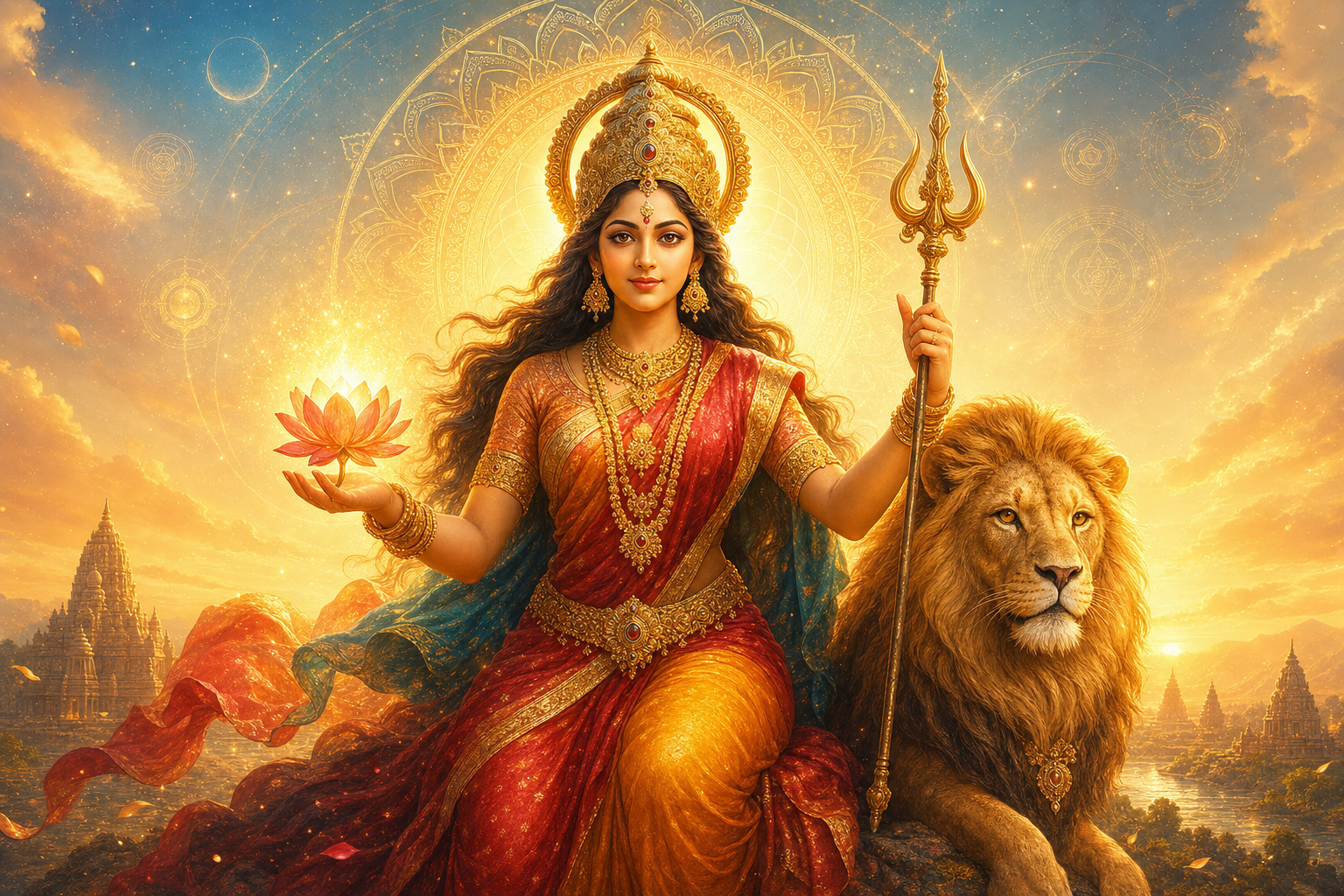
There is a moment in every morning when gentleness changes its texture. The first light appears soft, almost maternal, and then the same sun rises into a heat that demands attention. This simple movement of nature offers a useful way to understand Shakti, the Divine Feminine in Hindu thought. She is not diminished when she is tender, and she is not contradicted when she becomes terrible. Her motherhood is not sentimental softness alone; it is the complete power that nourishes, protects, disciplines, transforms, and, when necessary, destroys what threatens life and dharma.
Modern devotional language often describes the Goddess as “Mother,” and this is both beautiful and deeply rooted in Hindu spirituality. Yet the word “mother” can become misleading when it is reduced to comfort alone. In the Hindu imagination, the mother is not merely the one who soothes a frightened child. She is also the one who stands between the child and danger, the one who refuses harmful indulgence, the one who teaches restraint, and the one who can become unrecognizable in her intensity when protection becomes urgent. Shakti is therefore not always the gentle mother because reality itself is not always gentle.
Shakti, in its most basic sense, means power, energy, potency, and the dynamic capacity through which existence moves. In many Hindu philosophical and Tantric traditions, Shakti is not a decorative attribute of divinity; she is the operating principle of manifestation. Without Shakti, consciousness remains still and unexpressed. With Shakti, worlds arise, bodies breathe, speech becomes meaningful, memory takes shape, and moral action becomes possible. This is why Hindu Goddess traditions do not present the Divine Feminine as only affectionate. They present her as the force by which creation, preservation, destruction, concealment, and grace become real.
The familiar image of the loving Divine Mother is not false. It is incomplete when separated from her fiercer forms. As Annapurna, she nourishes. As Lakshmi, she sustains auspiciousness and prosperity. As Saraswati, she refines intelligence, music, language, and learning. As Parvati, she embodies sacred intimacy, tapas, and household harmony. Yet as Durga, she rides into battle against forces that no ordinary power can restrain. As Kali, she breaks illusion with a terrifying clarity. As Chamunda, she confronts decay, fear, and death without polite disguise. These forms are not separate moral personalities competing with one another. They are symbolic, theological, and psychological dimensions of one truth: compassion must sometimes become fierce to remain real.
The Devi Mahatmya, one of the central scriptures of Goddess worship, is especially important for understanding this paradox. In that text, the gods are unable to defeat the asuras who disrupt cosmic order. Their combined energies take form as the Goddess, who defeats Mahishasura and other destructive beings. This narrative is not merely a story of supernatural combat. It expresses a technical theological idea: when dharma is overwhelmed, divine power must become concentrated, embodied, and active. The Mother protects not by avoiding conflict, but by confronting the disorder that makes peace impossible.
Mahishasura is often read as a symbol of arrogance, instability, and shape-shifting ego. His buffalo form suggests tamasic heaviness: inertia, ignorance, and crude force. Durga’s battle against him is therefore not only a mythic victory over an external demon. It is also a map of inner life. Every person encounters forces that resist clarity: self-deception, anger, greed, addiction, pride, resentment, and fear. A merely comforting spirituality may temporarily soothe these tendencies, but it cannot uproot them. Durga’s sword, spear, discus, and bow symbolize disciplined tools of transformation. Her weapons are not signs of cruelty; they are instruments of precision.
Kali deepens the lesson further. Her iconography can be unsettling: dark complexion, garland of heads, protruding tongue, severed limbs, cremation ground, and dancing movement beyond social refinement. These images are not meant to flatter ordinary taste. They are meant to dismantle false security. Kali shows time, death, ego dissolution, and the end of pretension. She is frightening because human beings often cling to what must pass away. In this sense, Kali is not the opposite of the loving mother. She is the mother who refuses to lie about impermanence.
The distinction between violence and sacred destruction is essential. Hindu thought does not glorify random aggression. The destructive aspect of Shakti is meaningful only when it serves restoration, protection, and the rebalancing of dharma. A surgeon cuts to heal; a teacher corrects to educate; a parent restricts to protect; a society enforces justice to prevent collapse. In the same way, Shakti’s fierce forms represent destruction that has moral direction. They destroy adharma, not existence itself. They expose disorder so that life can breathe again.
This is why the category of motherhood must be expanded beyond sentimentality. In lived experience, motherhood is often tender, but it is also exhausting, vigilant, sacrificial, and morally demanding. A mother may feed with one hand and defend with the other. She may offer warmth, but she may also refuse a destructive desire. She may forgive, but she may also draw a boundary. The Hindu Goddess makes this fullness sacred. Shakti is not reduced to an idealized emotional function. She is the total field of protective intelligence.
At the philosophical level, Shakti also challenges the habit of separating spirituality from power. A spirituality without power can become passive, decorative, or evasive. Power without spirituality can become domination. The Goddess integrates the two. She reveals that true spiritual power is not the appetite to control others, but the capacity to uphold truth, protect the vulnerable, dissolve illusion, and act without cowardice. This is why the fierce Goddess is not an embarrassment to Hindu spirituality. She is one of its most intellectually honest expressions.
The same insight appears in the relationship between sattva, rajas, and tamas. Sattva brings clarity, harmony, and luminosity. Rajas brings movement, passion, and activity. Tamas brings inertia, concealment, and heaviness. A simplistic reading may assume that the Divine Mother should appear only as sattvic calm. Yet the world requires dynamic action. Durga’s battlefield is not tamasic chaos; it is rajasic energy guided by sattvic purpose. Kali’s terrifying form does not merely represent darkness; it exposes and consumes the darkness that binds consciousness. The Goddess operates through all levels of reality while remaining beyond them.
Tantric traditions further refine this understanding by treating the body, senses, mantra, ritual, and energy as pathways to realization rather than obstacles to be rejected. Kundalini Shakti, described as latent spiritual energy, is often symbolized as coiled at the base of the subtle body. When awakened through disciplined practice, it rises through the chakras and transforms the practitioner’s perception. This movement is not always comfortable. Spiritual awakening can disturb old identities, expose hidden attachments, and demand ethical maturity. Shakti as inner energy is therefore not only soothing; she is catalytic.
In everyday religious life, devotees often understand this intuitively. During Navaratri, the Goddess is worshipped through forms that include innocence, austerity, courage, beauty, ferocity, wisdom, and completion. The sequence itself teaches that spiritual life is progressive and multidimensional. One does not reach Mahagauri or Siddhidatri by denying Kalaratri. The dark night has its place. The fierce form has its function. The devotee learns that grace may arrive as comfort, but it may also arrive as the collapse of an illusion that had become unbearable.
This understanding also helps prevent a common misunderstanding of Hindu deities. The many forms of the Goddess are not arbitrary mythological decorations. They are symbolic languages through which complex truths become visible. A lotus, a sword, a lion, a skull, a veena, a bowl of food, or a gesture of fearlessness each communicates a distinct spiritual grammar. Hindu iconography is therefore not merely art; it is theology in visual form. The fierce Mother is a philosophical statement carved, painted, sung, and ritually invoked across centuries.
Durga’s lion or tiger is especially significant. It suggests mastery over raw force, courage, and instinct. She does not reject power; she rides it. This is a subtle but important lesson. Spiritual maturity does not always mean becoming mild in every circumstance. It means bringing force under conscious alignment with dharma. Anger, courage, grief, and intensity are not automatically impure. When governed by ego, they can destroy. When governed by wisdom, they can protect. Shakti teaches the difference.
The emotional power of Goddess worship lies in this realism. Many people approach the Divine Mother not because life has been easy, but because life has revealed its fragility. Illness, betrayal, social injustice, grief, family responsibility, fear for children, and the burden of moral choice often make a purely gentle image of divinity feel insufficient. The fierce Goddess gives sacred language to the moments when one must stand up, endure pain, resist exploitation, and cut through confusion. Her terror is not alien to devotion; it is devotion intensified into protection.
There is also a social dimension to this theology. A culture that worships Shakti cannot honestly treat feminine power as passive, secondary, or ornamental. The Goddess as mother, warrior, teacher, queen, ascetic, and cosmic force challenges narrow assumptions about womanhood. This does not mean every social practice has always lived up to the theological ideal. Traditions, like human communities, contain tensions. Yet the presence of Durga, Kali, Lakshmi, Saraswati, and countless regional Devis provides a powerful civilizational vocabulary for feminine dignity, authority, and sacred agency.
Regional Goddess traditions make this point even stronger. Kamakhya, Meenakshi, Vaishno Devi, Mariamman, Yellamma, Hinglaj Mata, Mookambika, Tripura Sundari, and many other forms reveal how Shakti is experienced through local geography, ecology, language, community memory, and ritual practice. The Divine Mother is not abstractly distant. She belongs to mountains, rivers, forests, villages, cities, households, and pilgrimage routes. Her tenderness and fierceness are both woven into the lived landscape of Hindu culture.
The idea also has relevance across Dharmic traditions when approached with respect for their differences. Buddhism, Jainism, Sikhism, and Hinduism do not share identical theology, but they often recognize that compassion must be joined with discipline, courage, and wisdom. Buddhist traditions, especially in some Vajrayana contexts, use wrathful imagery to express compassion that destroys ignorance. Jain dharma emphasizes ahimsa while also demanding severe self-discipline against passions that bind the soul. Sikh tradition honors courage, justice, and devotion as inseparable in the defense of righteousness. These parallels do not erase distinctions; they show a wider Dharmic insight that love is not weakness.
For this reason, Shakti’s fierce motherhood can strengthen unity among Dharmic traditions rather than divide them. Her symbolism encourages a mature religious imagination: one that values compassion without sentimentality, strength without cruelty, discipline without hatred, and devotion without escapism. A dharmic society needs tenderness, but it also needs clarity. It needs forgiveness, but it also needs justice. It needs contemplation, but it also needs the courage to confront what corrodes truth and harmony.
The modern discomfort with fierce deity forms often comes from a narrow definition of divinity. If divinity is expected to be only pleasant, then Kali appears excessive and Durga appears militant. Yet such discomfort may reveal more about modern expectations than about the Goddess herself. Nature creates and destroys. Time gives and takes. Moral life comforts and corrects. Birth itself is both miraculous and violent. The Divine Mother, if she is truly mother of the universe, must contain the whole spectrum of existence, not merely the parts that are emotionally convenient.
This does not mean devotees should imitate ferocity without discernment. The fierce Goddess is easily misunderstood when separated from tapas, humility, restraint, and dharma. To invoke Durga or Kali as a justification for uncontrolled anger would be a distortion. Their power is not personal rage made sacred. It is consciousness acting against disorder. The spiritual task is not to become harsh, but to become truthful enough that softness and strength arise in the right measure.
In personal life, this teaching is immediately practical. There are moments when healing requires gentleness, rest, prayer, and patience. There are also moments when healing requires a boundary, a refusal, a difficult conversation, or the end of a harmful pattern. The Divine Mother as Shakti sanctifies both movements. She allows the devotee to understand that saying “no” can be an act of compassion, that discipline can be a form of grace, and that destroying an illusion may be the beginning of freedom.
Shakti is therefore not “less motherly” when she appears as Durga or Kali. She is motherly at a scale that includes the protection of cosmic order. Her love is not limited to emotional reassurance; it is committed to the flourishing of life and the removal of what prevents that flourishing. She does not comfort the ego at the cost of the soul. She does not preserve peace by tolerating adharma. She does not confuse kindness with surrender to disorder.
The deeper lesson is that divine love is not always experienced as softness. Sometimes it appears as warmth, abundance, music, learning, and maternal shelter. Sometimes it appears as rupture, exposure, discipline, and the ending of what can no longer be sustained. Shakti holds both because reality requires both. To worship her only as a loving mother is to receive part of her grace. To recognize her also as destroyer, protector, and transformer is to approach the fullness of the Divine Feminine in Hindu philosophy.
Thus, the question is not why Shakti is sometimes terrifying. The more precise question is why a universe marked by suffering, ignorance, injustice, and impermanence would need a Mother who is only gentle. Hindu Goddess traditions answer with remarkable clarity: the Divine Mother must be tender enough to nourish creation and fierce enough to defend it. Her compassion becomes complete only when it has the strength to destroy what harms the sacred order of life.
Inspired by this post on Hindu Blog.



Leave a Reply
You must be logged in to post a comment.