
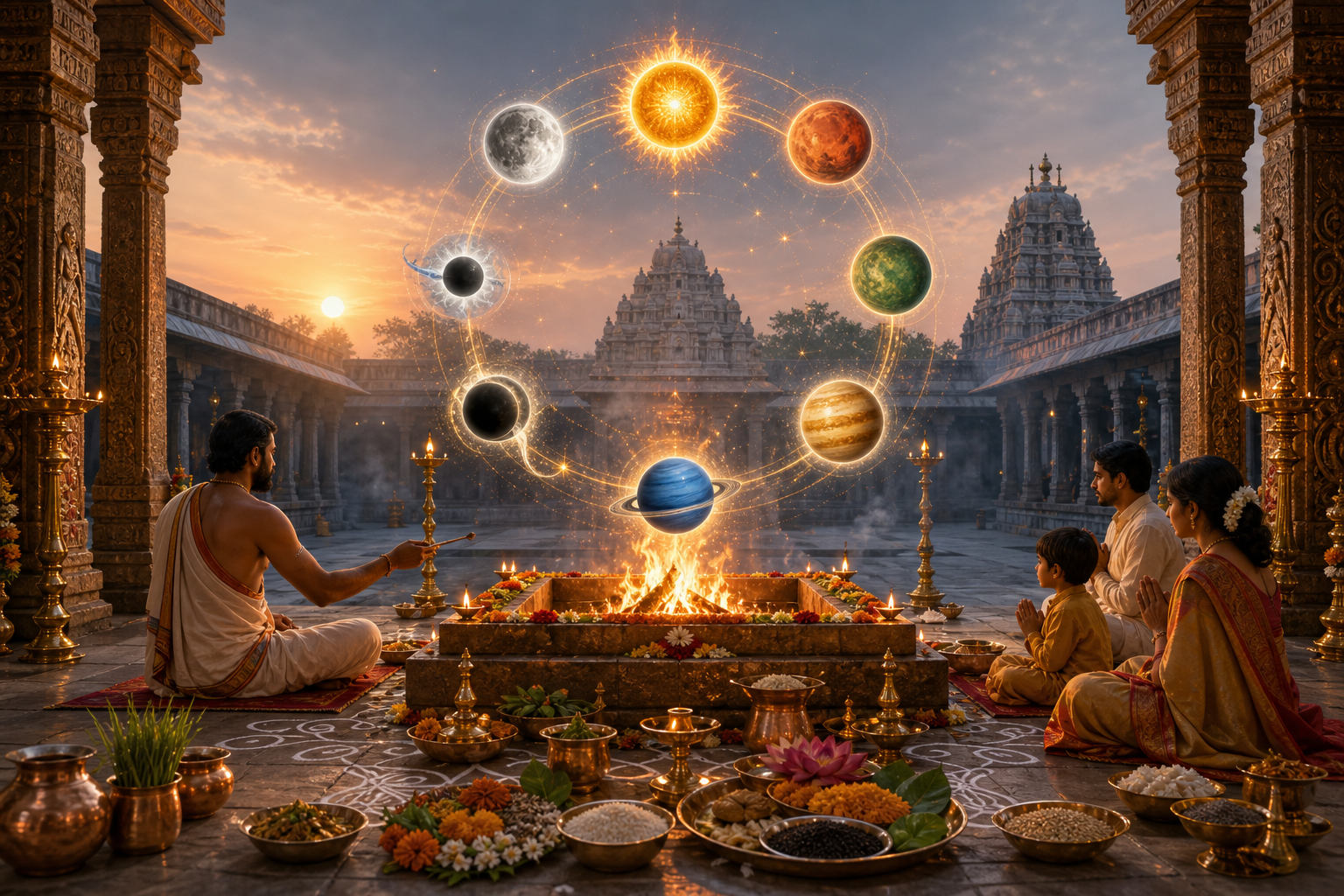
Navagrahamakha, often understood alongside Navagraha Shanti, Navagraha Homa, or Navagraha Yajna, occupies an important place in Hindu ritual practice because it brings together astrology, mantra, fire offering, ethical discipline, and devotional surrender. In the Hindu worldview, the nine grahas are not merely astronomical objects. They are sacred intelligences through which time, karma, temperament, health, social duties, and spiritual lessons are interpreted. The ritual is therefore not a mechanical attempt to control fate, but a disciplined act of alignment with cosmic order, dharma, and inner responsibility.
The term Navagraha refers to Surya, Chandra, Mangala, Budha, Brihaspati or Guru, Shukra, Shani, Rahu, and Ketu. In modern astronomy, this list includes the Sun and Moon, five visible planets, and the two lunar nodes rather than nine planets in the strict scientific sense. In Jyotisha, however, the word graha means that which “grasps,” influences, or seizes the field of experience. This distinction is essential because Hindu astrology is not simply a map of physical planets; it is a symbolic and sacred language for understanding the relation between cosmic time and embodied life.
Navagrahamakha is traditionally performed when the grahas are believed to be unfavourably placed in a person’s horoscope, when difficult planetary periods such as dasha, antardasha, sade sati, ashtama shani, rahu dasha, or ketu dasha are experienced, or when a family, home, temple, village, or larger community seeks harmony before a major undertaking. It may be performed before griha pravesh, marriage, childbirth ceremonies, temple consecration, business openings, travel, educational milestones, or collective welfare events. The ritual expresses a sober religious intuition: human beings live within a vast web of seen and unseen influences, and spiritual maturity begins when those influences are approached with humility rather than fear.
In classical Hindu thought, planetary affliction is not usually treated as punishment from an arbitrary deity. It is more accurately understood as the ripening of karma through time. The grahas reveal patterns, tendencies, pressures, and opportunities. Surya may illuminate questions of authority, vitality, fatherhood, leadership, and selfhood. Chandra may reflect the mind, emotion, motherly care, memory, and psychological stability. Mangala may bring courage, conflict, blood, land, discipline, and decisive action. Budha is associated with speech, intellect, trade, calculation, learning, and adaptability. Brihaspati represents wisdom, dharma, teachers, children, sacred knowledge, and expansion. Shukra is connected with beauty, relationships, fertility, pleasure, refinement, and material comfort. Shani signifies time, labour, endurance, suffering, discipline, responsibility, humility, and justice. Rahu points to obsession, ambition, foreignness, disruption, innovation, confusion, and worldly hunger. Ketu suggests detachment, ancestral karma, moksha, severance, insight, and spiritual austerity.
The purpose of Navagrahamakha is not to erase the moral structure of karma. Hindu traditions generally do not present ritual as a shortcut around dharma. Instead, the ritual is a means of purification, propitiation, and reorientation. It helps the devotee acknowledge limitations, pray for strength, seek grace, and commit to better conduct. The sacred fire becomes a witness to this inner movement. Offerings are placed into Agni not as superstition, but as a visible expression of surrender, gratitude, repentance, discipline, and renewed intention.
The ritual usually begins with purification. The place is cleaned, the participants bathe or prepare themselves respectfully, and the officiating priest establishes ritual sanctity through achamana, pranayama, sankalpa, and invocations. Sankalpa is especially significant because it states the purpose of the rite. It may name the individual, family lineage, location, date according to the Hindu calendar, nakshatra, tithi, and the desired spiritual or practical outcome. This act transforms a general ceremony into a precise vow placed before the divine order.
Ganapati Puja commonly precedes the main Navagraha worship because Ganesha is invoked as Vighneshvara, the remover of obstacles. Punyahavachanam may be performed for ritual purification, followed by kalasha sthapana, where consecrated vessels symbolize divine presence. In many traditions, the Navagrahas are invoked in a mandala or arranged through images, yantras, vessels, grains, flowers, cloth, lamps, and specific offerings associated with each graha. The arrangement varies by region and lineage, but the underlying principle remains the same: each graha is honoured as a sacred force within the cosmic order.
Mantra is central to Navagrahamakha. Vedic mantras, Puranic stotras, bija mantras, Gayatri mantras for the grahas, and regionally transmitted prayers may be recited according to the tradition followed by the priest and family. The power of mantra lies not only in meaning, but also in sound, discipline, repetition, and sacred memory. In an academic sense, mantra functions as a bridge between ritual speech and religious consciousness. In lived practice, devotees often experience it as a way of steadying the mind when ordinary reasoning has reached its limit.
The fire offering, or homa, forms the heart of the rite. Agni is invoked as the carrier of offerings to the deities. Ghee, sesame, rice, herbs, darbha, flowers, grains, samidha, and other prescribed materials may be offered with mantras for each graha. The officiant may perform a fixed number of ahutis for each planetary force, depending on the scale of the ritual. A smaller household rite may be concise, while a temple or community Navagrahamakha may include elaborate japa counts, multiple priests, extended recitation, and a formal purnahuti at the conclusion.
Each graha is traditionally associated with colours, grains, metals, directions, gemstones, days, and forms of charity. Surya is often associated with red or deep orange, wheat, copper, and Sunday. Chandra is linked with white, rice, silver, and Monday. Mangala is connected with red, lentils, coral, and Tuesday. Budha is associated with green, green gram, emerald, and Wednesday. Brihaspati is linked with yellow, chickpeas, gold, and Thursday. Shukra is associated with white, fragrant substances, diamond, and Friday. Shani is connected with black or dark blue, sesame, iron, and Saturday. Rahu is associated with smoky or dark shades, black gram, and serpentine symbolism. Ketu is linked with multi-coloured or ash-coloured symbolism, spiritual detachment, and offerings that reflect release from egoic attachment. These associations should be understood as traditional correspondences, not as rigid universal rules, because practice differs across sampradayas, regions, and family customs.
Charity, or dana, is an important part of Navagraha worship. Many traditions prescribe giving food, clothing, grains, lamps, cows in older ritual contexts, money, or useful goods to priests, the poor, students, or those in need. This aspect is ethically important. If the grahas reveal karmic pressure, dana responds by widening the devotee’s moral world. The ritual is therefore incomplete if it remains confined to private benefit. Its deeper meaning is fulfilled when it softens pride, increases generosity, and turns anxiety into compassionate action.
Shani worship illustrates this principle clearly. Saturn is often feared because Shani is associated with delay, hardship, loss, labour, disease, poverty, and social humiliation. Yet Shani is also revered as a strict teacher of justice. The person undergoing Shani-related difficulty is not merely encouraged to perform ritual; he or she is also urged to cultivate patience, honesty, service to the vulnerable, respect for workers, humility before time, and discipline in daily life. In this sense, Navagrahamakha is not fatalistic. It is transformative because it connects planetary concern with ethical reform.
Rahu and Ketu also require careful interpretation. These two grahas are not physical planets but lunar nodes, connected with eclipses, karmic shadows, sudden reversals, unconventional experiences, spiritual crisis, and intense psychological movement. Rahu may produce ambition, confusion, fascination with foreign or forbidden domains, and restless desire. Ketu may bring detachment, isolation, spiritual insight, or loss of worldly certainty. Their worship within Navagrahamakha acknowledges that not all human suffering is straightforward. Some difficulties arise as ambiguity, obsession, anxiety, or a feeling of being severed from familiar identity. Ritual gives such experiences a sacred container.
It is important to recognize that Hinduism does not treat the Navagrahas as competitors to the Supreme Reality. In different traditions, the grahas may be seen as servants of Ishvara, expressions of cosmic law, deities within the divine order, or symbolic instruments through which karma unfolds. Vaishnava, Shaiva, Shakta, Smarta, and other Hindu communities may interpret the ritual through their own theological frameworks. This plurality is one of the strengths of Sanatana Dharma. The rite can be performed with devotion to Vishnu, Shiva, Devi, Surya, Ganesha, or the family deity, while still honouring the grahas as part of the cosmic arrangement.
The broader dharmic context also matters. Hinduism, Buddhism, Jainism, and Sikhism differ in theology, ritual practice, metaphysics, and scriptural authority, yet they share a deep concern for karma, ethical conduct, discipline, liberation, self-mastery, compassion, and the purification of consciousness. A respectful discussion of Navagrahamakha should therefore avoid sectarian superiority. The ritual belongs specifically to Hindu practice, but its ethical message resonates with a wider dharmic sensibility: human life becomes meaningful when suffering is met with restraint, wisdom, service, and spiritual effort.
From a practical standpoint, devotees often approach Navagrahamakha during periods of uncertainty. A family may be worried about illness, marriage delays, repeated financial setbacks, educational obstacles, property disputes, emotional instability, or unexplained tension in the home. Academic language can describe these as ritual responses to crisis, but lived experience shows something more intimate. The ceremony creates a moment in which fear is given form, prayer is given voice, and the household is gathered around a sacred centre. Even when outcomes are not immediate or measurable, the devotee often receives clarity, emotional steadiness, and renewed commitment to dharmic living.
Navagrahamakha also reflects the Hindu understanding of time. Time is not only a neutral sequence of hours and dates; it is qualitative, rhythmic, and spiritually charged. Tithi, nakshatra, yoga, karana, vara, rashi, lagna, and planetary periods all form part of the traditional grammar of auspicious timing. The ritual acknowledges that action performed at the right time, in the right spirit, with the right preparation, carries a different quality. This does not deny human effort. Rather, it situates human effort within cosmic rhythm.
The temple tradition gives the Navagrahas a visible and communal presence. In many Hindu temples, the Navagraha shrine is placed in a dedicated area, and devotees circumambulate the deities while offering lamps, flowers, sesame oil, or prayers. Some temples give special prominence to individual grahas, such as Surya temples, Shani temples, Angaraka temples, or the famous Navagraha temple circuits of Tamil Nadu. These pilgrimage traditions show that planetary worship is not marginal; it is woven into the everyday devotional life of millions of Hindus.
At the same time, responsible practice requires discernment. Navagrahamakha should not become a source of fear, exploitation, or fatalistic dependence. Classical Hindu wisdom repeatedly emphasizes purushartha: righteous effort, disciplined living, learning, charity, devotion, and self-correction. A ritual performed without ethical change may bring temporary psychological comfort, but it does not fulfil the deeper intent of dharma. The grahas are best approached not as forces to be bribed, but as teachers to be honoured and understood.
For this reason, the guidance of a knowledgeable and trustworthy priest or astrologer is valuable. A proper assessment of a horoscope requires more than identifying one difficult placement. Jyotisha considers lagna, rashi, nakshatra, planetary dignity, aspects, houses, yogas, dashas, transits, divisional charts, and the overall strength of the chart. Similarly, ritual prescription should be proportionate. Not every difficulty requires an elaborate ceremony. Sometimes japa, simple puja, fasting, dana, temple worship, service, or disciplined personal practice may be more appropriate.
The spiritual psychology of Navagrahamakha deserves close attention. When people feel trapped by circumstances, they often oscillate between blame and helplessness. The ritual offers a third way. It accepts that life is shaped by forces beyond immediate control, yet it also asks the devotee to act: to pray, give, purify, listen, restrain harmful habits, honour elders, support the vulnerable, and live with greater awareness. In this sense, Navagrahamakha is a ritual of agency within humility.
The sacred fire also carries symbolic depth. Fire transforms what is offered into subtle form. Ghee, grains, and herbs disappear visibly, but the ritual imagination understands them as carried into the divine realm. This act mirrors the inner transformation sought by the devotee. Anger can become discipline, fear can become surrender, confusion can become inquiry, and suffering can become wisdom. The outer homa points toward an inner homa, where ego, impatience, and anxiety are gradually offered into the fire of awareness.
Navagrahamakha is therefore both technical and devotional. Its technical side involves mantras, counts, offerings, directions, sankalpa, kalasha, mandala, homa procedure, and scriptural lineage. Its devotional side involves faith, humility, reverence, and trust in the divine order. Its ethical side involves dana, restraint, truthfulness, service, and responsibility. Its psychological side involves courage during uncertainty. A complete understanding must hold all these dimensions together.
In contemporary life, the ritual remains relevant because modern people also live under pressure: career instability, family fragmentation, health anxiety, migration, social comparison, digital distraction, and emotional exhaustion. The language of the grahas may be ancient, but the human search for meaning in difficulty is timeless. Navagrahamakha gives that search a disciplined form. It teaches that one need not face uncertainty with panic, cynicism, or isolation. One may face it with prayer, knowledge, community, and dharmic action.
A balanced view of Navagrahamakha avoids two extremes. It should not be dismissed as mere superstition by those unfamiliar with the symbolic and ritual sophistication of Hindu traditions. It should also not be exaggerated into a guarantee of worldly success. Its power lies in its capacity to harmonize the devotee’s relationship with time, karma, nature, community, and the divine. The ritual does not remove the need for medical care, legal effort, education, financial prudence, or personal responsibility. Instead, it sanctifies human effort and places it within a larger sacred order.
Ultimately, Navagrahamakha is a profound expression of Hindu spirituality because it unites cosmic vision with everyday life. It recognizes the Sun that gives vitality, the Moon that shapes emotion, Mars that drives action, Mercury that sharpens intelligence, Jupiter that guides wisdom, Venus that refines relationship, Saturn that disciplines pride, Rahu that exposes restless desire, and Ketu that points toward release. Through worship, mantra, fire, charity, and self-correction, the devotee seeks not only relief from difficulty but also alignment with dharma.
When understood in this way, Navagrahamakha becomes far more than a ritual for appeasing the nine grahas. It becomes a sacred education in humility, responsibility, resilience, and spiritual integration. It reminds the community that the universe is not spiritually empty, that human life is not isolated from cosmic rhythm, and that even difficult periods can become occasions for purification and growth. The deepest promise of the ritual is not that life will become free from challenge, but that the devotee can meet challenge with steadier faith, clearer conduct, and a heart more deeply anchored in Sanatana Dharma.
Inspired by this post on Hindu Blog.
