

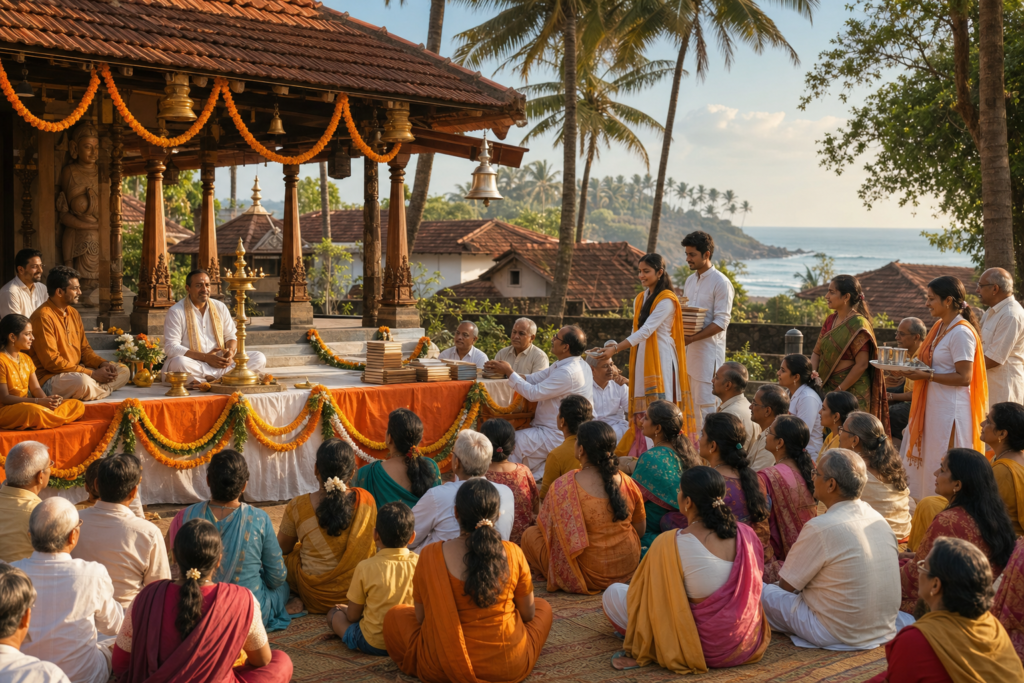
In many Indian villages, religious life often begins less as formal theology and more as shared culture: a temple visit, a kirtan gathering, a festival procession, a family vow, or an evening of singing and dancing. This narrative begins in that familiar setting, where husband and wife initially appeared equally distant from deliberate religious practice. Their participation in village functions was not marked by philosophical inquiry or disciplined devotion. It was social, seasonal, and cultural, shaped by community rhythms rather than by a conscious search for spiritual transformation.
The wife’s early relationship with religious events was especially typical of many rural devotional environments. She attended programs in the village, listened to songs, joined the festive atmosphere, and enjoyed the collective energy of celebration. Yet this did not necessarily mean that she had embraced a life of sadhana, vrata, japa, or scriptural study. Her interest was sincere at the cultural level, but not yet anchored in the disciplined principles of bhakti. The distinction matters because Hindu spirituality has always held space for both: cultural participation and intentional inner practice.
A significant turning point came in 2008, when she met an ISKCON devotee from the same village. The encounter was not merely social. The devotee was attempting to establish Krishna consciousness locally, and his presence gave familiar religious customs a more focused devotional framework. Through him, the language of village piety became connected to the disciplined path of bhakti-yoga: chanting the holy names, regulating daily conduct, honoring prasada, associating with devotees, and orienting the household toward Lord Krishna.
Her response was immediate and wholehearted. She adopted devotional principles with seriousness, not as an external display, but as a reordering of priorities. In Gaudiya Vaishnava practice, such a change is not understood as a superficial change in religious identity. It is a change in consciousness, where the center of life gradually moves from personal preference to seva, remembrance, humility, and surrender. Her transformation therefore became both domestic and spiritual: it affected how she viewed time, food, speech, relationships, and the purpose of daily life.
The husband’s journey moved at a different pace. He did not immediately follow her enthusiasm. This contrast gives the story its emotional force. In many households, spiritual awakening does not occur simultaneously. One person may feel drawn to devotion while another remains cautious, skeptical, distracted, or simply unprepared. The phrase “She Won, I Lost!” captures this affectionate reversal. The “loss” was not humiliation; it was the surrender of resistance. The “victory” was not domination; it was the triumph of sincere devotion over indifference.
This kind of transformation is best understood through the classical Hindu idea that spiritual influence often works through association. The Sanskrit term satsanga refers to the company of those who seek truth and live by dharma. In bhakti traditions, association is not treated as a casual social factor but as a powerful means of inner change. The wife encountered a devotee whose conviction made Krishna consciousness tangible. Later, through her own steadiness, she became the living association that gently challenged her husband’s reluctance.
ISKCON, the International Society for Krishna Consciousness, stands within the Gaudiya Vaishnava lineage associated with Sri Chaitanya Mahaprabhu and was carried globally in the twentieth century by A. C. Bhaktivedanta Swami Prabhupada. Its core emphasis is bhakti to Sri Krishna through nama-sankirtana, the congregational chanting of the holy names. For householders, the movement often translates devotion into practical disciplines: daily chanting, ethical restraint, vegetarian food offered to Krishna, scriptural hearing, temple worship, and community service. These practices can reshape family life without requiring withdrawal from ordinary responsibilities.
Theologically, Krishna consciousness is not merely belief in God as an abstract principle. It is the cultivation of a relationship with Krishna as the Supreme Person, approached through love, remembrance, service, and dependence. The Bhagavad Gita presents bhakti as a path that can be practiced amid worldly duties, provided action is offered with devotion and detachment. This is why the wife’s influence within the home is so meaningful. She did not need to deliver a formal lecture on Vedanta to begin a transformation. Her disciplined conduct became a form of teaching.
Her example also demonstrates the quiet spiritual authority of women in Hindu family life. Across dharmic traditions, the household has often been the first school of values. Mothers, wives, grandmothers, and sisters preserve memory through fasting days, stories, food practices, songs, pilgrimages, and temple observances. In this case, the wife moved from occasional participation in religious functions to conscious devotional leadership. Her insistence that her husband also take up the path was not an act of coercion; it reflected the conviction that spiritual progress is too valuable to remain private.
There is an important human dimension here. Devotion becomes persuasive when it is embodied. Arguments often create defensiveness, but lived sincerity creates curiosity. A person who rises early for japa, prepares food with reverence, speaks more carefully, avoids harmful habits, and becomes more patient in family life offers evidence that spirituality is not an ornament. It is a method of refinement. The husband’s eventual softening can therefore be seen as the natural result of observing transformation at close range.
From a technical perspective, bhakti-yoga works through repeated reorientation of the mind. The mind is not expected to become pure by accident. It is trained through sound, habit, diet, association, memory, and service. The Hare Krishna maha-mantra is central because sacred sound is understood to cleanse consciousness and awaken devotion. Scriptural hearing gives philosophical structure. Prasada sanctifies eating. Satsanga protects motivation. Seva converts emotion into action. Together, these practices create a complete devotional ecosystem rather than a loose collection of rituals.
This explains why her adoption of devotional principles was more than enthusiasm after a single meeting. A durable spiritual life requires discipline. In the Krishna bhakti tradition, discipline does not exist to suppress joy; it protects joy from distraction. Regulative principles, daily chanting, and regular association provide a stable container for devotion. Without such structure, religious emotion can remain dependent on festivals and moods. With structure, it becomes character.
The village setting adds another layer to the narrative. Rural religious life can preserve inherited forms with remarkable strength, yet those forms sometimes become habitual. A festival may be attended because everyone attends. A song may be sung because it is familiar. A ritual may be performed because it has always been performed. The arrival of a committed devotee can reactivate meaning within those inherited practices. What was once entertainment becomes kirtan. What was once social gathering becomes satsanga. What was once custom becomes conscious sadhana.
The husband’s initial disinterest should not be read as hostility to dharma. Many people live in cultural proximity to religion without feeling personally claimed by it. They may respect temples, festivals, elders, and scriptures, yet still keep spiritual discipline at a distance. The story is powerful precisely because it shows how that distance can close gradually. The first step is not always intellectual certainty. Sometimes it is trust in a loved one whose life has visibly changed.
The title “She Won, I Lost!” therefore carries a devotional paradox. In ordinary language, winning and losing imply competition. In spiritual life, the highest loss is the loss of ego, and the highest victory is the victory of grace. When one member of a family becomes an instrument of divine remembrance, the household gains. The husband may jokingly describe himself as defeated, but the deeper meaning is that resistance yielded to a higher taste.
This theme resonates across dharmic traditions. Hinduism, Buddhism, Jainism, and Sikhism all recognize that transformation is transmitted through lived example, disciplined practice, and community. Whether expressed as bhakti, dhyana, ahimsa, seva, simran, or satsanga, the principle is similar: inner life becomes stronger when supported by ethical conduct and noble association. The wife’s influence is therefore not sectarian in a narrow sense. It reflects a broader dharmic truth that sincere practice can awaken dormant aspiration in others.
The narrative also cautions against dismissing devotional movements as merely emotional. ISKCON’s public face often includes music, dance, festivals, and prasada distribution, but these visible forms rest upon a detailed theology and disciplined daily practice. Kirtan is not entertainment alone; it is nama-sankirtana. Food is not cuisine alone; it is prasada when offered with devotion. Community is not social activity alone; it is association meant to strengthen remembrance of Krishna. The wife’s journey from festive attendance to principled devotion illustrates this deeper shift.
At the same time, the story remains deeply domestic. Its setting is not a monastery, a university, or a grand temple. It unfolds in a marriage, in the subtle negotiations of everyday life. This is where spiritual practice is often tested most honestly. It is easier to appear devotional in public than to remain gentle, disciplined, and consistent at home. Her influence mattered because it entered ordinary life and asked whether faith could shape the household from within.
Such stories are valuable because they preserve the emotional texture of spiritual change. They remind readers that devotion does not always begin with dramatic visions or philosophical debates. It may begin when someone from one’s own village speaks sincerely about Krishna. It may begin when a wife begins chanting with conviction. It may begin when a husband, after resisting for some time, notices that the person closest to him has found a steadier center. In that recognition, the heart becomes less defensive.
The broader lesson is that Krishna consciousness, when practiced with humility, can become a force of family renewal. It can bring discipline without harshness, joy without frivolity, and tradition without mechanical repetition. It can also restore dignity to village religious culture by showing that songs, festivals, and gatherings are not merely inherited entertainment; they can become pathways to self-realization when connected to knowledge and practice.
The wife’s victory was therefore the victory of devotion, patience, and example. The husband’s loss was the loss of indifference. In the language of bhakti, both were blessed. A household that begins in shared disinterest and moves toward shared spiritual aspiration demonstrates one of the most practical truths of Hindu spirituality: transformation often starts not with public achievement, but with one sincere person choosing to live differently.
Inspired by this post on Dandavats.







Leave a Reply
You must be logged in to post a comment.