
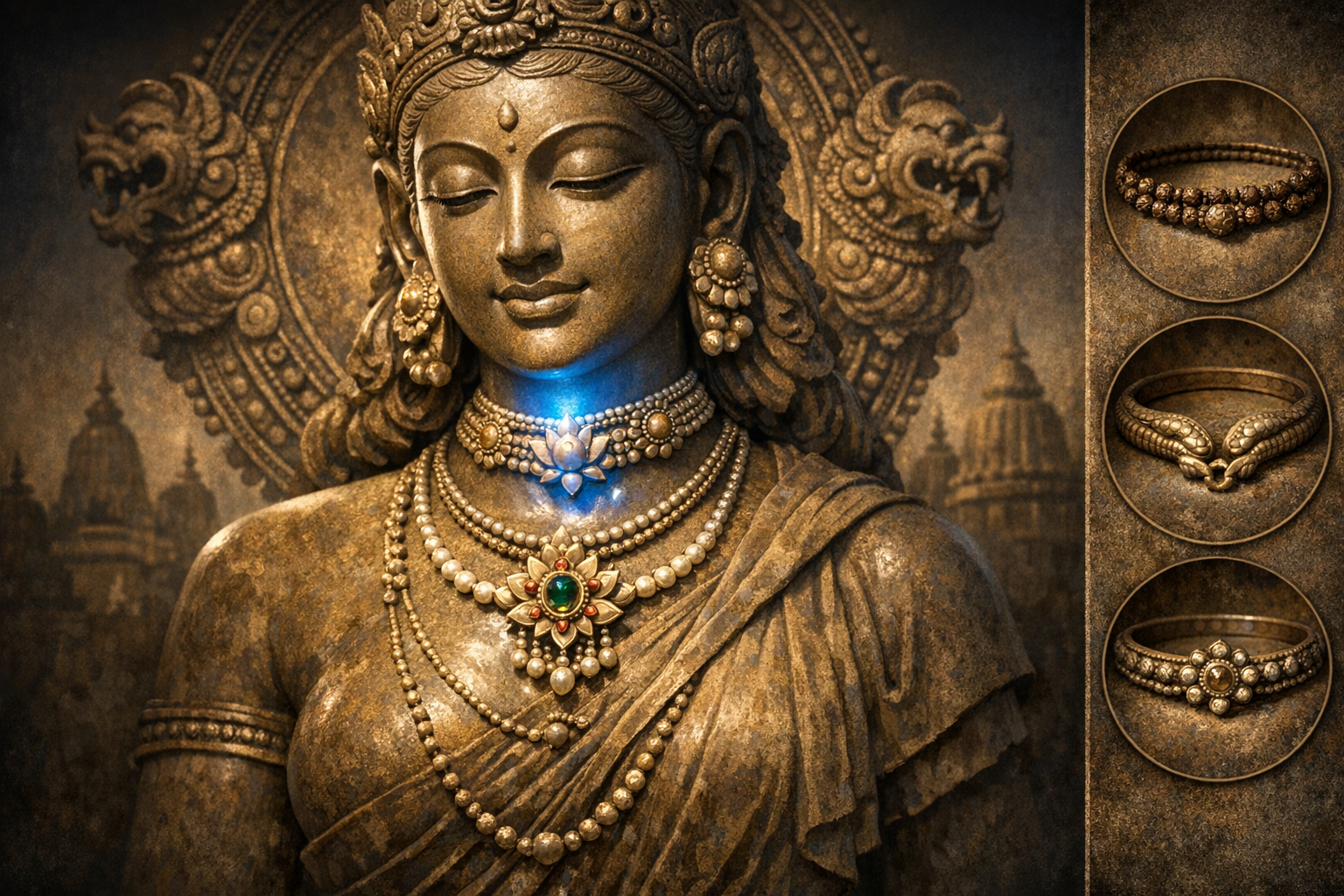
In the precise vocabulary of Hindu iconography, no ornament is ever a mere embellishment. Each ābharaṇa—derived from the root bhr, “to bear” or “to sustain”—is conceived as a bearer of doctrine, a visible vessel of metaphysics. Within this semantic field, the amukta, the sacred throat ornament, occupies a privileged position. More than a choker or collar, it frames the region of the kaṇṭha, anchoring attention on speech (vāc), breath (prāṇa), and the seat of mantra. In Hindu sculptures, especially those informed by Śilpaśāstra and Āgama traditions, the amukta becomes the compact, concentrated sign of what sacred adornment is meant to do: carry cosmic meaning in a perfectly balanced form.
The term amukta is encountered across Sanskrit and regional sources as an object “always worn” or “worn upon,” a semantic nuance resonant with courtly and devotional literature such as Āmuktamālyada. Iconographic treatises employ a broader taxonomy for neck ornaments—graiveyaka (neck-collar), kaṇṭhikā (close-fitting choker), hāra (mid-length necklace), and mahāhāra (long necklace)—while regional ateliers may use local names. In practice, amukta operates as a throat-embracing form within this family, its identity often coinciding with the kaṇṭhikā or graiveyaka class in temple bronzes and stone sculptures.
Classical manuals—Manasāra, Mayamata, Śilparatna, and the Viṣṇudharmottara Purāṇa—do not merely list ornaments; they prescribe how form, proportion, and iconographic function must harmonize. Neck ornaments thus articulate the vital transition from the head’s cognitive sovereignty to the torso’s emotive and energetic domains. The amukta, sitting high at the throat, binds this liminal zone—visually stabilizing the head–torso junction while semantically declaring mastery over speech, breath, and sound.
Within the Śilpaśāstra taxonomy, the throat region (grīva/kaṇṭha) is privileged territory. The graiveyaka or kaṇṭhikā denotes collars that clasp the neck firmly; the hāra denotes necklaces falling to the upper chest; the mahāhāra extends to the navel; and specialized strands—muktāhāra (pearls), ratnahāra (gems), and padaka-hāra (with pendant medallion)—layer down the torso. The amukta is the most immediate of these, cinching the neck with a disciplined ring that sponsors both aesthetics and doctrine.
Design grammar varies by deity and region but exhibits recurring formal cues. The amukta can be a string of fine pearls (muktā) articulating gentle, rhythmic relief; a rope-like beaded torus with rosette clasps; or a gem-set band whose tiny padaka motifs echo lotus, makara, or circular yantra-forms. In Chola bronzes, the amukta often appears as a tight pearl choker complementing a pendant-bearing hāra; in Hoysala stone, it reads as crisply undercut beading with floral bosses; in Pāla–Sena bronzes, heavier collars display dense granulation and medallions.
Materials signal ontology. Pearls (muktā) index lunar coolness and sattva; gold conveys solar brilliance and immortality; navaratna (nine gems) encode the planetary order; crystal and glass inlays project purity and luminosity. Craft techniques range from lost-wax casting for bronzes to chisel-and-drill micro-carving in stone, with repoussé and granulation common in metal embellishment for utsava mūrtis (processional images). The amukta’s feel on the sculptural surface—smooth torus, beaded cord, or faceted gem band—guides the viewer’s eye with calibrated highlights and shadow-lines.
Proportion is not left to chance. Iconometric canons situate the amukta at a measured interval below the chin, balancing it with the yajnopavīta (sacred thread), the hāra, and the vanamālā (garland). Its thickness, curvature, and projection are harmonized to the neck’s girth and tilt so that even with dynamic postures—abhanga in bronzes or tribhaṅga in stone—it remains visually “level,” creating a horizon around the throat. The result is structural poise and doctrinal emphasis achieved together.
Semantically, the amukta directs attention to the kaṇṭha as the locus of vāc and mantra. In yogic mapping, it crowns the viśuddha-cakra, purifier of sound and conveyor of truthful speech. On sacred images, this zone is not incidental: it is where utterance and breath become dharma. The amukta, therefore, is both an aesthetic collar and a visual mudrā affirming clarity, restraint, and the rightful ordering of sound.
In Vaiṣṇava images, the amukta commonly appears as a pearl kaṇṭhikā composed with the hāra carrying the padaka and the long vanamālā. The Kaustubha jewel—iconic to Viṣṇu—resides at the chest, while the amukta stabilizes the throat, forming a rhythmic sequence of sacred markers. Temple practice reinforces this by vesting utsava mūrti-s with tulasī kaṇṭhī strands, ritually aligning the deity’s breath and speech with sattvic coolness and compassion.
In Śaiva imagery, the amukta frequently assimilates the nāga (serpent) as necklace, or a rudrākṣa kaṇṭhikā, indexing ascetic power and the cyclic shedding of limitations. For Naṭarāja, the choker-like collar coordinates with the dynamism of the torso, damaru, and agni, asserting measure and mastery in the field of sound and flame. As Nīlakaṇṭha, Śiva’s blue throat becomes a theological epicenter; the amukta rings that center, pointing to the containment and transmutation of poison—ethical and cosmic.
Goddess iconography expands the idiom. Durgā’s collars alternate between pearl and gem-set rosettes, orchestrating visual strength with motherly grace. Śrī-Lakṣmī’s amukta often lifts the gaze before the luxuriant hāra cascade, mirroring auspiciousness through lotus medallions. In Lalitā Tripurasundarī traditions, the kaṇṭhikā can encode śrī-yantra motifs in miniature pendants, suturing tantra’s geometry to the living body of the goddess.
Gaṇeśa and Skanda images likewise maintain the throat’s articulation. Gaṇeśa’s amukta is typically a beaded choker consonant with rotundity and sweetness (mādhurya), whereas Skanda–Kārttikeya may display a sharper, warrior-like graiveyaka, visually allied to the vel (spear) and kīrtimukha emblems. In all cases, the amukta keeps the head–torso dialogue crisp, integrating attributes with anatomy.
The larger Dharmic world reiterates the principle while allowing theological nuance. In Buddhist art, bodhisattvas such as Avalokiteśvara and Maitreya appear with sumptuous graiveyaka and hāra combinations, expressing compassionate sovereignty and the eloquence of Dharma. In Jaina art, Tīrthaṅkaras, as perfected renouncers, remain unadorned; yet Yakṣa–Yakṣī attendants may wear refined chokers, reaffirming that ornament in sacred sculpture signals function and nature, not vanity. These convergences and contrasts exhibit a shared civilizational grammar: ornaments are semiotic devices mapping ethics, metaphysics, and soteriology onto the human form.
Regional ateliers adapt this grammar with signature finesse. Chola bronzes of Tamil country refine the amukta into high-sheen pearl bands; Hoysala soapstone in Karnataka plays with micro-bead relief and floral bosses; Pāla–Sena metalwork in Eastern India prefers dense collars with lotus medallions; Kashmir images introduce crisp rosettes with scarf-ends; and Southeast Asian counterparts at Angkor develop broad beaded chokers with makara and kīrtimukha motifs. Across these geographies, the amukta remains the quiet anchor of the throat.
Ritual life confirms the amukta’s sacrality. Daily alaṅkāra in temples follows sequences in which the throat ornament is placed with mantra, often after the yajnopavīta is adjusted and before the longer hāra is settled. Texts on consecration and worship describe ābharaṇa-dāna not as “dressing” but as enstatement of cosmic supports; the kaṇṭhābharaṇa steadies vāc for liturgy—prayers, stotra, and nāma-saṅkīrtana—so that utterance proceeds from centeredness rather than display.
An attentive museum or temple visitor can sense this logic in practice. Standing before a Chola Naṭarāja, the eyes often pause first at the bright crescent of the collar around the blue-marked throat before descending to the swinging hāra, or lifting to the flaming aureole. Before a Pāla Avalokiteśvara, the broad graiveyaka holds the composure of the face, preparing the viewer for the benevolent, articulate serenity that follows. The amukta acts like a caesura in poetry—a measured pause that makes the next utterance intelligible and beautiful.
From a technical standpoint, reading an amukta can guide dating and provenance. Pearl-banding with smooth torus profiles suggests bronze ateliers favoring high-polish finishing; sharply undercut beadwork with lotus bosses points to southern soapstone traditions; dense granulation and large padaka medallions align with eastern metalwork. Conservation notes that the throat, being a high-relief junction, often collects wear patterns; intact beading or medallion detail at the kaṇṭha can thus be especially diagnostic.
Ethically and theologically, the amukta also speaks to unity in diversity across Hindu, Buddhist, and Jaina visual cultures. While each tradition frames renunciation and adornment differently, a common principle persists: ornament is a disciplined language. It encodes virtues, cosmology, and practice into form. The amukta, poised at the threshold of breath and word, reminds that sacred art across these traditions seeks not spectacle but clarity—of sound, intention, and truth.
Thus, the amukta is far more than a throat ornament. It is a structural anchor, a doctrinal sign, and a meditative cue. In Hindu sculpture and its sister traditions, it invites the viewer to listen—to the quiet order beneath radiance—so that what is seen transmits what is to be known. In that transmission, the amukta fulfills the original promise of ābharaṇa: to bear, and to sustain, the cosmos as meaning made visible.
Inspired by this post on Hindu Blog.







Leave a Reply
You must be logged in to post a comment.