
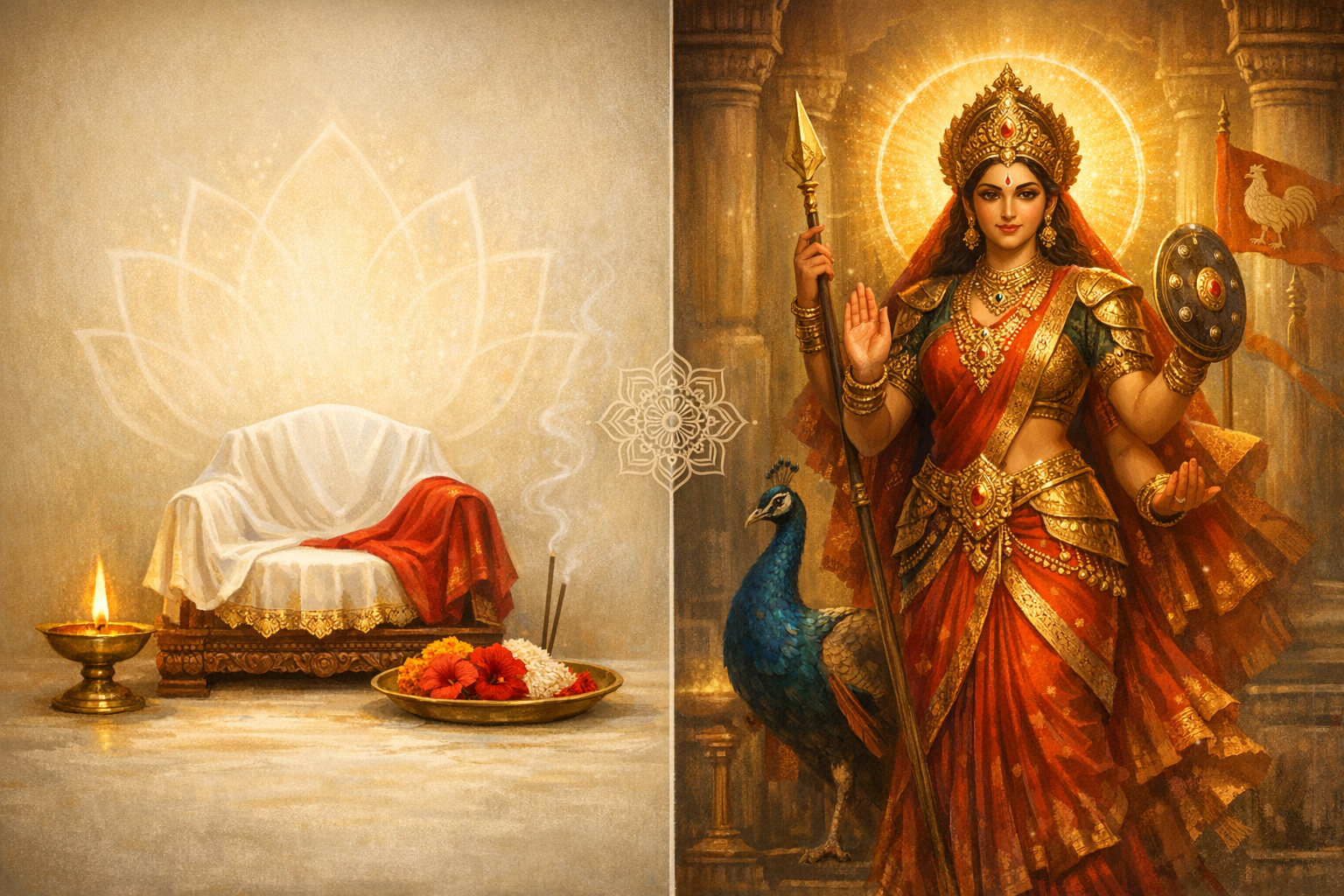
Two near-homophonous names—Kumari and Kaumari—often circulate together in Shakta and Tantric worship, but they do not denote the same reality. Confusing them compresses a nuanced theological and ritual landscape into a single plane. Kumari, in most Shakta-Tantric contexts, primarily indicates a ritual and contemplative state—virgin consciousness embodied and invoked—whereas Kaumari designates a distinct Hindu goddess, the martial Matrika associated with Kumara (Skanda/Kartikeya). Clarifying this distinction preserves textual accuracy, refines practice, and deepens the shared reverence for Shakti across dharmic traditions.
Philologically, the difference is embedded in Sanskrit morphology. Kumārī means “maiden, virgin” and functions as a general appellation and ritual category. Kaumārī (feminine of kaumāra) means “that which belongs to Kumāra,” identifying the goddess who is the shakti of Skanda. The former points to a state and a role within ritual frameworks; the latter points to a canonical deity whose iconography, mantras, and temple cults are well attested in Purāṇic and Āgamic sources.
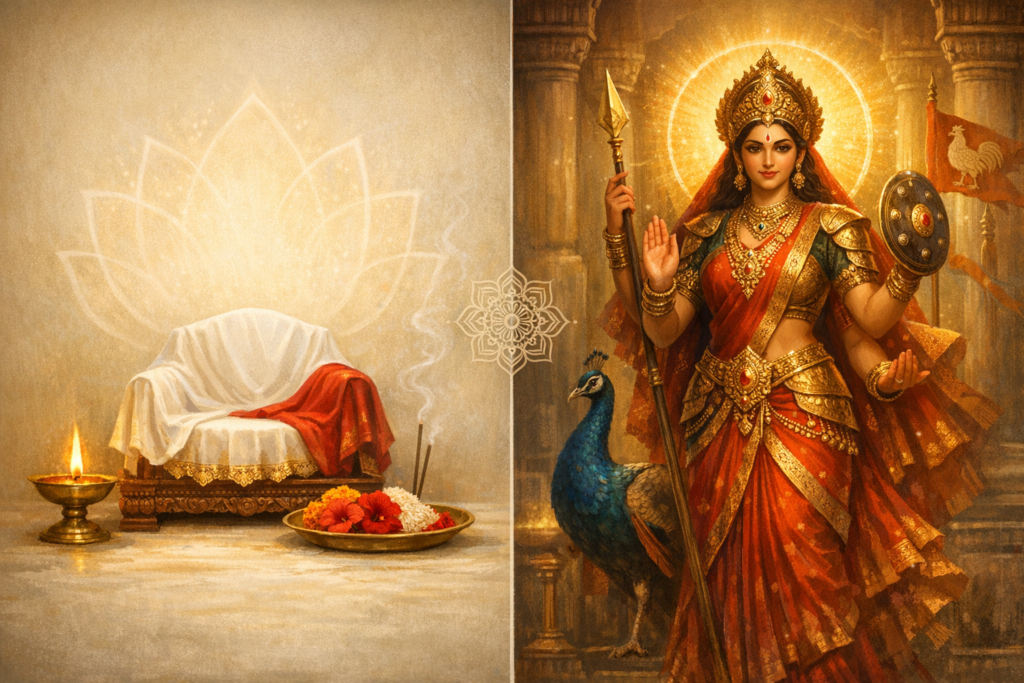
Kumari as ritual and state arises most visibly in Kumari Puja (Kanyā Pūjā), where a pre-pubescent girl is worshipped as the living embodiment of Devi—an enactment of Shakti’s presence in unconditioned, unappropriated form. This practice appears across regions, especially during Durga Puja and Navaratri, and is described in Tantric compendia of eastern India and in Shakta praxis associated with Kāmākhyā. The Kumari is not a permanent goddess in the ontological sense; she is an invited seat (āsana) for the Goddess’s energy during the rite.
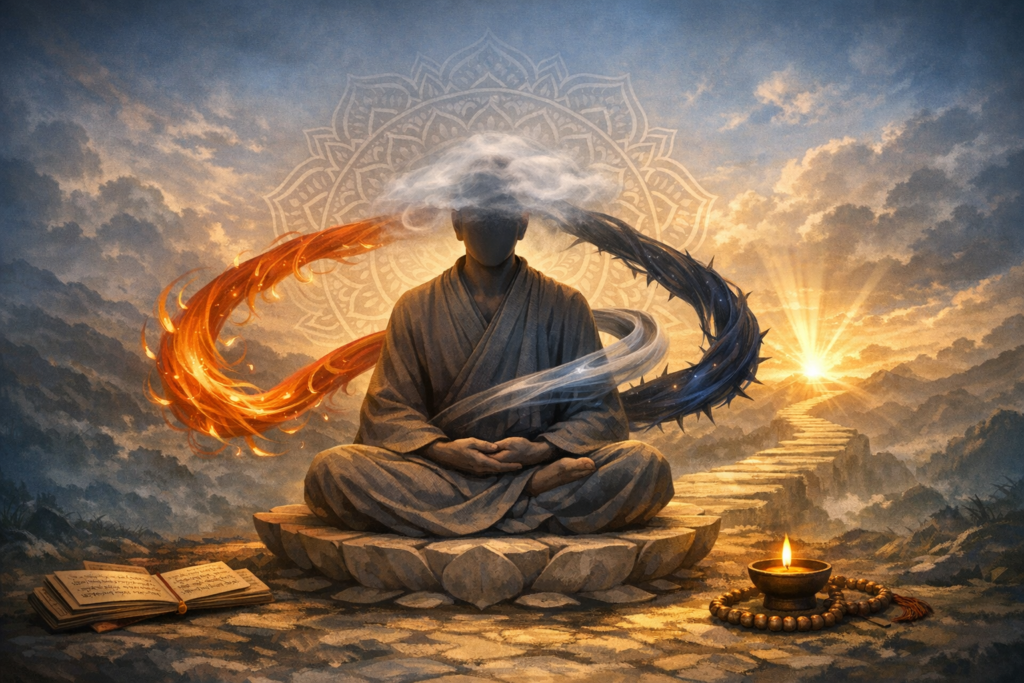
Beyond the visible ritual, Kumari denotes a contemplative principle: untouched awareness. Tantric interpretations often read virginity not as a social category but as a symbol of consciousness that has not been conditioned or divided—citta in its primal luminosity. In this sense, Kumari is akin to a meditative anchor, pointing practitioners to the innate freshness of mind that is free from habit-patterns. The image of a child holds this mirror precisely because it evokes beginnings unmarked by utility or possession.
Sri Vidyā traditions strengthen this insight through the form of Bālā Tripurasundarī, the youthful Goddess whose sweetness (mādhurya) veils unimaginable potency. While Bālā is a specific deity and Kumari is a broader ritual category, both converge on the theological motif of primordial newness: śakti that is ever-beginning yet never juvenile in power. Many households across the subcontinent recognize this intuition in lived ways: the sight of a child robed as a kumari evokes protective tenderness and reverence—the quiet feeling that sacredness abides here-and-now.
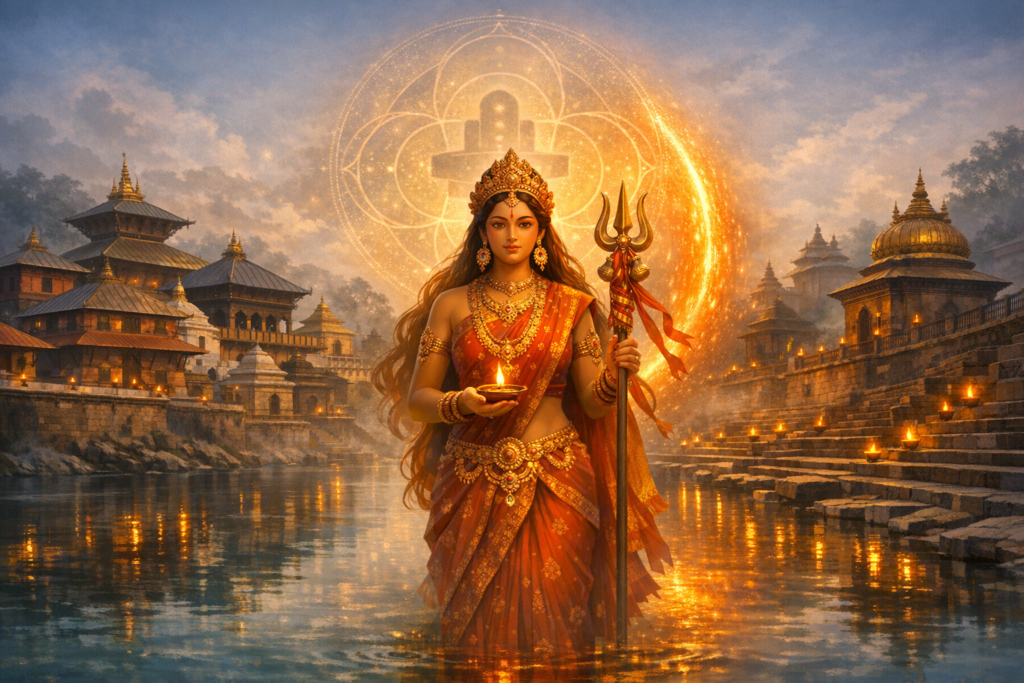
Regional variations amplify the theme. In Nepal’s famed Newar tradition, the Royal Kumari represents Taleju (a form of Durga). Here too, the Living Goddess is not a separate, independent deity named “Kumari”; rather, a chosen child becomes the seat of Devi’s presence through a precise lineage of rites. In Bengal and elsewhere, Kumari Puja during Durga Puja honors the same principle: Shakti dwells in all beings; the child becomes the pristine mirror.
Ethically, the Kumari rite demands utmost dignity and care for the child—food, gifts, protection, and gratitude—followed by a respectful ritual send-off (visarjana). Done rightly, it becomes a social ethic of seeing divinity in girls, challenging objectification and neglect. The practice is not a spectacle; it is pedagogy in reverence.
Kaumari, by contrast, is unequivocally a distinct Hindu goddess, one of the Saptamatrikas: Brahmani, Maheshvari, Kaumari, Vaishnavi, Varahi, Indrani, and Chamunda (with Narasimhi often added in Ashtamatrika lists). Kaumari is the shakti of Kumara—Skanda/Kartikeya/Subrahmanya—expressing the Devi’s kshatra, the disciplined and protective facet of divine power that upholds dharma.
Iconographically, Kaumari is associated with the peacock (mayūra) as vahana, the spear or vel as primary weapon, and sometimes the cock-standard emblem that also belongs to Skanda’s martial symbolism. She may be depicted with four or more arms, bearing implements allied with warriorship and protection. This visual grammar is not ornamental; it encodes a theology of courage, alertness, and compassionate force.
Purāṇic and Āgamic materials—including passages in the Agni Purāṇa, Matsya Purāṇa, Varāha Purāṇa, and iconographic chapters of the Viṣṇudharmottara—catalogue the Matrikas and outline their emblems, gestures, and functions. In Devi Mahatmya-oriented traditions, the Matrikas assist the Goddess in subduing asuric forces, illustrating how cosmic order is restored not by suppression of plurality but by the orchestration of many shaktis, each with distinct competencies.
Archaeologically, Matrika imagery is visible from at least the Gupta and post-Gupta eras and proliferates in medieval sculpture programs—Udayagiri, Ellora, and numerous temple precincts integrate these goddesses as liminal guardians at thresholds or flanking shrines. Kaumari’s presence in such ensembles affirms her independent goddess-status, anchored in the Skanda lineage and in living temple traditions of South Asia.
The practical implications for worship are clear. Kumari points to a ritual subject and a contemplative ideal—virgin consciousness—invoked in a girl during a time-bounded rite. Kaumari points to a permanent deity with murtis, mantras, yantras, kavacas, and festivals that honor her martial grace. Collapsing the two blurs both scriptural fidelity and ritual responsibility.
When these differences are honored, practice becomes more coherent. Kanyā Pūjā can be conducted with appropriate pastoral care, emphasizing dignity and education for girls, while Kaumari’s worship can be deepened through study of Matrika iconography, the Skanda narrative cycles, and the discipline of kshatra-dharma as an ethical path of protection and service.
Context within the broader Shakta tradition further illuminates both faces. Shakti in Hinduism is multiperspectival: motherly, fierce, playful, and contemplative. Kumari accentuates the contemplative and ethical intuition of seeing the Goddess in every child; Kaumari accentuates the protective, martial assurance that dharma is guarded. Together they embody tenderness and strength, compassion and resolve—the fullness of Devi’s possibilities.
These themes resonate across the dharmic world in ways that support mutual understanding. While Buddhism, Jainism, and Sikhism differ in theology and liturgy, each upholds complementary values: compassion for all beings, disciplined ethical conduct, and service (seva) to society. The Kumari ethic—seeing sacred worth in the vulnerable—mirrors these shared values; the Kaumari ethic—courage in defense of the right—aligns with kshatra as moral responsibility rather than aggression. Emphasizing these convergences fosters unity without erasing difference.
Ritually, practitioners often ask how Kumari Puja relates to Navaratri and Durga Puja. In many lineages, the rite culminates on Ashtami or Navami, sealing the nine nights of worship with a living recognition of Devi’s immanence. The child is offered respectful hospitality, prasada, and blessings, and the community is reminded that spiritual insight must become social care.
Practitioners similarly ask how to anchor Kaumari worship in daily discipline. Traditional responses emphasize study of Skanda-related scripture, practice of protective mantras, cultivation of courage without cruelty, and service to those who require safeguarding. The vel in Kaumari’s hand is not merely a weapon; it is a symbol of piercing clarity, cutting through confusion and fear so that resolute compassion can act.
Historically map these developments and the distinction becomes even plainer. Matrika cults—with Kaumari included—are archaeologically and textually attested for over a millennium and a half, forming an integral stratum of temple religion. Kumari Puja, though also ancient, is primarily a liturgical formation in which a human subject becomes an ephemeral seat of the Goddess, most famously articulated in Bengal and Nepalese settings but present in many regions and sampradayas.
From an iconographic standpoint, one will not find autonomous temples dedicated solely to “Kumari” as a goddess in the Purāṇic sense; rather, one encounters shrines and murtis for Kaumari within Matrika clusters or in association with Skanda. This alone should guide terminology in scholarship and practice: Kumari belongs to the semantics of ritual role and state; Kaumari belongs to the semantics of deity and cult.
A final theological synthesis is instructive. Kumari honors the primordial innocence of awareness and society’s duty to protect it; Kaumari honors the bravery and discipline that make such protection real. Tenderness without courage risks sentimentality; courage without tenderness risks hardness. Shakti in the Shakta tradition is both—hence Kumari and Kaumari are not rivals but reciprocities.
For students, seekers, and communities planning observances, careful language is therefore an ethical act. Naming the living rite as Kumari Puja while reserving Kaumari for the Matrika goddess aligns words with reality, supports accurate teaching, and nurtures unity within Hinduism and across kindred dharmic paths. In that alignment, ritual ceases to be mere form; it becomes truthful speech (satya), compassionate vision, and disciplined action.
In sum: Kumari as state, Kaumari as goddess. One points inward to the seed of unconditioned awareness and to the social ethic of honoring girls; the other stands outward as the Goddess who wields the spear of clarity and the peacock of high vision. Holding both with precision restores the full arc of the Divine Feminine in Shakta Tantra—an arc that is intellectually sound, ritually responsible, and spiritually transformative.
Inspired by this post on Hindu Blog.


Leave a Reply
You must be logged in to post a comment.